In recent years, Europe has taken significant steps to strengthen its defense capacity, driven by higher spending, new procurement programs, and a renewed focus on industrial readiness. By 2030, Europe’s NATO members are projected to spend €800 billion on defense—an increase of €300 billion from 2025—with equipment spending alone nearly doubling.1
However, Europe’s defense industry remains highly fragmented, limiting the ability to optimize spending.2 The proliferation of duplicative systems has resulted in less efficiency, making it difficult to deliver the speed, affordability, interoperability, and technological advancement required for rearmament at scale.3 Without sufficient expansion and modernization, much of the required scale-up could shift to non-European suppliers—risking the long-term stability of the defense industrial base and reducing the ability for Europe to achieve strategic resilience while partnering with allies.
At the platform level, joint cooperative programs such as the Future Combat Air System (FCAS/SCAF),4 Main Ground Combat System (MGCS),5 and Eurodrone6 have aimed to address these issues.7 However, pan-European collaboration remains highly complex,8 requiring broad political consensus and extensive cooperation—challenges compounded by considerations such as national sovereignty, local employment, industrial competitiveness, and national programs.9
A practical path forward: Supply chain consolidation
Fragmentation is not limited to major platforms; it extends throughout the entire defense industrial supply chain (Exhibit 1). Given the challenges of consolidating at the platform level, the greatest short-term potential could lie in supply chain consolidation—an area where private capital and other private actors can play a central role.
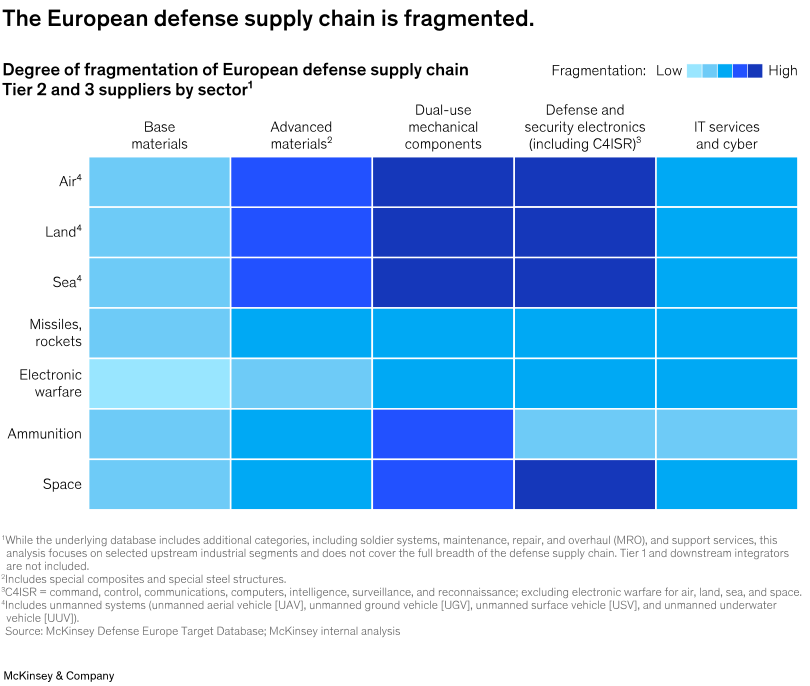
Specifically, this opportunity is concentrated in the Tier 2 and Tier 3 industrial base: specialist component manufacturers and service providers operating one or two levels upstream of the primes. Drawing on McKinsey’s proprietary database, which covers approximately 2,000 companies across the European defense supply chain, we have identified four particularly fragmented subprime segments where private actors are well positioned to drive consolidation and unlock value:
- Advanced materials: composites, ceramics, specialty glass, advanced alloys, and stealth materials used in armor and platforms
- Defense and security electronics, including C4ISR10: electronic warfare systems—sensors, radios, command-and-control software, data networks, as well as the dual-use electrical equipment that enables them, such as power units, control electronics, cables, connectors, and embedded hardware
- Dual-use mechanical components: complex assemblies such as gears, bearings, hoses, couplings, and transmissions for civilian and military platforms, as well as simpler mechanical parts such as casings, brackets, fasteners, and metal fittings
- Components for space assets: propulsion parts, structures, electronics, and satellite subsystems
McKinsey analysis11 shows that consolidation in these four segments could unlock around €9 billion in annual run-rate cost synergies—more than the current defense equipment budgets of 24 of Europe’s 30 NATO members (see sidebar, “Methodology”).12 If achieved early and sustained, these savings would amount to approximately €45 billion cumulatively by 2030, roughly equivalent to Italy’s 2025 defense budget.13
The industrial logic is strong. Our analysis of European defense value chains suggests that only about a quarter of prime-level value added comes from final assembly, integration, and testing, while around three-quarters is created upstream by component manufacturers and specialized service providers.14 In a system where much of the capability, cost, and risk sit in the supply chain, even modest consolidation can have an outsized impact.
Scaling Europe’s defense industrial base across four key segments
Consolidation across the four segments in scope presents a compelling opportunity to unlock value through scale, accelerate capability development, and deploy proven industrial levers. Spanning R&D-led capability platforms, high-margin electronics systems, and scale-driven manufacturing categories, these segments demonstrate how upstream consolidation could translate industrial efficiency into strategic and operational advantage (Exhibit 2).
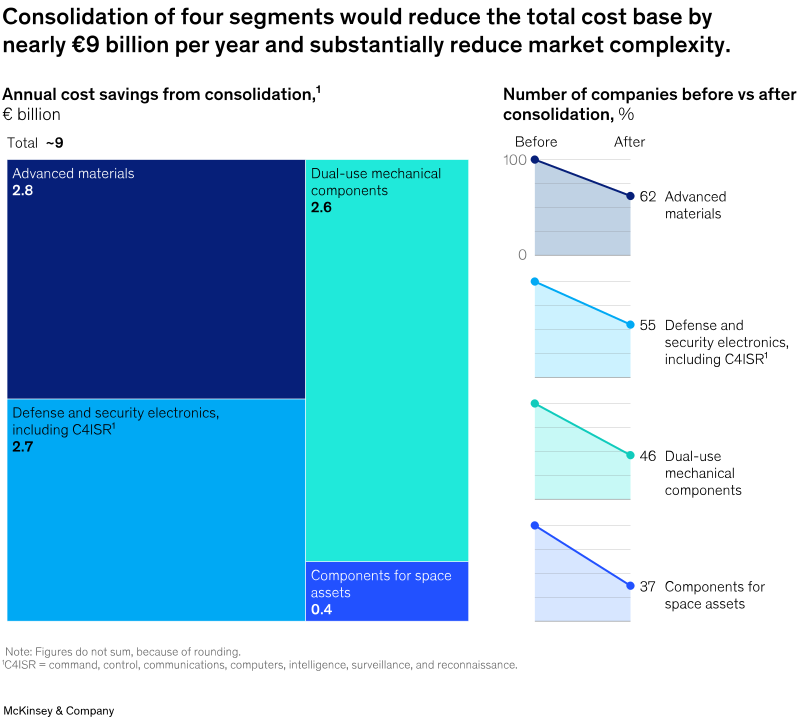
Advanced materials: Consolidating advanced materials suppliers could unlock up to €2.8 billion per year, as fragmentation currently hinders the R&D investment needed for next-generation platforms. Materials performance now drives platform outcomes—such as weight, endurance, survivability, and sensor performance—relying increasingly on composites, specialist glass, advanced ceramics, and coatings. Consolidation offers the chance to pool R&D, streamline footprints, and improve purchasing power. For investors, this could enable the creation of “materials platforms” capable of serving both defense and adjacent markets, particularly aerospace.
Defense and security electronics, including C4ISR: This category comprises high-margin platforms with approximately €2.7 billion per year in cost and margin uplift potential. It combines attractive economics and clear strategic importance, uniting high-margin C4ISR and electronic-warfare platforms—where margins are driven by intellectual property, software, and certification—with large, splintered pools of electrical equipment suppliers, whose offerings are quality-critical and labor-intensive to assemble.
Consolidation at the system and subsystem level—for example, sensors, radios, and mission electronics—could reduce duplication and enable a handful of European platform players to invest in modular architecture, standard interfaces, shared test infrastructure, and secure-by-design engineering. In component-heavy segments, such as cables, harnesses, connectors, and power units, value lies in manufacturing modernization, automation, and harmonized specifications. Selective vertical integration across systems, subsystems, and critical electrical components could further reduce integration risk, shorten qualification cycles, and improve delivery reliability.
Dual-use mechanical components: This category represents the value pool where execution matters most. As the foundation of Europe’s defense manufacturing across air, land, and sea, this segment is all about scale-and-throughput—consolidation could unlock an estimated €2.6 billion per year through procurement leverage and automation. Mechanical parts, often overlooked until they become a bottleneck, can stall final assembly when shortages occur. Consolidation could enable suppliers to invest in capacity buffers and systems upgrades, better meeting the evolving requirements of prime contractors.
Components for space assets: Although smaller, this segment is becoming increasingly critical as demand grows for secure, resilient communications, and as space emerges as a contested domain of sovereignty. Consolidation could unlock roughly €0.4 billion in value by addressing single points of failure in a fragmented supply base, and supporting the capital-intensive qualification and testing that is difficult for subscale specialists to fund and scale.
These savings could benefit government customers, end users, prime contractors, and capital providers. Notably, this estimate reflects only the initial opportunity; since the €9 billion estimate covers just four segments, the total value potential from Tier 2 and Tier 3 supply chain consolidation could be much greater.
The benefits of consolidation
Consolidation at the Tier 2 and Tier 3 supply chain levels offers benefits that extend well beyond cost savings alone. It can reduce duplicative R&D, enable larger and more sustained investment in modern manufacturing, digitalization, and AI, and accelerate the diffusion of innovation across programs. Executed effectively, this would translate into lower unit costs, higher and more predictable output, faster innovation diffusion, and a more resilient industrial base—without undermining national champions at the prime level or triggering platform-level political sensitivities.15 It would also increase commonality at the subsystem level, improving upgradeability and interoperability across allied forces, even if platform fleets remain diverse.
These advantages are distributed across the entire defense ecosystem, with distinct value for governments, industry, and investors alike. Governments could benefit from lower acquisition and sustainment costs, improved availability, and greater interoperability. Industry could gain the scale to reinvest in capacity, advanced manufacturing, and next-generation R&D, shifting from duplicated effort toward more effective innovation. Investors could unlock opportunities by pairing long-duration defense demand with scalable industrial platforms that support sustained, compounding value creation. Together, these effects could turn supply chain consolidation into a catalyst for faster capability delivery, stronger industrial resilience, and more effective use of Europe’s growing defense budgets.
Considerations for private capital and industry
For private capital and industry players alike, the implication is clear: Success will require moving beyond one-off transactions to a system-level approach to defense supply chains—whether through platform-based capital deployment or targeted vertical integration and capability build-out. This requires clarity on where to play, how to build, and how to operationalize from day one:
- Be deliberate about where to play. The strongest consolidation opportunities are likely in fragmented segments with repeatable products and improving demand visibility. Scale-driven categories—such as mechanical and electrical—could reward strong execution and cash discipline, while capability-driven areas, such as defense electronics, advanced materials, and space, may justify sustained investment in scarce capabilities. Defense electronics, especially C4ISR, could be particularly attractive, given higher margins that can help fund consolidation and longer-term capability build-out.
- Use diligence to assess defensibility. In defense supply chains, value often lies less in physical assets and more in certified processes, specialized talent, security compliance, and a proven delivery record. Effective diligence could therefore go beyond financials to assess single points of failure, customer concentration, and contract structures—testing durability at scale.
- Focus on a small set of repeatable value-creation levers. Early value could come from procurement scale, footprint specialization, standardization, targeted automation, and tighter working-capital discipline—alongside necessary investments in quality and cyber and security compliance. Improvements in delivery performance and lead times within 12 to 18 months could serve as early indicators of success.
- Embed ‘trusted supplier’ considerations early. Consolidation among Tier 2 and Tier 3 suppliers is likely to be assessed not only on price, but also on security and compliance. This may require early planning for data protection, cyber and quality upgrades, and facility and personnel clearances, with explicit recognition of timing and cost implications.
- Balance scale benefits with resilience considerations. As scale is built, efficiency gains may need to be paired with investments in backup capacity, surge buffers, and dual-source options for critical components. Tracking core metrics—such as on-time delivery, lead times, and qualified throughput—could help demonstrate improved reliability rather than new concentration risks.
Done well, supply chain consolidation could deliver significant financial benefits—potentially unlocking around €9 billion in annual value—while strengthening security of supply and delivery performance through the creation of scalable, investable supplier platforms. In turn, this could help ensure that Europe’s rearmament effort builds durable domestic industrial capacity, supports innovation and interoperability, and reinforces long-term strategic resilience.