The global security environment is shifting at an unprecedented pace—faster than at any point since the end of the Cold War. To meet rising national security challenges, European governments have set ambitious plans and funding commitments. Between now and 2030, Europe will need to mobilize well over €1 trillion in defense acquisition to rebuild force readiness, modernize capabilities, and replenish stockpiles—a substantial share of which will flow through defense acquisition systems.1
Yet Europe’s defense acquisition systems are not keeping pace with this urgency. While new technologies are emerging and operational lessons are being rapidly absorbed from ongoing conflicts, a majority of major European defense programs continue to run late and over budget. Closing this gap will require reforms to planning, requirements-setting, and procurement processes that better reflect the speed and uncertainty of today’s security environment.
Some defense ministries have begun to respond, but efforts remain uneven and incremental. Outside Europe, the Pentagon is implementing reforms to transform the traditional acquisition approach into a “Warfighting Acquisition System.”2 These reforms focus on priorities such as speed, commercial solutions, accountability, and a greater tolerance for measured acquisition risk. In Europe, reforms so far have been more targeted, ranging from the UK’s Defence Reform program, which includes a new National Armaments Director, to Germany’s Planning and Procurement Acceleration Act, Italy’s Defence Procurement Forum, and Spain’s new industrial and technological plan for security and defense.3
These European initiatives highlight the need for a clearer, repeatable model for how acquisition should work in practice. Because acquisition is delivered by a complex system, isolated changes rarely stick—reform needs an integrated blueprint that links strategy, industry, contracting, and delivery.
This article outlines eight principles for European countries to adopt a more flexible acquisition system—able to respond quickly to future threats at speed and scale, and at sustainable cost (see sidebar, “What is defense acquisition?”).
Breaking with the past
There are four core goals of acquisition reform to improve: speed (from decision to fielded capability), scalability (the ability to surge and sustain production and readiness), cost management (life cycle affordability and predictable unit costs), and innovation (rapid adoption of new technologies and continuous improvement based on operational feedback).
Across NATO countries, efforts over the past decades to adapt defense acquisition have not always delivered lasting change. Change is not easy: Navigating complex government bureaucracies, making do with scarce funding, and managing competing incentives all present challenges. These have led to delays and cost overruns, making it harder to meet changing military needs or adapt to technological developments. To achieve success in improving acquisition, previous shortcomings must become lessons. At the same time, humility is in order—past efforts were led by talented teams with bold ambitions; they discovered that this was truly a difficult challenge and that it was probably unwise to expect perfect solutions that can solve all issues.
Other public sector initiatives saw comparable challenges: Nearly 80 percent of government transformations do not fully achieve their intended outcome, and over 80 percent of public sector IT projects overrun their schedules.4 However, applying established best practices can substantially improve these odds and, in a changed environment, different emphasis can lead to different outcomes.
The challenges European acquisition systems face today have three main outcomes:
- Speed: Acquisition cycles for major capabilities are both objectively very long and often overrun. Well over half of major defense programs in Europe exceed deadlines, typically by 20 to 50 percent, while the average time to contract is estimated to range between two to four years.5 Accountability can be fragmented, with no single owner to make decisive trade-offs between speed and performance or costs, which can slow progress across programs.
- Cost: Over 50 percent of major acquisition projects overspend their original budgets by around 20 to 40 percent.6
- Relevance: Even if programs are delivered on time and within budget, they can be obsolete upon arrival. The time from identifying a need to the arrival of the capability can be longer than battlefield innovation cycles, making the acquired systems redundant.7 This can result in a widening gap between strategic ambition and operational effectiveness. As a result, “bridging spend” replacement may be needed to sustain legacy capabilities beyond their planned lifecycle.8
This points to the need for a radical shift in Europe—one that addresses the root causes of these shortcomings rather than treating the symptoms. Without fundamental change, any reform effort will continue to fall short, leaving nations ill-prepared to face evolving threats.
Building an acquisition system that is fit for the future
Rapidly introducing an acquisition system that is flexible enough to respond quickly to future challenges and threats requires more than small tweaks—fundamental restructuring is essential.
Reform should be designed around militarily relevant outcomes, not just process compliance, and should manage the trade-offs between space of speed, cost, and performance through the life cycle. Done well, it can create a repeatable pathway from strategic intent to fielded, supportable capability—fast enough to matter, and scalable enough to deter.
Eight design principles can help drive success:
- Creating multispeed acquisition pathways: This can be achieved by introducing tailored approaches and processes based on the capability being acquired (for example, survivable, attritable, or consumable hard- or software), starting from recognition of the need, through planning and budgeting, and onto procurement.
- Deploying spiral development to upgrade capabilities rapidly: An initial capability can be delivered quickly. Afterward, software and hardware can be continually updated (software in very short cycles with quick testing, and hardware in longer cycles and in modules) to adopt new technologies and adapt to battlefield lessons.
- Transforming the industrial base for productivity and strategic needs: This starts with clear sovereign capability decisions—explicit, long-term choices about which capabilities and technologies must be national or assured (where to invest, what to protect, and which suppliers and partners to rely on). Building on that, governments could drive scale, productivity, and resilience by concentrating demand on priority areas. Capabilities that are not strategically differentiating can be sourced through military off-the-shelf (MOTS) or commercial off-the-shelf (COTS) solutions to reduce cost and accelerate delivery.
- Aligning incentives with industry: Aligning industry’s incentives with industrial strategy objectives can help improve acquisition outcomes. Examples include stage-gated funding to encourage innovative solutions, stronger accountability for timely delivery, longer-term contracts to enable lower-cost funding for industrial scale-up, and risk- and reward-sharing agreements.
- Balancing competition with collaboration: Overlapping efforts risk delays (due to customer overload) and duplicated costs, while increased competition can incentivize performance and improve resilience. Industrial policy can support better decision-making between using off-the-shelf competitive solutions, developing sovereign capabilities and international collaboration.
- Aligning design, production, and sustainment contracts to optimize downstream outcomes, and using performance-based measures: This can be achieved by designing commercial mechanisms (at tender and at contract) that reflect the interlinkages between design, production, and sustainment, and incentivize reduced life cycle cost.
- Developing expertise and ownership: Acquisition excellence depends on expertise and close integration between military customers and procurement. Generally, there is a positive return on investing in technical resources in defense ministries and the military in program management and procurement functions, as well as in skills in risk, finance, legal, and commercial analytics.
- Spending more on less, but consistently: In an attempt to have full-spectrum forces, many countries spread their investments widely. Rather, they could make clear sovereign capability investment choices, backed by multiyear, stable funding, economic minimum-order quantities, and ongoing spiral development. Budgets could carry across years to prevent over- or undersupply, and to streamline approval processes. This would imply a more coordinated approach with allies to avoid duplication and ensure that all can access the needed capabilities.
These proposed principles are not independent fixes; they are interdependent elements of a modern defense acquisition strategy. Reform can be hard precisely because acquisition is a system: Progress in one area can be constrained by bottlenecks elsewhere, and there is no single silver bullet. Even so, each principle on its own can deliver meaningful improvement—but the largest gains come when they are advanced in parallel, so that the effects reinforce one another and compound over time.
Three equipment archetypes
The most important consideration is that a very broad range of very different capabilities is needed for operational relevance. It is difficult (perhaps impossible) to have a single acquisition system that works effectively in the same way for acquiring munitions, a fighter jet, or a piece of standardized software.
This is because there are inherent differences in the life cycle, risk, and cost of equipment. It is increasingly common to think about military equipment in three archetypes: survivable (durable, mission-critical platforms such as fighter jets, often crewed); attritable (reusable but may be lost in battle, such as intelligence, surveillance, and reconnaissance [ISR] drones, almost always uncrewed); and disposable (one-time use products such as one-way attack drones) (exhibit). An additional dimension to consider is the distinction between software and hardware, with software developed and improved in a fundamentally different and much faster way than hardware.
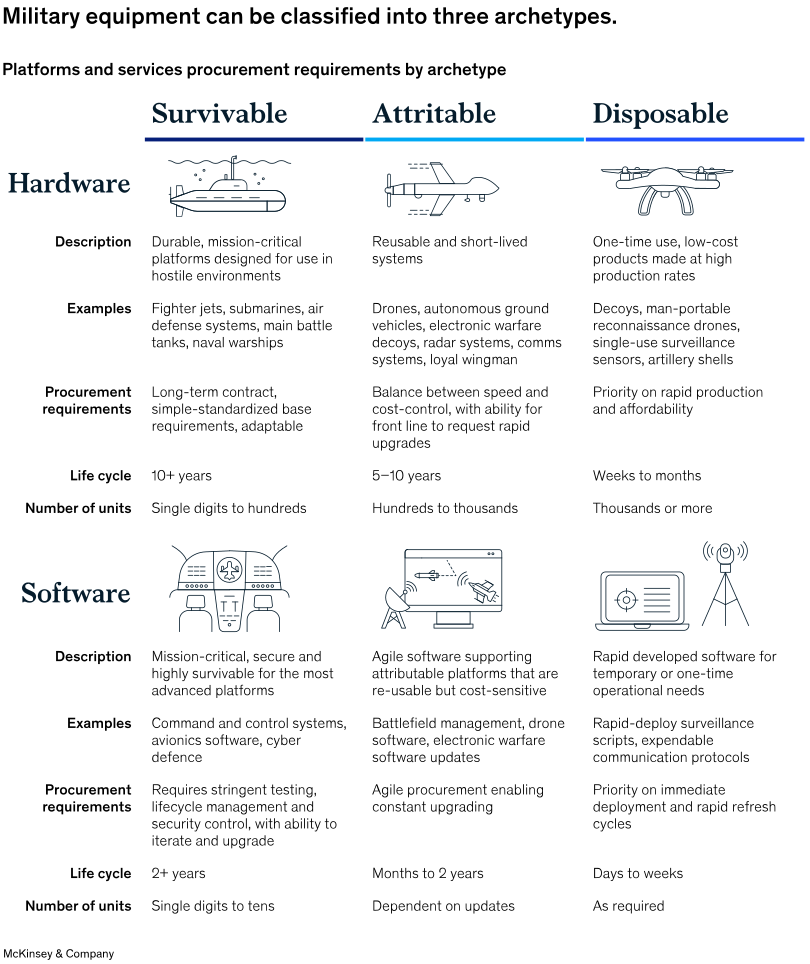
A multispeed procurement framework works most effectively when it accounts for these differences. Each capability type has distinct life cycles, risks, and integration needs and should therefore be approached differently. This approach is already being applied in the United States through Rapid Capabilities Offices and, more recently, the introduction of Direct Reporting Portfolio Manager (DRPM) roles under the Pentagon’s Deputy Secretary, which deliberately separate fast, risk-tolerant pathways from traditional major-platform acquisition.9
Each capability type should therefore be approached differently. That does not mean creating a fragmented, six-stream system: These archetypes can be grouped into three practical pathways—one long-term route for complex, survivable platforms, and two streamlined routes for rapidly evolving and disposable capabilities.
Adapting the acquisition process
We have identified potential improvement levers that could be used within current European acquisition systems, while laying the groundwork for longer-term changes. These can be divided into five categories of action: strategic, fiscal, contractual, organizational, and talent.
Strategic
Establishing a clear strategic path: Adapting the acquisition process is a task that requires setting priorities and engaging with stakeholders across government and industry. The process needs to be endorsed by senior leadership and could provide the rationale for increasing the focus on acquisition speed. It could drive engagement with industry to clearly signal objectives, and become the compass that orients stakeholders, resists potential inertia, and avoids using legacy processes.
Identifying constraints: This could identify the key barriers blocking the adaptation of the acquisition system. Although potentially a long process, addressing these constraints is essential to fundamentally restructuring acquisition.
Creating a capability road map: This could highlight the capabilities needed in the survivable, attritable, and disposable platforms over the coming years. The existing list of priorities could be categorized, highlighting future requirements and helping identify which parts of the industry are of strategic importance and which capabilities can be bought off the shelf. The capability road map could therefore be used to create an industrial strategy and an acquisition plan.
Providing leadership at the highest possible level: Strong leadership is needed to act quickly and boldly, including increasing acquisition risk to decrease operational risk and prevent loss of momentum. This could include creating a small, high-velocity senior leadership forum to tackle only the toughest crosscutting acquisition issues that cannot be resolved at lower levels. By agreeing on decisions quickly—and aligning on how they will be communicated, resourced, and reinforced—leaders could remove bottlenecks and accelerate adoption.
Working with industry: Industry could be encouraged to take on more of the technology risk in development, a larger share of the cost of innovation, and to bridge the gap between academia, research, and full-scale production.
Fiscal
Assessing the impact of investments: European governments could assess the outcome of different investments across the procurement life cycle to ensure they meet priority missions. This could become a repeatable process embedded in standard budgeting cycles. Budgeting could also allow funding to be rephased across years—allowing programs to be able to “veer and haul” more easily as delivery realities change, pulling spend forward to scale what works and pushing it back when risk remains. Carryover and rapid reallocation within clear guardrails could also reduce stop-start production and avoid end-of-year distortions.
Flexible, targeted funding instruments—such as the European Union’s Act in Support of Ammunition Production (ASAP)—show what veer and haul can look like in practice: shifting money quickly to relieve supply chain bottlenecks and expanding ammunition and missile production capacity, rather than waiting for the next annual budget cycle.10
Contractual
Rethinking existing contracts: All programs could be assessed against new priorities and balanced against the real cost (time and money) of pausing current procurement processes. This could help prioritize contracts with the greatest impact.
Restructuring future contracts: Principles for contracting could be reframed to prioritize speed of delivery and spiral development. These guidelines could consider the time to deliver the minimum viable product for frontline trials, which could enable subsequent contracts to be awarded for incremental improvements.
Encouraging wider participation: Nontraditional entry points into the supply chain could be considered, including at the component level, to allow for a wider range of suppliers and create a more dynamic landscape. Multitrack acquisition approaches could also play a role, incorporating third-party surge manufacturing capacity. Lessons from the commercial industry could be applied, such as rolling out modular, open system approaches, to increase flexibility and adaptability.
Stabilizing the demand signal: Contract length and size could be reconsidered to give greater predictability and confidence in future demand, while specific, measurable outcomes could be laid out to ensure accountability and progress.
European examples include Germany’s framework contract for 155mm artillery shells worth up to €8.5 billion;11 Spain’s Directorate General of Armament and Material’s (DGAM) placement of four contracts for 100 Airbus helicopters under its National Helicopter Plan;12 and the United Kingdom’s £1.5 billion commitment to build at least six munitions and energetics factories alongside procurement of up to 7,000 long-range assets.13
Organizational
Reviewing the full organizational structure: A multispeed system could be enabled by adapting organizational structures. Potential options include:
- Splitting the organization: Parts of the existing acquisition organization could be redirected to focus on rapid capability development to enable new, streamlined procurement methods.
- Developing a new organization: An entirely new organization could be created to support streamlined delivery.
- Adapting other organizations: The range of organizations already empowered to make rapid acquisitions could be repurposed—considering when they could be condensed into a single structure with greater authority and budget to support full acquisition and reduce the need for small purchases for trials and development.
Rethinking accountability: Decision-makers could be placed close to execution and empowered to take calculated risks to rapidly deliver innovative solutions. Accountable officials could be given the authority to act decisively, including to make trade-offs between cost, performance, and time, while program leaders could be given the control, expertise, and authority to direct program outcomes.
Clarifying decision rights to accelerate delivery: Using a lightweight decision-rights framework (for example, DARE—decision-maker, advisers, recommenders, executors) could make explicit who decides, who advises, and who executes for each key trade-off. When paired with active reinforcement—correcting misaligned behaviors in real time and communicating decisions with a clear execution runway—bottlenecks could be reduced and follow-through accelerated.
Embedding contracting officers within program teams: These officers could be positioned alongside end users and experts, such as engineers, to assess collaboration and fast feedback loops.
Streamlining the approvals process to accelerate delivery: Program teams could engage early with decision-makers to align on the evidence required for approvals, driving momentum from the start. Allowances would need to be made for potential delays to programs that require ministerial approvals.
Defining and routinely reviewing a small set of outcome metrics: These could include time-to-contract and time-to-field, readiness and availability, unit and life cycle cost, and delivery reliability, creating a fact base to steer resourcing decisions and accelerate trade-offs.
Organizational reforms are increasingly aimed at driving stronger decision-making—for example, the United Kingdom’s defense management reforms strengthen the center (strategic HQ) while creating a single armaments leadership function to drive end-to-end accountability for the equipment pipeline.14 Similarly, Australia’s planned delivery-agency model is intended to consolidate acquisition and delivery so program owners have clearer authority.15
Talent
Defining the acquisition talent model and the skills required to deliver outcomes at pace: This could help establish sets of job families with associated skills frameworks (for example, program leadership, systems engineering and integration, commercial and contracting, risk and assurance, and digital and software delivery) with clear competency standards, training pathways, and—where relevant—accreditation.
Reassessing competencies: Reskilling and upskilling training could be reviewed in light of creating a competency-based approach, helping ensure acquisition teams are prepared to deliver outcomes quickly.
Building depth and continuity in the roles that matter most: This could enable longer tenures for program leaders and critical specialists to match delivery time frames, while also creating standing expert pools (such as for contract design, test and evaluation, and sustainment analytics) that programs can draw on to strengthen decision quality and accountability across the life cycle.
Aligning incentives and learning to operationalize results, not process compliance. Such an approach could tie performance management and progression to a smaller set of outcome KPIs (for example, time-to-field, availability and readiness, and life cycle cost control) and institutionalize what works through playbooks, reusable templates, and postprogram reviews.
The Pentagon’s 2025 Acquisition Transformation Strategy includes explicit workforce measures—such as transitioning the Defense Acquisition University into a “Warfighting Acquisition University” with more immersive, scenario-based training, and longer tenures for key acquisition leaders to strengthen ownership and accountability.16
Now is the time for change
An increasing trend of global insecurity over the past few decades has now become an undeniable reality. The new security environment calls for urgent action from democracies around the world, and perhaps most pressingly, from Europe. Yet this is not simply a matter of providing more money; it is about fundamentally adapting defense acquisition systems to turn that money into defense capabilities.
The acquisition process can no longer be incremental; it needs to be flexible, adaptive, and able to respond quickly under pressure. The challenges are not insurmountable, but they must be dealt with now—and boldly.