The current geopolitical landscape demands a transformation of defense systems. At present, NATO equipment and technical architectures reflect the legacy of the AirLand Battle doctrine of the Cold War, designed for a single war of survival against a larger enemy. After 1989, the urgency of the mission dissipated, and investment in military equipment and modernization began to dwindle. However, NATO countries now are operating in an evolving and complex environment, where the disruptions are different, but no less significant.
Recent data from the front lines of modern conflict reveal a technology consumption rate that defies peacetime logic—combined forces are losing thousands and thousands of uncrewed systems every month.1 The daily attrition rate could rapidly deplete the conventional air fleets of most NATO countries.2 For the United States, it could take less than a week to deplete stockpiles of long-range precision munitions in a Taiwan scenario, based on repeat simulations.3
For the NATO and United States militaries, sustaining high-intensity combat without exhausting critical long-range precision munitions is a significant challenge.4 The future of defense will be in multidomain battle, necessary to sustain prolonged engagements, whether for low-Earth orbit satellite constellations, unmanned underwater vehicles, or precision munitions. Exquisite systems will continue to be important for addressing the most critical assets, but the defining characteristics of modern warfare will be mass.
To achieve mass, militaries will need to shift toward highly proliferated, resilient, and networked systems across all domains, which will be made possible and affordable by new technologies. Still, it is no easy task to build a sustainable defense tech stack. While growing numbers of disruptors and nontraditional defense players are delivering high-grade software, including autonomous swarming logic, AI-driven sensor fusion, and dynamic targeting algorithms, defense organizations are faced with a specific, complex challenge to transformation: deploying these capabilities onto legacy platforms. These older systems, designed decades ago, lack the onboard compute, energy, and open architecture needed to run modern code.5
In the past, the tech stack was developed for survivability; now, new technology megatrends, such as AI, advanced computing, lower-cost manufacturing, and a shifting global industrial base, will require optimization to ensure that inventories are replenished at the pace of operations. This means developing an affordable tech stack that can be produced, deployed, and replenished at industrial speed—necessary for achieving affordable mass.
The state of the current tech stack is largely the result of the investment structure that has been used in the industry. For the past decade, Western defense players have adopted a “barbell” investment strategy, focusing significant spending on the bottom of the tech stack (new platforms and hulls) and the top of the stack (new algorithms and AI).6 However, they have invested less in the digital infrastructure required to connect the algorithm to the machine.
From vertically integrated platforms to modular defense tech stacks
The imbalance of investment has impacted modernization efforts. Our analysis suggests that closing the “computing gap”—upgrading the current installed base of more than 700,000 nodes to host the AI capabilities that governments are already buying—will cost between $160 billion and $230 billion for the United States’ military alone. Until this infrastructure deficit is addressed, NATO’s and the United States’ allies’ abilities to realize the full potential of software at the tactical edge—where it is needed the most—will be constrained by limitations in the tech stack.7 Europe’s fragmented and aging installed base represents an even greater modernization challenge.
The five-layer defense tech stack of the future
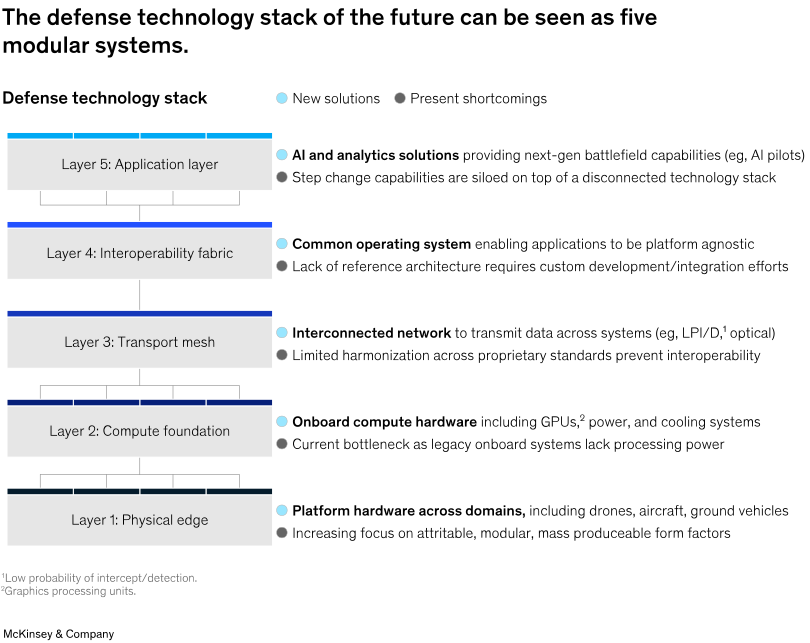
A modular, five-layer framework can help to explain why the current tech stack is unsuitable for modern warfare (exhibit). Over the past decade, these layers have been treated as a single, vertically integrated product, with the modernization of discrete technologies gated by the customer and integration. However, to overcome the integration challenge, they need to be disaggregated, allowing hardware and software to evolve independently at their own necessary speeds.
1. The physical edge
In the 20th century, value came from physical hardware. However, in the future tech stack, the physical platform—whether it be a drone, a ground vehicle, or a satellite bus—will be the commodity. The primary requirement for this layer is scalable producibility. In a world of contested logistics, militaries can no longer rely on bespoke, hand-built platforms that take years to build and require significant sustainment (maintenance) tails to support. Western ministries of defense (MODs) will require “attritable mass:” common, affordable, modular form factors that can be manufactured (or 3D printed) where needed, tolerating high losses without degrading the wider network. Exquisite, survivable platforms will remain essential (such as nuclear deterrents, high-end air dominance, and certain space missions), but deterrence and endurance now require attritable mass at scale, plus the ability to reconstitute quickly.
2. The compute foundation
The compute foundation provides the necessary processing capacity. This is the physical “brain” of the stack: the onboard graphics processing units (GPUs), electrical power management, and thermal cooling required to run AI workloads at the tactical edge. Currently, this is the ecosystem's most significant opportunity for advancement: Localized sensor fusion and processing cannot occur if the legacy platform lacks the compute capabilities to run the algorithm. Moving data off-platform increases operational latency and stresses communications networks. Significant retrofits will be required in the existing fleet alone to provide the processing energy needed to support modern applications.
3. The transport mesh
Data need to move through resilient, multimodal networks of low probability of intercept/detection (LPI/LPD) waveforms, 5G and 6G, and optical (laser) links. Currently, disparate assets cannot share targeting data due to rigid proprietary standards. The future stack relies on true interoperability—a self-healing mesh that routes insights from sensor-to-shooter regardless of the platform. A practical look at where existing, proliferated solutions (for example, Link 16 or common data link [CDL]) can serve as a bridge to future protocols, such as 5G derivatives and bespoke military protocols, that enable highly networked communications that are resilient to electronic warfare capabilities.
4. The interoperability fabric
This is the “missing middle” of defense investment: the layer that manages heterogeneity. It abstracts the hardware so that a mission application (layer 5, the application layer) can run on any platform (layer 1, physical edge). Without a reference architecture here, the ecosystem remains fragmented, requiring bespoke, multiyear integration efforts for every new capability. Heritage industry, disruptors, and customers need to meet in the middle and codify modular open systems approach (MOSA) architectures that do not overspecify the system or burden it with unnecessary cost and complexity. This is an opportunity to learn from commercial aerospace, automotive, personal computing, and mobile phones, where the market has chosen its reference architectures and operating systems to the benefit of the partner ecosystem. This digital drive layer would allow the innovation at the top of the stack to drive the platforms at the bottom.
5. The application and analytics layer
The premium software sits at the top of the stack: swarm autonomy, dynamic targeting apps, and AI pilots, all orchestrated with human-in-the-loop command and control. Both venture capital and attention are currently concentrated in this layer. However, without the underlying infrastructure of the previous four layers, this software has nowhere to run.
The challenges and evolving solutions in procurement and investment
The transition to the future defense tech stack is currently being stalled by a fundamental mismatch in business models between the buyer and the builder. Defense customers often procure vertically integrated solutions tailored to specific problems, similar to bespoke, all-in-one solutions. However, the current installed base was designed in a very different tech time—for example, the F-35 was created over 20 years ago and is still in use today. At the moment, the defense industry collates the five layers into closed, proprietary systems to secure contracts. However, this approach is evolving as the industry starts to recognize that more modular architecture is needed, such as those used in MOSA.
That said, major gaps still exist within both procurement and investment:
- The procurement trap: National security customers largely adhere to program-centric operating models that favor integrated hardware and software products over discretely upgradable technology layers within an open architecture tech stack. This model has been necessary historically because customers wanted a complete solution and lacked the expertise and rules for procuring and integrating stand-alone software. Tech disruptors are often forced to vertically integrate—for example, selling a fleet of ready-to-deploy drones rather than the operating system that could power them all. As a result, innovation gets trapped within specific platforms rather than shared across the force.
- The investment gap: The flow of funding illustrates this imbalance. Private capital has surged into the top of the stack, with AI attracting $12 billion in investment in 2024 alone.8 Venture capital investment totaled around $40 billion.9 In the United States, the public sector largely funds defense-specific investments at the bottom of stack, with $179 billion requested for fiscal year 2026 and $141 billion enacted in fiscal year 2025.10
Even though there are challenges in both procurement and investment, there are signs of change driven by a new class of institutional and capital frameworks that have emerged over the past several years. For example, the NATO Innovation Fund deployed its first tranche of deep-tech capital in June 2024, explicitly targeting dual-use manufacturing and autonomous systems (such as ARX Robotics and Space Forge) that bypass legacy procurement cycles.11 Simultaneously, the US Space Force's Commercial Space Strategy, released in April 2024, formally pivoted the service toward a hybrid architecture, mandating the integration of commercial solutions for tactical surveillance and data transport, rather than building government-owned defense networks.12 Japan established the Defense Innovation Science and Technology Institute (DISTI) in October 2024 to accelerate the adoption of breakthrough dual-use technologies.13
The orbiting bellwether: What low-Earth orbit can teach the muddy boots
Ten years ago, the space domain was the exclusive province of the “exquisite monolith”—multibillion-dollar satellites that took up to a decade to design and build. Today, that architecture partly has been inverted. Some of the older exquisite equipment have been displaced, but ultimately it is the lowering of cost that has hugely increased the relevance and use of space.
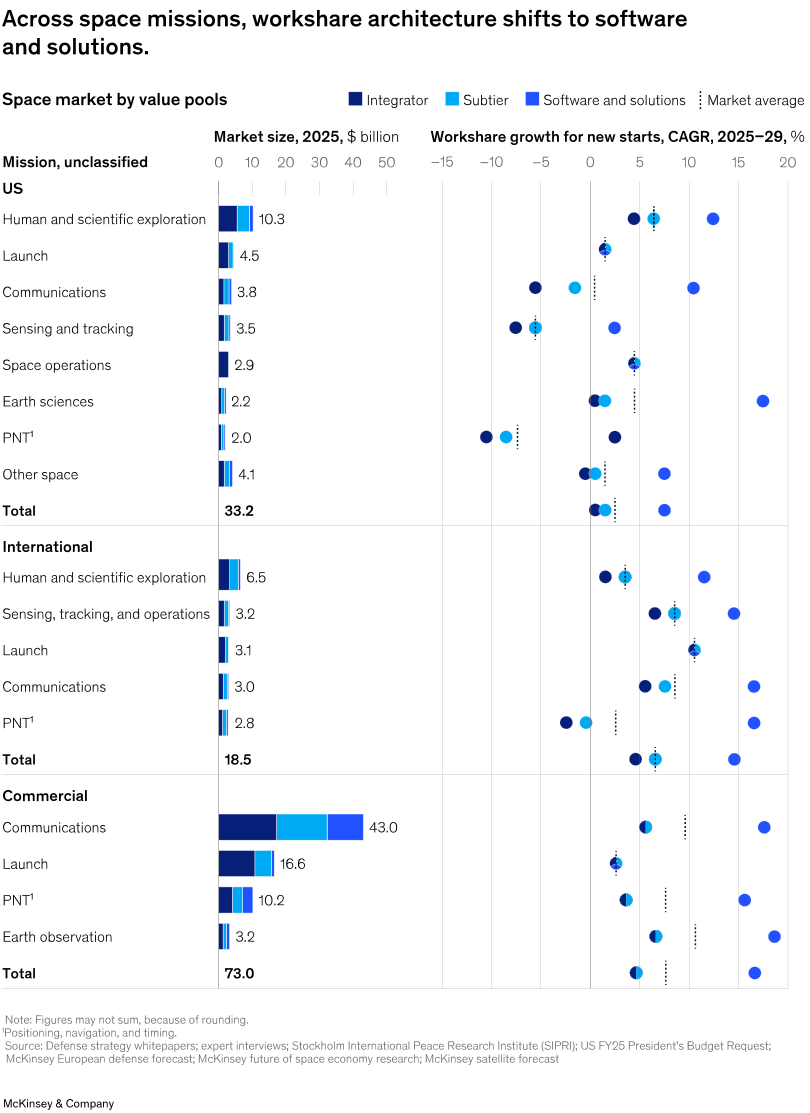
The low-Earth orbit (LEO) landscape is now defined by a proliferated mesh of thousands of disposable nodes, driven by commercial disruptors and new government frameworks (exhibit). This transformation provides a potential road map for the terrestrial battlefield across three critical layers of the stack—layers 1, 3, and 5: commoditization, network dominance, and value migration:
- Commoditization. Launch costs have dropped by an order of magnitude, and the satellite “bus” has become a standardized commodity.1 The strategic value has migrated away from the physical hull—now cheaper and replaceable—toward the capabilities it carries. This mirrors the necessary shift for terrestrial platforms, where disaggregation favors arrays of smaller, linked assets over single, high-value systems.
- Network dominance. As physical nodes have multiplied, the center of gravity has shifted to the network. Technologies such as space-based optical laser communications have become critical enablers, transforming isolated assets into a resilient, self-healing mesh. The power of the system no longer resides in the individual satellite but in the optical intersatellite links that allow data to flow dynamically above the fray.
- Value migration. With infrastructure costs reduced, significant value has shifted to the data and analytics layer. The scaling of workloads—driven by AI and accessible application processing interfaces (APIs)—has turned orbit into a software-defined domain. However, this shift has demonstrated one of the frictions in the future defense tech stack: Advanced space-based optical lasers handling vast data volumes now face acute computing power constraints, requiring significant upgrades to onboard processing to fully realize the software’s potential.
These moves signal that the “middleware” crisis is being resolved by a fundamental rewiring of how Western defense accesses and scales commercial innovation—as is already happening in the space domain (see sidebar, “The orbiting bellwether: What low-Earth orbit can teach the muddy boots”).
Implications for the ecosystem
As the current tech stack evolves to support greater modularity, value pools will shift, necessitating a strategic pivot for every player in the defense ecosystem, including defense prime contractors, defense disruptors, nontraditional suppliers, governments, and investors. Each of these players will benefit from adapting their role. Early efforts to refocus procurement priorities (such as Germany’s Software Defined Defense strategy, recent executive orders in the United States, and the Pentagon’s recent memo on its AI strategy) show promise, but may risk falling short of ambition if industry and government stakeholders do not lean into both the letter and spirit guidance.14
Platform integrators (defense prime contractors)
The era of the “walled garden,” where a single prime controls the entire vertical stack, is ending. As customers demand modularity, the defense primes that thrive may be those that transition from guarding closed architectures to curating open ones. A significant opportunity lies in the “digital retrofit.” With a significant compute and connectivity gap across the installed base, the most important contracts of the next decade may not be building the next fighter jet, but upgrading the avionics and mission computers of the fourth- and fifth-generation fleets to host third-party applications. Examples include F-35 Block 4 compute upgrades, the M2 Bradley active protection system, the Eurofighter Tranche 5 with electronically scanned array (AESA) radar, and the United States Navy’s Guided Missile Destroyer Modernization (DDG MOD) 2.0. Prior McKinsey analysis estimated that closing this computing gap for the United States would cost approximately $200 billion, which is on par with one year of total Pentagon defense procurement budget ($205 billion).15
The Pentagon under the current US administration has shown a willingness to work with nontraditional suppliers and challenge the primes’ business-as-usual models.16 Primes that seek to lock down these interfaces risk missing out on new opportunities, while those that build military “app stores“ enabling tech stack, could secure a central position in the new ecosystem. The primes bring scale, engineering breadth and depth, integration capability, and supply chain management that will continue to be essential, yet they need to adapt to both changing customer demands and the emergence of new peers. Additionally, the economics of programs are shifting, with more external capital available for development through internal research and development (IRAD) and potentially higher gross margin capture.
Component scalers (defense disruptors and nontraditional suppliers)
Disruptors will pivot from selling stand-alone demonstrations to addressing the missing middle (layer 3, the transport mesh, and layer 4, the interoperability fabric). Rather than waiting for a government program of record, winning leading archetypes—such as Palantir and Starlink—are partnering to integrate their software into the legacy compute foundations and contested connectivity environments of today’s forces. These partnerships could offer lessons for the C-suite: If an algorithm cannot run on a legacy hardware stack at the tactical edge, disconnected from the cloud, it may struggle to transition from compelling demonstrations to operationally relevant products.
Investors (public and private sector)
The current start-up model relies heavily on short-term R&D grants and venture capital to drive modernization, but this approach has a structural ceiling. While optimized for software margins and three-to-seven-year exit horizons, many private capital investors may be mismatched to the capital-intensive, ten-year timelines required to build solid rocket motor factories or advanced microelectronics foundries, for example.
The opportunity lies in bridging this gap by making industrial capacity an investable asset class. There are trillions of dollars in private infrastructure and private credit funds available, deterred by the binary risk profile of defense contracting.17 The customer’s role is to de-risk this long-term capital expenditure, moving beyond simple grants to tools such as loan guarantees and equipment financing that lower the costs of capital for hardware scale-up (for example, the US Office of Strategic Capital initiatives). This can provide investors and industry the revenue visibility needed to commit to at scale, multiyear capital investments. By creating investible production commitments, architects can unlock the deep industrial capacity that software investors will not fund.
The defense tech stack of the future represents a fundamental architectural shift from permanence to replenishable. The risk of inaction is not just technological, but structural: Investing in the capacity to rapidly produce such tech at scale is vital. If the ecosystem fails to address the missing middle—by fixing the industrial bottlenecks to build the platform and by constructing the digital infrastructure to connect it—Western defense organizations risk fielding the most sophisticated military in history that runs out of ammunition within the first week of conflict.