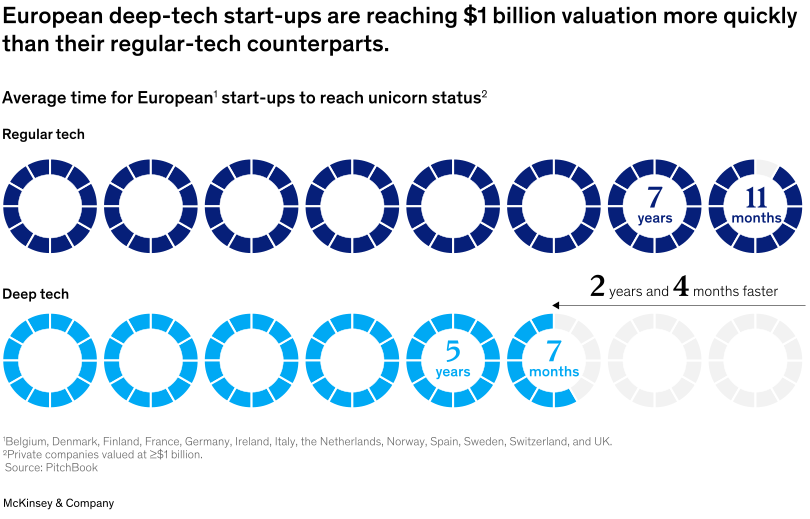
European deep-tech start-ups are reaching unicorn status more quickly than their regular-tech counterparts. It takes a deep-tech company an average of five years and seven months to achieve a $1 billion valuation, note McKinsey’s Hannes Erntell, Markus Berger-de León, Max Flötotto, Stéphane Bout, Tobias Henz, Tunde Olanrewaju, and coauthor. This is 28 months faster than a regular-tech company, which takes an average of seven years and 11 months to reach the same milestone. Deep-tech companies often have strong intellectual property, strategic industry partnerships, and robust funding from venture capitalists, which help them to scale quickly.
Image description:
A chart containing segmented circles compares the average time for European start-ups to reach unicorn status, with regular tech start-ups taking 7 years and 11 months, and deep-tech start-ups taking 5 years and 7 months. The chart uses segmented circles to represent the time taken by each type of start-up, with the deep tech start-ups reaching unicorn status 28 months faster than their regular tech counterparts. The data includes European countries such as Belgium, Denmark, Finland, France, Germany, Ireland, Italy, the Netherlands, Norway, Spain, Sweden, Switzerland, and the UK. The chart includes a footnote explaining that “unicorn status” refers to private companies valued at $1 billion or more.
Note: This image description was completed with the assistance of Writer, a gen AI tool.
Source: PitchBook.
End of image description.