Japan is not in crisis—and that may be its greatest blind spot. With the strength of a system built over decades, the country has high trust, deep institutional capacity, and substantial accumulated assets. Households, firms, and public institutions have acted as shock absorbers: Companies have prioritized employment stability over restructuring, and households have saved and adjusted their expectations. In addition, much of Japan’s quality of life is sustained by “invisible assets”: reliable public transport, universal healthcare, low crime, and well-maintained environments. These strengths have cushioned the impact of stagnation—but also masked it.
To read the full report, download the PDF here.
The global context has now shifted. Roughly every 20 to 30 years, the world enters a new era. The previous era—from the early 1990s to the late 2010s—was defined by globalization, digitalization, favorable demographics, abundant energy, and cheap capital. Many Asian economies surged: From 1990 to 2025, GDP per capita (purchasing power parity, or PPP) rose 14-fold in China, fivefold in India, fourfold in South Korea, and threefold in Singapore. In contrast, Japan’s GDP per capita increased by only around 30 percent.1 Stability was preserved, but dynamism was constrained.
That era is over. The new era taking shape is marked by geopolitical uncertainty, AI-driven disruption, demographic decline, energy transition, and rising capital costs. For Japan, this shift coincides with a clear structural inflection point: Inflation rose from near zero in 2021 to 3 to 4 percent from 2022 to 2025,2 wages are increasing, and government bond yields are at nearly three-decade highs.
Competitive positions are now being reset, but because there is no crisis, there is a risk that the urgency of the situation will be underestimated. Moreover, delay no longer preserves optionality; it erodes it. By acting with immediate intent, Japan can shape its position in the next cycle of growth. But if it does not act, drift may compound, as it has for three decades. In this environment, standing still is not a neutral option; it means falling behind. The cost of drift is becoming more concrete, including rising pressure on living standards; less fiscal capacity to maintain infrastructure, healthcare, and social security; and weaker capacity to invest in energy security, defense, climate resilience, and next-generation industries. Japan’s inherited strengths have cushioned stagnation so far, but they cannot substitute for renewed dynamism indefinitely. Poland’s GDP per capita (PPP) is set to surpass Japan’s this year, and other countries may follow if Japan does not reset its growth trajectory.
In this report, we offer a perspective for how Japan can reset its growth model with productivity, enter a new phase of prosperity, and launch a new generation of globally competitive firms within a dynamic corporate ecosystem.
Once a standout performer, Japan has faced three decades of slow growth
Taking a long view, Japan is one of the greatest success stories in modern history. Over the past century, GDP per capita in terms of PPP increased roughly 11-fold, far outpacing the global average rise in this measure. Within a few decades, Japan built world-leading industries, set the benchmark for manufacturing excellence, and reached a high level of GDP per capita.
But although Japan arrived at the frontier early, it has not pushed that frontier further. Instead, Japan has been in a holding pattern in which early success has not delivered continued momentum—indeed, since the early 1990s, growth has slowed to a crawl, with GDP per capita increasing by only around 30 percent (Exhibit 1).
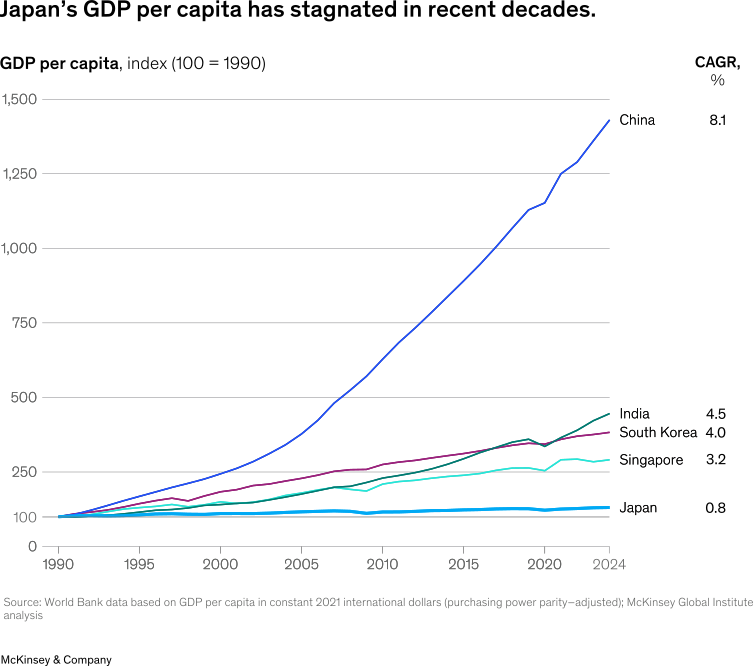
The question we pose is simple but consequential: As a new era unfolds, will Japan’s drift deepen? Can Japan capitalize, moving faster than the structural shifts unfolding, or will it fall behind? Will it be sufficiently motivated to act boldly?
The answer ultimately comes down to productivity. Sustained productivity growth is the foundation of rising living standards in every economy. For Japan, it is even more critical because rapid population aging is shrinking the available workforce, leaving productivity as the primary engine of future growth.
So what will drive the productivity gains Japan needs? The answer has two dimensions. First, decisions made within firms deliver productivity. A great deal of commentary on Japan’s “lost decades” has focused on macroeconomics, but there has been far less focus on the micro level: how companies are performing and how they can individually improve their productivity. Second, those firms need to invest—and invest big—in areas of the global economy that have the most growth potential.
Japan has high-performing companies, but strong performance is not widespread
When companies are productive, so are economies. Yet productivity gains are not evenly distributed. A relatively small share of firms—often the most dynamic and forward-looking—account for a disproportionate share of productivity growth. What distinguishes these firms is not just their scale but also their willingness to reallocate capital and talent aggressively, adopt new technologies at speed, and continuously reinvent their business models. In contrast, economies in which capital and labor are slower to shift toward higher-productivity areas tend to see weaker overall performance. The implication is clear: Raising productivity at the national level depends on enabling more firms to scale toward top-tier performance—and on accelerating the dissemination of best practices across the broader corporate landscape.
Analysis of corporate performance in other major economies provides insights on effective ways to boost productivity. The McKinsey Global Institute (MGI) conducted research on companies and productivity and found that the United States had a superior record of productivity than Germany, the United Kingdom, and Japan. The productivity growth of the US sample of companies between 2011 and 2019 was 2.1 percentage points. For the Japan sample taken between 2019 and 2023, it was zero (Exhibit 2).
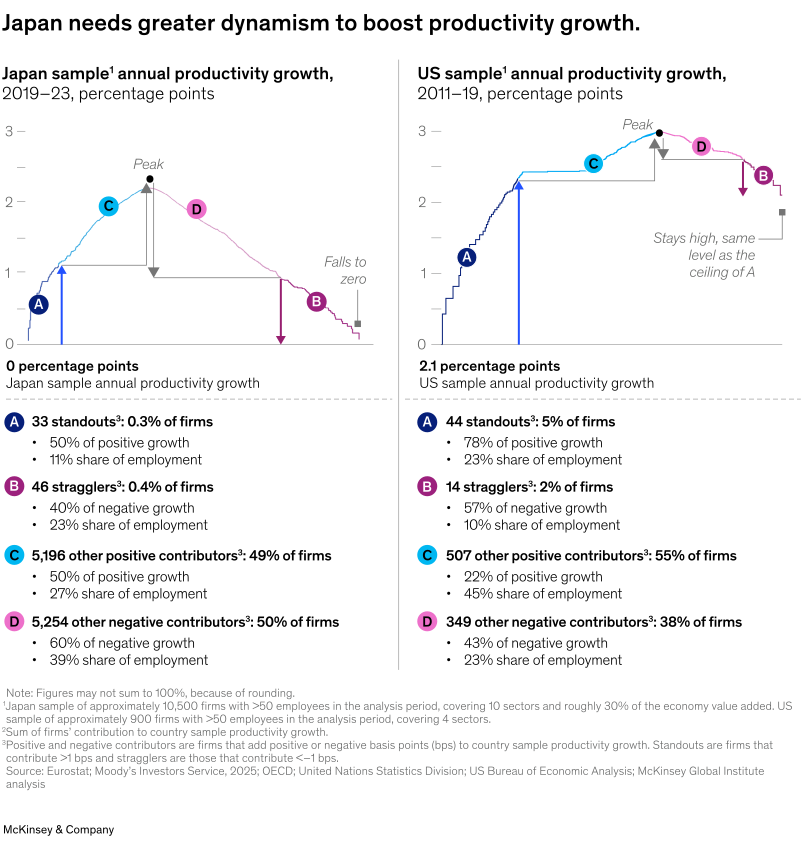
How did the United States succeed in reversing the downward drift in its productivity growth while Japan’s productivity remained in decline? The answers become clear when we look at the micro level—that is, at companies. The United States has more “standout” firms (defined as companies contributing more than one basis point of growth to the sample group we analyzed) with healthier productivity than other major economies. Just 5 percent of firms generated nearly 80 percent of positive productivity growth. The United States has fewer firms underperforming on productivity. In part this is because the US labor market is more flexible, allowing underperforming firms to be absorbed by stronger companies or exit the market. More than 40 percent of US productivity growth resulted from the reallocation of workers from low- to high-productivity firms.
An analysis of 10,500 Japanese companies suggests that corporate Japan lags behind in each of these dimensions. Japan has high-performing companies, but not enough of them. And in the aggregate, their performance is diluted by a long tail of underperforming firms. In our Japanese sample, 33 standouts—only 0.3 percent of firms—contributed half of total positive productivity growth, but more than 5,000 firms (50.0 percent of the entire sample) had a negative effect on aggregate productivity. The reallocation effect is notably limited in Japan’s productivity growth compared with the United States. Total positive contributors amount to 2.2 percentage points of productivity growth, yet low-productivity firms continue to absorb labor. As a result, there is limited reallocation of workers toward more productive companies, dampening overall gains. This reflects a Japanese corporate system that prioritizes stability over dynamism. Japanese firms have a low turnover rate: Less than 2 percent exit the market each year, in comparison with 7 to 8 percent in the United States. This suggests that Japan experiences limited competitive pressure and slower renewal of the corporate base than the United States.3 Underperforming firms stay in business longer in Japan than in more competitive systems. This persistence reflects structural and cultural factors, including a bank-centric financing system that sustains weaker firms, social norms that discourage failure, and institutional support that can prolong the life of small and medium-size enterprises.
Japan has global companies but needs more of them
Corporate Japan has a considerable global presence. A survey of roughly 500 manufacturing companies with overseas affiliates suggests that the overseas sales ratio reached 40 percent in fiscal year 2023, with overseas production at 36 percent.4
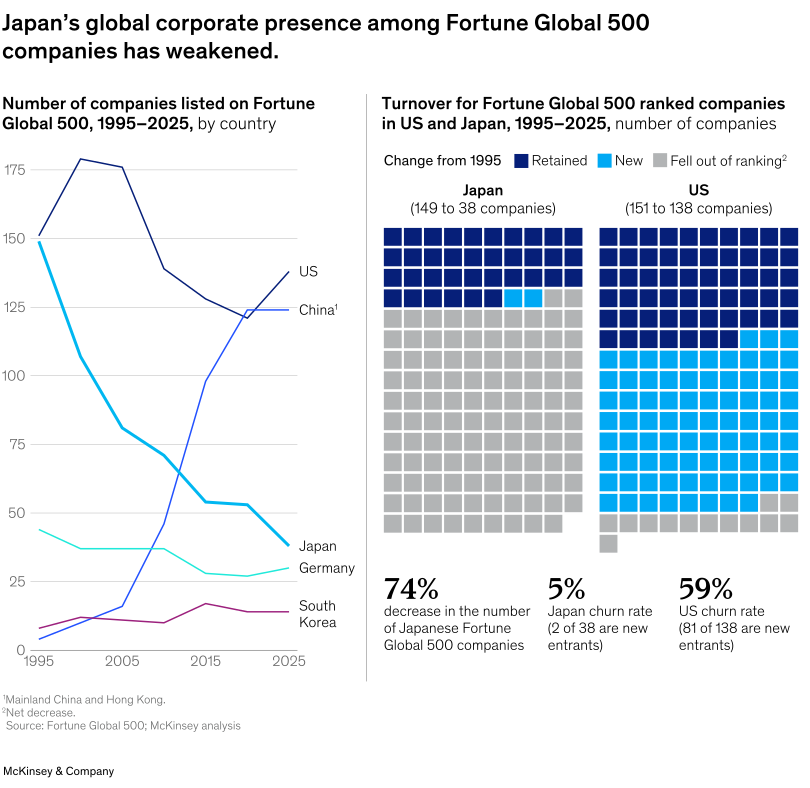
That said, the number of Japanese companies in the Fortune Global 500 has fallen from 149 in 1995 to 38 today (Exhibit 3). More tellingly, the majority of Japan’s current Global 500 companies were already ranked in 1995; only two of the current 38 (about 5 percent) are new entrants. This stands in stark contrast to the United States, which has retained a similar number of ranked companies (151 in 1995 to 138 in 2025) but has a churn rate of nearly 60 percent, with 81 of the current 138 ranked companies being new entrants.
Where to look when placing bets on growth
It pays to take a structured approach in determining where Japanese firms might focus their efforts in the new era. For this report, we examined about 4,000 global companies and about 4,000 Japanese companies to identify opportunities for Japan to compete in the next era and shape, accelerate, sustain, and participate in it.
Our analysis applied three lenses:
- Global landscape. MGI has identified 18 arenas of competition defined by high growth and dynamism, strong innovation intensity, and cross-border scale dynamics. These domains, in which value is being structurally reshaped, are expected to account for up to one-third of global GDP over time.5
- Japanese competitiveness. This lens combines measures of current performance, such as revenue share and profitability, with indicators of future potential, including venture capital and private equity activity and strength in patents. The resulting picture indicates deep capabilities but uneven translation into commercial scale.
- Criticality to national interest. Not all sectors carry equal weight. We therefore considered government priorities alongside each sector’s role in employment, ecosystem interdependence, and overall economic resilience.
There is no single “correct” or scientific way to categorize sectors into these arenas. What follows is one perspective. The boundaries are inherently judgment-based, and both composition and classification will evolve as economic conditions, technologies, and competitive dynamics unfold. Instead of an exhaustive list, the analysis frames a portfolio—forcing clear choices on where to concentrate effort.
Japan’s industrial policy can support productivity growth through a differentiated model that guides companies on where to lead, build, and reposition, and where to stay put. This includes an assessment of the 18 arenas of competition identified by MGI, as well as two additional arenas—shipbuilding and biopharma—added because of their relevance to Japan.
Using our three lenses described earlier, we identified four categories of opportunities: shape, accelerate, sustain, and participate (Exhibit 4).
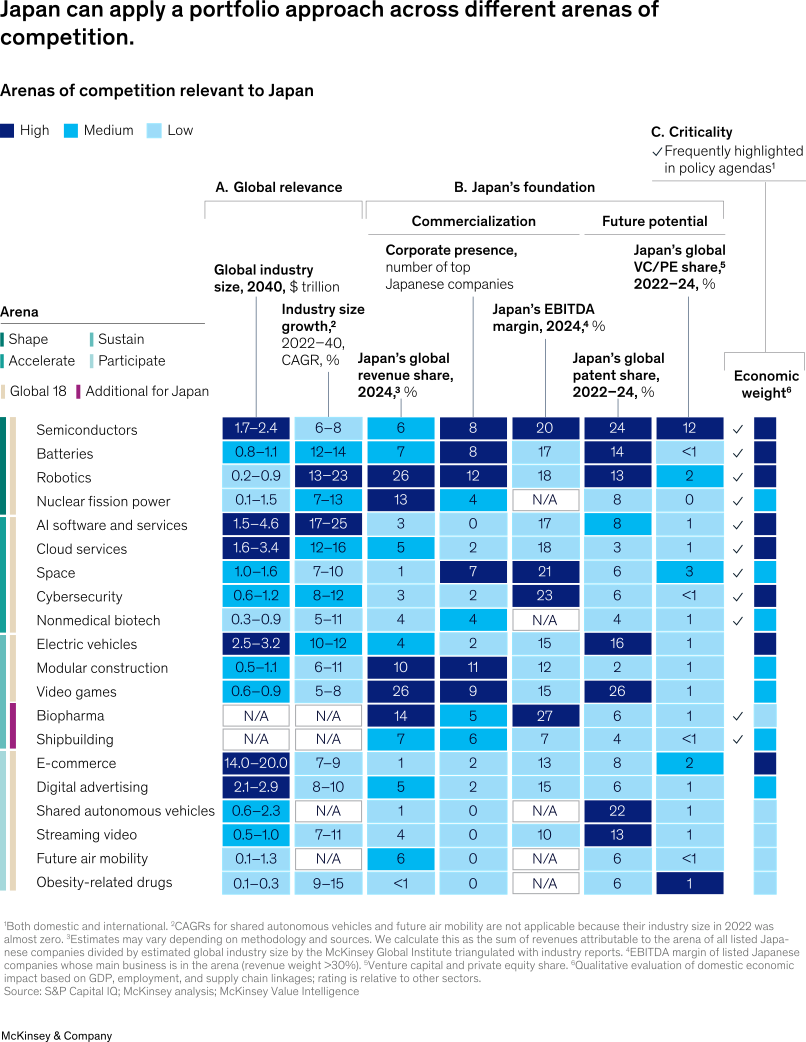
‘Shape’ arenas. Companies in these arenas could think about how to build global leadership positions, developing decisive scale and competing across the value chain. These arenas include semiconductors, batteries, robotics, and nuclear fission, sectors in which Japan already holds meaningful positions across both current commercialization and future potential. The priority for some of these industries is to move beyond component-level strength and capture greater value through integrated systems spanning design, manufacturing, and end-use applications. This requires coordinated action across incumbents, suppliers, start-ups, and research institutions; sustained investment in talent, capital, infrastructure, and long-term R&D; and active participation in shaping global standards.
‘Accelerate’ arenas. The priority for companies in these arenas is speed and focus to unlock (underused) strengths and rapidly build competitiveness. Such arenas—which include AI, cloud, cybersecurity, and space—are increasingly central to competitiveness, but Japan’s presence in several of these sectors remains limited. Japan might look to rapidly build capabilities and scale by accelerating investment in frontier technologies and system integration, deepening partnerships with start-ups and global leaders, and enabling faster access to global innovation through targeted policy support.
‘Sustain’ arenas. The “sustain” arenas comprise sectors in which Japan can harness core strengths and expand into adjacent opportunities: For instance, electric vehicles are a natural extension of Japan’s globally competitive auto industry base. These are not areas of immediate global leadership, nor are they foundational to system-level competitiveness in the same way as “shape” or “accelerate” arenas, but they remain globally relevant. Importantly, in many cases, Japan holds strong assets—whether in technology, intellectual property, or industrial capability—that can be repositioned toward higher-value segments.
‘Participate’ arenas. These arenas comprise sectors where Japan may not achieve global leadership but where continued engagement remains strategically important. These include both large, established markets and emerging domains with uncertain trajectories.
If Japan competes effectively in the key arenas, the prize could be transformative
Our scenario illustrates the scale of this opportunity. Assuming the broader global market develops at a medium growth rate scenario (midpoint between low and high scenarios), Japan could generate approximately $500 billion in incremental revenue by 2040, relative to 2024, if it grew across “shape” arenas at a rate two percentage points above the high-growth scenario. If the “accelerate” arenas were to grow at one percentage point above the high-growth scenario, the “sustain” arenas in line with the high-growth scenario, and the “participate” arenas in line with the medium-growth scenario, they could generate an additional $400 billion, $530 billion, and $220 billion, respectively.
In total, therefore, Japan has the potential for incremental revenue of about $1.7 trillion (Exhibit 5). This would make a material impact on the country’s economic fortunes. The effectiveness with which Japan executes this strategic portfolio will be a critical determinant of its long-term trajectory.
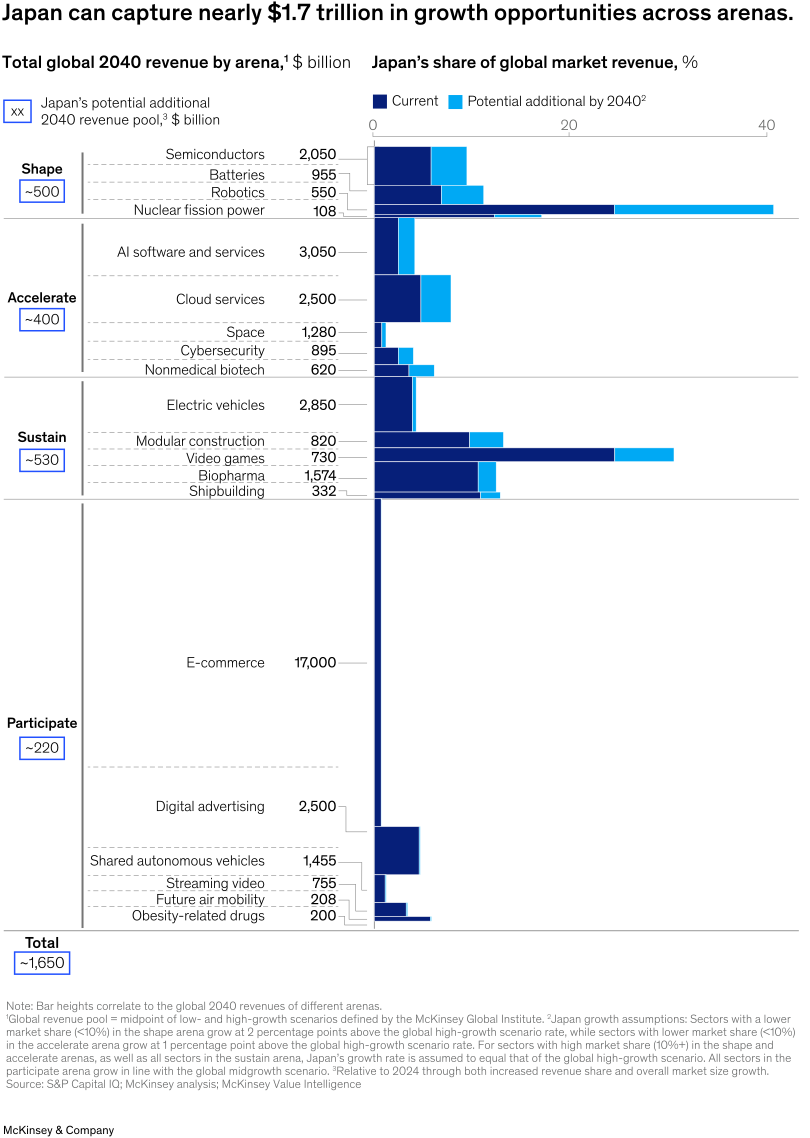
At the same time, the bar is high. Once slower growth in the rest of the economy is accounted for, a growing presence in these arenas is not enough; Japanese players need to outperform.
A reset for the new era
Further erosion of Japan’s competitiveness and influence is by no means inevitable. Japan has reinvented itself before when circumstances demanded it. But this time, incremental realignment may well be insufficient. Our analysis suggests that bold, coordinated, and sustained action across arenas could catalyze a productivity reset that turns drift on its head and creates much-needed dynamism. An enabling agenda for Japan’s executives and leaders rests on five priorities that can support the repeated creation of globally competitive Japanese firms.
- Infrastructure—including energy—will determine competitiveness in the next era. Infrastructure has long been treated as a background enabler of growth, but that approach is no longer sufficient. In the next era, infrastructure will help determine which economies can even participate in growth at scale. Energy is no longer merely a utility issue but a fundamental requirement that dictates industrial competitiveness.
- Deploy capital to power growth. Japan’s financial model has long encouraged preservation—an approach that made sense in a low-growth, low-rate world. But capital now needs to power the next productivity wave. Household financial assets exceed ¥2,000 trillion ($15 trillion), and just over half still sits in cash and deposits. Japan’s capital challenge is not a lack of capital. It is activation.
- Deepen connections with global systems. Winning globally does not simply mean exporting more. It means moving from product export to ecosystem participation; from supplier to trusted partner; and from standards follower to standards shaper. The broader opportunity is for Japan to move beyond maintaining strength in components and become more central to the global ecosystem—shaping the interfaces and standards that define how systems work.
- Shift human capital from a constraint to a skills multiplier through a more personalized approach. Japan’s demographic reality makes productivity a burning platform, not simply an aspiration. High-productivity sectors such as digital, AI, and advanced manufacturing face acute shortages, while labor remains concentrated in lower-productivity uses. In a shrinking workforce, flexibility can be a source of productivity. The rise of AI creates opportunities for partnerships among people, AI agents, and robots—turning AI and robotics from a defensive response into a productivity multiplier.
- Institutions are central to enabling renewal. Japan’s institutions have long been effective at preserving stability. But the next era requires a different test: Can institutions preserve social trust while enabling faster renewal? What is needed is more active renewal: earlier divestitures, cleaner exits, easier labor redeployment, and institutions that reward repositioning rather than continuity.
The real choice is between managed renewal today and unmanaged erosion tomorrow. Waiting does not mean standing still; it means entering later, on less favorable terms, into systems designed by others. Today, the task is to breathe life into a new model: one that preserves what Japan does exceptionally well—trust, quality, resilience, and industrial depth—while using those strengths to support faster renewal. In the previous era, resilience helped Japan absorb shocks. In the next, it needs to help Japan move sooner. Time is of the essence. Japan’s leaders should act now to take practical steps toward a dynamic future.
Related Articles

The race takes off in the next big arenas of competition