Since valuations peaked in 2021 and 2022, it has become more difficult to generate private equity (PE) returns. Many PE firms are sitting on assets purchased at the peak, when multiples were higher and financing cheaper, making it harder to exit at target multiples or within planned hold periods (see sidebar, “Lower multiples, longer holds”).
Lower multiples, longer holds
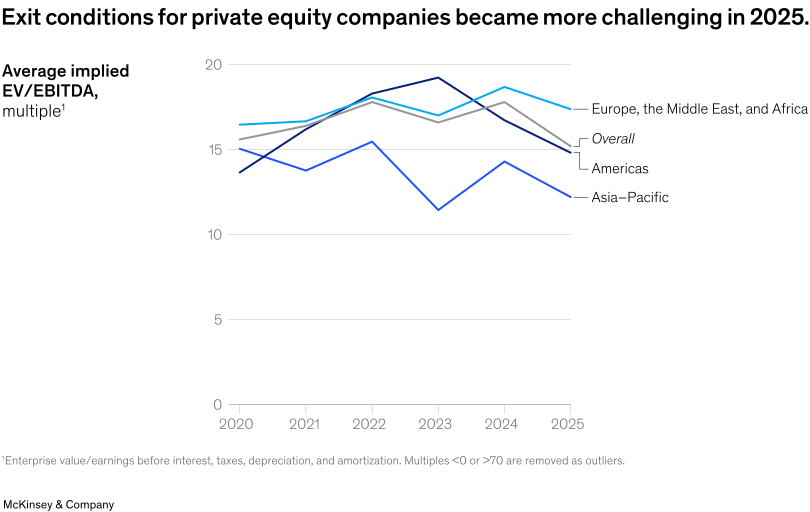
The average EV/EBITDA multiple declined from 16.4 in 2021 and 17.8 in 2022 to 15.2 in 2025 (exhibit). Average hold times increased to 6.2 years in 2025, up from 2009’s average of 4.0 years. Figures vary across sectors and industries, but headwinds are present in many industries.
In this environment, creating value increasingly depends on what sponsors can do to improve the performance and positioning of their portfolio companies ahead of exit. One powerful value creation lever is M&A integration. When done well, M&A integration can accelerate EBITDA growth, strengthen the strategic profile of an asset, and support higher exit multiples.
However, integrations are notoriously difficult to execute well. Even when the deal rationale is compelling, a combination can introduce new complexity and pull focus away from the core business. Many organizations fall short of fully integrating operations, processes, and culture, leaving value on the table. Each type of PE integration also carries more specific pitfalls that should be considered before pursuing it, as they can shape both the decision to proceed and how the integration is executed.
This article explores three common M&A integration strategies that private capital firms are using to achieve positive outcomes: rolling up smaller players, combining comparably sized portfolio companies, and accelerating innovation by integrating capabilities across a value chain. These do not comprise an exhaustive list of integration strategies but are examples of how PE companies are using well-executed M&A to create value.
Rolling up smaller players
In a roll-up strategy, a large portfolio company consolidates smaller players to capture benefits of scale and operational efficiencies. To do this successfully, the PE sponsor must ensure the company fully integrates the smaller companies in a short time frame, captures cost synergies, minimizes revenue loss, and accelerates growth. Successful execution hinges on combining teams to retain the strongest talent, quickly transitioning each of the acquired companies to a more efficient operating model, and managing the change for new employees. It also requires identifying and realizing cost savings through shared functions, systems, and processes. This strategy often relies on the sponsor’s capital and a long-enough timeline to see the accumulation of value over many acquisitions. It fails most often when the portfolio company aggregates companies but is unable to integrate them into a cohesive whole.
Join authors for an exclusive webcast
July 30, 10-11 a.m. EDT / 3-4 p.m. BST
How a PE sponsor successfully executed an insurance roll-up
A PE sponsor began a successful roll-up strategy by acquiring a large insurance broker. Then, over the next ten years, the insurance broker purchased more than 80 smaller insurance brokerages and agents, and performed what the industry calls “producer lift-outs” (individual brokers or small teams that bring their books of business with them when they move to a new company). Each acquisition was integrated into the core platform within months. The strategy enabled each of the integrated companies to achieve faster growth, offer clients more, and expand margins further than they could have on their own. The roll-up culminated in a successful exit at ten times the initial investment, representing a roughly 25 percent internal rate of return.
Four foundational practices for roll-ups
The acquiring company followed four key practices and avoided a common pitfall while pursuing the insurance roll-up:
- Bring a clear value proposition to the acquired company. A clear articulation of the value proposition not only helps PE sponsors find the right targets but can help clarify the integration strategy. In the above example, integrating into the roll-up provided each acquired company with new scale, reach, and offerings. Producers could grow their books with existing clients and attract new clients. Becoming part of the platform also provided more professional and efficient back-office support, reducing support costs, improving the producer experience, and making growth easier.
- Fully integrate core processes. It’s important to establish a clear, systematic, and fast way to transition acquired companies into the portfolio company’s system and processes. In the above example, the insurance roll-up had a mandate to complete each company’s platform migration within a matter of months, often integrating several at a time. To meet this deadline, integration leaders resolved challenges quickly, making concessions pragmatically (as long as they did not run counter to the core objective).
- Invest in M&A capabilities. A roll-up strategy requires executing many deals a year and often running several in parallel. The above portfolio company had a lean M&A team that identified targets, managed deal flow, and led the integration. However, the team didn’t do it alone; leaders of the core functional areas (such as finance, IT, HR, and legal) regularly contributed to M&A activities. This “all hands” approach enabled the organization to build repeatable M&A processes and develop executive experience. M&A was not a separate, siloed group but part of multiple leaders’ job descriptions.
- Be realistic about acquired talent. In most circumstances, the portfolio company’s talent retains key positions; however, it is often important to train and motivate talent from the acquired companies. For the talent they wanted to retain, the insurance roll-up created incentives tied to performance and growth. This included earn-out structures that rewarded producers for continuing to generate revenue after the acquisition, in addition to broader financial incentives and the benefits of working within the new platform. The company was pragmatic about individuals who were unlikely to be motivated and separated from them.
A common roll-up pitfall: Roll-up strategies can go wrong when PE owners focus solely on acquiring companies with low multiples and don’t expend the energy and resources to tackle the integration well. The result can be expansion that quickly turns into dilution. In a worst-case scenario, the combined company winds up with a complex set of internal processes, low transparency in financial reports, and an inability to exit through an IPO. To avoid this, it’s critical to ask how the acquiring company will improve the competitive position of the acquired asset and increase its returns.
Combining comparably sized portfolio companies
Private equity sponsors often combine two similarly sized portfolio companies to create a larger, more attractive asset for buyers or a potential IPO. These companies are often in overlapping markets, which creates an opportunity for efficiency improvement.
The most successful sponsors treat these combinations as a moment to rethink the cost structure from the ground up and improve EBITDA margins. They redesign how the combined business operates, upgrading go-to-market approaches, operations, and administration to suit the needs of a larger, more sophisticated organization. They also strengthen leadership by bringing in experienced executives who can manage a more complex business and position it for exit.
How an ad-tech company successfully combined with a competitor
An ad-tech company, entering a more mature phase of its PE ownership period, executed a large competitor acquisition. The combined company took a cleansheet approach to expenses and was able to reduce costs with a new operating model for go-to-market, product development, and back-office support. By redesigning its sales model, the combined company was able to create more capacity to pursue new accounts. The new product development team used the target company’s offshore center of excellence to reduce costs and streamline development efforts. The total value realization within 12 months was more than twice the diligence estimate.
Four foundational practices for combinations
The acquiring ad-tech company followed four key practices and avoided a common pitfall while pursuing the combination:
- Protect business momentum. When combining two comparably sized companies, disruption to either can cause significant value loss. The acquiring ad-tech company avoided this outcome by protecting momentum. As day one approached, leaders scrutinized how integration actions could affect important stakeholders. They built interim processes to manage shared customers and created FAQs for employees. They also ensured there were mechanisms to deal with day-to-day disruptions of operations, including escalation pathways to resolve issues and delegated decision rights that empowered employees to act.
- Systematize synergy capture. It’s important to capture value quickly, which can require a diligent approach to synergy capture. In the above case, the two companies created clear, side-by-side views of their financials and operations, making it easier to see where work overlapped. Through a bottom-up planning process, the integration team worked with functional leaders across the organization to identify specific opportunities for efficiency gains and assign owners for each initiative, drawing on input from those closest to the required changes. For example, the product development team decided to move more work to the target company’s offshore center of excellence to reduce costs and streamline development efforts. Then the CEO distributed aspirational synergy targets for each accountable executive.
- Institutionalize new ways of working. Rather than simply implementing temporary work-arounds during integration, the acquiring ad-tech company changed its culture, core processes, and operating model. It started with a culture assessment to identify culture risks that might require mitigation. The leadership team then held a two-day session where it defined design principles for the new operating model and functional organization structures and sequenced how changes would be rolled out across the organization. Integration leaders sought feedback from executives who had been through these transitions in the past, used benchmarks to calibrate the degree of changes, and redesigned workflows to support these changes.
- Use the transaction as a catalyst to transform. By combining the two businesses, the ad-tech company nearly doubled in size. Management used that step change to reset expectations for performance, focusing on both growth and efficiency. Leaders reorganized the sales model to deepen relationships with large customers while freeing up capacity to pursue new accounts. They also rebuilt general and administrative functions from the ground up, reducing costs by 27 percent.
A common combination pitfall: A well-known challenge of M&A integrations is that they can disrupt the underlying business. This effect can be more pronounced in large private equity combinations, where the organization becomes significantly larger and more complex at closing. As management attention shifts inward, execution can slip and customers may see less focus, creating openings for competitors. Unsuccessful deals often see a 3 percent dip in pro forma revenue following a large transaction.
Combining complementary capabilities
PE sponsors can create a new company with market-leading strengths by bringing together two different sets of capabilities. This is a hard strategy to execute, as it often takes time to find the right pair of companies with the desired capabilities. It can also be difficult to assemble these capabilities in a way that accelerates competitive advantage. Doing this successfully requires a robust understanding of the market and a compelling strategy.
How a PE sponsor acquired two utility-sector companies to create an end-to-end offering
A PE sponsor acquired two operating companies in the utilities sector. As each matured within the portfolio, the sponsor evaluated the potential of creating an end-to-end service by combining them. One company supported capital projects, while the other provided follow-on services. By linking the two companies, the combined entity could deliver more value—with lower investment and operating cost—to the end customer by bundling. The new entity could also assume some of the risk of the capital project and the value associated with this risk. Additionally, the end-to-end view would allow the new company to collect insights from the service that could be used to improve the capital business, leading to more resilient infrastructure and ultimately lower service costs.
Three foundational practices for combining complementary capabilities
The PE sponsor followed three key practices and avoided a common pitfall while combining capabilities in the utility sector:
- Get the new value proposition right. The sponsor found that the two businesses had different value propositions. The capital business had a long sales cycle and was judged by a track record of accurately modeling expenditures, timelines, and commitments. The services business, by contrast, was judged on economics and service levels. The combined company would have to redefine its value proposition to meet both requirements. The sponsor rigorously tested this value proposition with customers, company leaders, and investors. Once the combination was validated and the deal proceeded, the newly formed company clearly communicated the new value proposition to sales leaders and customers so the sales team could effectively sell the combined offering.
- Identify the target customer segment. When combining complementary capabilities, the right target customer is often different from the core customers of either business on its own. In the above example, the capital business most often served larger customers with a long sales cycle, whereas the service business served midsize customers and had an on-site presence. Recognizing these differences, the newly combined company focused on the overlapping “large midsize” segment where the same buyer controlled both budgets and tailored its approach to that shared customer base. Focusing on this segment allowed the company to set sales targets and measure how well the combined offering was performing.
- Integrate selectively. It’s important to keep in mind that not all areas need to be integrated. In the above deal, the operations that delivered the different capabilities (including capital modeling, project management, and on-site service) were kept separate. However, it can be beneficial to share lessons and data that help each part of the combined company improve. In the case of the above company, reports from the service side of the business helped the capital group improve the design and resiliency of future projects.
A common pitfall when combining complementary capabilities: The biggest pitfall for this M&A strategy is failing to move the market to the new combined offering. In some cases, the two businesses sell to different decision-makers within the same company, which complicates sales efforts; without a clear, differentiated value proposition, customers have little reason to change how they buy. And even when the buyer is the same, simply combining products rarely creates value unless the integration delivers something meaningfully better than what either company offered alone.
At a time of lower multiples and higher cost of debt, portfolio company integration has become one of the most important ways for PE sponsors to create value. Executing roll-ups, combining comparably sized portfolio companies, and combining complementary capabilities are not easy strategies; they demand strong deal rationales and careful integration. The work is difficult, but we have observed that sponsors who consistently master these strategies achieve stronger growth and higher exit multiples.