For decades, global manufacturing has been shaped by globalization, specialization, and the pursuit of ever-greater efficiency across borders. But as globalized supply chains are reshaped by geopolitical fragmentation, manufacturers are rethinking their location and sourcing strategies.
The rise of AI and automation against this backdrop of shifting global supply chains and increasing announcements of foreign direct investment in greenfield manufacturing suggests the time may have arrived for US manufacturers to reassess what and how much they produce at home, as well as how they do it.1
Leading organizations and first movers are already capitalizing on US manufacturing tailwinds and reducing their exposure to supply chain risk. But with new greenfield locations potentially taking years to establish, many are turning to their existing brownfield sites to unlock productivity and ramp up faster.
The question for US manufacturers is no longer whether they should be producing more on home soil. It is how quickly, economically, and resiliently they can ramp up production. The answer may lie in how they rethink their supply chains, organize their operations, secure sufficient labor, and leverage AI and technology.
Meeting the moment: Why ramp now?
At the turn of the millennium, the United States was the world’s largest manufacturer. Today the United States is the second-largest manufacturer globally, producing only about a quarter of the gross output of China. The country is also a major importer of goods, many of which are critical to national security, at risk from concentrated supply, or imported from geopolitically distant trading partners.2 In a world of greater geopolitical competition, supply chain resiliency is becoming a national priority.
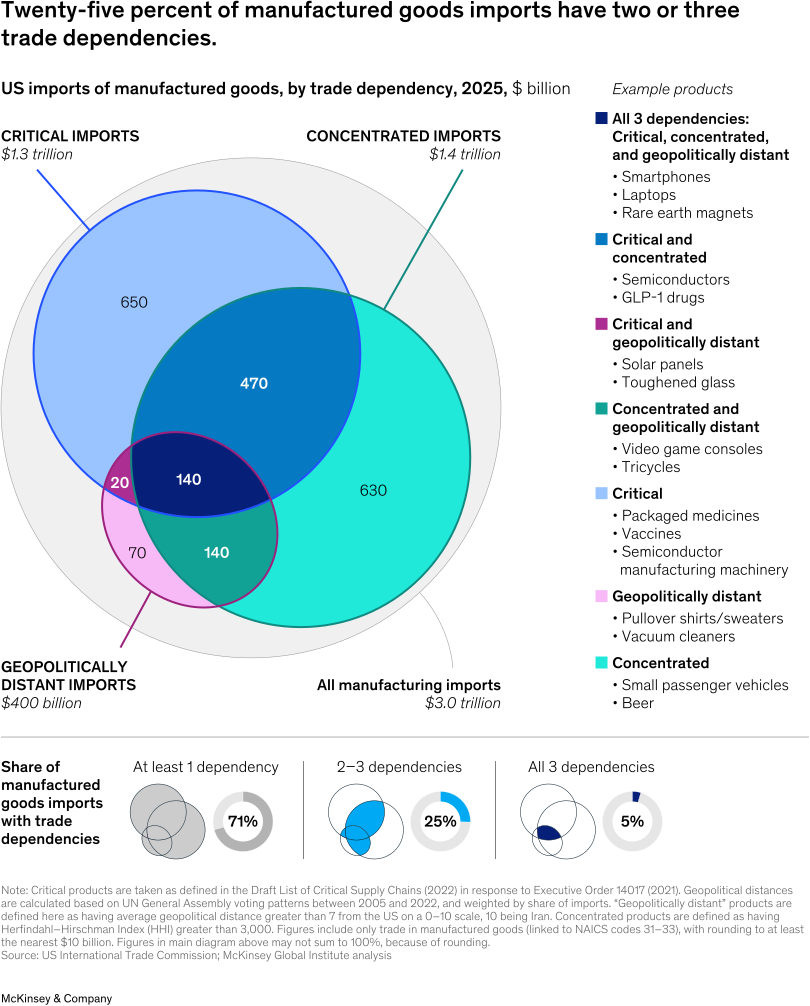
Of the $3 trillion of manufactured goods the United States imported in 2025, 25 percent face at least two of these three overlapping dependencies (Exhibit 1). These “Achilles’ heel” goods are diverse and important—including, for example, laptops, smartphones, rare earth magnets, semiconductors, solar panels, and vaccines.
Research from McKinsey Global Institute (MGI) has quantified the scale of the challenge and the opportunity. On average, Achilles’ heel products would need to roughly double domestic production capacity from today’s levels to meet current domestic demand. In certain categories, the required ramp-up is significantly greater. Active pharmaceuticals would need to ramp up fivefold, for example, and AI data center servers and advanced electronics more than tenfold.
MGI estimates that building domestic production capacity in Achilles’ heel products and their upstream supply chains would require $2 trillion in capital investment, equal to about 6 percent of GDP. Such investment would require compelling business cases. Specialized skills, energy and infrastructure, and shovel-ready projects could be even greater challenges.
Manufacturers have a front-and-center role to play in this next era for the US economy, driving resilience and growth. In some instances, manufacturers may be able to relook at product design to reduce their reliance on certain parts of the supply chain or make manufacturing simpler or faster. Where this is not possible, manufacturers can build targeted resilience for highly exposed, critical components while maintaining optimized global networks for the rest. On home soil, they can increase productivity growth by turning to Industry 4.0, automation, analytics, and AI to build the factory of the future.
Rethinking supply chain strategies, labor, and technology
A rapid increase in production can be derailed by a single weak supplier or overreliance on one source for critical inputs, which is why leading manufacturers do not see supplier resilience as a procurement issue; they treat it as an operating and strategic capacity issue.
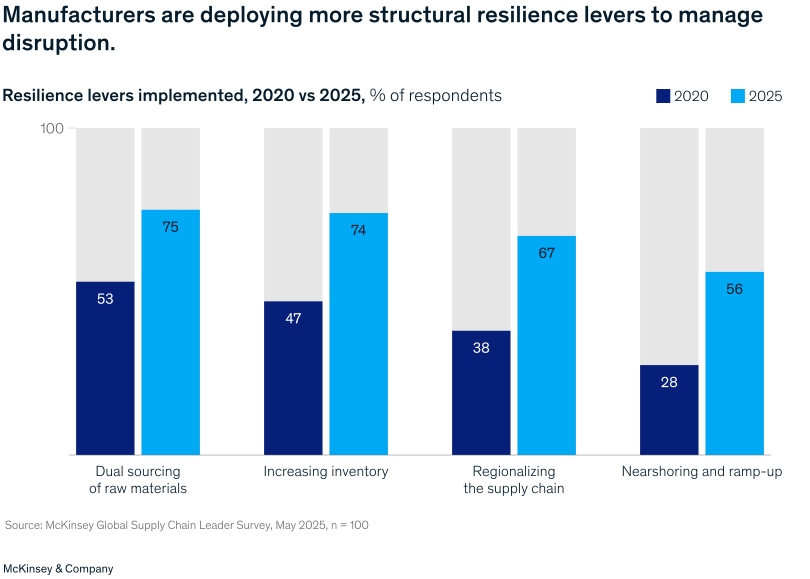
Manufacturers are increasingly moving from episodic supply chain firefighting to always-on resilience models, prioritizing supplier diversification, inventory repositioning, digital visibility, nearshoring, dual sourcing, and analytics-enabled risk management. Three-quarters of global supply chain leaders in our Supply Chain Leaders survey say they now have a dual-sourcing strategy for raw materials, versus 53 percent in 2020, with similar increases observed for increasing inventory, regionalizing supply chains, and nearshoring (Exhibit 2).
Companies are working with critical suppliers to improve visibility, planning, productivity, quality, and capacity. In some cases, the answer is long-term volume commitment. In others, it is joint process improvements, technical assistance, financing support, or investment in tooling.
To support a ramp-up strategy and move toward always-on resilience, manufacturers can strengthen supplier performance management and build win–win supplier models, focusing on the most vulnerable parts of their supply base (see sidebar “Applying a targeted resilience lens”).
Bottlenecks can, of course, extend beyond the direct supplier network. Sub-tier suppliers are often less visible but can create the most severe constraints due to a lack of capital, talent, visibility, or readiness to scale. Issues can also emerge in logistics, warehousing, distribution, packaging, field service, and last-mile delivery. Ideally, these elements are designed in tandem with a manufacturing scale-up rather than addressed after production has increased. A ramp-up that overwhelms the downstream network can quickly result in poor service, expedited freight costs, excess inventory, and margin leakage.
Leading companies are now using real-time data, advanced analytics, and scenario planning to continuously forecast and adapt to disruption across their networks. The aspiration is not a risk-free supply chain; it is a supply chain that can sense disruptions earlier, adapt faster, and protect service levels more economically.
Creating the culture, operating model, and workforce to scale
A production ramp-up is a cross-functional transformation touching nearly every part of the business: operations, procurement, engineering, maintenance, quality, HR, finance, sales, and logistics.
Agility is especially important in a ramp-up context, given the need for shorter planning cadences, stronger cross-functional coordination, empowered frontline teams, faster escalation processes, and real-time performance management. The goal is to create an operating model that can respond quickly without losing control or compromising quality, safety, or reliability.
Labor is a limiting factor but not in the way many leaders think. Demographic trends, retirement, and competition for skilled technical talent are constraining labor availability across much of the manufacturing sector.
If US firms ramp up to decade-high utilization rates and labor scales in proportion to output, the United States would need approximately 1.4 million additional manufacturing workers—an 11 percent increase in the current factory workforce. The largest increases would be in management, metal and plastic workers, and assemblers and fabricators, each requiring at least 200,000 additional workers under a proportional labor-scaling scenario.
The assumption that labor can grow in proportion to output is increasingly tenuous. The current unemployed population coming from prior factory roles is about half a million, suggesting that manufacturers cannot simply hire their way to the required capacity. In many regions, companies already struggle to fill production, maintenance, engineering, and technician roles.3 Even companies willing to raise wages may encounter a limited supply of qualified workers.
The factory of the future requires a fundamentally different workforce model. For many companies, scaling production is no longer just a labor question. Leading manufacturers are redesigning work around automation, robotics, digital tools, and AI-enabled decision support so that each worker can manage more complexity and generate more output. The future factory is likely to rely on smaller, highly skilled teams supported by better technology, clearer workflows, and stronger management systems. Workers will need to operate alongside robots, use AI-enabled tools, interpret digital performance data, troubleshoot increasingly automated systems, and adapt as technology changes.
Manufacturers wanting to ramp up can invest in talent pipelines and capability building, upskilling frontline roles in the near term while also building stronger talent pipelines through apprenticeships, school partnerships, retention programs, and targeted workforce development initiatives.
The key is to treat capability building as part of the ramp-up plan, not as a secondary HR initiative. The most successful manufacturers are likely to be those who build systems that amplify the effectiveness of their existing workforce while creating a more attractive proposition for the next generation.
Technology, automation, and AI are becoming baseline capabilities
Leading companies are already deploying AI-driven scheduling, predictive maintenance, real-time quality analytics, robotics, and flexible automation to reduce downtime, improve yield, and stabilize throughput. Automation and agentic data management are becoming baseline capabilities for companies operating at scale, and they offer an increasingly viable solution for manufacturers facing labor constraints or needing to ramp quickly.
In the past, many automation business cases struggled to secure approval because of long payback periods, high implementation costs, technology complexity, and limited flexibility, but now the economics of automation are changing. Technology costs are falling, giving manufacturers greater access to modular automation solutions, better robotics, and AI-enabled deployment.
As a result, manufacturers can implement automation more cheaply than ever before and on faster timelines, unlocking capacity within months, rather than waiting years for new facilities to come online. Manufacturers that combine automation, AI, and strong operating discipline may be better positioned than others to scale output without scaling cost and head count at the same rate.
Seven steps for ramping up manufacturing
Revenue growth during ramp-up can hide rising costs, not just from technology investments but also from overtime, expedited freight, scrap, rework, premium labor, supplier premiums, and inefficient asset use. If a ramp-up is managed without clear operational and financial discipline, a plant can easily increase output while destroying margin.
Ensuring that growth translates into real value, not just higher volume, is paramount. Ramping manufacturers need to understand where additional output improves margins, protects strategic customers, reduces exposure, or strengthens resilience (see sidebar “Questions to consider for a brownfield ramp-up”). An integrated view of cost, risk, service, and return on capital can guide capacity decisions to the highest-value areas.
Seven steps can help manufacturers unlock the potential of their existing assets:
- Quantify the opportunity in the current footprint. To determine how much additional output could be generated from existing assets, companies can benchmark current utilization against historical peaks, technical capacity, and best-in-class performance. The aim is to identify which plants, lines, and products have the greatest near-term ramp-up potential.
- Identify the true constraints. Next comes mapping bottlenecks across operations, suppliers, labor, quality, logistics, and maintenance. Seeing where the greatest risks lie allows manufacturers to prioritize the constraints that limit throughput, service, or margin. Here, it is important to treat capacity not as a single plant-level number but rather as an enterprise-wide consideration.
- Build a supplier resilience plan. With critical suppliers and sub-tier exposures identified, manufacturers can develop targeted mitigation plans for the highest-risk inputs, strengthening supplier performance management, visibility, and collaboration.
- Redesign the workforce model. Once manufacturers have determined where labor is the binding constraint and where technology can amplify productivity, they can selectively redesign frontline work around automation, digital tools, and AI-enabled support. Building upskilling programs, apprenticeships, school partnerships, and retention models can be explored in parallel.
- Deploy technology against the highest-value use cases. Manufacturers can use AI-driven scheduling, predictive maintenance, quality analytics, robotics, and digital work instructions to improve throughput and stability. Here, it is important to prioritize use cases tied directly to bottlenecks, cost, service, yield, and labor productivity; quickly scale what works; and abandon pilots that do not demonstrate measurable business outcomes.
- Maintain economic discipline. To avoid the “growth at any cost” trap, manufacturers can track productivity, utilization, yield, service, working capital, cost to serve, and return on invested capital, ensuring that incremental production creates value rather than simply increasing cost and complexity. Operational improvements can then be used to fund and derisk future capacity investments.
- Make selective new-capacity bets. New facilities will be required in sectors where ramp-up factors are high and domestic capacity is structurally insufficient. Manufacturers can derisk these investments by prioritizing capital based on demand durability, exposure, customer commitments, supplier ecosystem readiness, labor availability, energy availability, and expected return. Investments need to be sequenced carefully, given that new capacity often takes years to become productive output.
Many companies are already taking these steps and reevaluating their manufacturing footprint in response to the changing operating context. For one automotive manufacturer, tariff changes prompted a review of where certain components were produced in the past. A detailed analysis revealed that some components would, in fact, be cost-competitive to produce in the United States, overturning assumptions about which locations were best suited for the various aspects of supply.
For a steel manufacturer, a similar supply chain assessment delivered a different answer. There was a sound business case for relocating certain aspects of production, but because of serious capacity constraints, the manufacturer’s US supply base was unable to meet the demand for a particular product spec.
A deliberate and targeted strategy is needed to capitalize on today’s ramp-up opportunities. In some circumstances, greenfield expansion may be the most viable option, but in many cases, brownfield ramp-up is the quickest and most cost-effective solution. This was the case for an aerospace and defense company facing a two-to-fourfold increase in demand and a potential multibillion-dollar capital expenditure outlay to meet demand through greenfield expansion.
By looking at its existing manufacturing strategy and footprint, however, the company was able to shift volumes between brownfield sites to take advantage of latent capacity. It then provided targeted support to the most constrained sites and suppliers, introducing better planning systems and processes to track supply and demand signals as well as AI tools and digital twins to find bottlenecks and determine the cascading impacts of supply squeezes. The entire ramp-up effort was coordinated through a dedicated ramp management hub.
This approach identified 41 to 182 percent latent capacity potential across the targeted sites, achieving a 25 to 35 percent throughput uplift without any major additional capital investment. Also, lead times were reduced by 18 to 32 percent across various sites, with further value yet to be captured.
The purpose of a ramp-up is not simply to produce more. Rather, the objective is to increase production competitively, reliably, and profitably.
Companies can position themselves for meeting this objective and responding quickly to the evolving opportunity. We anticipate advantages going to companies that take an informed, disciplined approach to unlocking the factory they already have, building the supplier and workforce systems they need, and investing in the technologies and capacity that will define the next era of American manufacturing.




Related Articles