Think about the career of a great athlete. They perform at the highest level. Unlike one-time wonders, they improve over time. They are single-minded, and they sustain that improvement. What makes this possible? Training, especially interval training, where intense sprints are alternated with strategic rest to achieve peak performance.
A few companies are now drawing on the principles of interval training as they seek to reverse the long-term trend of failed transformations. Research dating back to the 1990s keeps finding that only about 30 percent of transformations succeed, defined as both improving operating performance and sustaining improvement over time.1 In 2023, our Rewired research found that 90 percent of organizations were undertaking some form of digital transformation, efforts that generated less than one-third of the planned impact.
The arrival of gen AI has ratcheted up the pressure. With so much potential at stake, business leaders’ ambitions for their digital transformations have skyrocketed. But success remains hard to come by. Our latest “State of AI” survey finds that even though almost nine-tenths of companies are using gen AI in at least one business function, only 7 percent say that they have fully scaled AI across the enterprise. More than 60 percent of respondents say that they’re still waiting for AI to have a material effect on their organization’s EBIT—and most of the rest estimate the effect at less than 5 percent.
Enter the athletic mindset. For a few business leaders, looking at their company through that lens has helped them drive transformation breakthroughs that previously seemed impossible. They follow three key principles:
- Define clear objectives and metrics, like an athlete setting performance goals. Transparent, measurable goals that follow a “true north” for the transformation keep everyone working toward the same outcomes. This clarity is particularly crucial in the context of AI-driven transformations, where the technology’s complexity and novelty increase uncertainty.
- Prepare and plan with the right experts, like an athlete committing to a training schedule. These leaders meticulously plan the transformation journey, including not only milestones and resources but also potential roadblocks. Clarity on expected challenges provides additional flexibility when mitigating the loss of momentum caused by inevitable problems.
- Execute with balance and consistency. A balance between rapid advancements and strategic pauses for reflection and adjustment helps ensure consistent progress. This balance is particularly important in AI projects, where the technology’s rapid evolution (such as the rise of agentic AI) makes continuous learning and adaptation especially critical to success.
To illustrate this approach, consider the experience of an energy company where a new IT head confronted an urgent need to increase speed to market and service-level quality. By adopting the athlete’s mindset and applying interval training principles, the company was able to prioritize 300 projects, change how more than 100 people worked, and increase technology adoption from 20 percent to 70 percent. Those improvements translated to faster innovation, cutting development time in half for new product versions designed to meet rising customer expectations.

Rewired, second edition
This updated edition offers brand-new insights into cutting-edge AI solutions—and what it takes to implement them—as well as the new economics of digital and AI transformations.
Reinforcing a clear purpose and common goal
Just as an elite athlete needs a clear purpose for their training journey—a challenging, inspiring aspiration that can motivate serious change—an organization needs a clear purpose for its digital transformation to break out of endless lists of AI use cases (the energy company had more than 100) with little to show for them. To be credible, the purpose must translate into specific goals that solve real problems, backed by a road map describing the pragmatic steps the organization will take to create new value—both for users and the business. Finally, the transformation needs agreed metrics, so that everyone in the organization can understand whether it’s making progress.
As part of an AI reset, the energy company developed its transformation goals by identifying the most important pain points that affected both the IT function and the businesses at every level of the organization, from top management to the front line. Three issues proved critical:
- slow, fragmented communication between the technology and business teams
- persistent silos within the IT function, which hindered collaboration and innovation
- an outdated IT ecosystem with high technical debt, which slowed product development lead time
To start tackling these issues, company leaders launched a methodical, iterative process to test four possible organizational models (Exhibit 1).
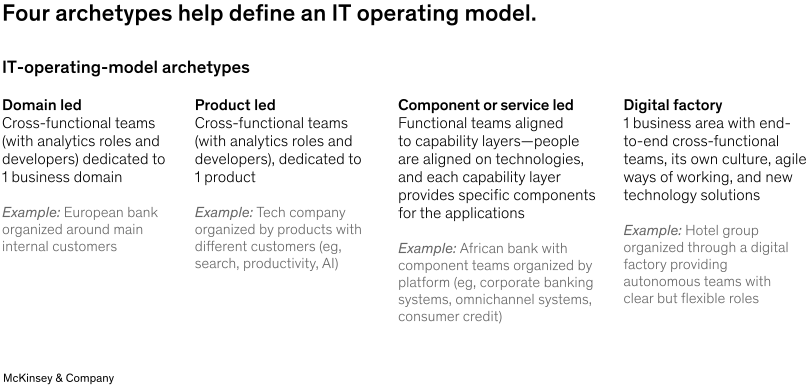
The models were not simply a choice leaders could make; instead, they were starting points to guide the design of a new IT organization. The IT leadership team, including the CIO and their direct reports, considered each archetype in turn. Through collaboration and debate, the team attempted to fit the existing organization into the archetypes, analyzing whether a shift to one or another would be worthwhile and how it could address the identified pain points.
Because the energy company’s primary business relied on a single enterprise-resource-planning system that encompassed most of its operations, the IT leadership team determined that a product-led structure was not necessary—there was too little “product” to justify this option. A component-led approach initially seemed more promising, but the leaders recognized that it might simply add more silos to an already siloed organization.
Ultimately, the leaders decided on a hybrid model, with a domain-led structure backed by a digital factory. This option allowed IT to mirror the business more closely, with separate domains for each major unit, and a cross-cutting domain for shared services. The focus was on speed and responsiveness rather than the introduction of numerous new technologies. Innovation was incremental, and the digital factory served as a delivery office for the domain-led structure, responsible for preparing road maps, conducting research, ensuring data quality, and driving innovation.
The final task of goal setting was to align on measures of success that would show that the transformation was achieving its purpose. Early in the transformation, leaders focused on reducing time to market for digital products—the most tangible evidence possible that communication was improving as silos faded. The second metric centered on capabilities, increasing the number of employees trained in AI so that the entire organization would be able to use the technology effectively. The third metric provided the real proof of a changed organization: increased adoption of AI solutions as new ways of working took hold.
Committing to a training schedule
Without their detailed and ambitious training regimens, Olympic athletes would never have reached such heights. Preparation is just as pivotal for companies. According to a 2021 McKinsey Global Survey, respondents indicated that, on average, nearly a quarter of value loss occurs during the target-setting phase, and another quarter during the planning phase. This underscores the importance of thorough preparation so that the transformation’s full potential is not compromised before it has even begun.
It also means engaging a full team, much as elite athletes engage experts ranging from coaches and physical therapists to nutritionists, sleep specialists, and even data scientists. At the energy company, leaders built the “from-to” of their operating model, engaging both business and tech stakeholders at three different levels: heads of departments, managers, and operational teams. This inclusive approach allowed them to integrate in-depth feedback while keeping strategic principles in mind. For example, cyber experts reviewed new processes and work practices for security compliance, data and analytics experts revised the data retention strategy, and the central transformation office identified flexible project management tools that could support the entire initiative portfolio.
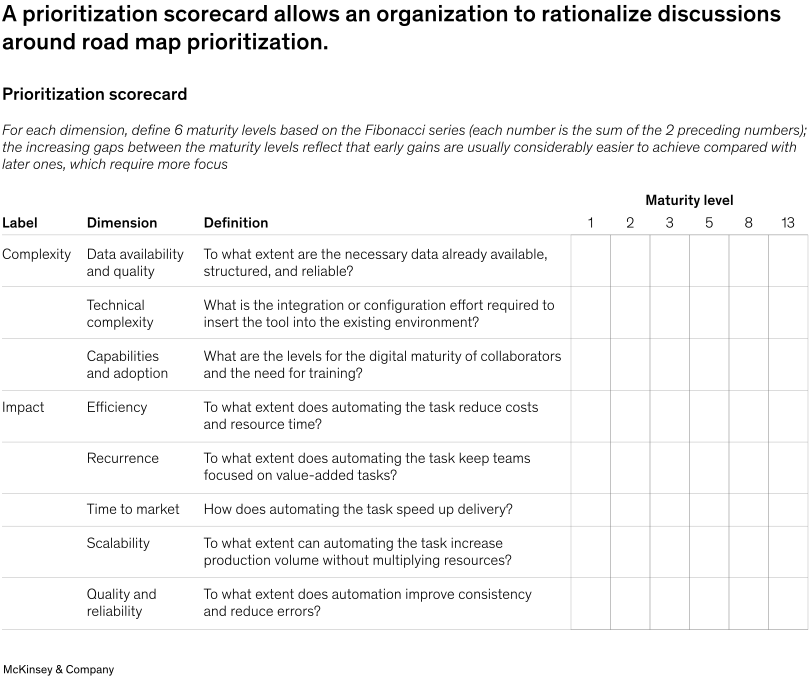
Next, after completing the design of the target operating model, the company leaders developed a comprehensive implementation and change plan. A prioritization scorecard, tailored to the company’s context and value at stake, helped leaders evaluate projects based on the complexity of their requirements and the potential impact they could achieve (Exhibit 2). For each dimension, the company defined six maturity levels. Once again taking a page from athletes, company leaders recognized that early improvements are easier than later ones. Rather than numbering the maturity levels in an ordinary sequence (1, 2, 3, 4, and 5), the company based the maturity levels on the Fibonacci series, in which each number is the sum of the preceding two: 1, 2, 3, 5, and 8. This additional weighting underscores the effort and focus required for breakthrough excellence.
To transition from planning to execution, the company convened top representatives from both business and IT to resolve interdependencies and resource requirements—all part of a “Commitment Day” for agreeing to the final transformation road map. Through intensive negotiations, the leaders deprioritized more than one-quarter of the first wave of projects to concentrate efforts and resources on the most critical initiatives.
Executing with diligence—and balance
Finding consistency is fundamental for athletes striving for peak performance, just as it is for organizations navigating the complexities of a digital transformation. Yet consistency requires interval training, that balance between rigorous training and adequate rest. In business terms, this might translate to balancing innovation and operational stability. At the energy company, this meant delivering the highest-priority transformation initiatives, while boosting long-term stability by building AI capabilities, while “repaying” long-standing technical debt (the costs and inefficiencies accumulated from years of shortcuts in software development and system architecture).
Keeping critical projects on track
The Commitment Day agreement prioritized two major innovation projects, but both ran into stumbling blocks. The first project, which required strong business involvement for testing, was stymied by factors including external development teams’ level of engagement and the use of three different, and incompatible, tools to manage backlogs. The second project suffered from conflicting delivery and performance expectations, an erosion of daily management practices, and declining morale.
Company leaders ran an intensive series of observations, attending all daily meetings and conducting one-on-one interviews with team members. A team norms workshop then focused on understanding what drivers motivated each team member in their daily work. “Quick workshops” addressed specific use cases identified by the team, such as managing incidents and bugs, streamlining communication using tools, and improving documentation. Three performance workshops aligned the team around the same success factors and associated KPIs, such as the “predictability rate,” which measured consistency in meeting production commitments. In less than three months, that metric rose from 67 percent to 93 percent, with similar gains for six other KPIs the team adopted.
Building capabilities
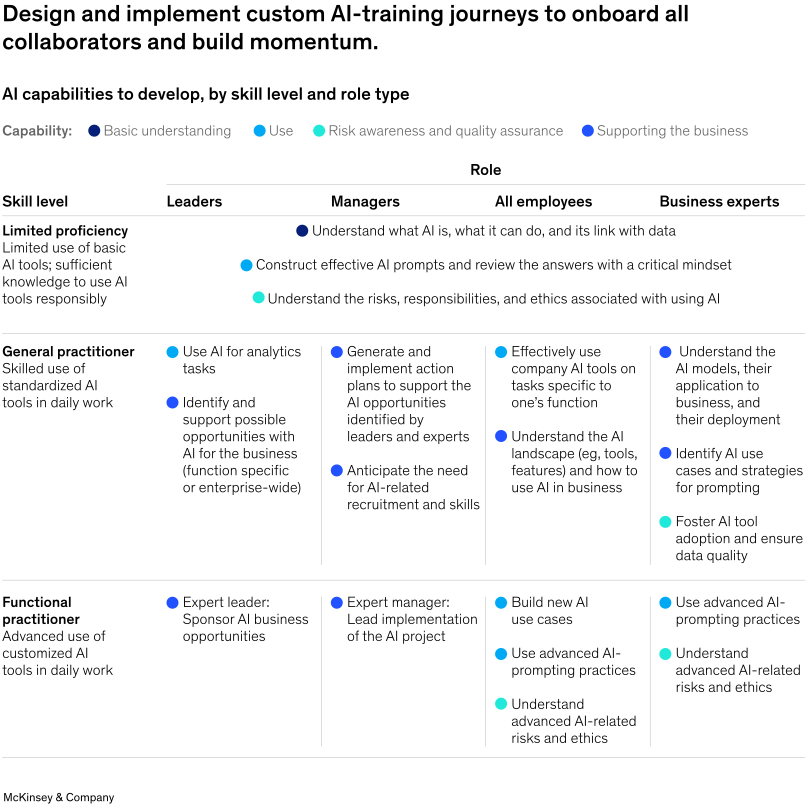
Long-standing McKinsey research on organizational health finds that few organizations believe they have the capabilities they need, instead citing lack of time, leadership support, and training resources as significant obstacles. To solve all three issues, the company designed custom AI training journeys tailored to each employee’s role, starting with basic proficiency in understanding AI’s strengths and limitations and drafting prompts, to advanced skills for functional practitioners in building new use cases or leading implementation of AI projects (Exhibit 3).
Repaying technical debt
The energy company used a simple two-step approach to tackle technical debt. First, it charged cross-functional teams with conducting an enterprise-wide architecture audit, pinpointing legacy systems and outdated processes. The teams mapped dependencies and interactions across the digital landscape, revealing a tangled web of liabilities that could no longer support the company’s growth trajectory.
Next, leaders defined a technical-debt “repayment” road map, backed by a detailed dashboard to monitor progress (Exhibit 4). Based on the audit, the company started decommissioning outdated systems, allowing for the reallocation of resources to more critical areas. It streamlined processes to align with current business objectives, reducing the complexity and dependencies within the IT landscape. IT leaders also developed a road map for cloud adoption, enhancing scalability and resilience while decreasing maintenance costs by an anticipated 25 percent over a two-year period.
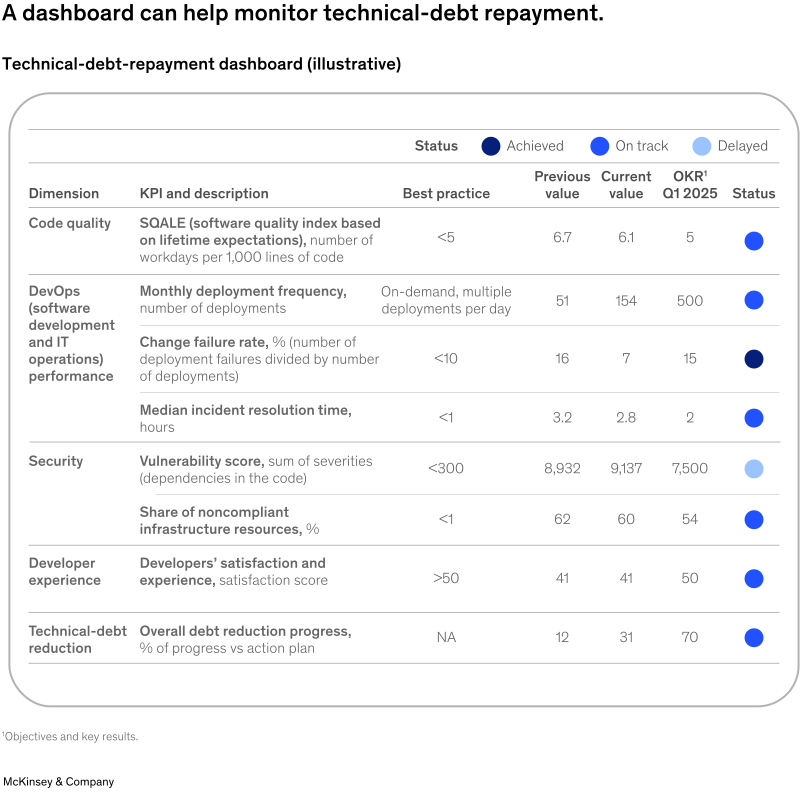
In just the first four months, these technical-debt measures reduced operational inefficiencies in the company by 10 percent, freeing up even more resources for growth-oriented projects.
Much like elite athletes, organizations aiming to excel in digital transformation must blend structured goals, meticulous planning, and disciplined execution with periodic adjustments. By embodying the athlete’s mindset, the energy company overcame the myriad challenges of digital transformation, ensuring that their journey not only met but exceeded ambitious performance benchmarks. By framing the digital journey as an interval training session, the company managed resources effectively, maintained momentum, and capitalized on opportunities for continued growth and resilience.