Lessons from our alliances: What AWS’s agentic journey can teach CEOs about rewiring for AI
As companies move from experimenting with AI to embedding agents into core business processes, the challenge is shifting from access to execution. In this conversation, AWS Vice President of Global Sales Greg Pearson joins McKinsey Senior Partner Liz Hilton Segel to share how AWS is rethinking its go-to-market organization for the agentic era, including what he has learned about experimentation, simplification, change management, and translating AI into real customer and business impact. The discussion offers practical lessons for leaders navigating a similar agentic journey.
Hear Greg and Liz talk about the AWS journey
Learning from our alliance partners
As part of McKinsey’s open network of alliances, we collaborate with many of the world’s leading technology organizations to help clients turn digital and AI ambition into measurable business value. These alliances give our clients and our firm more than access to technology platforms—they provide a front-row seat to how industry leaders are transforming their businesses.
Amazon Web Services (AWS) is one of those alliance partners. Through the Amazon McKinsey Group, McKinsey combines its strategy and transformation expertise with AWS’s cloud, data, and AI capabilities to help organizations move from AI experimentation to enterprise-scale impact. Yet AWS is not only a partner in helping our clients transform—it is also a company undertaking its own ambitious agentic transformation, including within its go-to-market organization.
Most organizations still treat AI as a technology deployment rather than a fundamental redesign of how work gets done, and the gap between experimentation and impact continues to widen. The journey underway at AWS also serves as a powerful proof point of McKinsey’s Rewired approach to digital and AI transformation: combining technology, talent, operating model, and business-led adoption to drive business outcomes.
Below, we explore how AWS is applying agentic AI to rewire its go-to-market engine and the lessons that CEOs can learn from its progress, challenges, and decisions along the way.
Reinventing sales in the age of AI
AI is reshaping how organizations operate, with up to $2.9 trillion in value at stake from automation alone.1 Yet despite widespread experimentation, only 39 percent of organizations report measurable EBIT gains from AI.2
Too often, AI is layered onto existing, manual ways of working rather than used to redesign how work gets done. The organizations achieving enterprise value are not simply deploying AI—they are rethinking how data, workflows, technology, and teams operate together.
AWS’s experience offers an example of the organizational changes required to scale AI impact across a large enterprise. As a global, multibillion-dollar business looking to expand its reach through AI, AWS has been reimagining how its go-to-market engine operates with agentic capabilities. This has required balancing a culture that empowers builders to innovate with the structure, data, and standards needed to scale. AWS’s experience highlights both the opportunity and the challenges of moving beyond disconnected use cases to a more integrated, agile, personalized, and agent-enabled operating model.
Viewed through the lens of McKinsey’s Rewired framework—which aligns strategy, data, technology, operating model, and talent to unlock AI impact—AWS’s journey offers five lessons for organizations seeking to translate AI experimentation into sustained enterprise value (see sidebar, “Five lessons from AWS’s agentic journey”).
Although the path wasn’t linear, AWS has begun translating these lessons into results. Customer teams now use agents to develop customer strategies, generate tailored solutions, and move from insight to action faster across the customer life cycle. In one example, an AI-assisted pipeline analysis agent surfaced nearly $77 million in additional commercial opportunities within one business segment. In another, after hearing about a customer’s new business priority over dinner, an account manager used an agent that night to turn that insight and historical data into a tailored demo and was confidently showcasing it at the customer’s conference the next day.
Building on this momentum, AWS is moving into a more integrated operating model: an agentic coworking environment in which personalized AI agents act as teammates alongside humans. Customer teams—from account managers to solution architects—can create, share, and reuse agents across regions and functions, enabling more consistent insights and faster execution.
Now my customer meetings are so different—I’m bringing a built pilot.
The sections that follow explore each of these lessons in detail, drawing on AWS’s experience to highlight what it takes to deploy agents at scale. While presented separately, these lessons evolved iteratively in practice, with progress across strategy, data, technology, and adoption reinforcing one another over time.
Defining the North Star: Reinventing go-to-market strategy in the agentic era
As customer expectations rise and the pace of business accelerates, many organizations are layering AI onto existing workflows to move faster. Without a clear end state, these efforts often fragment into disconnected use cases that fail to scale or compound value. By contrast, organizations experiencing the greatest impact from AI focus on one to three business domains and reinvent them end-to-end, resulting in an average 20 percent EBITDA uplift.3 The starting point is a clear strategy and a well-defined North Star.
For AWS, one of those focus domains that it committed to transforming end-to-end was its go-to-market function (exhibit). Like many organizations, AWS initially approached agentic AI opportunistically, with teams developing agents to address specific needs across the business. As adoption grew, AWS saw both the promise and the limitations of this approach: Agent deployments in pockets of the organization could solve local problems, but they could not unlock the coordinated, enterprise-wide outcomes that AWS was seeking. Rather than scaling disconnected efforts, AWS established a future-state vision for how customer teams, systems, and agents should work together and used that vision to guide subsequent transformation efforts.
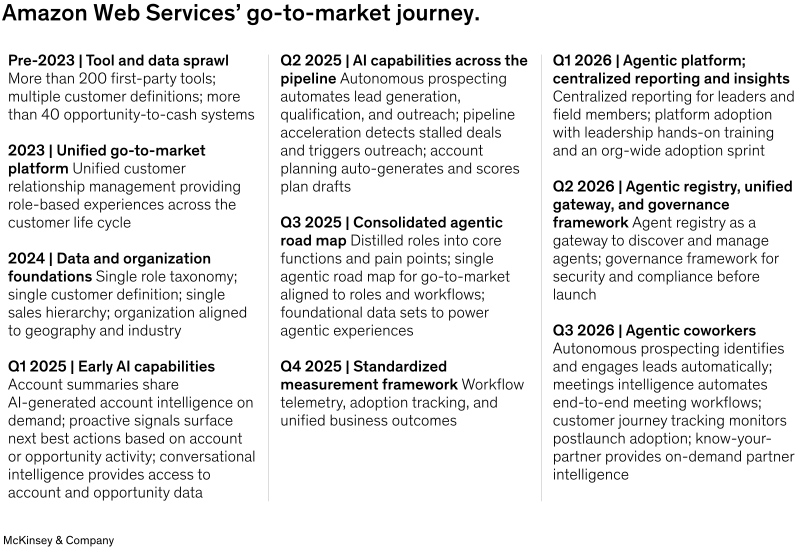
The starting point, however, reflected the realities of a business that had scaled rapidly over two decades. AWS had long empowered teams to innovate quickly and invest in support of growth. Over time, that approach contributed to a proliferation of tools and workflows, as well as growing fragmentation across data and systems. As teams moved quickly to meet evolving customer and business needs, AWS developed more than 200 first-party tools, operating across multiple data sources, without a consistent business view. Opportunity-to-cash processes spanned across more than 40 systems, slowing coordination, increasing data risk, and creating friction.
These challenges affected customers as well. In one instance, a financial institution noted that a smaller, AI-enabled competitor delivered a business and technical solution in two hours, while AWS required multiple hand-offs across experts to produce a comparable result.
Recognizing that adding more tools would only compound complexity, AWS turned its principle of customer obsession inward, treating its own customer and partner-facing teams as “Customer One.” The company launched a multiyear effort to simplify and unify its go-to-market model, reducing fragmentation across data, tools, and workflows. By early 2025, as teams began experimenting with agentic AI across the business, AWS recognized the risk of recreating the very complexity it had spent years addressing. Rather than allowing disconnected agent deployments to proliferate, AWS aligned business, product, and engineering teams around a shared vision for how customer teams, systems, and agents should operate.
To have speed and agility at this level of scale required us to do things differently. The only way to move fast was to build on a coherent go-to-market system with a strong foundation underneath it.
This evolution reshaped how AWS applied one of its core operating principles: “Two is better than none, but one is best.” Early experimentation across multiple solutions accelerated innovation but also introduced duplication and fragmentation. Over time, AWS shifted toward a more unified model—creating the consistency and shared foundation needed to operate with greater speed and agility at scale. Mechanisms such as cross-functional forums and weekly “AI Across AWS” sessions helped align priorities and ensure capabilities built in one part of the business could scale across the organization. This model preserved freedom for teams to experiment while creating shared standards, reusable capabilities, and common ways of working that could scale across the enterprise.
The North Star became clear: move from disconnected ways of working to a shared go-to-market foundation where customer teams, systems, and agents operate from the same context and act with greater speed across the customer journey.
Takeaway on strategy
Anchoring the system: Unifying the data foundation
Agentic AI is only as effective as the data it can act on. Leading organizations treat data as an enterprise product: built once, governed centrally, and reused across analytics, machine learning, and generative AI.4
Like many organizations, AWS had data spread across systems, with different definitions and owners. Even as a digital-native company, teams worked from disconnected views, often requiring manual reconciliation, which slowed decision-making. AWS recognized this as a scaling constraint and began addressing it in earlier transformation efforts, laying the groundwork for its agentic journey.
AWS consolidated hundreds of data sets into a smaller set of 20 foundational data sets spanning sales, partners, services, and marketing, allowing AI to surface patterns across previously siloed domains. Core definitions—such as customer hierarchies, roles, and revenue—were standardized to create a single taxonomy. For example, more than 75 field role definitions were unified, clarifying responsibilities. Customer and partner data (that is, accounts, legal entities, and contracts) are now connected into a single view, helping teams prioritize accounts and identify opportunities.
This created a governed source of truth. Customer teams no longer need to reconcile data across systems, and data is no longer managed by function but as a shared enterprise asset.
On this foundation, AWS built an integrated analytics experience, spanning functions, business units, industries, and geographies. Customer teams can access the information they need in one place, tailored to their role, while AI agents proactively surface relevant signals and context to support decisions. Leaders can see performance across regions and business units, while customer teams can track pipeline health and customer signals. Built-in access controls help ensure the data remains secure and trusted.
I get the complete context instantly. No 30-minute download. I can focus on building prototypes. . . . So I’m focused on innovation, not information gathering.
This experience brings together structured data (for instance, pipeline, accounts, performance metrics) and unstructured data (that is, customer interactions, notes, documents) into a single, consistent view. This allows agents and customers to operate from the same understanding. An AI-powered interface enables teams to query data in natural language, reducing the manual effort required to access and synthesize information. The impact goes beyond better reporting. Insights that once took days are now available in near real time, supporting more coordinated customer responses across teams. By unifying its data foundation, AWS worked to remove a key source of friction and create the conditions for enterprise-scale agentic workflows.
Takeaway on data
Powering the engine: Embedding AI into customer team operating models
Once the data foundation is in place, the next step is redesigning workflows. This is where many organizations fall short: layering AI onto existing processes instead of reimagining them end-to-end. In fact, AI-leading organizations are nearly three times more likely to have fundamentally redesigned workflows,5 and they achieve the greatest EBIT gains from AI.
AWS applied this principle by rethinking how its field organization operates and which work truly required human involvement. AWS’s annual Field Time Allocation Study revealed an opportunity: Customer team members could reclaim time with customers by allowing agents to own meeting preparation and administrative work. To address this, AWS broke down how work happens, distilling approximately 35 roles across nearly 40,0006 field members into core functions to identify where AI agents could meaningfully reduce manual effort.
AWS’s workflow redesign was not solely driven from the center. While the Field Time Allocation Study helped identify high-value opportunities, AWS also benefited from a culture of builders eager to experiment with AI in their day-to-day work. Teams across the business began developing agent concepts to address local challenges and improve how they served customers. Not every idea scaled, and the study did not predict every high-value use case. However, enabled by a common data foundation and shared architecture, AWS was able to capture these grassroots innovations, evaluate their broader applicability, and build upon the most promising concepts for enterprise-wide use. Workflow transformation became a combination of top-down prioritization and bottom-up innovation.
This led to the creation of a set of capabilities that operated across the commercial life cycle, with customer context carried across sales, partner, and marketing workflows. Rather than deploying isolated AI tools, AWS redesigned parts of the commercial process to reduce manual research, streamline coordination, minimize context switching, and accelerate how customer insights are translated into action.
We need partners that get AI and move at this speed.
At the top of the funnel, prospecting workflows that once relied on fragmented data and manual account research were rebuilt around dynamically generated insights, informed by intent signals, historical interactions, and customer information. According to AWS, these changes contributed to approximately twofold higher email open rates compared with the average,7 and, in one initial pilot, nearly a 4.5-fold increase in sales-qualified lead conversion.
As opportunities move through the pipeline, AWS customer teams use agent-enabled workflows to support customer strategy development, account planning, and solutioning in a more integrated way. AWS estimates that agents have reduced customer strategy preparation time by approximately seven hours per engagement, enabling teams to spend more time with customers. In one example shared by AWS, a routine account discussion evolved into a broader strategic conversation after an AI-assisted analysis surfaced a previously unidentified monetization opportunity within the customer’s existing data assets. Additionally, in an initial pilot, AWS reported that its AI-enabled selling strategy capability contributed to 30 percent more opportunities created and 44 percent more opportunities launched.
AI has completely transformed the way I worked. I can focus my time on building relationships and solving customer problems that actually matter. I’m doing the work I was hired to do.
Across these workflows, AI is increasingly shifting from a collection of stand-alone tools to an orchestration layer embedded in how teams work. Rather than helping individuals complete isolated tasks, agents are increasingly coordinating activities across customer teams, systems, and workflows—carrying context, triggering actions, and connecting work across the customer life cycle. Activities that once required multiple steps and hand-offs can now happen in a more integrated way, compressing time to value and enabling customer teams to focus on higher-value customer engagement.
Takeaway on technology and operating models
Reading the instruments: Measuring outcomes and propelling adoption
As capabilities launch, measurement becomes critical not just for tracking usage but also for understanding what works and where to invest. Yet fewer than 20 percent of organizations track well-defined KPIs for generative AI, despite its link to bottom-line impact.8
AWS was no exception. As agentic capabilities expanded, teams tracked productivity gains, time savings, and adoption across individual tools, but measurement remained fragmented and often disconnected from broader business outcomes. This made it difficult to compare performance across initiatives, assess overall impact, or prioritize investments effectively.
To address this, AWS established a standardized measurement framework that brings together workflow telemetry—including usage and time-on-task—with adoption tracking, A/B testing for experimentation, and business performance metrics. This provides visibility into how agentic tools are being used across functions and roles. However, AWS still faces a challenge common across many organizations: proving that adoption and productivity gains translate into measurable business value. Without clearer links to outcomes, such as conversion, deal size, customer experience, and revenue performance, it remains difficult to determine which capabilities are delivering the greatest impact and where future investment should be concentrated.
At the same time, measurement alone is not enough. Value ultimately depends on adoption, and adoption has been uneven and challenging, even at companies such as AWS. While AI capabilities have advanced rapidly, change management has not always kept pace. In some cases, capabilities were extended to audiences they were not yet designed to serve. For example, one prospecting capability achieved more than 90 percent adoption among its intended users, but its overall adoption rate initially appeared to plateau below 50 percent after access expanded to a broader group whose workflows the tool was not built to support. The gap reflected a mismatch between the capability and the needs of its expanded audience.
Even when the right users had access, adoption was not automatic. Customer teams and managers often lacked clarity about which agents to use, when to use them, and how to incorporate them into their daily workflows. Users also faced an onboarding tax—connecting agents, configuring permissions, and completing setup before realizing any value. These additional steps created friction, slowing adoption and reinforcing the operational challenge of moving AI capabilities from availability to everyday use.
These patterns reflect a broader challenge for organizations at this stage: Adoption is treated as a follow-on effort rather than being designed into capabilities from the start. Leading organizations architect for adoption end-to-end, embedding role-specific guidance, workflows, and enablement up front, not retrofitted later. They back this commitment by investing up to five times more in change management initiatives.
AWS is now addressing this challenge more directly. Field champions provide peer-to-peer support, helping teams navigate new capabilities and incorporate them into daily work, while immersion sessions are underway to equip leaders to integrate AI into workflows and role-model the change for their teams. As leaders see the value, they are embedding tools into core business rhythms—such as mandating the use of AI-powered reporting tools in weekly and monthly business reviews—and creating space for teams to showcase new capabilities.
Along the way, AWS has observed some unexpected benefits. As AI reduces the time required to gather information, inspect forecasts, and prepare reports, some managers are finding they can spend less time reviewing data and more time coaching teams and developing talent. While not an explicit objective of the transformation, AWS views this shift as an encouraging sign that AI can free leaders to focus more of their energy on the uniquely human aspects of management.
As innovation accelerates, sustained impact will depend less on introducing new agents and more on embedding them into how work already gets done. AWS is evolving toward an integrated agentic experience, in which front-end agents, connected to enterprise knowledge, contextual data, and specialized skills, can support users directly within workflows. AWS believes that by minimizing friction and reducing the need for behavioral change, adoption becomes a more natural extension of the tools and environments that customer teams already rely on, ultimately enabling organizations to scale impact more effectively.
Takeaway on talent, adoption, and change management
At the horizon: Agentic coworking
While many organizations remain in the early stages of AI adoption, emerging agentic models suggest a possible shift in how work may be organized and executed over time, with humans and agents collaborating more closely across workflows and decision processes.
According to AWS, this shift has led to more agent-enabled ways of working, in which agents can draw on shared enterprise data, business knowledge, and customer context to support work across the customer life cycle. Over time, AWS believes this can create a more connected operating environment across teams and workflows. Achieving this vision requires agents to operate from a shared understanding of the business. As such, AWS is building a shared knowledge layer that connects structured and unstructured data sources, allowing information to be interpreted more consistently across the organization.
To support a growing set of agents, AWS is adopting standards, such as the Model Context Protocol (MCP), with roughly 4,000 MCP servers developed internally. MCPs help agents access information, interact with tools, and take action across systems more seamlessly.
This new world requires all of us to work differently, to be the fastest and most knowledgeable team on the planet and deliver for our customers.
By creating more consistent ways for agents to access information and interact with systems, AWS aims to make capabilities more reusable and easier to integrate across the enterprise. A shared registry allows customer teams to discover existing agents, while secure sandbox environments provide standardized paths for building new agents that can collaborate with others.
Rather than requiring users to navigate multiple tools or agents, AWS is focused on building reusable, “headless” capabilities that can be embedded across different applications, workflows, and user experiences. According to AWS, the same underlying capability can support users wherever work happens, drawing on shared data, knowledge, and business processes to deliver relevant insights and actions in context. Increasingly, these capabilities are accessed through common employee experiences, such as AWS’s Quick desktop environment, which provides a unified entry point to agents, knowledge, and workflows. As new capabilities are introduced, they can be integrated more consistently into existing systems and surfaced through familiar interfaces rather than requiring users to adopt new tools.
Quick [app] for desktop is changing the game for us . . . with premeeting help and postmeeting notes. I have a morning briefing skill. . . . It reads earnings calls from all my customers and helps me understand their business challenges.
AWS believes this approach can enable greater agent customization while preserving security, access controls, and consistency across the organization. As users create increasingly personalized agents and skills, AWS is focused on grounding those capabilities in trusted enterprise data and shared context, helping to improve response accuracy while providing a more consistent experience across teams and workflows. For leaders, the implication extends beyond architecture: When agents become teammates rather than tools, team structures, decision ownership, and performance expectations need to evolve alongside them.
More broadly, AWS’s experience offers a glimpse into how agentic operating models may reshape the enterprise. Rather than relying primarily on standalone applications, organizations may increasingly explore more autonomous, coordinated systems in which agents support workflows within defined guardrails for human oversight and intervention.
As these models mature, roles are likely to evolve as well. Customer-facing teams may focus more on rapid innovation with customers and partners to reduce time-to-value, while operations teams may reinvent core mechanisms and workflows for human–agent collaboration. In turn, success may be increasingly assessed through business outcomes.
The next leg: Preparing for the journey ahead
AWS’s agentic evolution illustrates that scaling agents is an operating model transformation rather than simply a technology challenge. The greatest value comes not from deploying more AI tools, but from redesigning how data, workflows, and people work together so intelligence can be translated into action.
Throughout AWS’s journey, a consistent pattern emerged: Progress came from focusing efforts on a business domain that could reshape performance and customer outcomes, building a strong foundation of high-quality data, and embedding agents into how work gets done. As these elements came together, agents evolved from disconnected use cases to part of a coordinated system of reusable capabilities and interoperable workflows, enabling information to move more consistently across the enterprise.
At the same time, AWS’s experience underscores how difficult enterprise-scale transformation can be. Challenges around adoption and value measurement persisted even with strong executive sponsorship, significant technical resources, and a culture built around innovation.
AWS’s journey offers a glimpse into a broader shift underway. As agents become increasingly embedded in business processes, competitive advantage may depend less on access to AI itself and more on an organization’s ability to integrate AI into the fabric of its operations. The leaders of the next era may not be those with the most agents, but those willing to use them to fundamentally rethink how work gets done.
1 McKinsey Global Institute analysis of US data, 2025.
2 “The state of AI in 2025: Agents, innovation, and transformation,” McKinsey, November 5, 2025.
3 “The AI transformation manifesto,” McKinsey Quarterly, April 7, 2026.
4 “Building the foundations for agentic AI at scale,” McKinsey, April 2, 2026.
5 “The state of AI in 2025: Agents, innovation, and transformation,” McKinsey, November 5, 2025.
6 A total of 39,905 field members.
7 AWS email open rates measured from May through July 2026 were compared with industry-standard benchmarks reported in Prospeo’s “Standard email open rates in 2026: Benchmarks by industry.”
8 “The state of AI in 2025: Agents, innovation, and transformation,” McKinsey, November 5, 2025.
About the author(s)
About the author(s)
Becca Coggins is a senior partner in McKinsey’s Chicago office; Jennifer Stanley is a partner in the London office, where Peter Dahlström is a senior partner; Kelli Greenberg is a partner in the New York office, where Liz Hilton Segel is a senior partner and Vanessa Woodward is a consultant; and Naveen Sastry is a senior partner in the Bay Area office.
The authors wish to thank Audrey Xiao, Lily Liu, and Nicolle Kuritsky for their contributions to this article.