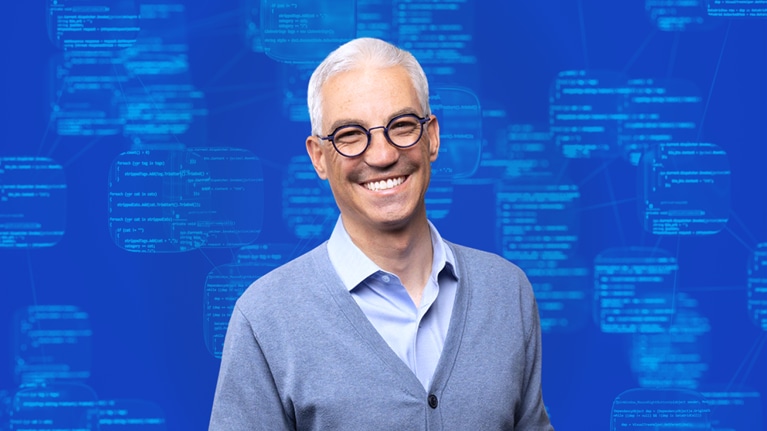
Julie Goran on building adaptable companies for the age of AI
The second edition of Rewired offers a practical blueprint for organizations with bold ambitions to unlock value from tech transformations. This series explores the six core capabilities for the Rewired recipe and the people who bring them to life.
Since the first edition of Rewired was published in 2023, the discussion about AI has moved from potential to value creation at scale. That is where many organizations still stall. Slow decision-making, siloed teams, fragmented data, and legacy operating models can even keep ambitious companies from scaling impact. In the AI era, advantage belongs less to the organizations with the most experiments and more to those that are changing the way they work.
To explore how organizations can build that muscle, we spoke with Julie Goran, a McKinsey partner and contributor to the second edition of Rewired.
Turning AI into organizational change
For Julie, one of the biggest differences between the first and second editions of Rewired is the shift from theory to implementation.
“The first edition established the concepts,” she says. “What’s different now is that organizations want to know not just what to do, but how to do it. The second edition is much more practical and focused on lessons learned.”
That evolution reflects how quickly organizations’ questions are changing as AI moves from experimentation into day-to-day operations.
“We’re seeing organizations ask very practical questions,” says Julie. “What tasks are humans doing versus agents? Where do we need humans in the loop? And what does that mean for managers and teams?”
Those questions often force trade-offs in governance, decision-making, and how work gets done across the organization.
Companies are also experimenting with operating models ranging from digital factories to product-and-platform organizations. In Julie’s view, the most successful transformations focus less on the “perfect” model and more on ensuring that the model can actually work within the organization.
That focus on implementation has shaped Julie’s career at McKinsey. She first joined the firm as a business analyst after her undergraduate studies, later left to attend law school, and ultimately returned to consulting.
“I enjoyed law school,” she says. “But I loved the broad-based problem-solving that comes with consulting.”
Since then, she has served in McKinsey’s people and organizational performance work, helping clients navigate challenges spanning talent, culture, leadership, and operating model design. Today, she leads the firm’s agentic organization efforts, which help companies adapt to the changes AI is bringing to the workplace.
Building a workforce that can evolve with AI
That role gives Julie a front-row seat to how organizations are preparing for the future of work.
In one recent client engagement, she supported an organization that redesigned its strategic workforce planning process around AI adoption. The company analyzed how different roles would evolve as AI capabilities expanded, with some facing significant disruption and others changing more gradually. Rather than treating AI as a stand-alone technology initiative, the company incorporated those insights into team design and learning.
“They fed those insights back into their talent systems,” says Julie, “and were able to identify the new skills they needed, the roles they would need to hire for, and how teams would need to operate differently.”
For Julie, that is the kind of work that separates AI activity from AI impact. The technology may unlock the opportunity, but the operating model determines whether the opportunity scales. Roles need to be redesigned. Managers need new skills. Teams need to change. Talent systems need to reinforce the behaviors that the transformation requires.
And people need to come with it.
“While many people have been waiting for the chance to rethink how work actually happens, AI is creating real uncertainty and anxiety for many employees,” says Julie. “Organizations need to acknowledge those concerns and help people navigate the change if they want transformation efforts to succeed.”
Leaders will also need to rethink how they lead. Many have built successful careers in a world where AI was not reshaping how work gets done, and they now face the challenge of adapting their own management practices alongside their organizations.
That’s why communication, adoption, scaling, and capability building are so important.
“The technology will keep changing,” she says. “The real challenge is building an organization that can change with it.”