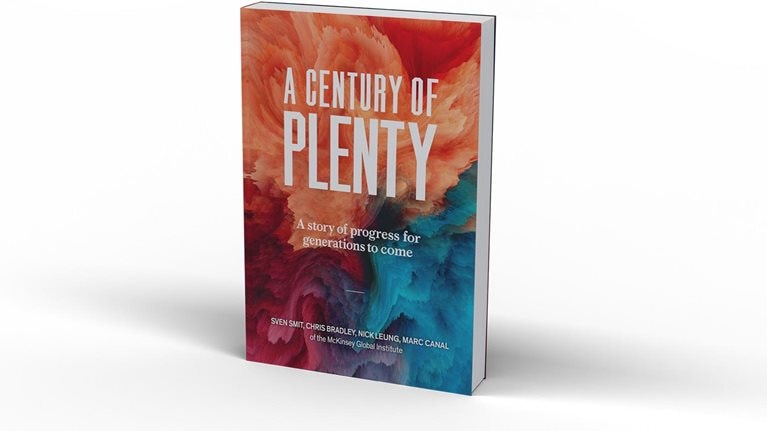
We humans made unprecedented progress over the past 100 years. The question now is whether we can do it again, and maybe even do it better. In a new book from the McKinsey Global Institute (MGI), A Century of Plenty: A Story of Progress for Generations to Come (McKinsey Global Institute, January 13, 2026), imagine a world in which every person in the world enjoys at least Switzerland’s standards of living today.
That may sound crazy, but we stress tested this vision, and it is, indeed, physically possible. We will have enough energy, food, metals, and minerals. We can innovate quickly enough. And we can do this while protecting our planet.
The optimists have been on the right side of history. We believe they will be again. But we have to believe in growth—the key to better and longer lives, human dignity, and opportunity. The possibility of plenty will remain abstract unless we act. We need to build the future for generations to come.
What follows is an edited transcript of a conversation about the book between five of its authors. Taking part are former MGI chair and McKinsey senior partner Sven Smit; MGI directors and McKinsey senior partners Chris Bradley and Nick Leung; MGI senior fellow Marc Canal; and former MGI executive editor Janet Bush.
Sven Smit: Hi, I’m Sven Smit. I’m very excited to talk about our book A Century of Plenty: A Story of Progress for Generations to Come. I’m here with some of my co-authors. A much larger team also worked on this book. We’re hoping to have some fun chatting about the book, and how we put it together. One way to do that is to play a game. So we pick a card, which has a question that triggers conversation, and see where it goes.
Why did you write this book?
Sven Smit: My first question is why did you write this book?
Well, my story is we got a question from a former managing partner of McKinsey, Ian Davis, who asked us, “What have you learned about the past 100 years in the McKinsey Global Institute?” And we, I think collectively, responded, “We learned a lot.” But then we said we also need to know where progress could go based on what we learned. And concluded that progress could result in plenty. And that this thought was perhaps worth a book.
Nick Leung: It was at our annual meeting in the London office, and Ian Davis was our London office manager. He asked us the question, “So, in 100 years, what have you learned?” And everyone immediately started thinking, well, there’s the global balance sheet, there’s the empowerment work, there’s all these different things that have been researched now over the past few years. And then from there, I think we said, yes, but we can’t just look back. Let’s look ahead 100 years, and actually we probably spent more time than in the end looking ahead than looking back.
Chris Bradley: For me, I just felt like we’re in this time—everyone feels it—of epic change; geopolitical change, we’ve got AI, we’ve got demographics, we’ve got all these things coming at us. It’s a confusing kind of change without a narrative.
One of the things we looked at in the book was Edelman Trust Surveys. And in some countries, like in Germany, less than 10 percent of young people think that the next generation’s going to be better off than the one before it. I think we’ve all collectively felt the world doesn’t have a rudder or a keel or a narrative of where this is all going, except to say, oh, permacrisis or volatility. And we just wanted to grab the narrative: What actually happened?
When you look back, what you see was this stunning century of progress, but totally unfinished business. In fact, MGI research says we’re almost exactly halfway toward empowering the world, right? From almost 0 percent start halfway. And so the inevitable question—to your point about adding the second half to the book—arises: “What does the second half look like? And is it even possible when our children’s generation don’t feel like growth is good?” And so we went on crazy mission, asking ourselves (maybe this is a bit far) whether we can change the whole narrative of the world? Or at least die trying.
What does “plenty” mean to you personally?
Sven Smit: Janet, here’s the next card.
Janet Bush: What does “plenty” mean to me personally? Well, it’s very easy if you’re relatively well off and middle class to think money doesn’t matter, but it really does matter if you’re poor. The key thing, and we looked at this a lot in the book, is we’ve got to get the people who’ve been left behind, brought up, and we think we’ve shown that it’s possible.
The other thing is that money is not just money. It’s not just, oh you know, “filthy lucre.” It’s money that makes you happy, because it gives you education, it gives you healthcare, it gives you all the good things in life that really make a good life.
Nature matters to me. So, if we had a world where everybody was well off, but living in a city and there were no beautiful birds or forests left, I would be very sad and my soul would be crushed. And I think we’ve shown in the book that you can still preserve nature and we can live in harmony with all the other species in the world and still give those left behind something to live for and a good life.
Nick Leung: I like also the word “personally” there. One of the things that we did in the book was to tell the personal stories of not only the authors, but also the entire team. It’s very much a story of how the past 100 years have affected each of the people involved and their families. Where did their grandparents grow up? Where did they come from?
And that frames what will happen next, what we think about. That’s why the subtitle talks about the next generations. Where is this going? Is there a basis, as you said Chris, for optimism? Should we look back, see the tremendous progress, and say, “Well hang on, if we’ve made so much progress in the past, why are we not more confident that our children, our grandchildren, will live better lives?” So I really like the idea of the “personally.”
Marc Canal: And to me, plenty means more. It means abundance. So, it’s not just that we describe plenty but we talk about plenty using the results, the outcomes like living better lives etcetera, but also about the way to get there: an abundance of building housing, building energy, building more stuff, right?
At the end of the day, it’s about more, and this concept sometimes can be tricky for people. Like, do we need more? Getting affordable housing, getting affordable energy, it means actually building more of it, right? So, to me, plenty is not just the goal, but it’s also the way we get there.
Sven Smit: Let’s also recognize that most people in large swaths of the world, the majority of the world, are far away from plenty, which we (jokingly) define in the book using Switzerland—a wealth perspective about where everybody should go.
I always have this image of a farmer in Kenya who just needs a water pump to go from missed harvest to fertile harvest for 50 bucks. And we’re trying to solve the EV, ICE, God knows what, problem, which costs 1,000s and 10,000s for the vast majority of people going to plenty. It’s catch up to the life that we know. So, we know it’s technically possible. We just need to get it done.
I think people have underestimated just how many people can’t think of the stuff that we in the Western richer worlds are thinking about as our problems. They are still dealing with whether they will have a harvest.
Chris Bradley: We often talk about the top 1 percent, and we chose Switzerland as a benchmark in this book: could the entire world be a Switzerland? But it just so happens that $82,000 (Switzerland’s income per capita) is literally the top 1 percent. So the average Swiss person is in the top 1 percent.
And we often use this top 1 percent as this divisive thing. But in this book, we said no. Everyone’s in the top 1 percent by 2100. And what’s that going to look like? That’s very personally motivating.
What would you say to someone who believes the best days of humanity are behind us?
Sven Smit: I’m going to throw the cards to Mark.
Marc Canal: OK, what would you say to someone who believes the best days of humanity are behind us? That is quite an interesting one.
Looking at history, if they had said the same thing at any point in the past 100 years, they would have been so incredibly wrong—on empirical grounds. It’s crazy to think this way, right? Second, I would say that if you look at what we have, the amount of technology, more educated people than ever before, more brains than ever before, it’s also hard to believe. I would never bet against human ingenuity. I think that’s the worst bet. I’m a fan of humans and I think we’re problem solvers and we’re just going to get better and better.
I would never bet against human ingenuity.
Sven Smit: I get this issue a lot. I present to student groups in many different forums. I often end with saying that I believe that my 16-year-old daughter could actually make a 120 lifespan. But that with a little bit of progress that AI and other people will help us to achieve, we probably could get even to 150. Then the question is, “Why would you want to be 150, because the future is not going to be great.” I respond that I’d like to be 150, because I would like to see my great, great, great grandchildren no matter what they live through because I want to be there to help them. And I actually believe the future will be bright and I would like to see the bright future. But they are not convinced. So, I think that the best way to open that conversation is to ask young people, “Where did you get that (downbeat) view? And then they go silent for a while and then they start talking about climate, war, pandemics, AI going to eat their jobs.
Chris Bradley: Housing.
Janet Bush: Cost of living.
Sven Smit: And so they just load up lots of problems that are real to them. I’m not belittling this. But then I go back to my parents and they tell me the price of their house collapsed by 40 percent just after they bought it in the oil crisis. I haven’t seen much like that very recently.
Then I say, “If you read our book and you read MGI’s research, you see that, for all these problems, the solutions are available, including for climate, poverty, and affordability—if we get on with it.
But I keep going and ask, “Where do you get your view?” And when you then go to the source material, it’s often quite broad news. And we know that the news has some negative bias, because that gets you to clicks and all that kind of stuff.
I think we can have a fundamental discussion with young people in which you share our story, and I think we can make a lot of progress in getting people out of their negative mindset. But that mindset is very strong.
Janet Bush: If you analyze each decade of the past 100 years, I think seven or eight out of the ten decades were characterized by pessimism rather than optimism.
In 1925, people were extremely pessimistic. In the short term, they were right to be because then a second catastrophic war came and a huge depression. But in every generation, we tend to be hardwired toward pessimism. And the trouble is that that stops you getting things done. And so I think that the spirit behind the book is that we wanted to take a more optimistic view and then you can get things done.
Nick Leung: It wasn’t just optimism. I think one of the things that was really powerful is the reframe, right? This book tries to reframe. I can’t remember which of you guys came up with the idea, the microscope, and the telescope? The reframe is to say, “No matter how challenging the things we see today, and they are real challenges, we don’t belittle them, you need to reframe them within the context of a longer period of time. You reframe it in 100 years, and these things look different, right?
To Sven’s point about his parents and the oil crisis, these were very real concerns at the time. We don’t belittle them or the problems we have now. But when you step back 100 years, you see the pattern of overcoming those challenges through ingenuity, through engineering, through the things that humanity has come up with. And again and again, in each of the past three centuries, we accelerated human progress.
Chris Bradley: But there was never a clean shot to the tee. Every decade had a crisis and we were almost always in the rough. So, when we went to write this book, the real story of humanity is struggle, but ultimately a victory. We all went back and rang up our parents and tried to remember the story of our grandparents. My grandfather lost a brother to pneumonia because the family couldn’t afford drugs. He had to fight a war that he never talked about in North Africa. He lived in Suez as a school principal in the middle of a Suez crisis and had to immediately evacuate to Australia.
The real story of humanity is struggle, but ultimately a victory.
The bizarre thing for us is that we are looking at this movie with 2020 hindsight. The reality is that in 1925 to 2025, global income per capita was six times higher. But when they were losing brothers and sisters and fighting in wars and getting evacuated because of major geopolitical events, our grandparents didn’t know that. And that’s the amazing thing. They couldn’t have known, but they just got on with it.
Sven Smit: Just to say, I think we have a little bit of a Western world bias in the group sitting here. I know you live in China, Nick, half European and half Chinese. But we’re still a little biased. There would be more people in Africa and India and they are not in the room. When I travel and I talk about challenger growth in the process of the future, it’s actually a very different story when you’re in India. So, I think the Western world or the rich world has talked itself into the realm of talking about limits; it’s painful and so on. When I go to Africa, they say, “Could you tell the people in Europe: Can we get food first and then when we get food, we’ll go to school and then we when we go to school, we will go on to have health care, and then when we have healthcare we can start to think about Western world issues, you know, all the social stuff that you spend time thinking about.”
I think we should just be very careful to acknowledge that that this jump to plenty is highly desired and in the mind of people in Africa, Indonesia, Latin America, wherever you go. And it’s also highly in the mind of the poor people in the West (although they may have a touch of believing that it is not possible). The children of parents who experienced progress are worried about whether they can have the same. Children who have not seen their parents make that progress still see a lot of road ahead. I think China sits in between.
I think we should just be very careful to acknowledge that that this jump to plenty is highly desired and in the mind of people in Africa, Indonesia, Latin America, wherever you go.
Chris Bradley: In the Edelman survey, doesn’t the majority in China believe the next generation will be better off.
Nick Leung: It’s 60 percent and India as well. So the places that saw recent progress, very recent progress, are long-term optimistic—short-term pessimistic as well, like everyone at the moment, but there is a more long-term optimism
Chris Bradley: Places where people build stuff.
Nick Leung: That is the key.
Marc Canal: Exactly, but in the West, there’s not a single advanced economy where more than 30 percent of people think the next generation will be better off. That includes the US, Germany, and France, where it’s 9 percent.
Chris Bradley: Australia’s 17.
If we put the book in a time capsule for the next century, what do you hope readers in 2100 will think about it?
Sven Smit: We’re going to throw the cards again. I’m going to throw them to Nick.
Nick Leung: If we put the book in a time capsule for the next century, what do you hope readers in 2100 will think about it? Oh boy. Well, we had this conversation when we were writing the book, because we knew that precise predictions are likely to be 100 percent inaccurate. We are pointing out things that we think are possible, but we’re not saying this will happen exactly. I think this could work in terms of what how we to achieve plenty, but obviously there’ll be puts and takes. Some places will grow more, some places will grow less. We’re positing the possibility that we can all reach a certain level of progress. So, how will they think about it?
Marc Canal: I think they will say directionally right but precisely wrong. Of course, it’s going to be precisely wrong because it’s not even a prediction, right? The numbers are not going to be what you see in 75 years, no way, right? But I think people will be surprised about how right the direction was given the pessimism of today.
Nick Leung: I would hope that they look at it and say, sure, of course it’s obvious—just like if someone wrote a book in 1920 saying that we would reach a level of progress today, we would say, yeah, of course. We’ve seen it, it happened.
Chris Bradley: I love how we conceive of the future. Look at Star Wars, such culture-defining movies. They imagined things like light wormholes, robots, AI and sentient robots, but they couldn’t imagine the touch screen. They still have all these silly buttons.
Sven Smit: And they are always hitting the silly buttons precisely wrong.
Chris Bradley: So, actually what happened is we didn’t get infinite space travel, and we haven’t yet got sentient robots, but we did get rid of the buttons.
It would be a fun exercise in 100 years’ time to see what happened and what didn’t. So, in the book, we painted a scenario for energy. We asked whether we can energize the world cleanly and with abundance.
We calculate that we would need up to three times more energy and 12 times more electricity. And we have this scenario where that energy comes from 40 percent nuclear, 40 percent renewables, and 20 percent everything else. We had to make this scenario believable, based on the physics we see today and what’s going on.
And people might look back at what we wrote and laugh because, say, fusion came along or we made batteries so cheap that you didn’t need the nuclear plants. We don’t know, but I think what we have shown is that, however it happens, at least it’s possible.
Sven Smit: I don’t know what they will say. I don’t even know what language they will speak. But if I had hope, I would say it made a difference. That’s my fervent hope. I actually don’t care whether the prediction is totally right or wrong or precisely right or wrong, but that what we wrote made a difference; that there was something in the waters of the world, which this book coalesced a little bit.
Marc Canal: Once progress has happened, you can take it for granted. There’s some chance that in 2100 they’re having a similar discussion about being in a crisis of hope because they are, again, looking into the microscope and seeing the bad things.
Once progress has happened, you can take it for granted.
Did your views change during the research process?
Sven Smit: Let’s throw the cards again, this time to Chris.
Chris Bradley: Did your views change during the research process?
Actually, that’s been part of this process. In fact, I think what’s magic about MGI and why I think we were well qualified as a group to write this book is that we are a crucible of lots of perspectives coming together with a lot of rigor; across all points of the political spectrum, different sets of values, lots of different cultures. We had people in our team from every continent in the world. So, I think that the whole book was a melting pot.
What did I change my mind on the most? I think the thing that probably hit me hardest was that I came into this book thinking, “Can’t people just see it’s obvious that we are going to have progress.” There’s actually a part of our book where we have a whole question mark on whether growth was good? We ask whether we do it again, and we talk about this thing called the machine of progress. Is there too much sand in the gears and is progress over?
I think for me what changed what that I gained a little bit more empathy for the questions people have on their mind around growth, and the responsibility we have not only to share a positive vision of growth, but also to address the reasons why people might think growth is bad. People might think it has too many externalities and does too much damage. Why might they think that? They may think that there is not enough “stuff”, because they can’t see how we could build more mines. They don’t understand how big the world is. They might think growth’s not for me, because they see generational exclusion, a particular concern of mine, that in their society, wealth has grown enormously, but it’s basically good to be old.
So, I think the thing that changed my view during the process isn’t so much the stridency and the vision of progress being real—I’ve been around MGI long enough to kind of see the direction the train’s going—but just to stop and say, “OK. What is a very human approach to this question that empathizes with why not everyone would instinctively agree and what kind of new social contract we might need.”
Janet Bush: I was kind of the opposite. I started as more of a pessimist. I was worried about climate change. I was worried about inequality. I was worried about preserving nature and biodiversity, and I wasn’t convinced that we could just grow, grow, grow, and make people rich and not have more sand in the machine. I started being very pessimistic and then as the team proved the possibility and put the numbers on it, I thought, “OK, I get that. Yes, I’m pretty convinced.”
I think it’s going to be difficult. The point I would make is that, yes, progress is possible, but we’ve really got to make a lot of good decisions. We’ve got to do the right things; like we’ve got to use growth for the energy transition to get to clean. We’ve been really successful, but we’ve got to do it again. So there’s a huge responsibility on us.
Sven Smit: I’ll take the other side of the coin. We took on a very large group to do the work and it worried the hell out of me that we would land in a quagmire in which we couldn’t get to a common way to articulate this, that there would be places where we just couldn’t get people convinced. On certain topics, there were people in the team who were very skeptical and rightfully so; they challenged certain pieces while they were optimistic on other pieces. But I think the process actually changed my view that that a large group actually could come together. I gained confidence that this book is going to make a huge difference, because we were able to make a bridge between people who were really widely dispersed in their initial views to something that we have in common. This changed my view on how the world should have the conversation on this, how we can get young to old, from India to China to Switzerland to Germany, to the US to Australia into a boat. There was a meeting at which I was accused of being one of the old Muppets on the balcony. My worry was that I would be the old Muppet.
Chris Bradley: No worries, Sven, you’ve achieved that.
Sven Smit: I’ve achieved that. And the real reality is that the Muppets would not actually go to the place and we went to the place, and that takes courage. I know people live in different bubbles. And, in these bubbles, some of this stuff is more controversial. I had in my head, “What will my daughter say, what will both daughters say?” The eldest one has several times said that she cannot talk to her friends about these views on progress. I just hope that when she reads it that maybe there’s a way that she can. That would be us making a difference.
Nick Leung: I think what you described is exactly the two parts of this. On the one hand is a deep empathy for all the points of view of the people around the table; in part three of the book, we articulate, we think very well, some of the arguments that question progress. But then also the facts, right? So it’s a combination of empathy and facts, and I think, Sven, that’s your prescription, Sven, that everyone should go away and write a book like this.
Chris Bradley: Or at least they would then figure …
Sven Smit: … out and talk about it.
Chris Bradley: At least. But, if you just say it’s a conversation and a dialogue that we need to have with the world, I share your hope that maybe this book can spark more of those dialogues and more of those frictions.
Sven Smit: Janet, you’re back with the questions.
How does this book connect to what’s happening in the world right now?
Janet Bush: How does this book connect to what’s happening in the world right now? Well, hugely. I think we’ve already talked about the fact that there’s this feeling that everything is going wrong. We’ve got war in Europe. The Middle East is always very challenging. Economics is awful in many ways in the West, maybe not so much in the East. People are worried about climate change. Am I going to have a job or is AI going to take my job? There’s huge change. So, I think that we have addressed all of that head on and then flipped the narrative and said, “You know, there have always been huge crises. We’re in one now, a period of incredible uncertainty, but we’ve come through it before.” That’s the sort of the thing that’s informed our narrative, I think.
Chris Bradley: One of MGI’s core narratives is that we’re in a new era and that, in a way, we have got to shift up. We’re confused at the moment, because we’re tuned to the channel that we’ve all become very fine-tuned to: the era of markets. So when the Berlin Wall fell down, the internet started, we had Moore’s Law at full force, we had globalization, a unipolar world order. And energy abundance or helpful demographics, all those things. We’ve just become accustomed to a world that had radical change in it, but change according to a very fixed set of rules. Like Moore’s law, radical change, like an electronic device in 1990 versus one in 2020, radically different, but based on the same fundamental principles.
And the core narrative is: guess what, the rulebook of the world has changed, and if we hold our aerial on that network the TV signals now are very fuzzy and confusing, and we’ve got to shift into a new network because it’s a new era. A new era where we’re not unipolar anymore, but multipolar—that’s really confusing. Oh, and all this tariffs business. What’s going on? What’s this talk about geostrategic this and security that. Well, that’s multipolarity and a world where it’s not Moore’s law, which is double every 18 months, but compute going up every 3.3 to 4 times per year. This kind of radical boom where we’re not talking about digitization, we’re talking about humanization.
Completely different demographics—we have just entered the world in which demographics is now not aren’t working for us, but working against us; where energy contention is at an all-time high, and we’re in this kind of electrification race, where China’s building ten times the new electricity every year than the US is. And also a world where we just got used to cheap money and easy growth: we had the biggest supply and demand shock simultaneously in human history when China entered the world market. And now less than 10 percent of countries now are growing at more than 5 percent per year, so we don’t have that hyper growth anymore. So, when we talk about how today’s situation affected this book, I would say that the book is located in this fundamental junction that we’re in now and we had to try to make sense of it, asking, “Can we reimagine plenty, not in the world as it was, that we liked, and was very stable, but in the new world?”
Can we reimagine plenty, not in the world as it was, that we liked, and was very stable, but in the new world?
If readers take away one idea from this book. What should it be?
Chris Bradley: Let’s take a question.
Nick Leung: If readers take away one idea from this book. What should it be? One idea.
Chris Bradley: Growth is good.
Janet Bush: Anything is possible, but we have to make it happen.
Sven Smit: I will lead to bring a future of plenty.
Marc Canal: It starts with a new narrative.
Nick Leung: I would say something that is similar to you guys, which is that it is in our hands, that we always think about “it” as something that is done to us whereas I think what the book proves is that it’s up to us and the next generations to make it happen.
Sven Smit: Whenever you come up with a story that is more optimistic than the average crowd around you, you run the risk of being the Muppet sitting in the balcony who says, “You guys just don’t get it.” Pessimists might say we are just a bunch of optimists with a technical calculation—great that the technical issue is there but we will never achieve it because humanity is not like that or whatever other barriers they see.
I just want to repeat one thought that I think is very rich on this from a guy called David S. Landis who says the optimists have it. Not because they’re always right, but because they keep trying and by trying you might get closer to plenty than if you don’t try. If you’ve given up on the future being better, what are you going to do? You have almost no options. The pessimist really only gets it right by being proven right that life wasn’t good. The optimist gets proven right that it didn’t work out, but the second journey is just much better than the first.
I am deeply convinced that the technical analysis and the economic analysis and the possibility analysis of the physical reality we’ve done is right. So I don’t think this will be wrong. Maybe we’ll use different materials; in the precise materials, we could be wrong. But whether the world tries or not does depend on whether the world gives it an optimistic try. Pessimism becomes a divide and conquer. I just want to call this out because we could be dismissed for being a bunch of optimists writing a little story. But the pessimists of a 100 years ago were proved wrong and I hope that today’s pessimists will be, too. We should not deny that the stance of optimism is the right one.
Chris Bradley: I agree that this is the moment of danger for the world and why this moment matters, because pessimism can be massively self-fulfilling. If no one believes in future generations and no one wants to have children, then we end up with a childless future. If no one believes positively, we don’t invest. If people think that the world is fundamentally unequal and it’s all rigged, they will vote in certain ways for policies that may or may not improve growth. And you get all these, and maybe, Nick, for you coming from China, there was a period in history where a great, great civilization, empire, decided to stop growing and didn’t grow for a really, really long time. And so I reckon optimism has to win, but it is a battle. It’s a battle, and the biggest concern I have about the pessimistic vibe is that it becomes ultimately self-fulfilling, and that’s why this new narrative’s so important.
Pessimism can be massively self-fulfilling.
Janet Bush: And I think that what’s important about the way the book turned out is that it isn’t just optimism. It is optimism, but it takes into account a lot of what the pessimists are saying, and it takes it head on. If we hadn’t included the problems in the book, I think we would have been much less credible. The worries people have. They’re all in the book.
Sven Smit: This future is not virtual, it’s not a game. It’s not in a video game. This future is real. It is bridges, roads, power stations, data centers, robots, humans with better tools, better cars, cleaner cars, different energy. And I think we’ve lost our ability to build at the pace that China has had for the past 30 years, a pace that we’ve had in Europe, which is the nuclear build out of France. And if you believe in plenty, this is the time for the builders. I would have a huge bias of that our leaders should be builders, our leaders should be oriented toward building. They should hate permits that are taking a long time. They should like good permits that assure quality, but they should hate long process. They want to build, and by building this future will come.
Conclusion
Sven Smit: So I think it’s time to close the conversation. It’s a conversation about this book, A Century of Plenty: A Story of Progress for Generations to Come. We really hope you enjoy it and that we can be with you to tell the story.