Quirch Foods began in Miami in 1967 as a family-owned importer of Latino staple foods and today generates more than $4 billion in annual sales across 40 US states, the Caribbean, and Latin America.1 Latina-owned Nopalera built a Mexican-inspired beauty brand into hundreds of US retail stores before expanding into Mexico.2 Angel network Angeles Investors co-led a $32 million Series A investment in Canela Media, aiding its growth to more than 60 million active users across the United States and Latin America.3 The city of Laredo, with almost 275,000 residents4 and 36 percent of its nonfarm workforce in trade,5 has developed distinctive capabilities in logistics, warehousing, and customs brokerage, enabling it to handle $354 billion in international trade in 2025.6
These are just a few examples of the importers, exporters, investors, and specialized locations that fuel the US–Latin America trade corridor.7 It is one of the world’s biggest and most critical economic arteries, generating $1.5 trillion in trade in 20258—about 1.5 times the total trade between the United States and Canada and the equivalent of 85 percent of all trade within the European Union.9 Discussion of the corridor tends to center on large forces that shape it, such as trade agreements and tariffs, geopolitics, commodity cycles, inflation, or immigration. These forces help set the baseline of how the corridor may change in overall size. However, analysis of these factors does not fully explain how US companies continue to create enduring value within the corridor in new ways.
The success of companies such as Quirch Foods, Nopalera, and Canela Media shows how US-based Latino consumers, businesses, and places can turn positional and proprietary advantages into value that flows back to communities.
Latino consumers in the United States, a population spanning distinct national-origin groups, generations, and cultures, can provide a large and growing base of demand and cultural influence able to extend to other consumer segments. Latino businesses can bring cross-border knowledge and networks that reduce friction. A fast-growing base of entrepreneurs can expand productive capacity and drive innovation. Latino communities often concentrate and connect these advantages—from logistics and customs hubs in Laredo and El Paso to commercial and energy hubs in Miami and Houston—and extend them digitally beyond any single geography.
These factors converge to provide pathways for economic mobility in communities with sizable Latino populations in the United States. The number of Latino-owned businesses increased by 7 percent annually from 2017 to 2023,10 far outpacing the rest of the nation’s near-flat growth.11 However, these businesses are underrepresented in some of the largest export sectors, accounting for 6 percent or less of manufacturing, mining, and IT firms.12 Instead of relying on organic opportunity creation as the only source of growth in trade, our analysis finds that a systematic approach to the development of the US–Latin America trade corridor, with coordinated efforts across investors, businesses, trade ecosystem institutions, and governments, could increase trade volumes by 2.3 percent annually to $1.8 trillion by 2035,13 presenting a meaningful opportunity for US-based Latino consumers, businesses, and places.
Yet while the advantages that US-based Latinos have through the trade corridor are real, they remain fragmented and underscaled, leaving limited pathways for stakeholders to holistically capture that value in each place. An integrated ecosystem and amplification engine for the US–Latin America corridor could help create and capture this potential value by focusing on five key areas:
- Designing capital to enable scale. Expand access to fit-for-purpose capital, from working-capital loans, receivables financing, and trade finance to equity investment. Prior McKinsey analysis found that providing more business banking products and services for Latino business owners could mean closing a $200 billion business-lending gap. Extending capital from seed to scale-up will enable more firms to participate in trade, where longer cash cycles, currency risk, and high up-front investment are common challenges.14
- Building market access and distribution deliberately. Connect specialized hubs to Latino demand through multinational corporation (MNC) procurement, retailers, distributors, platforms, and import-export channels. Roughly 75 percent of US–Latin America corridor trade is concentrated through a handful of major ports, while a long tail of more than 100 smaller ports handles the rest. But not all cities are equally connected to the opportunity this creates. Among markets with similarly sized Latino populations, cities connected to the most ports receive more than three times the consumer goods from Latin America relative to other cities, highlighting significant commercial opportunity for businesses involved in the corridor supply chain.15 These networks can also be the infrastructure through which new exporters emerge. A survey of small businesses from the US Export–Import Bank (EXIM) found that while 53 percent of respondents would like to become exporters, 45 percent did not know where to start.16 As hubs become more connected, relationships between businesses can surface more knowledge about export opportunities and enable execution partnerships.
- Prioritizing the coordination of institutions to lead change. Establish an accountable coordination layer (or corridor-wide institutions) that connects capital, distribution, and hub-level efforts. Support today could be scaled: The United States Hispanic Chamber of Commerce (USHCC) represents more than 260 chambers, while the National Minority Supplier Development Council (NMSDC) connects more than 15,000 minority-owned businesses through 23 regional councils. The Korea International Trade Association illustrates how this could work on a global scale by providing tailored support in target overseas markets for South Korean businesses in the form of advisory, market intelligence, customer matching, finance, training, and advocacy (see sidebar “South Korea’s example: Intentionally driving economic value”). A US-based version of this could support businesses in the corridor to enter US Latino micromarkets with culturally distinct needs while also supporting Latino-owned businesses in the United States with export potential to enter international markets.
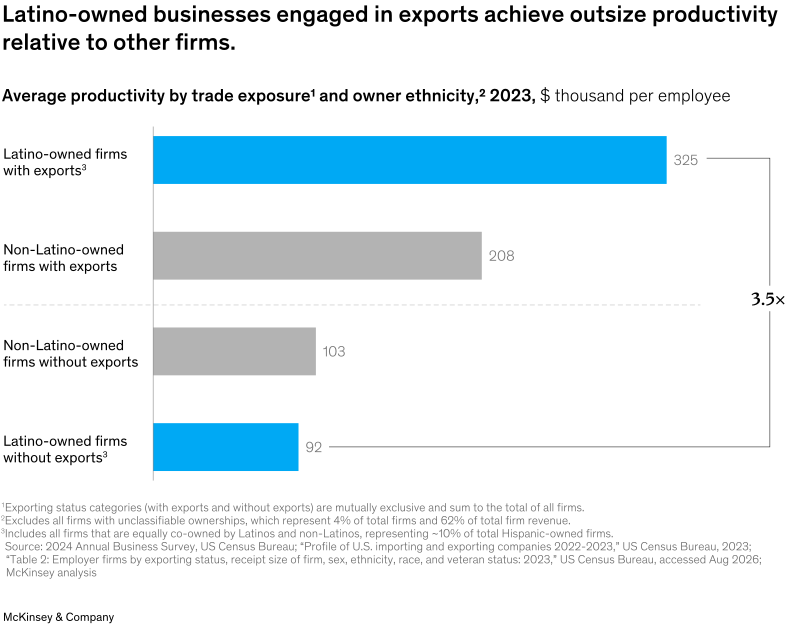
- Making commercialization an explicit objective. Build a repeatable pipeline that identifies promising firms, validates demand, develops products and talent, and prepares businesses for export and market entry. Latino-owned exporters show outsize productivity, yet only about 2 percent of Latino-owned employer firms export today.17
- Protecting ownership and reinvestment. Design mechanisms that support Latinos to participate more broadly in ownership as the corridor grows rather than taking income alone.
Countries around the world, including France, Japan, South Korea, and the United Kingdom, have connected these five elements to create broader economic value. This kind of integrated ecosystem and amplification engine could create similar economic opportunities for communities with significant US Latino populations by growing the number of successful corridor-related Latino businesses as well as creating significant ownership and employment opportunities.
Understanding a critical economic corridor
The trade corridor between the United States and Latin America ranks among the six largest regional trade relationships globally.18 Almost one-fifth of total US trade activity flows through it, growing by an average of about 3 percent annually in real terms since 2015. While growth is projected to slow to 1.5 to 2.0 percent in the next decade, the corridor is still projected to be worth $1.7 trillion to $1.8 trillion by 2035.19 Additionally, potential headwinds and uncertainty exist around tariffs, inflation, and trade agreements, and scenarios with other challenges to trade could impact growth rates. But regardless of how these changes unfold, the US–Latin America corridor is likely to continue to play a significant role in global economic activity, and other known structural shifts may alter where value comes from.
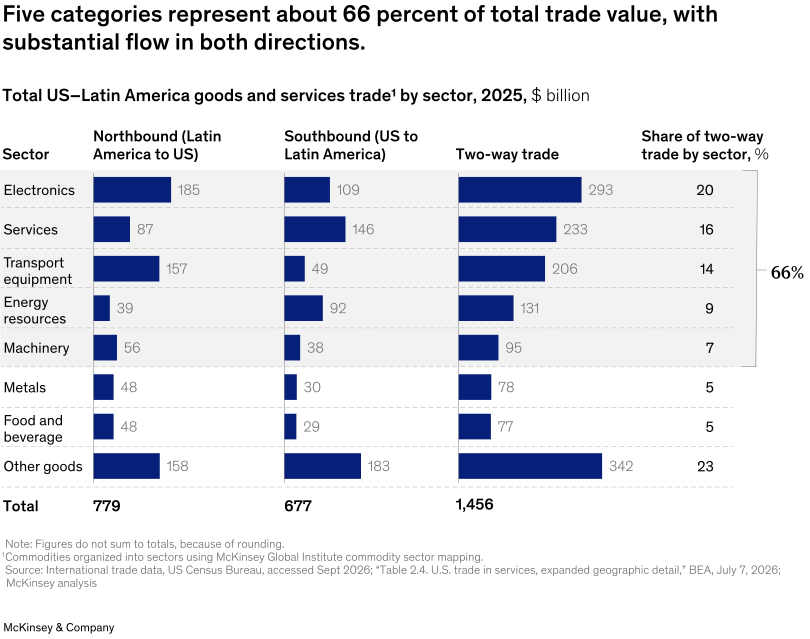
Today, around two-thirds of goods and services traded are concentrated in five categories: electronics, services, transport equipment, energy resources, and machinery (Exhibit 1). And while significant trade flows both ways, with around $779 billion heading north and $677 billion south, the linchpin is Mexico, which accounts for about 66 percent of US–Latin America trade and nearly 80 percent of imported goods to the United States.20
An increasingly integrated economic relationship
The production system between the United States and Latin America is also becoming increasingly integrated, with growing activity in higher-value sectors. While the corridor remains concentrated in the same major trading relationships, the roles different countries play within it are becoming more diversified. Between 2019 and 2025, for instance, Mexico added approximately $126 billion in electronics trade as well as growth in transport equipment, machinery, and medical and scientific instruments.21 That shift is continuing: Computer server exports from Mexico reached nearly $83 billion in the first half of 2026, with almost 94 percent of that destined for the United States.22
The corridor’s integration is also deepening based on continued country-specific specialization. Costa Rica nearly doubled its bilateral trade with the United States from 2019 to 2025, driven in part by roughly $5 billion of additional medical and scientific instrument trade and $3 billion in electronics.23 Chile’s and Peru’s roles in metals, minerals, and energy value chains are expanding, as are Brazil’s and Colombia’s roles in higher-value services, including business, digital, financial, and intellectual property (IP)–related services. Three factors are driving this:
- Latin America’s proximity, relatively lower vulnerability to transport disruption, time zone alignment, and supplier integration are powerful advantages as companies endeavor to secure supply chains and move production closer to customers in US markets to realize cost and operational efficiencies. Regional trade dynamics have recently reinforced the trend, with meaningful actions and announcements from leaders in Latin America, such as Mexico and Panama, focusing on the United States as a trade partner rather than other nations. This dynamic could create openings for US Latino-owned firms and workers across the value chain, from production and logistics to professional services and finance.
- Digital connectivity is making more activity tradable across the corridor in both directions. Data costs fell by around 21 percent annually on major US–Latin America routes from 2022 to 2025,24 fueling the expansion of cross-border delivery of software, fintech, media, professional services, data, and AI. Digitally deliverable services were worth about $85 billion in 2025, having increased by around 9 percent annually since 2023.25 Knowledge-based services alone could represent a $100 billion export opportunity.26 AI could accelerate this shift: A recent McKinsey analysis estimates that fully utilizing AI and automation could unlock up to $450 billion in annual economic value in Latin America by 2030 while helping the region gain efficiencies in the tradeable sectors where it leads and expand across the value chain toward digital and advanced manufactured goods, further strengthening and diversifying its economies.27
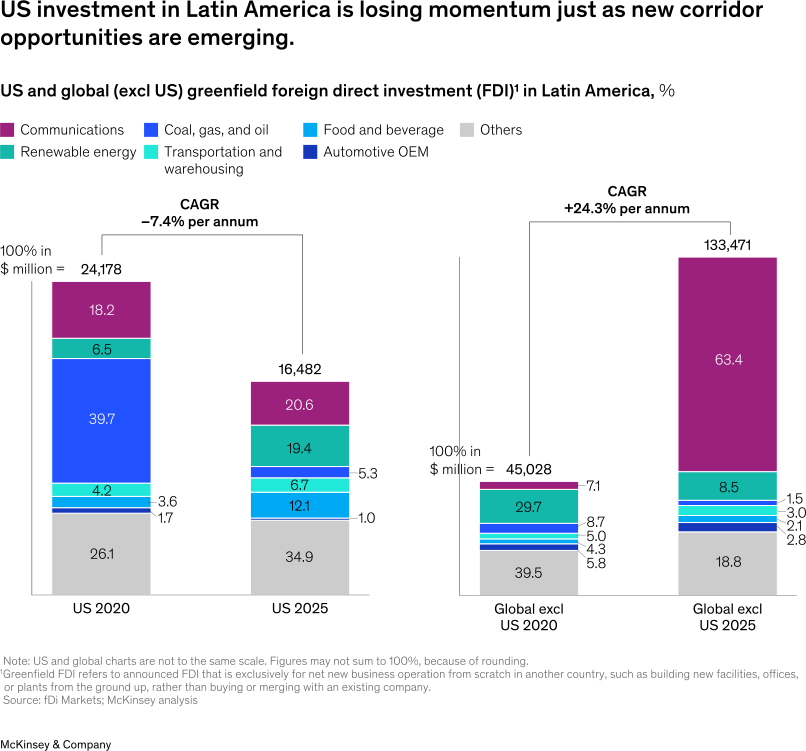
- Capital stock from foreign direct investment in the corridor reached $464 billion in 2025, with about 84 percent of that represented by investments into Latin America from the United States.28 However, US investment into Latin America has remained flat since 2020, while US companies building new businesses in Latin America, or greenfield investment, has fallen by about 7 percent annually (Exhibit 2). During the same period, global greenfield investment (excluding the United States) into Latin America nearly tripled from $45 billion to $133 billion, suggesting there could be further potential for the United States to position itself to capture the corridor’s next wave of growth.29
These three shifts are creating new corridor opportunities, though who captures them will depend heavily on geography, sector, and existing market access. Latino-owned businesses and communities with distinctive positional advantages and large Latino populations (those in trade hubs, in high-growth sectors, or with established cross-border networks) are best placed to benefit. An emerging ecosystem is already turning those specific advantages into repeatable plays that scale value across markets.
The importance of US Latinos in creating value from trade
Five distinctive advantages across consumers, businesses, and places highlight how Latinos today create outsize value in the corridor. First, Latino consumers provide a large and growing base of demand that companies are increasingly accounting for in their strategic decision-making. Second, Latinos wield a variety of unique cultural identities with influence that can extend beyond Latino markets. Third, Latino businesses can bring cross-border knowledge and networks that reduce friction and enable success in the corridor. Fourth, a fast-growing base of entrepreneurs and workers can expand productive capacity and unlock innovation. Finally, physical and digital integration in specific places, such as Latino-population hubs and ports of entry, concentrates and connects these advantages, enabling new business models and extending their reach across the corridor.
Consumers: Distinctive demand and cultural influence create a launchpad for growth
Large and rapidly growing Latino-linked demand can provide a promising base market for businesses operating across the corridor. In broad terms, around 68 million US Latinos today represent $2.8 trillion in household consumption, which grew three times faster than non-Latino consumption from 2019 to 2024.30 Latino-linked demand already accounts for about 15 percent of Latin American final-goods imports, up from 12 percent a decade ago and above Latinos’ share of US household income.31 As an example of how Latino-linked demand can enable mainstream adoption, Modelo Especial’s US off-premises retail sales grew from around $2 billion in 2018 to more than $4 billion in 2024, while the share of the brand’s business coming from non-Latino consumers rose from 30 percent to 45 percent. It is now the top-selling beer in the United States by dollar sales.32
Latino cultural influence also extends beyond Latino consumers, creating a path to scale promising business models for products that are otherwise new to non-Latino consumers. For example, more than half of US music listeners engage with Latin music.33 Its share of US recorded music revenue has doubled since 2020 to roughly 9 percent of the market.34 Similar dynamics are seen across industries. Modelo and Tajín have become mainstream consumer brands, while beauty players such as Ceremonia and Nopalera are translating Latino heritage into differentiated propositions.35 In fashion, reggaeton superstar Bad Bunny’s Adidas collaborations and designers such as Willy Chavarria have brought Latino cultural references to global audiences, while sports and travel—from Inter Miami to Puerto Rico tourism around major cultural events—show how cultural relevance can translate into broader spending and economic activity.36 These are some of the early examples of how business leaders are starting to realize the significant pool of value related to sports,37 entertainment, fashion, beauty, and other sectors within the Latino community.
Businesses: Cross-border capabilities and a growing productive base serve and scale demand
Knowledge and networks can reduce cross-border friction, lowering the search and transaction costs of connecting customers, suppliers, partners, and institutions across markets. When paired with strong operations, they can turn cross-border familiarity and connectivity into commercial advantage. This emanates from deep interpersonal relationships that connect the United States and Latin American markets even outside the arena of trade. For instance, phone traffic between the United States and Mexico represents the world’s largest bilateral route, accounting for about 8 percent of global international call minutes.38 Such interconnectivity has a tangible business impact: Latino-owned exporters generate around $325,000 in revenue per employee, about 3.5 times that of Latino-owned nonexporters (Exhibit 3).
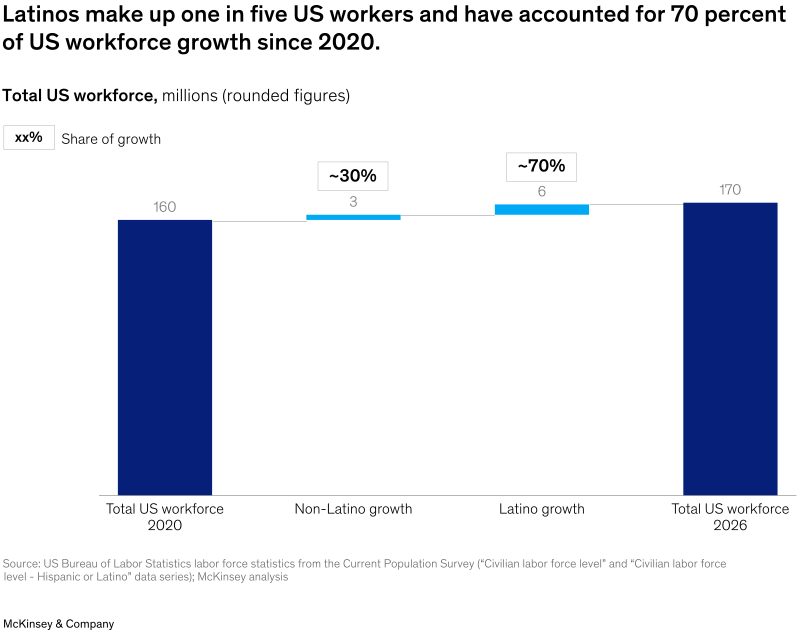
Latino business and labor make up a prominent proportion of total productive capacity in the United States. Per the US Bureau of Labor Statistics, Latinos now make up roughly one in five US workers and have accounted for 70 percent of US workforce growth since 2020 (Exhibit 4). And according to the US Census Bureau American Community Survey 2024 release, Latinos are increasingly skilled: For example, the percentage of foreign-born Latinos who have been in the United States five years or less with a bachelor’s degree or higher increased from 14 percent in 2010 to 26 percent in 2024, while US-born Latinos with a bachelor’s degree or higher similarly increased from 17 percent to more than 26 percent during the same period.39
The number of Latino-owned firms with employees grew by about 6.8 percent annually from 2017 to 2023, compared with growth of less than 1.0 percent for non-Latino-owned firms.40 In addition, Latino-owned employer firms generated around 7 percent of net new jobs in the United States from 2017 to 202241 and, according to Stanford University, are more represented in emerging technologies such as blockchain and Web3 compared with White-owned businesses at 5 percent versus 1 percent, respectively (representation in AI sectors is comparable).42 Taken together, a larger, more skilled, and more entrepreneurial Latino base of workers and owners could translate to a latent resource for the corridor that increases both supply and demand for its commercial offerings.
Places: Physical concentration and digital integration multiply Latino advantages from trade
Physical and digital integration concentrates the advantages of Latino businesses and consumers and connects them across markets. Trade capabilities are highly concentrated geographically, with eight leading US–Latin America trade hubs accounting for roughly three-quarters of corridor imports.43 These hubs bring together specialized infrastructure, industries, networks, and demand, including logistics and customs capabilities in Laredo44 and El Paso,45 energy expertise in Houston,46 and commercial connections in Miami.47 Beyond ports of entry, Latino population hubs also create downstream opportunities born out of the corridor by concentrating demand and opening business opportunities around traded goods. However, direct connectivity to the corridor still matters for both consumers and businesses: Among places with similarly sized Latino populations, stronger connections to ports importing from Latin America are associated with substantially greater availability of Latin American consumer goods.48
Digital connectivity can extend the same advantage beyond a single geography. Recurring cross-border interactions include scalable services, proprietary data, platforms, and IP. Businesses are finding different ways to translate cultural knowledge, institutional access, and cross-border data into business models that serve customers across multiple countries, such as the following:
- Félix Pago, a unicorn start-up, facilitates US–Latin America remittances through a fully digital WhatsApp-native interface.49
- Desteia, which has raised seed funding of $11.5 million as of 2025, integrates with Mexico’s customs filing portal to simplify compliance for MNCs.50
- Sonoro, which raised $12.5 million in Series A funding, has built one of the world’s largest podcast networks by creating culturally relevant audio content for audiences across the continents.51
By creating ways to serve long-standing needs of Latino customers across geographies, digital integration converts the advantages of Latino consumers and businesses into market-defining plays.
From distinctive advantages to proven plays
Latino consumer, business, and place-based advantages are already translating into action. Across the US–Latin America corridor, companies, entrepreneurs, investors, governments, and ecosystem institutions are using them in a set of recurring plays that create and capture value, showing how Latino-linked demand and capabilities can successfully create opportunities across markets.
MNCs are importing and commercializing Latin American products in the United States, often using existing Latino demand as an initial market before scaling more broadly. Modelo illustrates the potential, scaling from a heavily Latino consumer base to become the number one beer by dollar sales in the United States.52 MNCs are also investing to expand across Latin America, bringing capital, technology, infrastructure, procurement, and operating capabilities. This trend is particularly pronounced in the technology sector: For example, Microsoft invested $2.7 billion into cloud and AI infrastructure in Brazil,53 and Amazon announced a $5 billion cloud-region investment in Querétaro, Mexico.54
US Latino-owned businesses and entrepreneurs are pursuing a broad set of cross-border models. Across the models, each uses their unique knowledge of the Latino consumer and preexisting networks to carve out a competitive advantage. Some import and commercialize culturally connected goods, using their knowledge of Latino demand and sourcing networks to build scaled businesses. Others export brands and business models into Latin America, leveraging propositions first developed in the United States as well as cross-border market knowledge and owned assets. Nopalera, for example, which has an established footprint across more than 700 retail points in the United States,55 recently partnered with Ulta Beauty to launch in Mexico and leveraged a $4 million Series A funding to further fund its domestic and international expansion (see sidebar “US Latino-owned business spotlight: Nopalera”).56 Others are building digital services that solve recurring cross-border frictions: Félix Pago processed about $1 billion in remittances in 2024,57 Nuvocargo reports customs clearance times that are up to 34 percent faster,58 and Nowports reports shipment delays that are up to 40 percent lower through technology-enabled logistics and customs capabilities.59
Places are developing plays of their own. State and local governments could build infrastructure and specialized capabilities to help make trade easier or focus on particular sectors rather than trying to replicate a full gateway. Laredo and El Paso illustrate deep logistics and customs ecosystems,60 for example, while Tampa shows how a secondary hub can build differentiated capabilities in cold-chain and food distribution.61 Specialized connectivity can materially expand access to corridor trade. Among cities with similarly sized Latino populations, stronger links to Latin American entry ports are associated with around three to four times greater availability of imported goods, and cities such as San Antonio illustrate how logistics and sector specialization can turn that connectivity into economic activity.62
Capital providers and ecosystem institutions play a complementary role by helping promising corridor businesses access the capital, customers, and capabilities needed to scale. Capital providers offer fit-for-purpose capital, including growth equity, working capital, and trade finance. For example, L’Attitude Ventures built a $100 million venture capital platform for early-stage investments in US Latino-owned businesses (including Nopalera), while fintech platform and marketplace Mercado Libre uses proprietary sales and payment data to rapidly assess creditworthiness and provides working-capital financing to merchants that are underserved by traditional lenders.63
Ecosystem institutions such as Latino chambers and supplier networks connect firms to customers, distributors, capital, specialized hubs, and country-specific expertise that would be difficult for any business to assemble alone. One example is ConnectAmericas, an Inter-American Development Bank (IDB)–created platform enabling Latin American businesses to achieve 17 percent higher average export value by connecting them to a network of about 240,000 companies with capital opportunities, buyers, suppliers, and training.64
Taken together, these initiatives show the corridor already contains many of the ingredients needed for broader value creation. The challenge is not the absence of successful models but rather that they remain fragmented and are not yet connected to an integrated system that can scale them consistently.
Driving greater US–Latin America economic value in the corridor
Broad and largely external forces such as global policy, cross-border investment, and commodity trade cycles drive much of what forecasts anticipate for the corridor. Based on these trends, a McKinsey Global Institute analysis implies a change in growth rate from 3.0 percent in real terms in the past decade to around 1.5 to 2.0 percent per year through 2035,65 translating to $1.2 trillion to $1.7 trillion in cumulative added trade volume, with the current balance between northbound and southbound holding roughly stable as a share of corridor trade.
Yet there is a potentially sizable additional opportunity centered around the distinctive capabilities of US Latinos. Despite these advantages across businesses, consumers, and places and proven value creation plays, the ecosystem needed to capture the value remains fragmented. Capital, market access, institutional support, commercialization pathways, and ownership mechanisms are frequently unavailable or too dispersed for the companies and places best positioned to use them. We estimate that systematically addressing these barriers that prevent proven models from scaling could add $170 billion to $295 billion in incremental trade through the corridor in the next ten years, expanding the corridor’s growth by 18 percent. Taken together, the corridor’s momentum and this added opportunity represent up to $2 trillion in cumulative added trade over the next decade. The benefits would extend beyond the businesses that gain new opportunities to import and export. There could also be sizable spillover effects into the broader economy that create jobs, lower prices, and generate more choice for consumers and more vibrant places.
But the additional value is not guaranteed. Capturing it depends on addressing the five system constraints.
Limited access to capital
Surveys of Latino entrepreneurs have documented that more than 70 percent of Latino-business owners used their personal funds to start their businesses, and as few as 12 percent use banks or financial institutions66; Latino-owned firms are also less likely to receive the full financing they request compared with other groups.67 At the same time, firms based in Latin America that would otherwise be exporting or importing are unable to access finance to engage in trade. It is estimated that expanding access to trade finance (for example, through working-capital loans, receivables financing, letters of credit, and supplier finance) could increase trade volumes by 6 to 9 percent across Mexico, Guatemala, and Honduras,68 all of which count the United States among their largest trading partners. Improving access to different capital products at different stages of growth on both sides of the corridor could enable more businesses with promising business models to capture value from trade, especially in the critical transition when founder-funded firms seek institutional scale.
Latino-owned businesses have long shown their ability to effectively use capital to expand into international trade and business activity. By the late 2000s, Brightstar, founded in Miami by Marcelo Claure, became the largest Latino-owned business in the United States69 by building a scaled mobile phone exporting business that grew revenue from $140 million in 1999 to more than $1 billion by 2003.70 The key to its early expansion was using working-capital financing to build inventory that could be sent to Latin America.71 Today’s businesses are using newer financial mechanisms to reach customers across markets. Miami-based unicorn tech scale-up Félix Pago,72 for example, has raised multiple rounds of venture funding to expand its remittance platform across multiple Latin American countries.73 Since its founding in 2020, it has served six million customers across 11 Latin American markets and processed $8 billion in transactions.74
Narrow market and distribution connectivity
About 75 percent of trade in the corridor is concentrated in leading hubs that reach only around 16 percent of US Latinos.75 And further dispersion of traded goods from ports of entry to consumers in other Latino population hubs is uneven. Some of the largest Latino markets in the United States remain relatively disconnected from the trade infrastructure and distribution networks that would allow demand to translate more fully into corridor flows (Exhibit 5). This finding is consistent with McKinsey’s The economic state of Latinos in America report, which documented that 41.5 million Latinos live in consumer deserts and are 1.3 times as likely as White populations to have low access to consumer goods.76
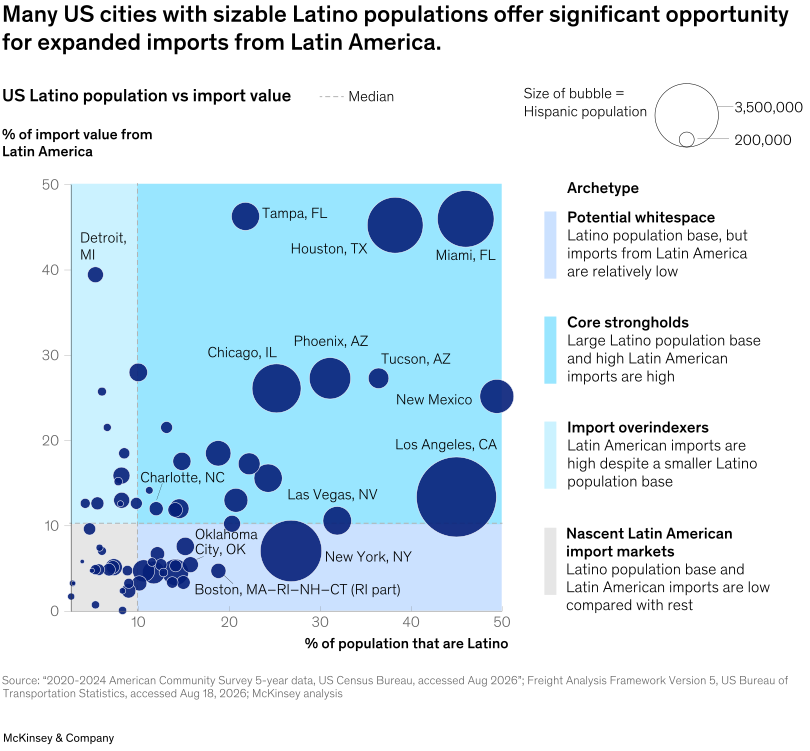
This highlights meaningful opportunities for greater consumer import penetration. For example, Los Angeles and Las Vegas have sizable Latino populations but a comparatively low level of Latin American imports, suggesting room to expand sourcing and distribution, particularly given their proximity to Mexico and cross-border logistics advantages. Companies may consider whether cost, lack of knowledge about Latin American imports, access, or other factors are barriers for consumers. Other markets show what stronger connectivity may unlock for cities that are not major ports of entry themselves: Tampa has built a differentiated position in food distribution,77 for instance, while Dallas functions as a major logistics hub that supports Latin American imports well beyond what local demographics alone would suggest.78
More broadly, among places with similarly sized Latino populations, stronger connections to Latin American entry ports are associated with materially greater availability of Latin American consumer goods.79 Latino businesses need consistent pathways to access MNC procurement, retailers, distributors, platforms, corporate customers, and export channels. Without them, commercially viable businesses tend to stay local or niche. Broader market access and distribution connectivity may unlock significant economic value by converting demand into repeat purchases, larger orders, and national or regional reach.
Source Logistics, founded by Latino entrepreneurs, highlights this opportunity. It has made growing coverage of the US Latino population its core growth strategy to meet rising demand for Latin American goods, especially food and beverage.80 Through M&A and new warehouse builds, it has expanded to 5.8 million square feet of warehousing nationwide, reaching 80 percent of the US Latino population and 75 percent of the total US population with same-day delivery; its longer-term goal is to achieve 95 percent total US population coverage.81 This growth helped it rank on the Inc. 5000 2025 list of America’s fastest-growing private companies for the second consecutive year.82
As connectivity improves between trade hubs and other cities, opportunities will emerge for businesses with rights to win as exporters. Quirch Foods, which started as an importer of consumer goods from Latin America, built distribution networks across the United States from a central distribution node in Miami.83 While 80 to 90 percent of its business remains domestic, over time, its import business led to relationships with domestic meat and seafood producers that it combined with its cross-border networks and infrastructure assets in Miami to expand into exports. Now Quirch ships more than 100 containers a week globally, with a focus on Latin America.84 Other successful export businesses in the corridor highlight the value stronger networks can create. For example, SolvChem, a Latino-owned chemicals distributor based in Houston, created an international division in 2009 to export chemicals to Latin America.85 Having already built chemicals handling infrastructure in Houston and a regional network of suppliers, it used its proximity to a key corridor port to become a dominant player in chemicals exports, generating more than $100 million in revenue per year.86
Low institutional coordination
Despite an extensive support ecosystem, Latino trade participation remains low. For example, the USHCC represents more than 260 chambers, and the NMSDC connects more than 15,000 minority-owned businesses through 23 regional councils, but only 2.1 percent of Latino-owned employer firms export, compared with 2.6 percent for all US employer firms.87 An accountable corridor-wide coordination layer could connect commercial development, capital, distribution, specialized hubs, country-specific regulation, market knowledge, and skills, surfacing promising opportunities that would otherwise be missed.
The United States also lacks a coordinated and scaled set of efforts to amplify the commercial power of Latino cultural assets. Such vehicles have been deployed globally to great effect, such as Enterprise Ireland, which holds capital, capability building, and market access under one mandate: The same agency that funds a company also opens markets for it with its 42 overseas offices so the firm never has to assemble the system itself. In 2025, its client companies had record export sales of €38.86 billion and employed 232,425 people.88 The United States has already had major success promoting commercialization of other cultural assets at home and abroad, such as through its film industry, which has an estimated global annual trade surplus of $15 billion.89 A coordinated group of stakeholders in the United States, such as investors, trade associations, or nonprofits, could focus on identifying emerging trends with commercial potential from within the Latino community and support them to develop their business models, leveraging import and export opportunities.
Brazilian influencer Camila Coelho illustrates what’s possible when entrepreneurs can scale products in the corridor. She leveraged her more than ten million social media followers to launch two companies generating more than $10 million in combined sales by 2021: a fashion label with Revolve and a beauty line built around ingredients native to Brazil reaching more than 400 Ulta Beauty stores and shipped to 17 countries.90 She has used the corridor by turning Brazilian ingredients into US-launched products sold back into Latin American markets. With an enabled ecosystem, entrepreneurs like Coelho could establish a new age of US cosmetics and fashion rooted in the US Latino community.
Nascent commercialization pipeline
The opportunity for Latino firms’ broader participation in the corridor is not constrained by a lack of demand or business performance but by an uneven ability to commercialize and scale. The US–Latin America corridor lacks a pipeline that identifies promising firms and assets, validates demand, develops products and talent, builds export or market entry readiness, protects IP, codifies playbooks, and replicates what works. Having repeatable capabilities, playbooks, and intermediaries that identify promising opportunities and help move businesses from proof of demand to scaled market participation could unlock substantial value for Latino-owned businesses. Other economies have built central agencies or intermediary institutions to perform this pipeline-building function. For example, Business Sweden, a collaboration between the Swedish government and Swedish Foreign Trade Association, institutionalized the concept of getting proven firms export-ready and has helped thousands of Swedish companies enter international markets, including prominent and fast-growing businesses, such as the electric and autonomous freight company Einride, which went public earlier this year.91
The missed commercialization opportunity is especially stark for Latino cultural assets, which are unlocked by trade but have potential for economic spillover effects in the US economy. Bad Bunny offers one example: The singer and rapper’s rise was enabled in part by Puerto Rico–based Rimas Entertainment, which secured an early YouTube monetization agreement that helped Bad Bunny reach audiences without relying on a traditional major-label model. That model has translated cultural demand into broader economic activity.92 During Bad Bunny’s 2025 Puerto Rico residency, total spending in San Juan rose nearly 20 percent versus comparable weekends a year earlier, while international spending around the venue increased by more than 15 percent.93 The residency also connected visitors with local businesses and helped expand Puerto Rico’s reach into new tourism markets, a tangible display of the economic power of culture that went global just months later with Bad Bunny’s performance at the Super Bowl LX halftime show.94
If the United States could build a similar coordination and amplification apparatus to the same results that South Korea achieved from its Hallyu cultural engine, the economic opportunity in the United States could be worth more than $300 billion over ten years, with trade-related activity adding another $60 billion.
Weak ownership and reinvestment mechanisms
Economic growth in the US–Latin America corridor can generate income without creating durable, Latino-owned assets that let value compound over time, such as equity, brands, proprietary data, platforms, and distribution networks. Weak mechanisms for ownership and reinvestment mean founders, creators, and communities often don’t retain a lasting stake in the value they help create, which is evident at both the household and the firm level.
At the household level, Latino households that own a business hold roughly 2.2 times the net worth of those that do not,95 yet only 6 percent of Latino families receive an inheritance, part of a $380 billion wealth transfer gap that McKinsey documented.96
At the firm level, Latino-owned firms capture less of their industries’ value than peers, generating less than half as much revenue per firm as other firms (excluding MNCs).97 This suggests a scale gap that compounds the ownership gap.
Latino firms in the corridor show how scaled ownership can create significant value. Goya Foods, for example, highlights the payoff of retained ownership and reinvestment. It has grown into a multibillion multinational food distributor while retaining family ownership despite multiple buyout attempts. Its former COO went on to found AUA Equity, which has an investment strategy built around its distinctive knowledge of scaling products nationally from the Latino business ecosystem.98
Creating and capturing greater value from the US–Latin America corridor
A more integrated US–Latin America ecosystem holds the promise of generating significant economic value, especially for US Latinos—although it will not materialize automatically. Creating and capturing this value requires investment to build an integrated ecosystem and amplification engine for the corridor that eases entry for new participants while helping existing players scale. Such a system would allow US Latinos to apply their distinctive capabilities to proven plays to capture more value while creating spillover effects that benefit communities. For stakeholders already engaged with the corridor, the ecosystem’s amplification engine can help them succeed more often and scale faster by connecting them to system support they may be missing. As more plays succeed, assets are created along with knowledge, relationships, data, brands, and capital that strengthen the next cycle of growth in the corridor. New participants will also benefit by having better access to the existing ecosystem and access to the market entry playbooks that have been codified.
Realizing these opportunities in the corridor could have substantial impact on the economic mobility potential for Latinos in the United States. As Latino-owned businesses succeed and grow more frequently, the share of wealth that the Latino population claims through ownership increases. When stronger networks enable better exchanges between businesses about the proven plays, more businesses can enter adjacencies that have higher potential for export, a proven way to increase value creation. As businesses in the corridor grow, they create employment opportunities for other Latinos in their communities, which in turn enables skill development and opens career pathways for wealth creation. Finally, corridor participants reinvest resources into their communities through direct spending and through tax revenue generation, creating a financial base to improve quality of life through services and amenities.
Investors, businesses, governments, and mission-driven organizations looking to participate in the corridor to access these opportunities don’t need to build every capability themselves. Key stakeholders need to proactively collaborate to make this integrated ecosystem and amplification engine a reality. Each actor will be responsible for building distinct but complementary and coordinated levers that can work together to open the pipeline of opportunities. A summary of each stakeholder, how they benefit from the ecosystem, and steps they could take is in the table below.
| Stakeholder | How they may benefit from the opportunity | What they could do to plug in |
|---|---|---|
| Multinational corporations (eg, large manufacturers, retailers, digital platforms) | Unlock new sources of growth by tapping into the $2.8 trillion Latino consumer market1 with differentiated, culturally relevant, and high-potential products. Build more diversified and resilient supply chains by identifying and accessing services from qualified and differentiated suppliers with corridor-specific capabilities, leveraging proximity and regional production networks. | Make the corridor part of their core growth strategy (eg, sourcing, product development, market entry), not only marketing. Diversify procurement channels and invest in supplier development to enhance resilience and integrate subject matter expertise. |
| Small and medium-size enterprises and entrepreneurs (eg, Latino-owned exporters, importers, consumer brands, and professional services firms) | Build larger, more productive businesses by accessing US–Latin America markets and customers. | Adapt existing businesses to opportunities in the corridor by identifying products, capabilities, customers, and friction that can travel across markets. Build export and market entry readiness (eg, regulatory knowledge and certifications). |
| Investors and financial institutions (eg, commercial banks, venture capital and private equity firms, and development finance institutions) | Create and access differentiated investment opportunities in a fast-growing segment (eg, Latino-owned businesses are growing at around 6.8% annually versus less than 1.0% for US employer firms2). | Design capital around corridor business models. Trade-focused firms tend to have long cash conversion cycles, limited collateral, and foreign exchange exposure and can make traditional underwriting costlier. Aggregate smaller, high-potential Latino trade opportunities into investable portfolios such as funds, helping firms access more capital to scale while diversifying risk and increasing investor appeal. |
| State, local, and regional governments (eg, economic development agencies, port and airport authorities, workforce agencies, and the offices of governors and mayors) | Increase local participation in corridor value chains, supporting job creation, business formation, and a stronger tax base. Attract productive investment aligned with local industries and capabilities. Better connect unmet Latino demand with Latin American origin goods and services. | Define trade sectors and corridor strategy based on local industry strengths, talent, infrastructure, and demand. Target investment in logistics, talent, and other infrastructure that enable local Latino-owned firms to participate in sectors and trade aligned with local strategy. Align workforce and credential programs with corridor sectors, such as customs brokerage and logistics or key skills in high-trade sectors. |
| Ecosystem institutions (eg, industry associations and chambers of commerce) | Reduce search and coordination costs (eg, make corridor participation easier for firms without established networks). Multiply impact by connecting more firms, codifying what works, and replicating proven models across borders and markets. | Build a shared market knowledge base to facilitate connectivity and scaling, such as business registries, data, standards, and playbooks. Measure what creates ownership and wealth; identify high-impact models and facilitate replication across sectors and markets. |
The trade corridor between the United States and Latin America is big, growing, and critical to the economic dynamism of the region—but there are pockets of opportunity that have yet to be realized. The path is not without risk. Headwinds and uncertainty could impact how these opportunities can be realized. Nonetheless, commercial activity in the corridor will continue, and many of the ingredients for generating greater value are already in place. An integrated system that consistently scales distinctive Latino capabilities could turn this potential into greater economic momentum, providing another pathway for economic mobility for Latinos and the communities they live in nationwide.