As much as artificial intelligence is fundamentally reinventing which technology products and services enterprises purchase, it is also dramatically shifting how technology vendors sell their offerings. Most software and tech providers’ customer-facing functions, such as direct sales and customer support, have begun to adapt to this transformative technology, but one key area has been notably slow to make the necessary adjustments: the partnership channel, which continues to leverage a traditional software-as-a-service (SaaS) playbook to sell AI products and is often one of the last functions to undergo an AI-enabled operational transformation.
Sales channel partners play a critical role for leading software and technology vendors, driving around 60 percent of revenues on average.1 Yet, two out of three technology vendors report gaps in channel capabilities, with the top quartile of providers, based on partner management capability, outperforming the median twofold.2 This gap becomes even more critical to address amid the AI boom, as software and tech channel leaders are grappling with how the technology is reshaping the business externally and internally:
- Externally, the traditional transactional channel approach isn’t well-suited to the shift from predictable SaaS revenue to consumption- and outcome-based models that tie growth to usage and measurable impact instead of up-front bookings. The advantage is moving from broad reach to targeted expertise, with partners evolving from resellers to co-architects, as AI solutions require deeper integration with customer data, workflows, and compliance environments.
- Internally, AI offers a powerful opportunity to transform channel operations. Automation and predictive insights can drive acceleration as well as efficiency—shortening sales cycles, sharpening partner investment decisions, and improving ROI.
Software and tech providers determined to maximize the full potential of AI can help to rebuild the channel for this new era, but it will require decisive, complex actions. This article, based on interviews with industry leaders and our experience in the market, lays out those critical channel moves across five broad areas.3
Five channel moves to capture the AI opportunity
Adapting the tech sales channel successfully to AI is a complex undertaking that requires a variety of changes, from new types of partners and ways they work with customers, to new compensation models and capabilities.
Reassess your partner map around archetypes most relevant for AI growth
Traditional partner models were built for distribution at scale, often organizing thousands of resellers, system integrators, and independent software vendors by tier. AI requires a different approach. Enterprise customers increasingly need specialized partners with the technical and domain expertise to shape architecture, integrate solutions, grow adoption, and deliver measurable outcomes. In fact, around half of enterprises are working with partners to design their AI and agentic architectures.4
Four broad partner archetypes are gaining importance, aligned to how AI solutions are built, deployed, and scaled (exhibit):
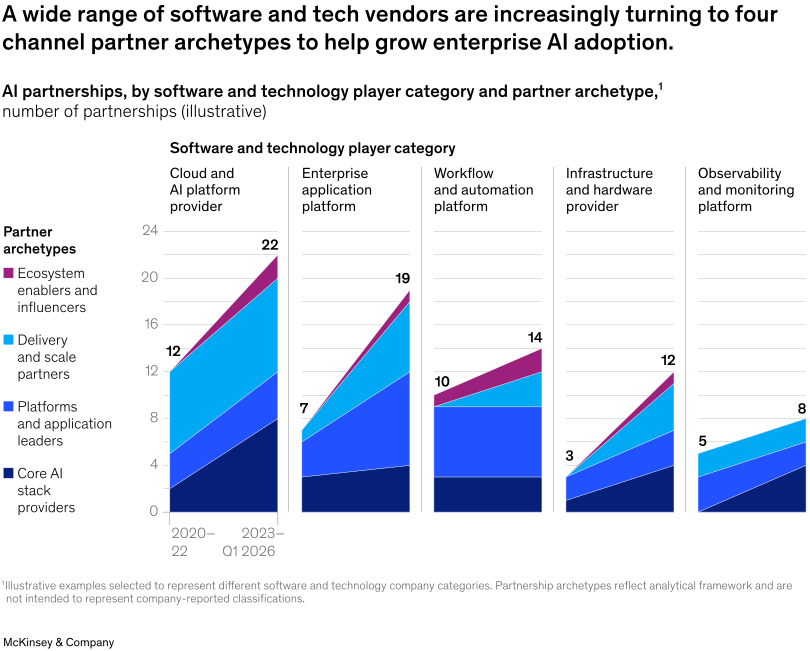
- Core AI stack providers provide the foundation for AI performance, scalability, and trust. This includes foundation model and infrastructure providers (such as OpenAI, Anthropic, and NVIDIA) that supply core models and compute, as well as data, governance, and responsible AI partners (for example, Credo AI and Fiddler) that support testing, observability, and risk management.
- Platforms and application leaders determine where AI is embedded and how it is integrated into enterprise workflows and decision systems. This includes enterprise workflow and decision platforms (for example, Palantir, Salesforce, ServiceNow, and Workday), domain-specific platforms, and emerging agent specialists (such as Sierra and UiPath) that operationalize AI within business processes and specific use cases.
- Delivery and scale partners translate AI solutions into deployed, scaled enterprise offerings. System integrators (for example, Accenture and GlobalLogic) support integration and customization, while marketplaces (for example, AWS Marketplace and Microsoft Marketplace) and evolving solution providers (for instance, CDW and SHI) are increasingly exploring ways to package and deliver AI solutions to customers.
- Ecosystem enablers and influencers shape demand, technology choices, and the pace of AI adoption, even when they are not traditional channel partners. Strategic advisers help organizations define AI priorities and architecture choices, while private equity and venture capital firms can influence technology decisions and accelerate adoption across their portfolios.
The implication for channel leaders is a shift from broad partner coverage toward more targeted orchestration, matching partners to the roles and stages of the AI life cycle where they can create the most value. Together, these dynamics mark a decisive shift to precision partnering as the foundation for enterprise adoption and measurable outcomes.

Software development: Leading the AI revolution
Agentic software development can accelerate innovation, improve quality, and reduce both costs and risk. But capturing the full value requires much more than just deploying new tools.
Embed partners across the full customer life cycle, from codesign through expansion
Traditional partner engagement often seemed like a relay race: Vendors are handed off to partners at the point of sale, and partners are handed off to customers at deployment. That construct cannot support AI sales, where the complexity of integration and the consumption-based economics demand continuous partner involvement, from the proof of concept (POC) stage to scaling adoption.
The new motion is a barbell, with partners deeply embedded at both ends of the customer life cycle:
- On one end, partners are gauging usage demand and leading production-level POCs. More than half of large-scale AI projects now rely on partner-led POCs to establish technical credibility and secure the executive buy-in that is key to scaling projects, according to McKinsey research. AWS has also moved to extend this model through partners, launching its Generative AI Partner Innovation Alliance after more than 50 percent of POCs developed through its Generative AI Innovation Center moved into production.5
- On the other end, partners are staying engaged during postdeployment to propel adoption and usage, and to identify new use cases that fuel expansion. Several partner programs now tie ongoing compensation to customer adoption, consumption growth, and land-and-expand outcomes, rather than to just one-time bookings. For example, Microsoft’s FY27 partner incentives reward Azure consumption growth through tiered incentives, with higher rates for strategic workloads, including AI-related services such as Microsoft Foundry.6
One practical implication of this shift is that vendors need to package AI around industry-specific data, workflows, use cases, and compliance so partners can sell clear business outcomes that encourage increased usage (as proven in the POC stage) rather than broad, vertical-agnostic tools and licenses.
To help drive this shift, channel leaders can redefine partner engagement rules—with partners closely involved earlier in codesign and POC before a deal is made and remaining accountable through adoption and expansion.

Technology, Media & Telecommunications
Navigating rapidly changing markets to promote innovation, capture new opportunities, and create value
Launch a dedicated AI partner program with its own criteria, tiers, and incentives
The SaaS-era partner program rewarded upfront bookings and contract value. In AI, value accrues through consumption and adoption over time. Applying the old incentive structure to new economics produces costly misalignment. Software company channel leaders may build a new AI program track from scratch, addressing shifts in what, how, and whom they pay in AI channel sales.
-
What to pay: Design of financial and nonfinancial incentives. Financial incentives should include shared development costs, dedicated technical teams to accelerate agent builds, and AI-specific SPIFFs (sales performance incentive fund formula) and marketing campaign funds tied to POCs and pilot scaling. Microsoft’s AI Cloud Partner Program, for instance, grants partners Azure credits, product licenses, and sandbox development environments, while AWS offers gen AI POC funding for POCs executed by validated partners, typically covering up to 10 percent of costs, capped at $25,000.7
Nonfinancial incentives matter just as much, including free-to-try agents with one-click deployment, priority placement of partner-built offerings on the vendor’s marketplace, and 60-day early access to new AI products.
- How to pay: Compensation models. Three dominant structures are emerging across the industry, including up-front payouts at deal closure for committed spend; accrual-based payouts to reward ongoing consumption and expansion; and hybrid accelerators that blend up-front payouts, early revenue share, and usage-based milestones.
- Whom to pay: AI program entry requirements. AI-first programs should carry strict thresholds to maintain quality and credibility. One leading hyperscaler requires top-tier partner status, multiple “referenceable” production AI deployments within the prior year, rigorous architecture reviews (including responsible AI and hallucination prevention), and a dedicated bench of certified machine learning specialists and trained engineers.
Harness AI to transform channel productivity
Many channel organizations still struggle with inefficient partner management, including long deal cycles, high support overhead, and underperforming partner revenue. AI and agentic workflows offer the potential for a structural reset that can fuel significant efficiency gains, unlocking opportunities to improve win rates and focus on high-value growth activities. Across more than 30 curated use cases spanning sales, marketing, operations, programs, and enablement that we assessed, AI has shown the potential to improve productivity by 30 to 45 percent.
The opportunity is not just about cost reduction; it is about faster pipeline velocity, higher win rates, and more effective partner engagement. Salesforce’s 2026 State of Sales report finds that 40 percent of partners now have full access to company AI tools, with a further 55 percent having partial access—reflecting a broad push by vendors to extend AI capabilities into their partner ecosystems.8
Some valuable AI use cases for channel partner management can have a significant impact, for example:
- Decision engines based on AI and large language models can score opportunities by probability to win and recommend the optimal partner archetype.
- Agents can be developed to generate context-specific, hyperpersonalized proposals or sales and marketing collateral that integrates directly into “partner battlecards.”
- Predictive forecasting and autogenerated dashboards or email follow-ups on leads can help improve partner performance and productivity.

Enterprise Software
Accelerating growth amid a shifting industry landscape
Revamp capabilities in the channel organization for AI
AI deployments are iterative, complex, and deeply embedded in customer workflows—and most fail without the right on-the-ground support. Industry research finds that organizations scrap more than half of AI POCs before they reach production, while 42 percent of companies report abandoning most of their AI initiatives, up from 17 percent in 2024.9
A critical organizational shift for software vendor channel leaders is therefore building forward-deployed engineering (FDE) capacity at scale. This approach embeds engineers directly inside customer operations for months at a time, but doing this internally is expensive and hard to scale. One potential solution is to treat FDE capability as a service that select partners can deliver on the vendor’s behalf.
What makes the FDE model work
The FDE model succeeds because it closes the gap between external product assumptions and operational reality. FDEs identify undocumented processes, legacy system complexities, and misaligned incentives that remote teams cannot discover.
Two capability sets make the partner-enabled version work:
- Strategy and architecture stay internal. Channel teams retain ownership of problem framing, use case prioritization, solution architecture, and value articulation, which is the differentiated, vendor-specific knowledge that should not be delegated.
- Execution and embedding scale through partners. Select partners are certified to provide FDE-equivalent on-the-ground presence: sitting inside customer environments, managing deployment cycles, troubleshooting integrations, identifying new use cases, and driving continuous adoption.
Leading vendors have already operationalized this model with measurable results. For example, Salesforce launched its FDE Partner Network in April 2026 with more than 30 firms, including Accenture, Deloitte, IBM Consulting, and PwC. By tying incentives to agents reaching production rather than deal closure, Salesforce leverages partners’ global delivery capabilities and industry expertise to support scaled deployment and adoption. FDE partner network members have driven one-third of all successful Agentforce implementations to date.10
From channel transformation to channel advantage
The shift to AI-first channel models requires a comprehensive overhaul of how software and tech vendors partner, sell, and measure success. Channel organizations built for scale can transition to high-touch, iterative delivery models. Partners can evolve from resellers to cobuilders, depending on up-front investment and new financial models. And customers, many still early in their AI maturity, can benefit from partners who can navigate pilots to production rather than just close deals.
Early movers that have already succeeded in such a transformation have followed a sequence of key actions.
- Develop an AI partner program across the customer life cycle. Organizations can start by investing in a select set of high-capability partners: decision platform players, domain specialists, and AI-native builders. They can also set a clear near-term target: generate 5 to 10 percent of revenues through AI-native partnerships and establish distinct entry criteria, tiering, and incentives. Channel partners are most critical precisely at the POC-to-production stage, where deploying proofs of value at scale determines whether pilots become programs. As a result, it’s key to engage them at codesign and POC stages and hold them accountable for postdeployment adoption and expansion milestones, not just handoffs at the point of sale.
- Scale and optimize with AI. Software and tech vendors can identify ten high-impact workflows within channel operations to “agentify,” from partner scoring and lead routing to proposal generation and onboarding. Predictive pipeline tools, automated enablement, and AI-powered forecasting can improve productivity and orchestrate the broader ecosystem.
- Build partner-enabled FDE capacity. AI deployments are iterative as customers need engineers embedded in their environments, not just at handoff. To address this challenge, channel leaders can certify select partners to provide forward-deployed engineering at scale, expanding customer proximity without proportionally scaling internal head count.
As software and tech vendors contemplate the critical move from product sales to AI solutions and AI-enabled channel operations, they can view it as a fundamental transformation of partner ecosystems rather than an incremental adjustment. The channel leaders who follow the five key actions industry leaders have already demonstrated can build the kind of ecosystem depth that compounds over time: redesigning the partner map, embedding partners across the life cycle, launching a dedicated AI partner program, investing in AI-driven channel productivity, and restructuring the organization’s capabilities, including the FDE model. Those who stick with the status quo may find their partners increasingly misaligned with how AI is bought, deployed, and scaled, and their own goals and outcomes out of reach as a result.