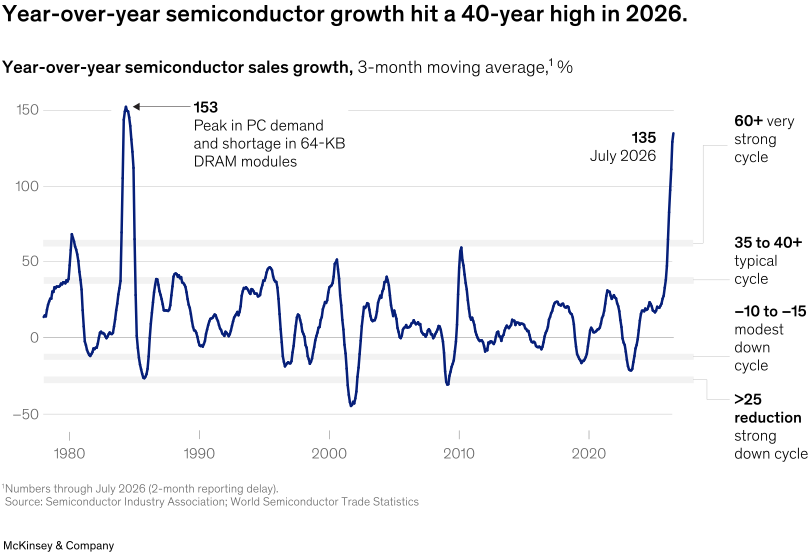
Although the semiconductor industry has a long history of surpassing expectations, the results for early 2026 are still surprising. The year-over-year increase in sales reached a 40-year high in July; shortly after, market revenues rose above $1 trillion for the first time. By any measure, the extent of this growth is exceptional.
As with several other industries, the rise of AI is responsible for the semiconductor sector’s unprecedented surge. Five major hyperscalers have announced planned capital expenditures of about $800 billion for 2026 and $1 trillion for 2027, with the vast majority going to AI infrastructure. This trend has helped push the average selling prices (ASPs) of leading-edge chips and memory well above predicted levels, resulting in much stronger growth than anticipated.
In light of these developments, analysts have boosted their estimates for future semiconductor growth. For our base case, we now project that the market will reach $2.3 trillion by 2030—about 44 percent higher than the $1.6 trillion we estimated in the autumn of 2025. The pace and magnitude of this change suggest that AI could permanently reshape the semiconductor industry’s long-standing growth patterns if it continues to gain traction. While the market has historically been highly cyclical, AI could usher in a period of sustained growth and keep ASP high for both leading-edge chips and memory.
A new market projection
When we created estimates in the autumn of 2025, we considered how semiconductor market value might evolve across three scenarios. The resulting estimates ranged from $1.1 trillion to $1.8 trillion, with the base case at $1.6 trillion. We used the same methodology to estimate the current base case of $2.3 trillion (in the range of $1.7 trillion to $2.6 trillion).
The new estimates are much higher, primarily because ASPs for leading-edge chips and memory—the two segments driving most industry growth—have risen substantially, with further increases expected. Supply of these chips is limited, but demand is surging largely due to data center expansion. Our new wafer volume forecast predicts an approximately 7 percent overall CAGR through 2030, which is similar to the estimate in our autumn 2025 analysis. Announced fab capacity buildout, on the other hand, is not sufficient to eliminate the supply–demand imbalance and relieve price pressure.
Our current scenarios differ mainly in the assumptions about ASPs for leading-edge chips and memory, especially DRAM and high-bandwidth memory (HBM). As with any forecast, market developments will determine which scenario ultimately materializes. Reaching the $2.3 trillion market value projected in our 2030 base case would require several market conditions, including a stable global economy and high levels of data center investment (see sidebar, “Essential conditions for our base-case scenario”). Based on current market developments, the conditions underpinning our base-case scenario are likely to be in place by 2030, while our more pessimistic low-case scenario appears increasingly unlikely to materialize.
To create our estimates, we took a comprehensive look at the value generated by fabless companies, OEMs with in-house design, and captive-chip players. We also considered more detailed data on companies headquartered in China. This detailed approach tends to produce higher estimates than those of other analysts. For comparison, one leading analyst also predicts a 2030 market value of $2.3 trillion, while two others put it between $1.7 trillion and $2 trillion.
Surging demand, fueled by AI
One impetus for updating our analysis was the strong year-over-year increase in semiconductor sales for the first half of 2026—the highest reported since the mid-1980s (Exhibit 1). The only comparable period is the 1980s, when the market was about 2 percent of its current size.
Based on the semiconductor market’s current trajectory, we revised our projected CAGR through 2030 to 19 percent, up from 13 percent in our autumn 2025 analysis and well above the historical average of 9 percent from 2014 through 2024. But growth will likely vary widely by market segment. Chip sales for servers and data centers, which are fueling most of the market’s recent growth, will continue to be the most powerful force. Revenues in this segment are expected to rise from $330 billion in 2025 to $1.2 trillion by 2030, a 29 percent CAGR (Exhibit 2). The wireless segment comes in a distant second, with $205 billion in growth and a 10 percent CAGR.
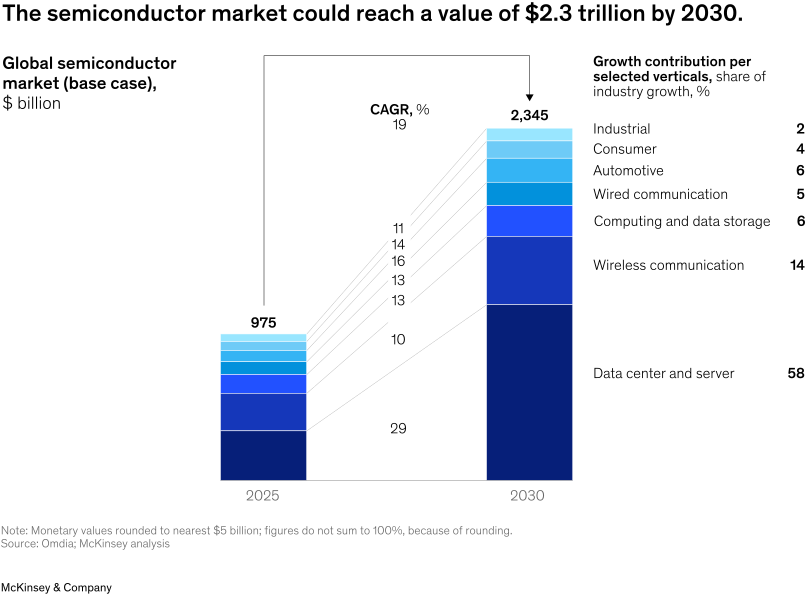
Across sectors, much of the new growth will come from higher ASPs resulting from the intensifying supply–demand imbalance. This represents a distinct departure from typical industry patterns.
If data centers continue to proliferate, their growth would keep ASP high unless chipmakers substantially increase supply ahead of demand—a development we consider unlikely until well into the next decade, given the time it would take to ramp up even more new manufacturing capacity.
The leaders within the technology stack
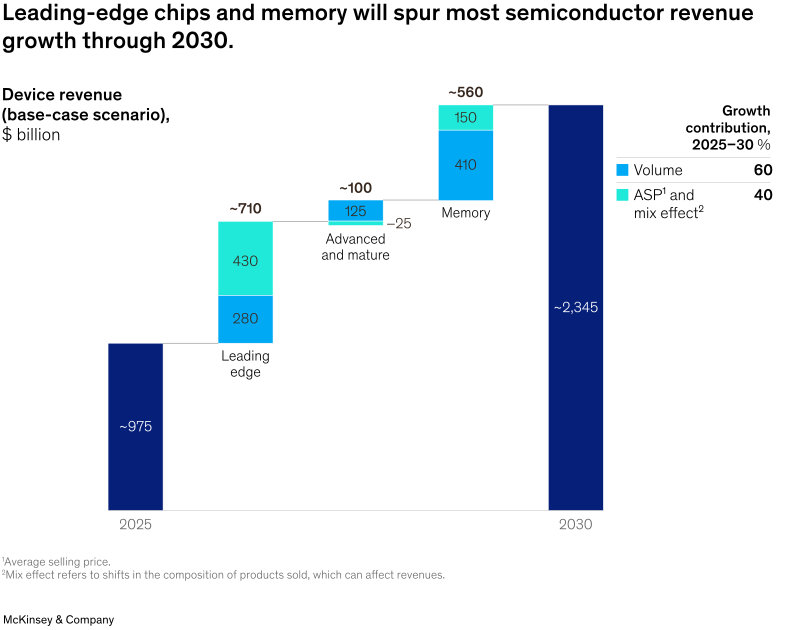
We also revisited our analysis of the leaders within the technology stack. Continuing the trends seen earlier in 2026, leading-edge nodes—defined in this article as those of 7 nanometers (nm) or less—and memory (especially HBM) remain the twin engines of growth. Between 2025 and 2030, both volume and ASP are expected to increase—a double tailwind rarely seen in semiconductor history (Exhibit 3). Advanced and mature nodes, by contrast, will see more modest volume growth and declining ASPs.
Trends in leading-edge chips
Historically, wafer ASPs have tended to decline in the first two years after launch (for instance, annual decreases of about 10 percent for 28 nm wafers and about 25 percent for 150 nm wafers). But ASPs for today’s 3 nm and 5 nm wafers are increasing by 2 percent or more annually, driven by strong demand from AI and high-performance computing amid limited capacity.
The significant increase in ASP, combined with volume and mix effects, could increase the value of leading-edge chips by $710 billion by 2030.
Trends in memory
AI models require large amounts of memory to store model parameters and process data rapidly. During inference, memory requirements increase with the size of the context window, which is the amount of information the model can consider when generating a response. As the number of concurrent users and volume of tokens increase, memory requirements also rise.
HBM sits close to the processing unit (GPU and/or CPU) and provides the bandwidth needed to keep expensive compute resources operating efficiently. It requires significantly more DRAM wafer capacity per bit than traditional memory, as well as more complex stacking and packaging.
As AI gained traction over the past few years, demand for memory, especially DRAM and HBM, rose much faster than supply. With no substitutes for memory available, the shortage quickly translated into higher ASPs. DRAM prices have increased roughly sixfold since early 2023, erasing 15 years of declines and taking ASP back to 2011 levels (Exhibit 4). Today, DRAM ASP is 550 percent above levels historically associated with comparable production increases over the past 45 years.
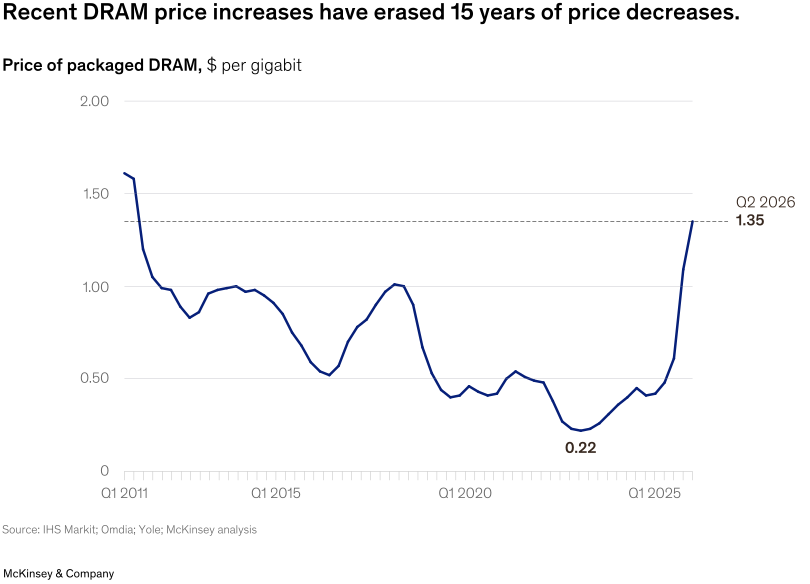
Few short-term solutions to the memory shortage are available. While companies can reengineer products to decrease DRAM/NAND requirements, this process is time consuming and does not provide immediate relief. Other alternatives include delaying production or moving to a new technology generation. Long-term solutions to the memory shortage, which some companies are already implementing, include the following:
- investing in new fabs to increase DRAM and HBM manufacturing capacity
- exploring advanced packaging solutions (for instance, taller HBM stacks and 2.5D or 3D integration to increase memory density and bandwidth)
- increasing the bit density per wafer for DRAM through next-generation technology
If these solutions prove successful, memory supply could begin to catch up with demand around 2027 and prices could begin to decline, following the cyclical pattern typically seen within the semiconductor industry. Even then, memory ASPs could remain higher than historical patterns would suggest, however.
Merchant gross margins for HBM could decline from about 80 percent in 2024 to about 50 percent by 2030, primarily because of increased competition in the accelerator space rather than ASP decreases. Despite the lower margins, memory will remain an attractive segment, with our base-case scenario suggesting that its value will increase by $560 billion by 2030.
Trends in advanced and mature nodes
Beyond leading-edge logic and memory, AI growth also benefits a broad range of advanced- and mature-node applications and products.1 These include field-programmable gate arrays, which can be reconfigured to support rapidly evolving AI architectures; workload-specific connectivity and data flow components; and data center power electronics. Some pockets, such as photonics or power electronics, might also grow rapidly, but in aggregate, advanced and mature nodes will not grow as strongly as leading-edge chips and memory through 2030. While sales volume for advanced and mature nodes will increase through 2030, ASPs will fall. Total growth for this segment is expected to be about $100 billion.
The semiconductor industry is on a trajectory toward a $2.3 trillion market by 2030, driven in large part by the rapid build-out of AI data centers. Companies planning around a more modest, roughly $1 trillion market are underestimating the opportunity. Growth will result from more than volume increases because AI is accelerating the shift toward higher-value leading-edge chips and HBM, which is pushing up ASPs and altering industry economics. These forces could reshape industry dynamics permanently. The companies that emerge as leaders will be those willing to recalibrate where—and how boldly—they invest.