The race to scale AI has triggered one of the largest infrastructure build-outs in modern history. By our estimates, global spending on data centers could reach $7 trillion by 2030. Whether a build-out is successful depends on many nuances, including the availability of capital and energy resources. But one issue is emerging as a critical growth constraint: the traditional operating models of industrial equipment suppliers that manufacture many of the long-lead critical components in the data center value chain. Many incumbents developed their processes serving utilities and other regulated industries with long planning cycles and predictable demand—an approach now misaligned with the speed and scale required in today’s data center market.
In this article, we use “equipment” to mean the full set of electrical, thermal, and mechanical infrastructure required to build and operate a data center—across both white space and gray space1—excluding semiconductors. Suppliers of this equipment, often called original equipment manufacturers, or OEMs, are central to the build-out. They provide the transformers, switchgear, cooling systems, and other critical equipment that keep data centers operational; many are experiencing record demand and historically high valuations as a result. But even as revenues accelerate, many OEMs are struggling to keep pace—not just with delivery volumes, but with innovation timelines. Few can integrate fast-changing chip designs into their new products fast enough.
This lag in traditional industrial output is creating an opening for adjacent players in sectors such as automotive and aerospace: Drawing on their manufacturing prowess and expertise in electronic and thermal components, they could deliver the equipment that data centers need to scale—and step into a multitrillion-dollar market that is expanding faster than the traditional supply base can serve. But traditional industrial equipment makers that act decisively can still defend—and grow—their share of this expanding market before new entrants gain a foothold.
What’s breaking legacy data center supplier models?
We see three main forces shaping a shake-up in the industrial sector.
Power and critical components are now pacing items
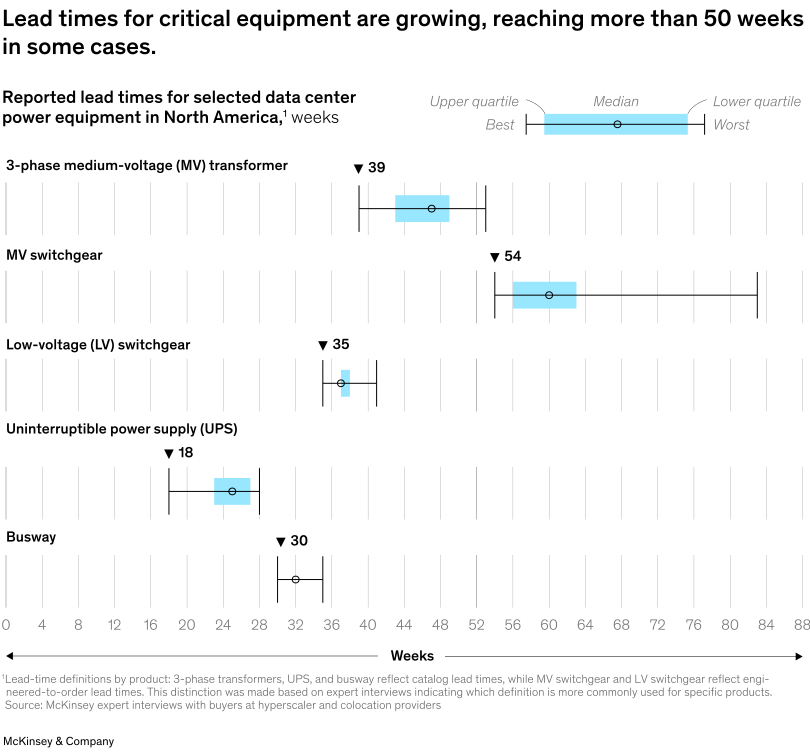
Industrial equipment suppliers were not built to respond to today’s volatile data center demand (see sidebar “The high bar for data center equipment”). These companies’ planning cycles, procurement processes, and commissioning models evolved for steadier growth and more predictable utilization. Data centers are a massive opportunity for traditional suppliers, but the shape of demand—faster ramps, bigger step changes, and more simultaneous builds—challenges their long-held business models. Lead times in North America for critical equipment such as medium-voltage switchgear and transformers can now reach 80 weeks and 50 weeks, respectively—showing just how overtaxed industrial suppliers are (Exhibit 1).
For hyperscalers that purchase equipment to build data centers, delivery delays are not just an inconvenience but also a strategic risk. When power access units, transformers, switchgear, cooling systems, or the skilled labor needed to install, test, and commission this equipment become roadblocks, the entire build-out slips—potentially stranding billions in deployed capital.
Equipment delays slow build-outs in the short term and can also derail hyperscalers’ long-term business objectives. Thus, hyperscalers need to know if their equipment suppliers can reliably deliver on time and at scale.
Silicon road maps dictate downstream innovations
Hyperscalers are increasingly selecting equipment suppliers based on whether they can prove a road map aligned with the future architecture, not just deliver products that meet today’s specs.
Technical road maps for graphics processing units (GPUs) and custom silicon now set the rules for the entire supply chain. Because chip architecture defines power density, thermals, and interconnect requirements years in advance, equipment procurement no longer starts with an RFP; it starts with data center builders soliciting suppliers that can engage at the semiconductor-engineering level. Hyperscalers and GPU providers use codified reference architectures from leading semiconductor companies to define the technical and operational requirements (that is, power density, cooling approach, interfaces) that suppliers must meet years before a shovel hits the ground. This landscape is further complicated by the need for suppliers to navigate multiple reference architecture ecosystems—each with distinct technical requirements and qualification pathways.
In other words, industrial manufacturers can no longer rely on delivering fully built equipment that slots into data center build-outs. They must instead design their products directly alongside semiconductor companies—iterating quickly and continuously to incorporate the latest chip designs.
The pace of data center innovation is accelerating
Suppliers today face another challenge: Data center architectures are evolving at a breakneck pace. Designs that once evolved over multiyear cycles are now refreshing annually—or even sooner—compressing the window for equipment suppliers to redesign, requalify, and scale their products based on these architectures.
The shift is visible in rising rack power densities, which are tightening the coupling between electrical and thermal systems. Transitions such as higher-voltage distribution—for example, 800 volts of direct current at the rack level—can drive redesigns across both IT equipment and facility infrastructure. Such changes can reshape how companies need to design, test, qualify, manufacture, and service products.
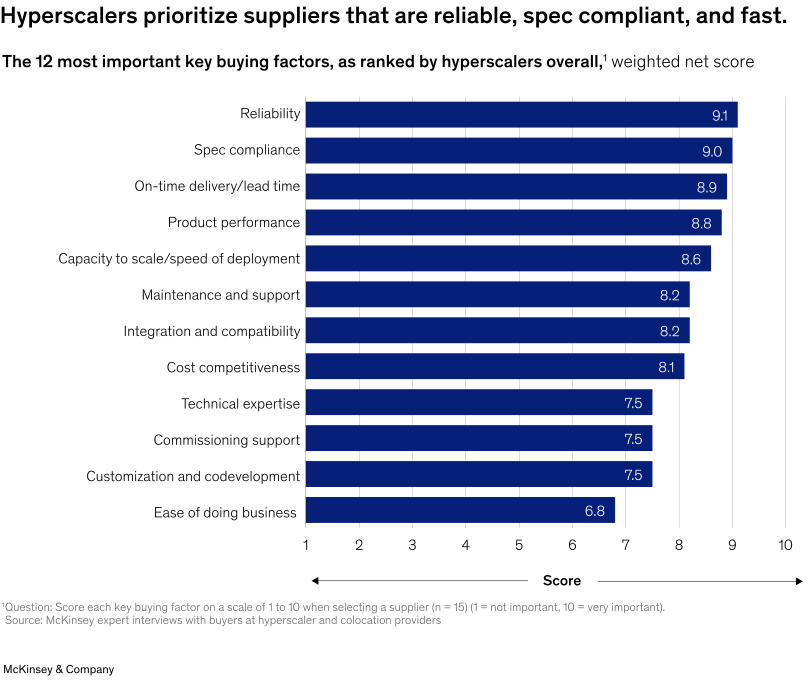
This acceleration resets how suppliers should approach new-product development and introduction (NPDI). Products can no longer be updated every few years; they must evolve fast enough to remain qualified across successive reference architecture generations—without sacrificing reliability or manufacturability. In practice, that compression is colliding with the already extended lead times described above. In response, hyperscalers are reserving production slots earlier and paying premiums for schedule certainty—while increasingly deprioritizing suppliers that cannot demonstrate aligned NPDI cadences and credible next-generation road maps (Exhibit 2).
What these three forces mean for suppliers: An operating-model reset
Many suppliers now understand that hyperscalers value reliability, specification compliance, and on-time delivery—but even those stringent demands are becoming table stakes. Suppliers must also demonstrate execution readiness and the ability to co-engineer products. To navigate this shift, industrial supplier incumbents can rebuild their operating models around three capabilities: an engineering-forward organization model, systems-level product development, and strategic investment to improve readiness.
Organizational model: From sales-led motions to engineering-led engagement
Hyperscalers increasingly expect suppliers to participate early in the design phase of data center architectures, learn quickly through pilots, and take clear ownership of delivering complex systems on demanding timelines. Suppliers that want to earn that opportunity will need to establish an engineering-forward organizational model. They will need a cross-functional team to own the data center customer end to end—from early technical engagement and solution design through delivery, installation, testing, commissioning, and ongoing service.
According to our analysis, some suppliers overlay a lean data center market organization on top of existing product business units. This new organization leads front-end sales, engineering engagement, and solution definition. Others move to a matrixed model, with a larger data center organization that unifies customer engagement, solutions, and services while products remain in product lines. A smaller set of suppliers has gone further, establishing a fully market-focused data center division with end-to-end P&L ownership (see sidebar “How equipment suppliers can adopt engineering-first organization models”).
Product development: From components to system integration
Data center customers increasingly favor equipment that fits cleanly within defined power, cooling, mechanical, and control environments.
The demand for plug-and-play equipment is driven in large part by the rise of prefabricated, modular data center design frameworks that require power, cooling, and control systems to be pre-integrated and tested in repeatable modules before deployment.
As a result, equipment is now increasingly developed as integrated building blocks rather than as individual products. This means suppliers have to define technical interfaces between subsystems and collaborate early with semiconductor companies. In response, many incumbent industrial suppliers are attempting to bring synergistic talent under one roof through targeted M&A or partnerships—such as power equipment manufacturers partnering with cooling, controls, software, or automation providers to build system-level integration expertise.
Strategic investment: From efficiency to readiness
A supplier’s manufacturing scale still matters to hyperscalers building data centers, but readiness to meet future architectures is becoming even more important. Suppliers that underinvest in validation and testing (such as high-voltage labs or AI-load-simulation risk) could miss qualification windows for data center build-outs. Readiness also depends on how suppliers expand capacity. Forward-thinking players are investing in digital tools and simplifying designs to accelerate production and increase output.
Talent is emerging as another readiness constraint. Experienced engineers and field service technicians are in limited supply and high demand. To improve talent readiness, industrial suppliers can partner with trade schools to build the pipeline, upskill existing teams, and, in some cases, acquire services organizations to bring field technicians in-house.
Finally, readiness now extends deep into the supply chain. Industrial suppliers are increasingly locking in access to critical tier-one and tier-two components well in advance, recognizing that shortages anywhere in the system—from high-voltage transformers to the electrical steel, breakers, and controls inside them—can delay delivery of entire solutions.
Action items for industrial CEOs
For industrial company CEOs who want to position their organizations as preferred partners for the next generation of data center build-outs, we recommend focusing on five priorities:
- Establish joint product development and R&D with leading technology players. Build direct co-engineering relationships with hyperscalers and GPU providers so your products are designed as reference architectures from the outset. The most strategic suppliers don’t just respond to RFPs; they help shape them.
- Build the ability to scale production quickly. Ensure there is flexibility to move from pilot to volume production on hyperscaler timelines.
- Organize around the customer, not the product line. Stand up dedicated, cross-functional account teams that own the hyperscaler relationship end to end—from early technical engagement through delivery, commissioning, and service—rather than routing customers through siloed product organizations.
- Deploy capital fast but derisk it. Stage gate investments to match demand signals, pursue innovative capital partnerships that reshape the risk profile, and diversify across adjacent industries to avoid overexposure to a single demand cycle.
- Treat talent as a strategic investment, not an operational input. Invest aggressively in workforce development—through trade school partnerships, upskilling programs, and targeted acquisitions of services organizations—to prevent field talent from becoming a binding constraint on growth.
The window for industrial suppliers to secure leading positions in the great data center build-out is narrowing. Those who move early—aligning with reference architectures, building qualification pathways, and delivering hyperscaler-level execution—can capture a disproportionate share of the trillions of investment at stake. Those that wait for the RFP may find the opportunity has already been allocated—without them.