What do value, desirability, and exclusivity mean to luxury consumers? Increasingly, the answer depends on where they live.
As the luxury market emerges from a period of slower growth, consumers in the United States and China will play an outsized role in determining which brands emerge as leaders. These two countries represent the industry’s most significant concentration of luxury demand: The United States remains the world’s largest luxury market by sales, while China is expected to be among its fastest-growing through 2030. Overall, the global luxury market is projected to reach $700 billion by the end of the decade, growing 4 to 6 percent annually.
While the specific behaviors vary by market, four dimensions are changing how consumers engage with luxury. In both the United States and China, emotional connection is overtaking status as a driver of desire. Experiences increasingly compete with products for discretionary spending. Exclusivity is shifting from scarcity to insider recognition. And discovery is moving beyond boutiques and brand-owned channels into AI platforms, resale marketplaces, and peer networks.
Drawing on a survey of more than 2,000 luxury clients in the United States and China, and extensive interviews with clients across both markets, this year’s State of Luxury report examines client expectations across four dimensions—desirability, exclusivity, moments, and discovery—and what brands must do to remain relevant in a more fragmented luxury landscape.
If status doesn’t drive purchases, what does?
Consumers’ desire for status symbols, or highly covetable and visible goods, has long supported growth for luxury labels. That’s beginning to change.
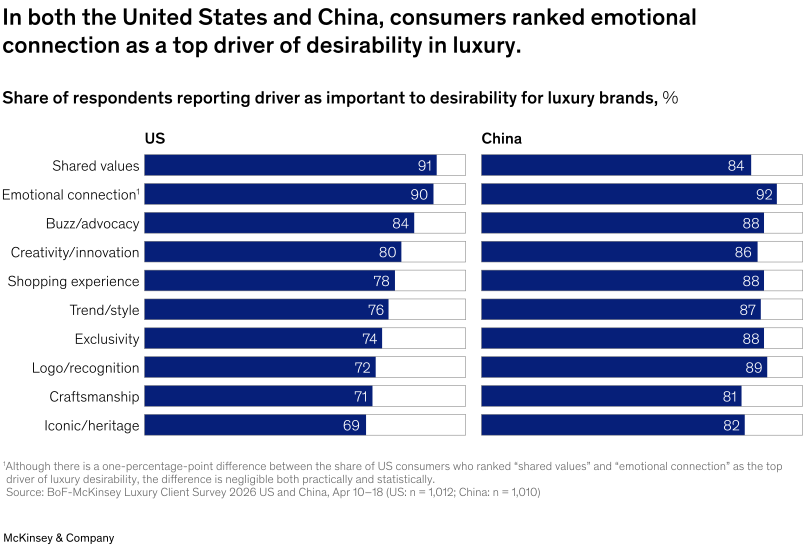
Across both the US and Chinese markets, emotional connection now ranks as a top driver of brand desirability, ahead of traditional luxury markers such as craftsmanship, heritage, and exclusivity (Exhibit 1). Consumers are looking for brands that reflect their identity, values, and aspirations, rather than simply signaling wealth or status.
How that desire is expressed differs by market. In the United States, luxury consumers are gravitating toward challenger brands: 68 percent said newer or disruptive brands better reflect their identity, compared with 63 percent who said the same of established luxury houses. When targeting US luxury shoppers, heritage brands may need to behave more like disruptors—creating campaigns that are more responsive to cultural trends, being more creative in both campaigns and product innovation, and building communities around shared values or purpose.
In China, established brands retain the advantage, with consumers placing greater value on trust, recognition, and brand authority. Here, desirability depends on visibility and high-touch service experiences that make clients feel known rather than simply sold to.
In both markets, craftsmanship and quality—while essential—have become the price of entry. Immediate desire, not scarcity, is now the strongest driver of full-price purchasing.
State of Luxury 2026 webinar
Please join our webinar to explore our State of Luxury research in more detail
(September 23 at 9 am ET) .
When anyone can buy a luxury product, what makes it exclusive?
Consumers are becoming skeptical of scarcity for scarcity’s sake. Being recognized by the right people—the “if you know, you know” crowd—is more important than being recognized by everyone.
Across both the United States and China, relatively few consumers say that a product being difficult to find is what motivates them to pay full price. Instead, exclusivity is tied to recognition, access, and experiences that feel earned rather than engineered.
Zooming into the United States, consumers rank early access to collections, limited-edition products, and membership-like benefits among the strongest drivers of exclusivity. Brands targeting the US market should create insider ecosystems built around access, community, and loyalty.
In China, exclusivity is defined less by product access than by elevated service. Consumers place greater value on bespoke services, private shopping appointments, and trusted adviser relationships. Here, exclusivity is experienced through recognition and personal attention rather than through access alone. Luxury players should therefore empower sales advisers to deliver highly tailored experiences and selectively curated access.
Perhaps most strikingly, consumers in both markets are more likely to describe challenger brands as exclusive than established luxury houses. For many clients, exclusivity no longer comes from scale, heritage, or visibility. It comes from cultural relevance, distinctiveness, and the sense that not everyone is carrying the same product.
How does a brand sell goods when experiences become luxury’s biggest competitor?
Consumers are evaluating their relationship with luxury according to the moments and memories that may be linked to a brand.
The shift is visible in how consumers say they would spend additional discretionary income. Travel ranks as the top choice in both markets, ahead of any luxury product category. But the broader implication is not that consumers prefer vacations to handbags. It is that they increasingly associate luxury with experiences that feel personal, memorable, and difficult to replicate.
In the United States, luxury clients are most interested in lifestyle experiences, such as travel and well-being-related activities. That means luxury labels now compete with boutique hotels, private clubs, wellness destinations, and cultural institutions for consumers’ time and attention. Brands should move beyond one-off events and generic hospitality to create experiences that deepen a client’s connection to each brand’s craftsmanship, provenance, styling, or collectability. Recurring engagement models (membership or wellness programs, for example) can help luxury players build loyalty and deepen the emotional connection consumers have with a brand, as would establishing a foothold in milestone moments (such as weddings or birthdays).
Chinese luxury consumers, for their part, perceive experiences to be more closely tied to the brand itself. The physical store remains a top source of inspiration when shopping for luxury goods, and the place where emotional connections and memories are created with shoppers. As a result, consumers in this market place greater value on private shopping events, personalized service, and relationships with knowledgeable sales associates. Stores should function as immersive brand theaters where storytelling, personalization, and relationship building matter as much as conversion. This may require a rethinking of success metrics: Time spent in-store or interactions with a customer on a messaging platform, for example, may matter as much as same-day transactions.
What happens when brands lose control of discovery?
Consumers are using AI tools, resale platforms, creators, and peer networks to research, compare, and validate products before they ever enter a boutique. The path to purchase is becoming more intentional, more informed, and more influenced by platforms that brands do not fully control.
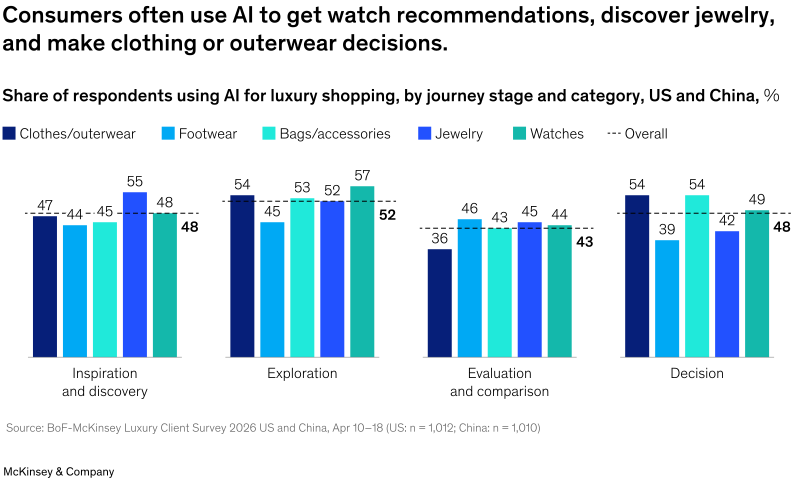
AI is accelerating this shift. Across both the United States and China, consumers most frequently use AI during the exploration phase of the purchase journey to understand product differences, compare options, and receive personalized recommendations (Exhibit 2).
Yet important differences are emerging between markets. In the United States, AI is beginning to influence inspiration and consideration, particularly among higher-spending consumers. In this market, brands may need to compete for algorithmic relevance as aggressively as they compete for cultural relevance—ensuring that product information, reviews, and brand narratives are structured to surface in AI-driven environments.
AI plays a more functional role for consumers in China, helping them navigate product specifications, quality, and comparisons. Because Chinese consumers equate luxury experiences with high-touch service, luxury brands should use AI to deepen client confidence, not reduce human interaction: Pairing high-touch advisory services with AI tools that a shopper can navigate themselves can deepen consumer engagement more than either would independently.
Resale is reshaping luxury participation just as profoundly. Established luxury consumers—not aspirational shoppers—are the most active resale buyers. For these consumers, resale is less about affordability than access—a way to discover rare, archived, and hard-to-find products beyond traditional retail channels.
In the United States, resale is driven as much by the “thrill of the hunt” as by value. Consumers view the secondary market as a source of discovery, collectability, and unique finds. As resale platforms increasingly determine which products become collectible, iconic, and investment-worthy, brands that ignore resale risk surrendering control over long-term value perception.
Similar to the functional role AI plays for Chinese consumers, resale adoption among Chinese consumers remains more trust-led than thrill-led, making authenticity, provenance, and credibility paramount. Although resale is still relatively nascent in China, brands targeting Chinese luxury shoppers will need to solve trust deficits before they can fully capitalize on AI- and resale-driven engagement.
In tomorrow’s luxury market, products may be the easier part of the equation for brands to get right. Across the United States and China, consumers are redefining what luxury should deliver: more emotional meaning, insider recognition, memorable experiences, and rewarding discoveries. The next generation of luxury leaders will be those that deliver on those intangible, irreplaceable elements that consumers value as much as the products themselves.
Download The State of Luxury, the full report on which this article is based.