Grocery is a core part of the packaging industry’s business. Food and beverage as a whole accounts for more than 40 percent of packaging revenues,1 so as European grocers face continued pressure on margins and growth, packaging players feel the squeeze.
The McKinsey State of Grocery Retail Europe report details current trends and growth opportunities in the European grocery retail market.2 Below, we explore the major takeaways for packaging companies, including where growth is likely to come from and the strategies that could help them meet grocery retailers where they are.
As grocery volumes remain essentially flat, packaging players should explore growth through mix, share, or substitution
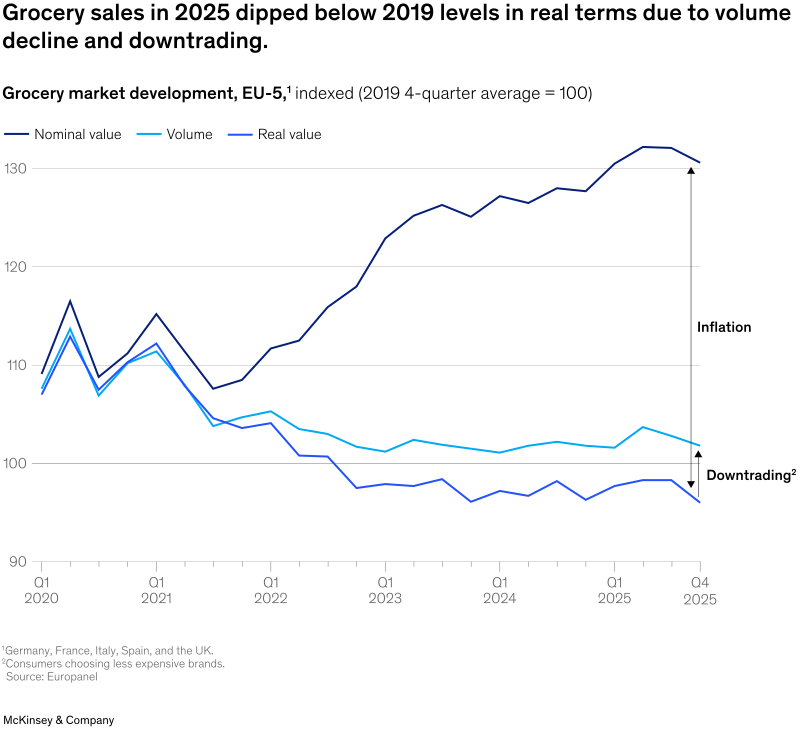
Grocery volumes in Germany, France, Italy, Spain, and the United Kingdom are just 2 percent above 2019 levels (reflecting just 0.3 percent growth annually), while real sales have dipped about 4 percent. Looking ahead, growth will likely continue at a similar pace. And while many packaging players have historically pursued growth in Central and Eastern Europe, particularly in corrugated and cartons, the outlook there is even more cautious; McKinsey analysis projects volume growth of –0.3 percent in the region from 2026 to 2030.
Packaging players will not be able to grow just by trusting the underlying market. Instead, growth in grocery will come from mix, share, or substitution, for example, launching flexible pouches to replace rigid plastic packaging or achieving a strong position with brands growing above market.
Convenience is here to stay, creating packaging opportunities in food service and food to go
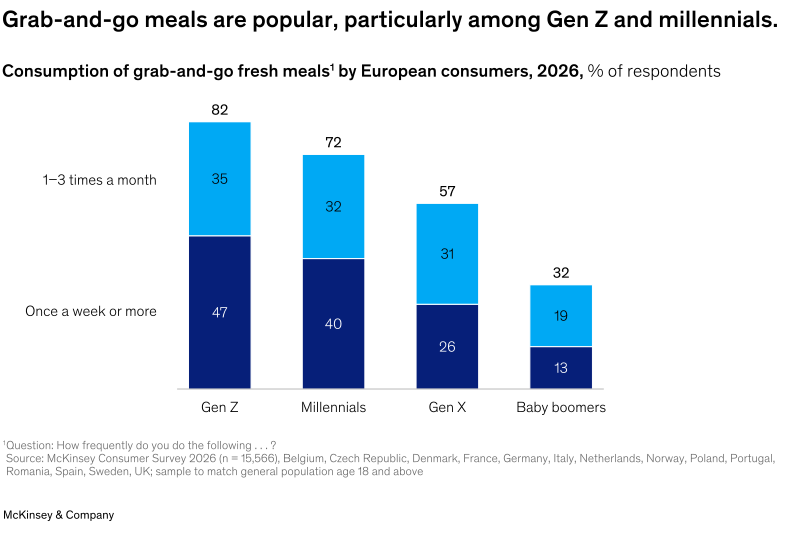
Food service is growing at a faster rate than grocery sales, at 6.8 percent compared with 4.8 percent from 2022 to 2025.3 And younger generations regularly purchase ready-to-eat meals, which have become one of grocery CEOs’ top ten focus areas.4 Some grocers are adding in-store kitchens to serve this growing demand.
The result is an area that’s more prone to growth for packaging players. Cups, trays, sandwich packs, barrier board, and the like could see increasing demand, though players may have to balance this expansion with new waste-reduction rules such as the Packaging and Packaging Waste Regulation legislation.
Growth is polarizing across retailer types, product categories, and market segments, increasing the relevance of certain packaging formats
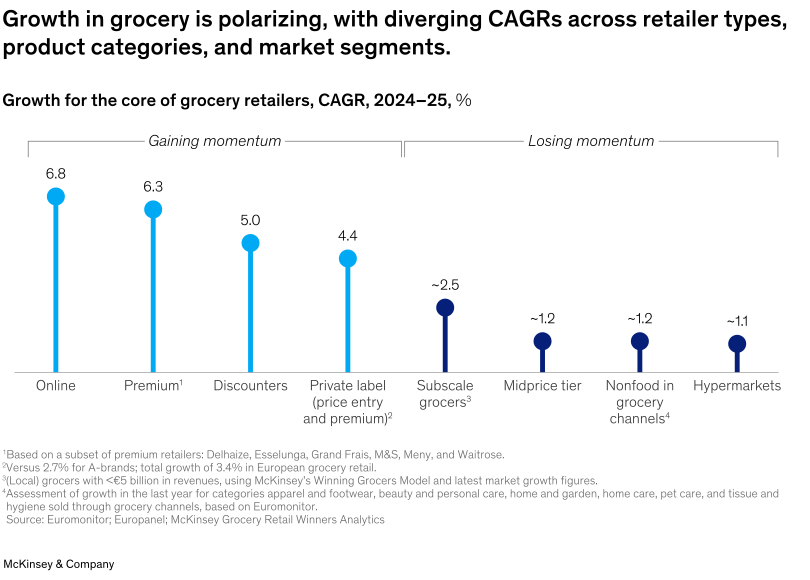
Across retailer types, product categories, and market segments, growth areas are shifting, with discounters, premium, online, and private label rising. However, growth varies by country. Consider online: In a recent McKinsey survey, 76 percent of UK consumers reported shopping for groceries online, compared with just 28 percent in Poland.5
As momentum shifts to these areas, the opportunity for packaging players is in shelf-ready and corrugated display, such as in discounters, and e-grocery packaging, particularly in high-growth regions.
Private label growth means retailers are increasingly setting packaging specifications
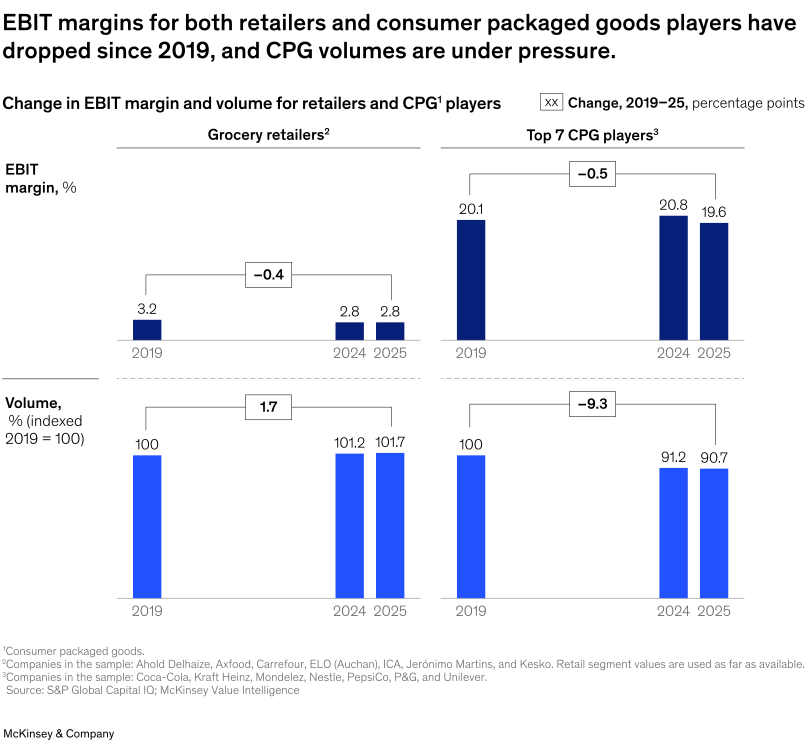
Private label grew to 40 percent of grocery value in 2025,6 up five percentage points from 2019, and could reach up to 44 percent by 2030.7 And 70 percent of food innovation launches are private label.8 With the seven largest consumer packaged goods companies being well below their 2019 levels, growth comes from outside these blue-chip customers. Even as shoppers have more disposable income, they say they intend to stick with private labels.9 While private labels are now becoming tiered brands, with premium and economy offerings, they will continue to bring a strong cost lens to purchasing decisions.
As private labels gain ground, retailers, rather than food manufacturers, are increasingly setting packaging specifications. Leading packaging companies will thus position themselves as thought partners on packaging design and specifications while also helping drive down costs for retailers. For example, they could produce more shelf-ready or lightweight packaging; explore using fewer, high-volume packaging formats standardized across brands or categories; and substitute premium materials for more cost-effective ones.
As grocers focus on costs, packaging players should consider following suit
With grocers’ EBIT hovering just under 3 percent, cost remains a top priority.10 According to McKinsey analysis, the four highest-cost programs will total more than €11 billion as grocers try to radically reduce cost of goods sold, turning to joint sourcing and purchasing gains as levers that also affect packaging.
For packaging players, cost competitiveness thus becomes a “must win,” as does aligning with areas of growth, such as private label, food service, and online retail. Now is not the time for more of the same. By rethinking their strategy, packaging players can maximize their growth opportunities in grocery.