Revenue cycle management (RCM) is undergoing a structural shift. Long treated as a back-office function focused on reactive cost containment, it is fast becoming a core strategic enabler for care delivery organizations facing sustained margin pressure, evolving regulatory requirements, and dynamic reimbursement complexities. Financial resilience—the mission of RCM—requires more than a focus on top-line revenue and cost management. It now increasingly demands building structured, integrated revenue excellence across front-end, middle, and back-end processes to bridge administrative, clinical, strategic, and technological domains.
Our latest survey of US-based leaders at care delivery organizations (see sidebar, “Research methodology”) underscores the urgency of this transition. The vast majority of respondents report that payer-related factors are contributing to aging accounts receivable (A/R). More than half anticipate additional financial pressure from H.R.1,1 and nearly half note that the cost to collect is rising.
In response, operating models are evolving, and while using AI and automation in RCM is a priority, leaders have more measured expectations for near-term returns, our survey shows. Outsourcing strategies are also shifting, with 60 percent of respondents saying they plan to change their vendor strategy over the next two years.
The implication is clear: Incremental fixes are no longer sufficient. Revenue excellence depends on disciplined investment, stronger denial prevention infrastructure, tighter vendor governance, and scalable platforms that demonstrably improve yield and cash flow. In a margin-constrained environment, stakeholders that align technology, services, and accountability with measurable and pragmatic outcomes will be best positioned to capture value as RCM transforms.
External pressures strain revenue cycle performance
Regulatory developments and payer dynamics are straining revenue cycle performance. Expanding regulatory mandates and intensifying payer friction are compressing already tight margins, slowing cash realization, and exposing myriad operational vulnerabilities across the revenue cycle.
Regulatory developments deepen financial strain
Accelerated by the COVID-19 pandemic, care delivery organizations have faced increasing margin pressures due to inflation, workforce shortages, and rising labor costs. New regulations stemming from H.R.1, coupled with recent regulatory changes such as the No Surprises Act and hospital price transparency rules, further complicate operational and financial management. More than 65 percent of survey respondents anticipate negative financial impacts due to H.R.1 alone (Exhibit 1).
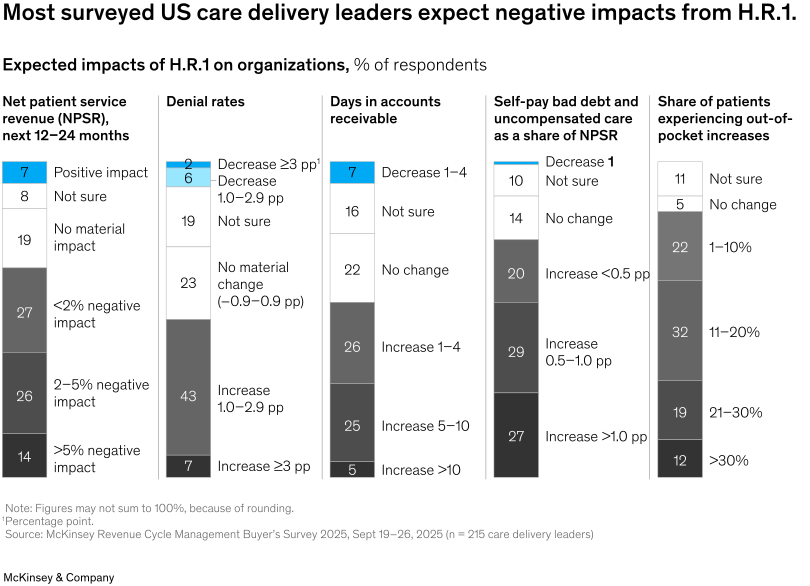
Respondents expect several pressures to intensify, further straining margins. Specifically, they foresee increases in denial of payment (50 percent), A/R days (56 percent), self-pay bad debt and uncompensated care (76 percent), and share of out-of-pocket (85 percent).
Payer friction increases margin compression
Care delivery organizations face two financial headwinds from payer interactions: net reimbursements increasingly falling below the cost of delivering care, and time to payment lengthening. Strengthening denial prevention is thus a critical aspect to help improve yield, but execution gaps persist. For instance, although 47 percent of respondents cite improving clinical denials as a top priority, only 36 percent report developing standardized processes. In parallel, appeal success for overturning denials remains low. According to our survey, an average of 2.63 percent of net patient service revenue (NPSR), weighted by response frequency, was written off due to clinical denials, representing a critical source of reimbursement deterioration.
Among respondents noting that formal payer escalations were favorably resolved less than 60 percent of the time, commonly cited obstacles include communication and coordination, such as extended review cycles or asynchronous communication with payers (30 percent); authorization-related complexities, such as prior authorization and eligibility questions (21 percent); and coding-related discrepancies or differing interpretations of coding guidelines (18 percent).
Payment delays further strain performance. Surveyed leaders acknowledge that escalated reimbursement issues often take longer to resolve than expected. A majority of respondents (78 percent) report that at least 10 percent of A/R lengthening is attributable to payer-related causes, such as pending medical records, disputed claim authorizations, or appeal backlog.2 Escalated reimbursement issues took 36 days to resolve on average,3 with only 43 percent resulting in a favorable outcome for care delivery organizations, per our survey.
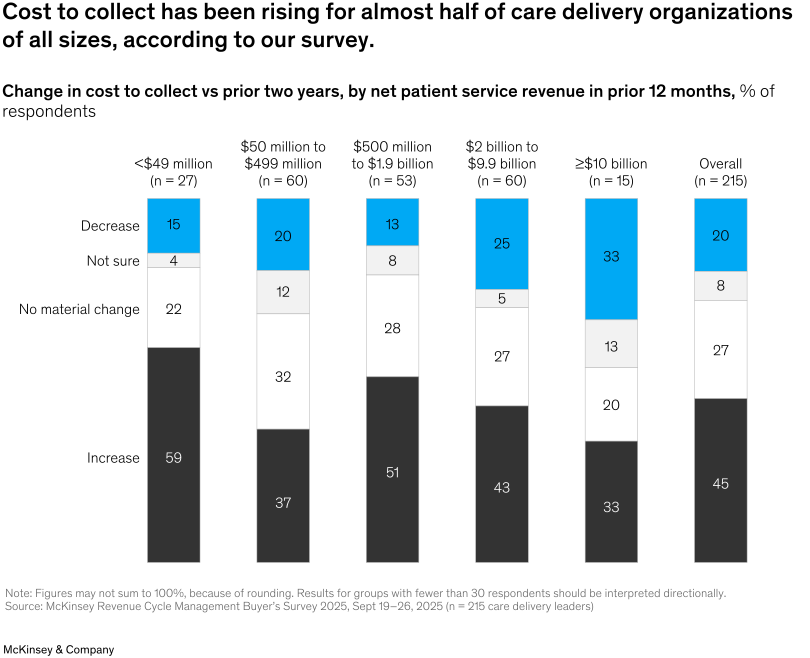
Given the pressure from regulatory and payer complexities, it’s not unexpected that 45 percent of respondents across organization sizes indicate that cost to collect has been rising (Exhibit 2).
Operating models adapt to new demands
In response to regulatory and payer complexities, care delivery organizations in our survey say they are recalibrating their operating strategies to mitigate anticipated risks. While interest in AI and automation is accelerating, surveyed leaders report that their organizations are pairing digital enablement with selective outsourcing to evolve their capabilities.
AI and advanced technology deployment are priorities, but expectations are tempered
Care delivery organizations are showing interest in expanding AI and advanced technologies to help them address pain points, with 51 percent of leaders in the 2025 survey saying AI and advanced technologies are priority focus areas. In our 2024 survey, 33 percent of respondents said AI and advanced technologies were top priorities. Automation demand in RCM is gravitating toward the functions with the greatest impact on stabilizing increases in denials, speeding up time to reimbursement and lowering cost to collect. In the 2025 survey, the most prioritized functions are improving denial management and appeals (57 percent) and documentation and coding accuracy (56 percent) (Exhibit 3).
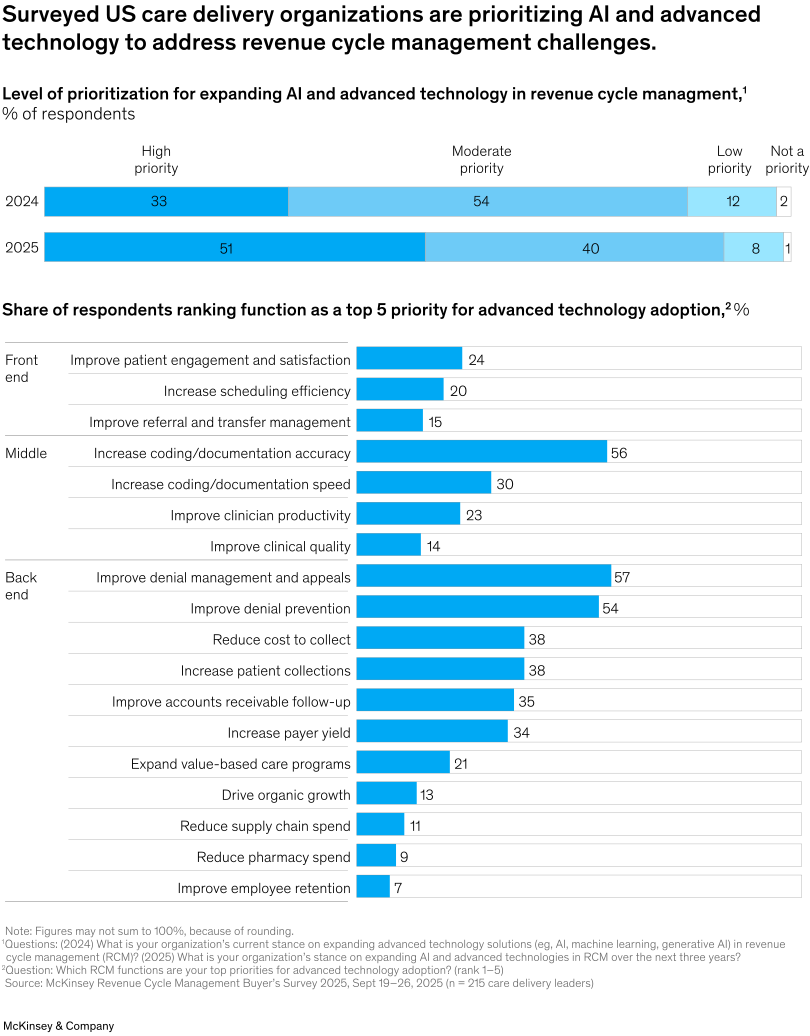
Yet surveyed leaders’ expectations for the magnitude and pace of ROI have tempered. In 2024, for example, about half of respondents believed autonomous coding could manage over 35 percent of outpatient coding volumes. However, in 2025, only a third of respondents believe 30 percent of outpatient coding volume will be automated. These results suggest a moderation in expectations, both for the extent of coding that can be automated and the proportion of leaders who buy into the automation opportunity more broadly.
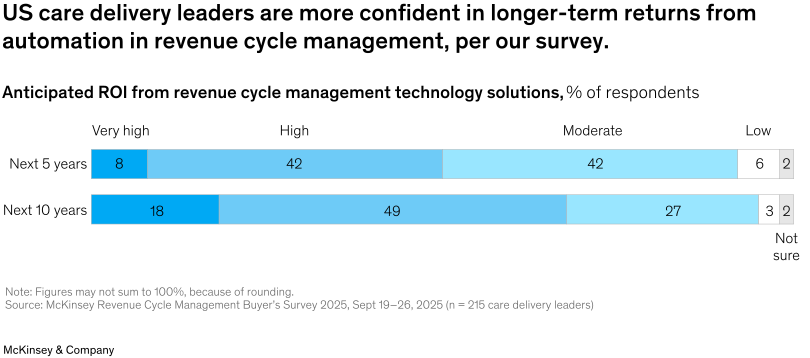
Overall, 8 percent of the 2025 survey respondents expect very high ROI from automation, and 42 percent expect high ROI over five years, compared with 18 percent and 49 percent, respectively, over ten years (Exhibit 4), largely reflecting greater confidence in longer-term returns.
Barriers to full automation include financial constraints, interoperability challenges, staff training, and change management. While no single barrier (among seven assessed) exceeded 50 percent of responses, these four surpassed 40 percent, suggesting that RCM leaders need to address challenges holistically to more seamlessly transform their workflows.
Outsourcing strategies consolidate around integrated platforms
Despite growing emphasis on automation, outsourcing to acquire capabilities remains crucial. Only 6 percent of respondents report plans to reduce outsourcing due to technology. Outsourcing interest among surveyed leaders is concentrated in the same functions where automation is prioritized—denials, A/R follow-up, coding, and eligibility/authorization—pointing to care delivery organizations implementing comprehensive and complementary strategies to address their biggest pain points. Current market dynamics favor scaled platforms that can integrate services and automation and build upon established capabilities within existing processes.
As revenue cycle pressures intensify and operational models evolve, surveyed leaders are signaling meaningful shifts in how they plan to structure outsourcing over the next three years (Exhibit 5). Sixty percent of respondents expect to change their outsourcing approach, with three-quarters of that group planning to expand their outsourcing efforts.
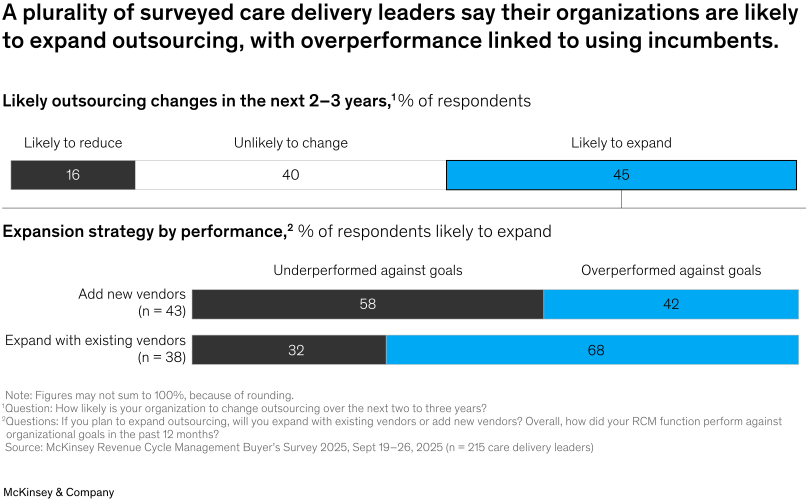
Respondents who say their organizations exceeded their RCM performance goals in the prior 12 months show a preference for expanding with existing vendors (59 percent) versus new vendors (41 percent), while those who indicate underperformance showed a higher frequency of expecting to expand through new vendors (68 percent) versus existing vendors (32 percent). This trend may indicate that incumbents with strong performance and integrated platforms that can layer automation onto existing services and workflows may prove more favorable than introducing a new vendor—and workflow—into the operating environment.
Implications for the RCM ecosystem
The 2025 survey points to distinct potential implications for care delivery organizations, vendors, and investors navigating a margin-constrained environment. As regulatory pressure intensifies, payer friction evolves, and expectations for AI moderate, stakeholders must reassess their strategy to balance disciplined investment, operational execution, and platform scale. Those that align capital, capabilities, and collaborations with measurable performance will be best positioned to capture value in the next phase of revenue cycle transformation.
For care delivery organizations
Care delivery organizations must invest selectively while tightening operations as margins shrink. Success will depend on the following:
Prioritize automation with clear ROI. As adoption of AI and advanced technology rises on the RCM agenda, expectations for immediate ROI are moderating as reality sets in. Surveyed leaders are recognizing that benefits may take several years to materialize, given financial, interoperability, and change management challenges. Deliberate governance, domain-level transformation, and avoiding pilot purgatory make AI enablement a phased transformation rather than an out-of-the-box solution. But with capital constraints and intensifying scrutiny on strategic spending, RCM leaders should be prudent and diligent when adopting automation solutions. Organizations need to continue investing in AI and advanced technology to remain competitive but should establish ROI benchmarks and prioritize credible, near-term (nine to 12 months) impact to sustain internal support.
Strengthen vendor governance. The survey indicates respondents’ sustained interest in outsourcing and preference for integrated or more comprehensive support. Among respondents intending to bring RCM functions in-house, 75 percent cite vendor performance management as a key need, compared with 41 percent of those expanding within existing outsourced functions.
This suggests that strategically managed vendor relationships can strengthen accountability. Organizations therefore have an opportunity to craft stronger contract terms that include well-defined service-level agreements, recurring KPIs with leading and lagging indicators, and provisions for financial upside and downside risk sharing that align with regulatory requirements. A “champion challenger” model, in which an incumbent solution is tested alongside a new-challenger solution in a live, low-risk environment before scaling the new solution, can provide flexibility to shift volume to better solutions.
Institutionalize denial prevention. Denials remain a key source of margin pressure. Survey results reveal that respondents with dedicated, standardized denial prevention processes report greater success in appeals (47 percent success rate), compared with those with limited or ad hoc prevention resources (37 percent) or varied staff across departments (42 percent) (Exhibit 6).
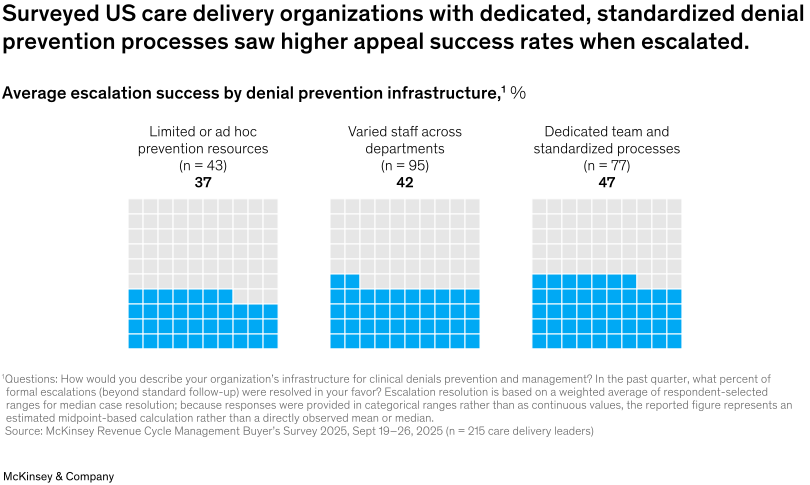
However, many organizations still underinvest in denial prevention and instead rely primarily on downstream appeal management. To help improve yield, a more effective approach would integrate prevention and recovery efforts, supported by cross-functional infrastructure that addresses root causes across clinical, operational, and payer-facing workflows. Key actions center on improving upstream processes: confirming medical necessity before delivering services, embedding clinical validation support to ensure accuracy of medical-necessity documentation and coding, standardizing processes to enable complete and compliant submissions, and improving transparency into the root causes of denials. Joint operating committees with escalation infrastructure for payer engagement and analytics-enabled insights into denial drivers may also help leaders. Additionally, AI-enabled feedback loops can slow denial inflow and strengthen overturn rates, while automation reduces manual burden.
For vendors
Vendors must pair innovation with measurable performance as care delivery organizations’ expectations sharpen. Differentiation will hinge on the following:
Prove tangible ROI from AI. Vendors should focus on AI applications that provide demonstrable value, particularly in areas of high demand among care delivery organizations, such as AI solutions that improve coding accuracy, identify denial root causes, and automate A/R follow-up. However, in the context of lowered expectations, now is the time to focus on value over hype and to establish arrangements that align with care delivery organizations’ priorities.
Half of surveyed leaders note they plan to pursue modular, integrated solutions (flexible components that can be adopted over time and connect seamlessly into a unified system), and 21 percent say they expect to pursue point solutions. Given the disproportionate interest in modular solutions, vendors should prioritize interoperability and broaden offerings to expand into critical adjacent workflows to build an increasingly integrated ecosystem. Aligning with these preferences can help accelerate adoption and demonstrate ROI from AI earlier, as modular offerings can enable care delivery organizations to realize incremental value, validate performance, and scale capabilities over time—creating proof of value that enhances long-term loyalty.
Among organizations likely to outsource, the top buying factors are maintaining operational control, ease of onboarding and implementation, and pricing structure, per our survey. For those planning to expand with existing vendors, the top priorities were interoperability, quality performance, and breadth of capabilities. With respect to organizational size, a higher proportion of respondents from smaller organizations note that cost to collect has increased (44 percent) versus larger, at-scale organizations (33 percent).4 These differences shape organizations’ outsourcing priorities and value expectations, underscoring the importance of aligning AI offerings with what buyers value to clearly demonstrate ROI.
Reduce payer friction. Vendors can enhance their offerings by prioritizing capabilities that improve interactions between payers and care delivery organizations, such as optimized documentation processes, appeals automation, A/R follow-up, and payer engagement tools. Successful vendors can further distinguish themselves by providing services alongside tech-enablement tools to help customers address execution gaps where staffing or expertise is limited.
Lead on denial prevention. Denials are a persistent pain point, and a majority of surveyed leaders say their organizations lack the infrastructure to prevent (64 percent) and manage (47 percent) denials. This imbalance signals a growing demand for more scalable, purpose-built solutions that can strengthen denial prevention and improve recoveries. Vendors that can address root causes upstream while improving downstream overturn rates may find themselves better positioned than those focused solely on reactive denial management.
Vendors can link targeted denial solutions to a comprehensive platform that includes AI capabilities to predict and mitigate the root causes of denials before appointments or billing. The greatest impact comes from integrating prevention and recovery capabilities and embedding technology-enabled feedback loops that continuously inform upstream workflows based on downstream denial trends.
For investors
Investors must apply disciplined capital allocation as differentiation within RCM accelerates. Value creation will depend on the following:
Back scalable modular solutions. Surveyed leaders are favoring interoperable, multiworkflow platforms over fragmented point solutions. Investors should thus prioritize vendors with scaled or scaling platforms with broader modular workflows and strong data interoperability, particularly across coding, denials, A/R follow-up, and authorization. The market favors modular platforms that combine focused performance with scalable breadth to avoid both narrow point tools and unfocused end-to-end offerings.
And with nearly half of respondents expanding outsourcing through incumbents, switching costs and vendor stickiness are rising. This means that additional opportunities include expanding into adjacent payer-facing workflows, such as vendors improving denial overturn rates, escalation issue resolution, and A/R performance.
Prioritize validated ROI. AI adoption is accelerating, but capital should flow to vendors with validated, defensible ROI and proven automation technologies. Investors should therefore prioritize assets with validated AI use cases, repeatable performance metrics, and customer references showing tangible improvement. Vendors that differentiate through derisked adoption models (such as invested pilots, performance-based pricing, and embedding AI within tech-enabled services) that align incentives with care delivery organizations’ outcomes represent attractive investment opportunities.
Invest in payer-facing capabilities. Vendors that address reimbursement complexities represent high-growth investments. Those that reduce payer rework and improve yield through documentation integrity, predictive-denial prevention, underpayment recovery, authorization optimization, and tools that surface contract misalignment or overlooked reimbursement are best poised to scale. Embedding regulatory intelligence into these workflows will help care delivery organizations manage rising complexity and mitigate the potential downstream effects of new requirements, such as those in H.R.1. Successful vendors will be those that act as intermediaries between payers and care delivery organizations, not just workflow enablers.
Our 2025 survey results suggest that care delivery organizations that treat RCM as a strategic capability will be better positioned to withstand tightening margins and increasing reimbursement complexity. Progress hinges on disciplined investment, stronger cross-functional governance, and partnerships that deliver measurable operational and financial outcomes. The organizations that translate these priorities into consistent operational execution will be better positioned to strengthen financial resilience as revenue cycle dynamics continue to evolve.