



The data points in this blog post are based on research by McKinsey Panorama.
If banking seems to have one constant in recent years, it’s relentless innovation. And the pace isn’t slowing: Institutions continue to introduce new products and tools and evaluate existing ones, and many of the innovations that were leading-edge just a few years ago have become business as usual. The challenge? How to make sense of it all.
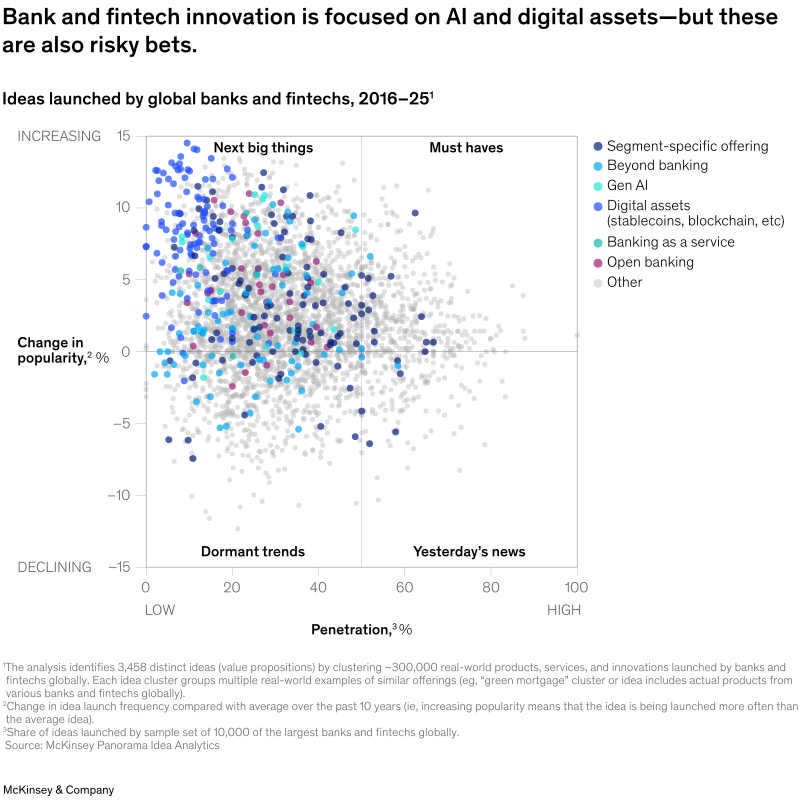
We used AI to do just that, examining the banking industry’s past to provide clues to its future. Using Idea Analytics, McKinsey Panorama’s new gen AI–enabled platform for tracking banking innovations (for more, see sidebar, “More about McKinsey Panorama and Idea Analytics”), we drew from 20 million data sources and a decade’s worth of more than 300,000 real-world banking products and services to map almost 3,500 unique ideas by market penetration and launch frequency (exhibit).
Four key insights for banking
Our research yielded four key insights for the banking industry to consider:
- The industry remains awash with “next big things,” demanding it accelerate its ability to cope.
- Two “next big things” dominate: AI and digital assets, such as blockchain. And both remain untested at scale.
- For all the efforts to tailor customer journeys, the industry still isn’t there. But AI offers a new path to personalization at scale.
- Coping with the innovation crush requires banks to adopt a high-speed portfolio-management approach similar to a venture capital (VC) firm or start-up incubator.
A dot plot shows the ideas launched by global banks and fintechs from 2016 to 2025. The y-axis plots change in popularity, which is the change in idea launch frequency compared with average over the past 10 years, in percent. The x-axis plots penetration, the share of ideas launched by sample set of 10,000 of the largest banks and fintechs globally, in percent. Ideas are mapped into four quadrants. The “yesterday’s news” quadrant includes those with high penetration but declining popularity. The “dormant trends” quadrant includes those with low penetration and declining popularity. The “must haves” quadrant includes those with high penetration and increasing popularity. Last, the “next big things” quadrant includes those with low penetration but increasing popularity. The “next big things” quadrant holds the majority share of ideas related to segment-specific offerings, beyond banking, gen AI, digital assets (stablecoins, blockchain, etc), banking as a service, and open banking.
Insight 1: The industry is drowning in ‘next big things’
Our analysis shows the banking sector has thousands of “next big things”—products and services with high launch frequency but low penetration, represented in the top-left quadrant of the exhibit. This points to the challenge facing banks, which today have disproportionate exposure—and expend heavy resources—innovating and experimenting with unproven technologies. The solution is not to stop advancing but for the industry to accelerate its ability to understand trends, incubate ideas, and quickly analyze what’s working (and what’s not).
Insight 2: Innovation is dominated by AI and digital assets
Two next big things dominate, and it isn’t close. AI and digital assets products sit at the very top left of the top left quadrant, accounting for around 70 percent of the top 1 percent of ideas ranked by penetration and growth. Yet both remain untested at scale, and for AI specifically, positive momentum has not translated to universal adoption: While 88 percent of companies have adopted AI in at least one business function, just 7 percent have deployed it fully. If banks want to transform their operating model, merely deploying AI is not enough; our analysis suggests competitive advantage will come from integrating it into core decision-making and revenue engines.
Insight 3: AI finally offers a path to personalization at scale
Banks have long undertaken efforts to tailor customer journeys, leaving related products firmly in the high-penetration quadrant of our matrix. Yet while once-revolutionary ideas such as customized senior financial packages, multitier banking loyalty, cash back rewards credit cards, and tailored working-capital financing solutions are now widely adopted and no longer drive differentiation on their own, true personalization remains out of reach. AI has the potential to change that.
Insight 4: High-speed portfolio management is essential
The dizzying array of products and services—all with varying degrees of sophistication, maturity, and long-term viability—underscores the need for high-speed portfolio management within multispeed banking organizations. What’s required is managing innovations critical to core operations with care and control while adopting a high-speed approach similar to VC firms or start-up incubators for other parts of the portfolio. That means making decisions much more rapidly about which next big things will fail, which could serve profitable niches, and which are likely to become business as usual.
The ability of banks to gain an advantage through innovation is increasingly shaped by product and service prioritization, not volume. And the explosion of products and services in the past decade has made it hard to clearly identify how the industry has changed and where future opportunities may lie. Taking a panoramic view could make all the difference, empowering leaders with the information they need to make more precise and deliberate strategic choices.
For a PDF version of this article, click here