On a large construction project, a small hang-up can quickly become a much bigger problem. For example, a field superintendent discovers that prefabricated pipe spools no longer fit because of a late engineering change. That might trigger days of requests for information (RFIs), drawing reviews, procurement checks, schedule updates, and cost assessments, while crews wait or work around the problem.
In an agentic future, the superintendent captures a photo of the issue on a mobile device. Within minutes, AI agents compare the image with the latest 3D model, engineering drawings, procurement records, and construction schedule. They identify the likely cause, draft routing options, check material availability, estimate cost and schedule impact, and recommend a path forward.
Human experts remain in control. The discipline engineering lead approves a solution while procurement and construction teams check material availability, fabrication requirements, constructability, and execution constraints. Rather than spending days assembling information from multiple functions, project leaders receive a consolidated view of options, trade-offs, and implications within hours. They quickly decide whether to modify the design, reorder materials, rearrange work, or deploy crews elsewhere until the issue is resolved. In parallel, agents update the project execution plan and send the field superintendent recommendations to adjust the work sequence to improve schedule, cost, and margin performance.
This example is among many potential transformations created by AI and illustrates the future that is beginning to take shape among leading architecture, engineering, and construction (AEC) firms. When agents handle routine tasks, people can focus on making decisions about pricing, risk, and other areas that require human judgment and fuel differentiation. Those that employ this approach early may be best positioned to rewire their businesses to unlock value from AI, while those that treat AI as a more superficial productivity tool could cede its potential to partners, clients, or new competitors. In this article, we explore what AEC leaders can do now and over the next few years to redesign work, create value from their data, automate their entire operating systems, and turn AI into a source of lasting competitive advantage.
AI’s inflection point in AEC
AI is unlikely to be an extinction event for AEC firms, but it could meaningfully change who leads the industry. Early adopters are reporting productivity gains from design, modeling, and construction-feasibility workflows, though these advantages will likely soon be table stakes. The McKinsey Global Institute (MGI) projects that the AEC industry could unlock roughly $228 billion by 2030 in annual value in the United States through AI and other automation technologies, while in Europe, the impact on the construction sector alone could equate to roughly $126 billion.
Focus on redesigning domains
As work becomes faster and cheaper to deliver industrywide, the leaders will be firms that use AI most effectively to control client relationships, workflows, and their underlying data. This means focusing on transforming domains—end-to-end processes that are small enough to be redesigned independently but large enough to deliver meaningful business impact—instead of deploying isolated use cases.
AEC, in its broadest sense, is one of the world’s largest industries: Global construction output was about $15 trillion in 20251 and projected demand could reach $22 trillion by 2040. Yet labor productivity has stagnated. Construction productivity improved by only 10 percent, or 0.4 percent annually, from 2000 to 2022, compared with 90 percent, or 3.0 percent annually, in manufacturing. On its current trajectory, construction output could fall short of demand by up to $40 trillion cumulatively by 2040.2
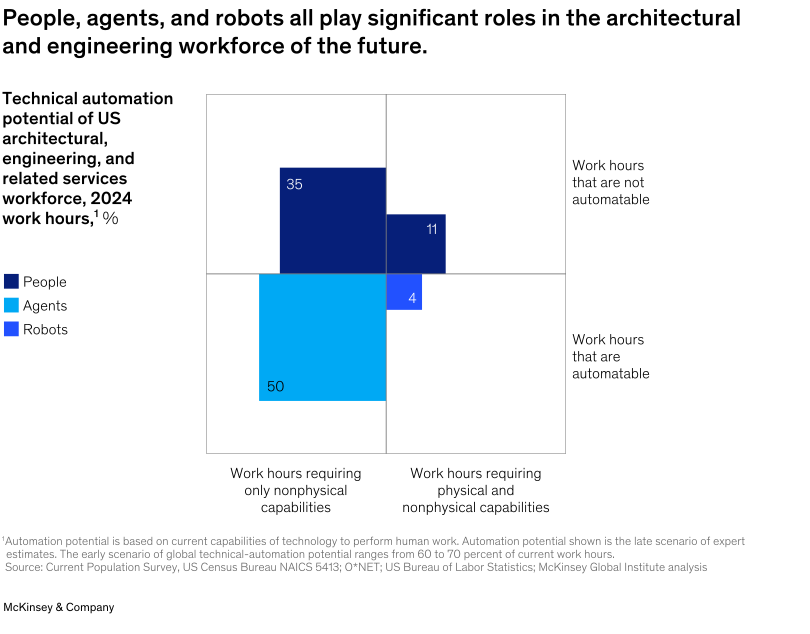
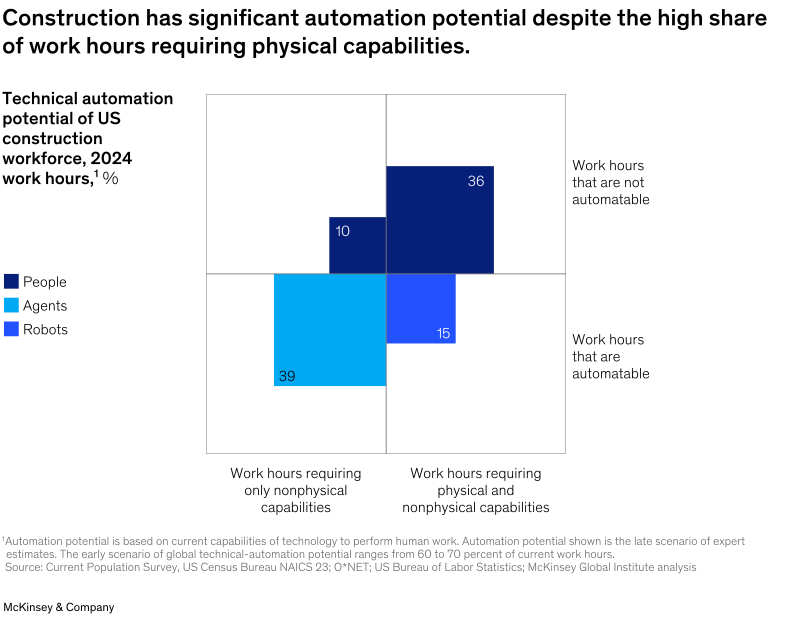
If deployed effectively, AI could automate a significant amount of nonphysical work in the AEC industry, according to an MGI analysis (Exhibit 1). AI is unlikely to solve the industry’s productivity challenge on its own, but it is one of the first technologies with the potential to address knowledge work, coordination work, and physical execution together (see sidebar “Why agentic AI differs from past tech waves in AEC”). In practice, AI adoption will take time, and companies will only automate work when they have a compelling business case and an appropriate solution for specific tasks.
Improving efficiency and consistency is crucial
For AEC firms, the value of AI lies not only in faster work on new builds and larger, more complex projects but also in more consistent work. Today, performance often depends disproportionately on the judgment of experienced professionals who have “seen this movie before.” That creates risk because a small number of people control so much knowledge, which limits how consistently companies can deliver projects and price their services.
AI can capture lessons from prior projects—including schedules, requests for information (RFIs), change orders, and numerous task-level decisions—and make them available to teams inside daily workflows. For example, a junior planner could be warned about a sequencing risk that a veteran scheduler would have spotted. A designer could see constructability issues before contractors discover them in the field and submit RFIs. Human experts still would own judgment, accountability, and trade-offs. But when accumulated experience lives inside the workflow rather than inside individuals’ heads, the whole firm benefits.
As agents become embedded across functions, more value and profit will go to firms that control three things: proprietary project data, the workflows where decisions get made, and the ability to charge for outcomes rather than hours.
Larger design practices, specialty contractors, technology platforms, asset owners, and trades with privileged project data may all find new ways to capture value from AI. But they also may face competition from emerging AI-native companies that launch new services and platforms to directly compete downstream from the tools and software offered today.
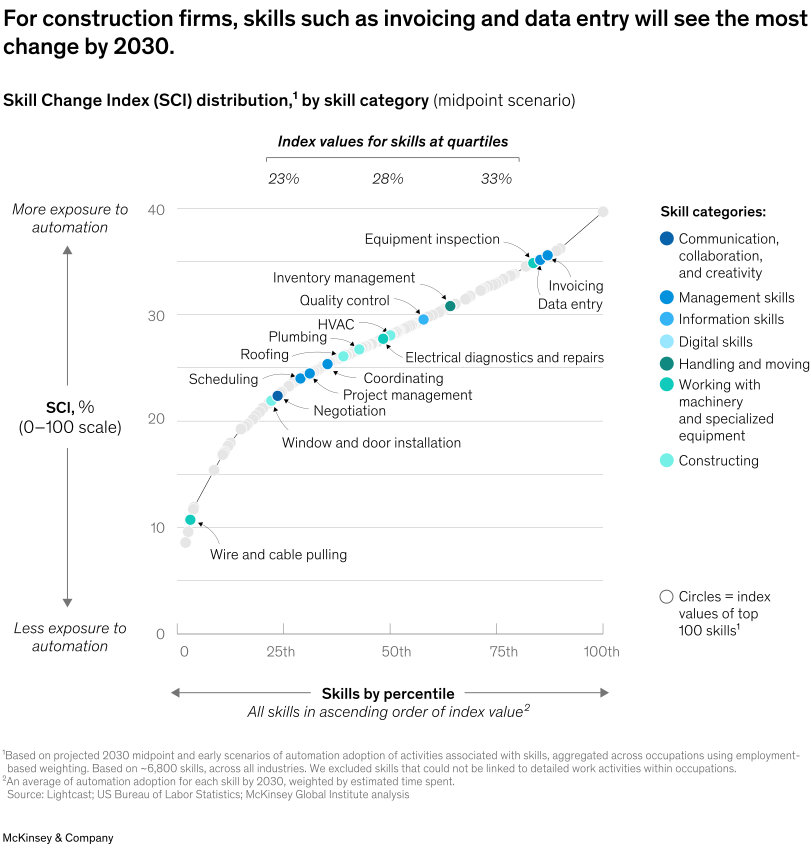
Much of AI’s value could come from areas where time, money, and margins are lost today, and where AI can quickly improve efficiency. Areas such as invoicing, data entry, and equipment inspections are expected to change the most by 2030 (Exhibit 2). Firms that control these layers may gradually capture more value than those that own only major project deliverables. How that value shifts depends on adoption speed, data access, commercial models, and where human judgment remains critical.
Key areas of impact in the months and years ahead
AI value in AEC is expected to unfold across three time horizons. In the near term, leaders can use agents to streamline knowledge work and coordination workflows. In the medium term, companies can gain an advantage by turning project data into reusable institutional assets. In the long term, AI will increasingly connect design, planning, logistics, equipment, and site execution into a more automated operating system.
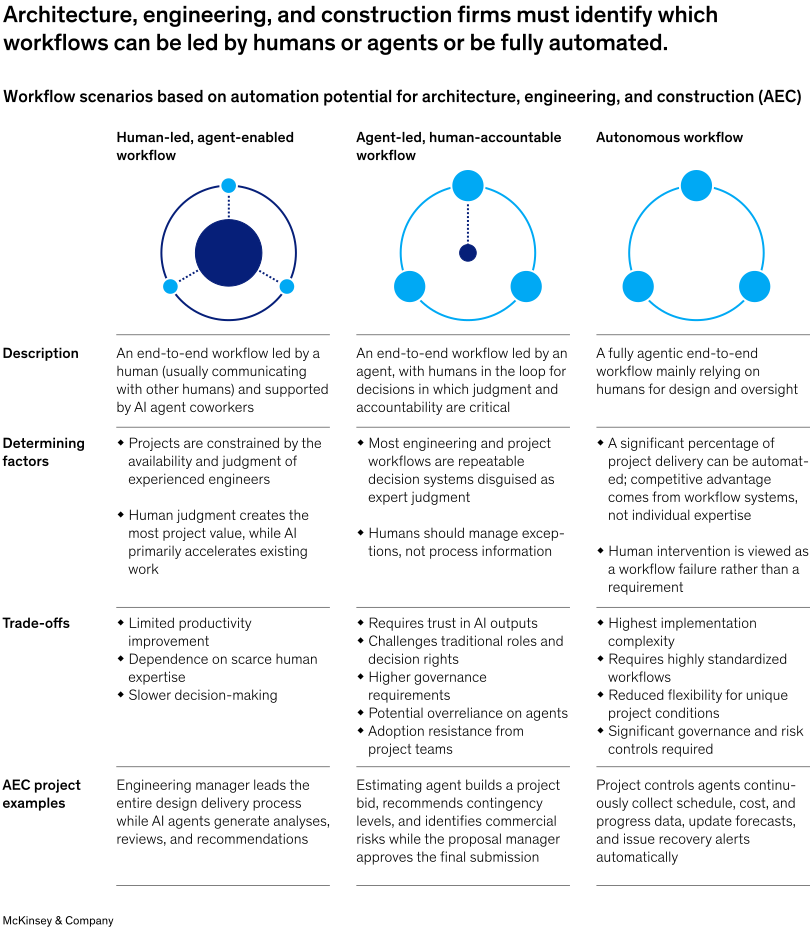
Our analysis shows that there are more than 150 workflows across 25 AEC-related domains, with varying degrees of AI and automation potential. To create value, leaders should determine which workflows would be best led by humans and supported by agents, led by agents with humans making critical decisions, or fully automated (Exhibit 3).
Near term (first 18 months): Streamlining end-to-end workflows
In the near term, the biggest gains are expected to come from streamlining repeatable workflows where fragmented information creates delays, rework, and inconsistent decisions, including the following workflows that cut across the project life cycle:
- Win and price the work: This includes conducting bid/no-bid analysis, proposal drafting, estimating, benchmarking, scope normalization, and pricing scenarios.
- Design and engineer for constructability: This includes performing design checks, specification review, code and standards interpretation, value engineering, and design-to-fabricate constraints.
- Plan and procure: This includes handling schedule development, look-ahead planning, sequencing, material availability checks, equipment needs, procurement packages, and contract-obligation tracking.
- Build and control: This includes managing RFI and submittal triage, progress tracking, cost forecasting, variance narratives, change-order routing, claims support, safety observations, and quality checks.
- Run enterprise support: This includes executing finance closing, invoice validation, compliance, document control, knowledge search, onboarding, and other repeatable back-office workflows.
The key is to use AI to connect these activities across teams and project stages, rather than to optimize isolated tasks. A schedule agent, for example, creates more value when it is connected to procurement, design changes, cost forecasts, and field conditions than when it is used as a stand-alone planning tool. The firms that succeed with AI in the near term will be the best at orchestrating agentic work across workflows. Many of these agentic solutions can be implemented midway through a project to partially capture the value, meaning there is no need to finish all ongoing work before embarking on the AI journey.
Medium term (18 to 48 months): Leveraging data advantages
Most AEC firms have enormous archives of drawings, RFIs, specs, and close-out reports, but most are unusable because they are inconsistent, paper-based, and siloed across systems, among other issues. Data becomes an advantage only when firms capture it at the point of creation, structure it so it can be reused, track its origins and meaning, and retain the rights to learn from it over time.
The primary advantage, or competitive moat, may come from firms capturing information as work is happening rather than piecing together value later from fragmented records. Historical project files tend to record what was decided, but information captured during the actual work process can also show how and why a decision was made, including the alternatives considered, assumptions made, and trade-offs accepted—information that is much harder for competitors to replicate.
Another competitive moat comes from creating a learning loop to train AI models. A firm that systematically connects estimates to actual results, schedules to real-world progress, design choices to constructability outcomes, and risk decisions to actual claims data can build a self-improving system.
Vendor data rights are another advantage that AEC leaders consistently underestimate. As AI capabilities improve, technology vendors are pushing harder to access project data and the rights to learn from it and reuse it to create new products, or to put guardrails around how their products or software can be used to train proprietary models. They are also increasingly competing to control workflows, learning loops, and business opportunities built on top of project data. Firms that overlook the details of vendor agreements risk giving away too much control and long-term advantage. When establishing vendor relationships, firms must be careful about whether they can easily move their data, keep it separated from other customers, or leave a platform without losing information so they can retain the benefits of their AI adoption efforts.
Additionally, AI may reframe the role of building information modeling (BIM). Instead of treating BIM as a static file delivered at the end of a project, firms can use AI to transform it into a live, continuously updated view of the project throughout its life cycle. This would enable firms to automatically track installed materials, project progress, schedule risk, and project performance rather than relying on manual field reporting. As AI gets better at verifying and tracking project activity, firms can use real-time data and documented evidence to inform approvals, payments, and risk decisions.
Further, near the end of projects, agentic workflows can verify that punch list items and project documentation are complete and prepare information needed for maintenance, warranties, and performance workflows. Project handover could become the start of longer-term service relationships that include building maintenance, diagnostics, and performance improvement. Firms that secure clear rights to project data and use open, portable standards may be better positioned to continue delivering value to clients after construction is complete.
Even as AI enhances workflows, domain expertise will still matter over the medium term, possibly even more than it does today. Real value will come from knowing how to interpret agentic outputs, when to ignore or adjust AI recommendations, and how to apply standards in real-world project conditions.
Long term (beyond four years): Unlocking value on site
Construction work will remain physical, local, and safety-critical. Over the long term, on-site value from agentic AI will come from orchestrating and progressively automating the entire site operating system. Moving beyond initial areas of improvement, such as progress tracking, quality control, and equipment dispatching, AI will likely eventually support autonomous construction equipment, yard logistics, optimized haulage, and transportation coordination between factories, yards, and the site.
These systems can use real-time data to determine what should move, when it should happen, who or what should do it, and what safety controls are needed. AI can also shape designs that are easier to manufacture, transport, lift, install, and inspect. By incorporating constraints such as standard module sizes, transport limits, and manufacturing tolerances early in design, teams can simplify field work and reduce costs, scheduling delays, and safety risks.
Robotics and humanoids are likely a longer-term development. Large-scale use in construction, for tasks such as moving heavy materials, welding, and plumbing, is potentially a decade away. But AEC leaders can seek commercial terms that specify who captures the value when it arrives. Firms that wait to renegotiate contracts until automation is table stakes could find that the financial upside has already shifted to owners and technology platforms. Until AI is deeply integrated into site operations, the speed of field work will continue to limit how much digital productivity translates into real project output.
Implications for pricing and partnerships
As AEC companies reimagine workflows, commercial models, and the industry, structures will likely shift. Leaders need to consider how to capture value from agentic AI through new pricing and partnership models.
From selling effort to selling excellence
AI will reduce the amount of labor hours needed in an industry that often charges clients based on time spent working. Without new commercial models, firms may give away productivity gains. The opportunity is not only to shift from charging for time and materials to charging fixed fees, but also to transition from selling capacity to selling excellence with fewer surprises, more reliable schedules, lower risk, and better project outcomes. Firms can adopt outcome-based models, including fixed fees, milestone payments, shared savings, risk-monitoring services, or performance-linked incentives.
Buy, build, or partner depending on where competitive advantage lies
Historically, the largest technology shifts in AEC, such as computer-aided design, BIM, cloud platforms, and project-management software, came from outside the industry. AEC firms have historically struggled to build and scale software products, and AI is advancing too quickly for most incumbents to rely primarily on internal development. Partnerships and acquisitions can provide models, product talent, and operating playbooks faster than most firms can build them. Recent acquisitions of AI technology companies by established AEC firms show that industry leaders increasingly see AI-focused startups as important sources of technology, expertise, and talent.
The decision to build, buy, or partner can be made by focusing on where the competitive moat lives. Firms can build in areas where they have distinctive advantages that competitors or vendors cannot easily replicate, such as proprietary data, specialized workflows, strong client relationships, or accountability for project delivery. In other areas, partnerships or acquisitions may make more sense (see sidebar “Own the engine, do not assimilate it”). Most AEC firms overinvest in building generic AI capabilities and underinvest in strengthening areas where they have lasting strategic advantages, including systems and workflows where core decisions are made.
AI reduces effort but not accountability
While AI can make many tasks easier to perform, it does not reduce the need for accountability. Project owners may start automating document-heavy and early-stage work, but they are less likely to take on responsibility for work that requires significant problem escalation, judgment, and risk management.
Firms that automate routine paperwork while strengthening their role as trusted experts are more likely to protect the parts of the business that remain hardest to replace. This creates a quieter challenge, however: Many tasks that AI is automating now are what junior staff traditionally have used to build experience and judgment. AI could concentrate expertise within a smaller group of senior professionals, weakening the training pipeline as firms become more dependent on expert judgment.
Firms may need to train junior staff more intentionally through structured reviews, simulations, explicit standards, and exposure to real project failure cases. Otherwise, they risk creating a generation of workers who learn how to operate AI tools without developing the judgment, pattern recognition, and risk awareness needed to lead complex projects and handle difficult situations in which clients expect a human to own the consequences.
AEC firms also must prepare for an important governance issue. Formal regulation may take time to catch up with AI, but practical limits on how the technology is used could arrive sooner through contracts, insurance requirements, and customer expectations. Companies will increasingly need clear records of how AI was used, what data it accessed, what checks and controls were applied, and where people reviewed or approved the work. Professional engineering bodies are already beginning to update their codes of conduct to reflect the use of AI, mandating that its use be proportional to the risks it entails. Audit trails, human oversight, and strong AI governance will become essential for winning and sustaining client trust.
What leaders can do now: A winning agenda
Based on our work, we have developed a six-step playbook for AEC leaders to follow on their journeys to integrate agentic AI into their operations.
- Prioritize three to five high-value workflows. Start with areas where cost, schedule, risk, and performance variability are highest, such as estimating, constructability review, and schedule risk. To minimize bottlenecks, prioritize implementation in workflows where performance today depends heavily on a small number of experts.
- Redesign the work, not just the task. Reconfigure workflows so agents retrieve information, draft outputs, flag risks, and route decisions while humans own judgment, accountability, and trade-offs. By embedding the organization’s best accumulated experience into redesigned workflows, every team benefits from lessons learned across the portfolio.
- Build data products around workflows and capture them as work is being done. Treat project data as reusable assets with clear ownership, quality standards, traceability, and access rights. Data should be structured around the decisions it supports, not just stored for compliance. Also, negotiate vendor data rights, portability, and customer data separation as important strategic issues, not just technical contract details.
- Update commercial models in parallel with AI deployment, not after. Move away from charging for hours toward charging for outcomes. Waiting until clients can clearly see productivity gains may hinder pricing renegotiation. Make deliberate decisions early about which productivity gains to pass on to clients, which to reinvest into higher-value work, and which to keep as improved margin.
- Choose where to build, buy, or partner. Build AI capabilities only in areas of lasting competitive advantage. Partner or acquire everywhere else, particularly on tools that improve coordination and workflows between systems. When acquiring technology providers, behave like a supportive customer and give their teams autonomy so the technology gets used on real projects. When partnering, be aggressive but selective. Share enough to create value while protecting the proprietary data, workflows, and know-how that differentiate the business.
- Scale with governance and measure what matters. Maintain human oversight, audit logs, risk controls, data security, insurer-ready documentation, and role-based training. Consider how to use AI as a part of daily project delivery, not a collection of pilots. Track outcomes that reflect real business and operational impact. Avoid relying on metrics such as the number of software licenses deployed or pilots, which may overstate progress. Measure whether AI is improving project delivery and business performance to be better positioned for potential changes in market conditions.
Capturing value from agentic AI requires more than adopting new tools; it means rewiring commercial and operating models. The value is larger than an individual company’s performance. It can extend to society at large through lower-cost infrastructure, faster delivery of housing, more reliable energy and industrial projects, safer maintenance, and better use of scarce engineering and construction talent.
AEC leaders who act early can use lessons learned across projects to reshape how their firms create value. Firms that move too slowly may find that competitive advantage gradually shifts to competitors, vendors, AI-native startups, or even clients themselves.