Transformers are one of the most critical components of the power system. They connect offshore wind to the transmission grid, enable utilities to minimize new grid build-outs, and carry the growing demand for electricity. Every unit of electricity passes through several transformers before reaching its final destination, making transformers one of the most ubiquitous and consequential links in the entire power system.
Because they are so critical, any shortfall in transformer supply reverberates across the grid. An unavailable transformer can stall interconnection queues, delay new capacity additions, and push back grid build-out timelines.
For most of the past two decades, this risk was mostly theoretical. Annual power demand was largely flat in Europe and North America, with North America recording modest growth of less than 2 percent per year in the early 2020s.1 Few new power plants were built, and grid expansion proceeded at a measured pace. Transformer demand was predictable, with steady order backlogs and utilization rates.2
However, the market has changed. A structural rise in electricity demand, driven largely by increasing electrification across industries and data center expansion, has led to a global surge in grid investment. At the same time, the shift toward renewable energy sources is increasing transformer demand compared with traditional energy sources. The transformer industry has absorbed the excess demand by stretching its capacity, but there are limits to what can be done to extend supply. The market has roughly doubled, tipping the industry into a supercycle, which has implications for the transformer value chain.3
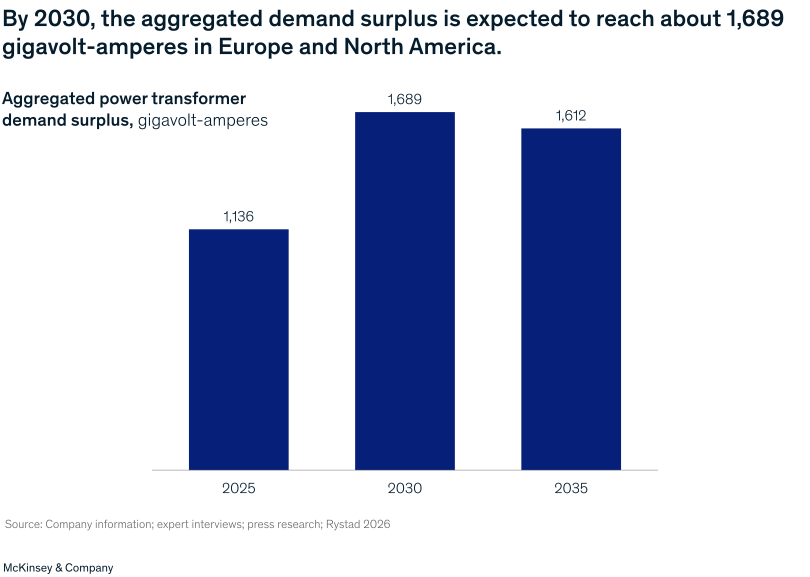
Now, a second phase of the supercycle is beginning, with global transformer demand expected to grow at about 3.5 percent annually, resulting in a 40 percent increase by 2035.4 But the system is already running at its limits, with supply being the limiting factor for several years. This development has led to a global supply backlog that reached more than 1,000 gigavolt-amperes (GVA) by 2024 and is expected to grow to approximately 1,690 GVA by 2030.5 Considering Europe and North America, the served power transformer market demand is expected to grow at a CAGR of approximately 8.3 percent until 2030, reaching approximately 1,000 GVA due to supply-side expansions.
In this article, we explore what is driving transformer demand, why supply has struggled to keep up, why secure access to transformers is becoming a strategic priority, and the implications for the transformer value chain as well as the implications for utilities, developers, manufacturers, and investors.
The demand drivers behind the supercycle
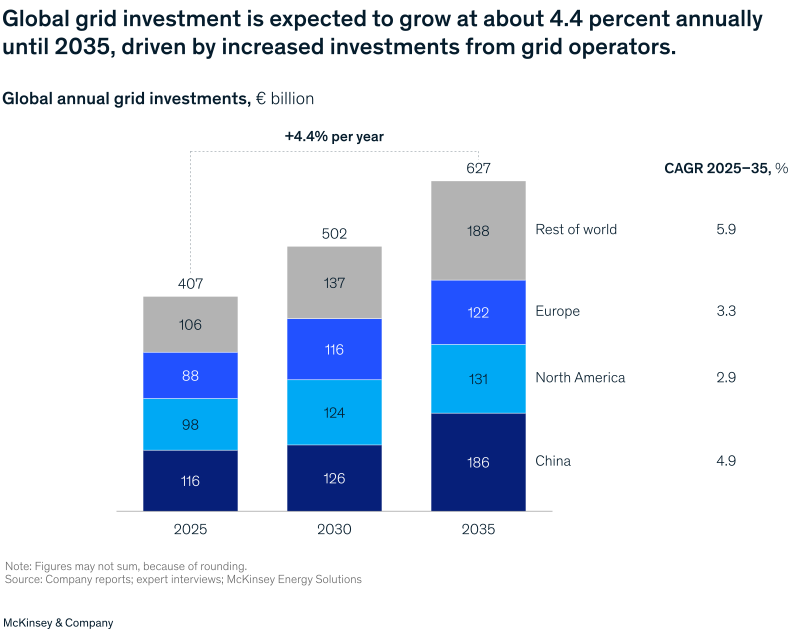
Transformer demand is rising because, as energy demand grows, more electricity is flowing through grids than ever before—over longer distances, in more directions, and with greater flexibility. On top of this, a large share of the existing transformer fleet is reaching the end of its lifespan.6 Sustained grid investment is therefore needed, predicted to reach €627 billion by 2035.7 As transformers represent an estimated 20 to 25 percent of total transmission capital expenditure,8 rising grid investment translates directly into rising transformer demand. Global grid spending is projected to grow by approximately 4.4 percent annually through 2035, driven by three forces (Exhibit 1).
1. Rising power demand, fueled by data centers and electrification
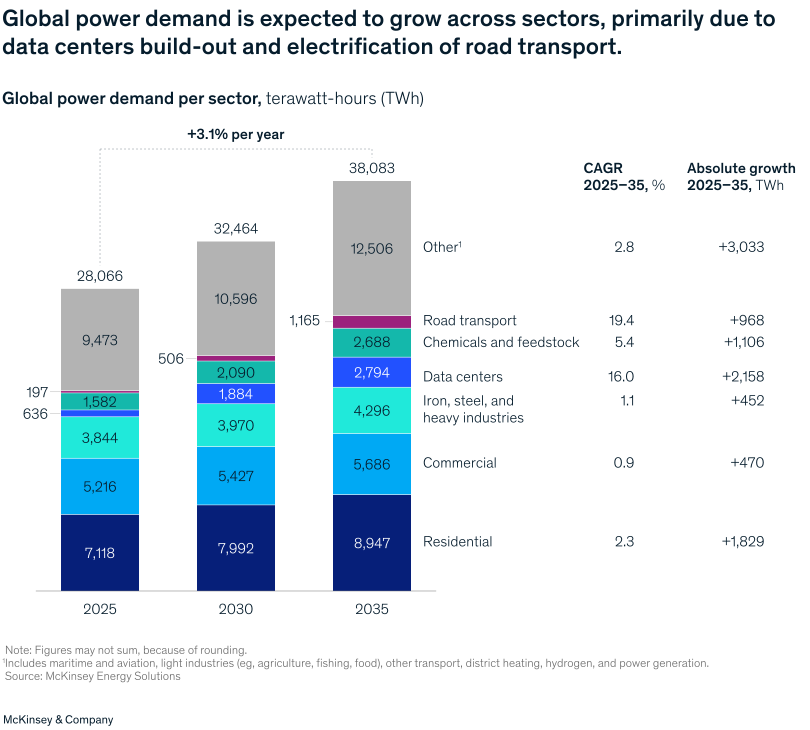
Global power demand is projected to increase by approximately 3.1 percent annually, reaching roughly 38,000 terawatt-hours by 2035 (Exhibit 2).9 Traditional demand from residential, commercial, and industrial customers is expected to remain the largest source of electricity demand, but growth is accelerating primarily because of the rapid expansion of data centers and road transport.
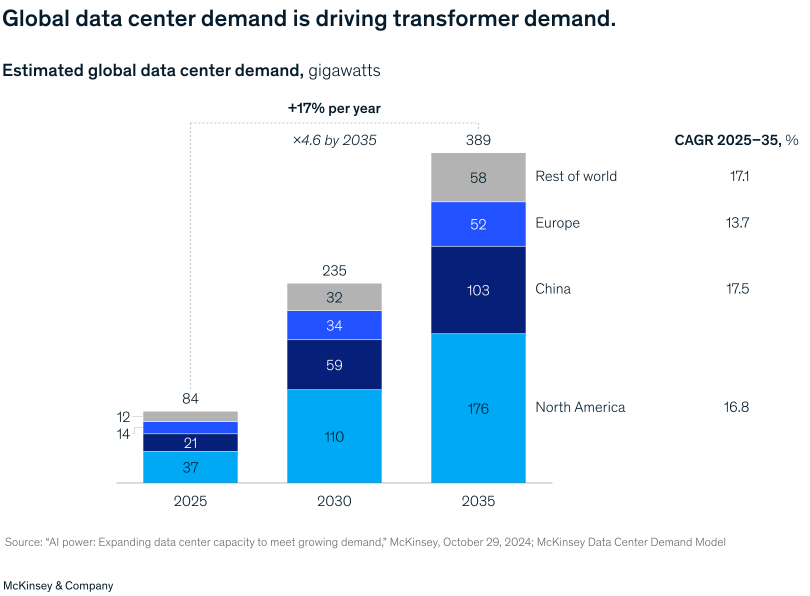
Data centers are the fastest-growing source of new power demand, rising at 16 percent annually.10 Global data center capacity is expected to increase by approximately 17 percent per year, reaching about 389 gigawatts (GW) by 2035, a 4.6-fold increase. This expansion could account for roughly 70 percent of North America’s power demand growth and 30 percent of Europe’s (Exhibit 3). Although data center operators are increasingly generating their own power, transformers will still be required to deliver that energy.
Electrification of road transport is another major source of rising electricity demand globally. The fleet of battery-electric vehicles is expanding at more than 20 percent a year as tightening emissions regulations and falling battery costs drive the phase-out of internal combustion engines.11 Buildings and industry are adding to this growth as decarbonization accelerates the adoption of electric technologies such as heat pumps.12
2. A renewables-heavy mix needs more transformers per megawatt
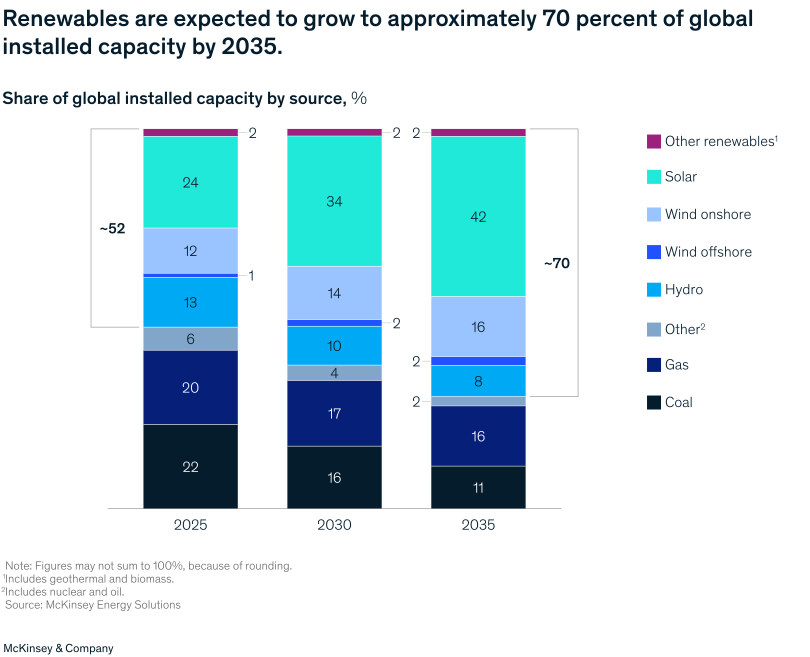
Renewables’ share of installed capacity is projected to rise from about 50 percent today to roughly 70 percent by 2035, driven primarily by onshore wind and solar (Exhibit 4). This matters because renewables require more transformer capacity per unit of delivered energy, for three compounding reasons:
- Generation is moving away from load centers. New renewable capacity is often built far from where power is consumed.13 This means electricity must travel longer distances and flow in new directions, such as from coastal to inland regions and across climates.
- Renewable assets operate at lower utilization. Solar, for example, may run for about 2,140 hours a year, compared with 5,120 hours for a gas-fired plant.14 Producing an equivalent amount of electricity therefore takes roughly 2.4 times the installed capacity, with each additional increment requiring its own grid connection.15
- Renewable energy is more dispersed. Rather than connecting a small number of large conventional plants, capacity spreads across many smaller wind and solar sites, multiplying the number of grid-connection points. Each of these sites requires additional low- and medium-voltage transformers to collect output and raise it to the voltage required for grid integration.
This shift adds further transformer demand beyond increasing the amount of electricity moved. Grids in Europe and North America need to become more interconnected to accommodate increasingly dispersed power flows, and more storage is needed to manage renewables’ intermittency. Thus, storage capacity is expected to reach approximately 2,300 GW by 2035, growing at about 18 percent annually, with each increment requiring additional transformers capable of handling bidirectional power flows.16
A parallel shift within conventional generation adds to these effects. Coal generation is declining by approximately 1 percent a year, whereas gas is increasing by 3 percent.17 New, smaller gas plants also create more granular connection requirements than the larger coal facilities they replace, even if the effect is less pronounced than that of renewables.
3. Replacement of an aging transformer fleet
Much of the grid infrastructure in Europe and North America has exceeded its 25- to 40-year design life, and failure rates tend to climb after roughly 30 years of operation.18 In these regions, replacement accounts for more than 30 percent of transformer demand. Replacement units are typically larger than the assets they replace due to increased power needs.19
The new normal: Constrained supply and a repriced market
Transformer types and their expected market share
Transformers serve distinct roles across the electricity value chain. Generation transformers step up voltage at power plants for efficient connection to the grid, typically across a 10 to 765 kilovolt (kV) range.1 Transmission transformers step voltage up or down within high-voltage networks—typically 110 to 765 kV (where the 765 kV market in the United States is still limited to €1 billion a year and is served by fewer than 10 suppliers,2 including GE Vernova, Siemens Energy, and SGB-SMIT Group)—to move power over long distances. Distribution transformers, generally operating at 10 to 30 kV, step voltage down closer to end users for residential, commercial, and industrial consumption.3
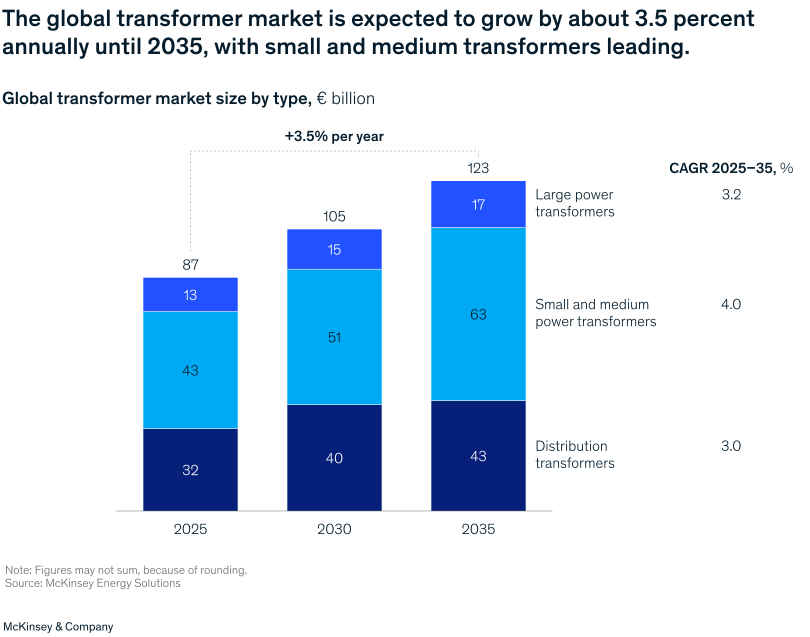
These established application categories account for the core transformer market, although the market can also be segmented into three product types—large power, small and medium power, and distribution transformers. Of these, small and medium power transformers are expected to be the fastest-growing category, with a CAGR of around 4 percent through 2035, followed by large power transformers at 3.2 percent, and distribution transformers at 3 percent (exhibit).
Solid-state transformers (SSTs) sit outside these conventional categories. They combine power electronics, digital controls, and high-frequency isolation, enabling more active voltage control, bidirectional power flow, and direct AC/DC conversion. However, SSTs remain short of broad deployment, particularly in utility-scale applications, because their cost, reliability, protection requirements, and grid standards are still developing. As a result, their timing and market potential are difficult to evaluate.
Global transformer demand is increasing by approximately 3.5 percent annually and is expected to reach about 5,600 GVA by 2035.20 Of the three most common types of transformers—large power transformers, small and medium power transformers, and distribution transformers—small and medium ones are expected to lead this growth (see sidebar “Transformer types and their expected market share”). At the same time, served market demand is expected to grow at a CAGR of approximately 8.3 percent as supply expands, albeit not fast enough to close the gap.
Supply is unlikely to adjust quickly. Manufacturing is concentrated among a few large players across a fragmented base of about 500 manufacturers worldwide, and new capacity is slow to add (see sidebar “A selection of the fragmented supplier base”). Building a new transformer plant is capital-intensive, slow to permit and commission, and dependent on highly specialized labor. Long qualification and testing cycles add more time before new capacity can serve the market. Key inputs, such as grain-oriented electrical steel, are in tight supply from a few qualified mills.21 These constraints compound each other, and announced capacity additions, which may help over time, typically involve multiyear ramp-ups and may face delays.
Although transformer scarcity is global, it is most acute in Europe and North America.22 In these markets, domestic power transformer demand of 914 GVA exceeded supply of 566 GVA by 38 percent in 2025. This gap is expected to persist through 2030 and beyond, even when taking announced capacity additions into account. By 2030, announced power transformer capacity expansions of around 186 GVA will only modestly exceed projected demand growth of 150 GVA. Consequently, the annual supply shortfall will remain broadly unchanged at approximately 312 GVA.
In response to the domestic supply deficit, European and North American customers are also turning to foreign suppliers, who in turn benefit from attractive, relatively higher prices.23 Net imports reached 112 GVA in 2025, with projections to roughly double to 258 GVA in 2030. This 18 percent annual growth rate is largely fueled by export-focused build-outs in countries such as South Korea and Türkiye.24
However, the impact of imports is fundamentally limited by export countries’ domestic demand, trade tariffs, localization requirements, and severe logistical constraints. For large power transformers, international sourcing becomes even more constrained due to rigorous qualification and testing standards.
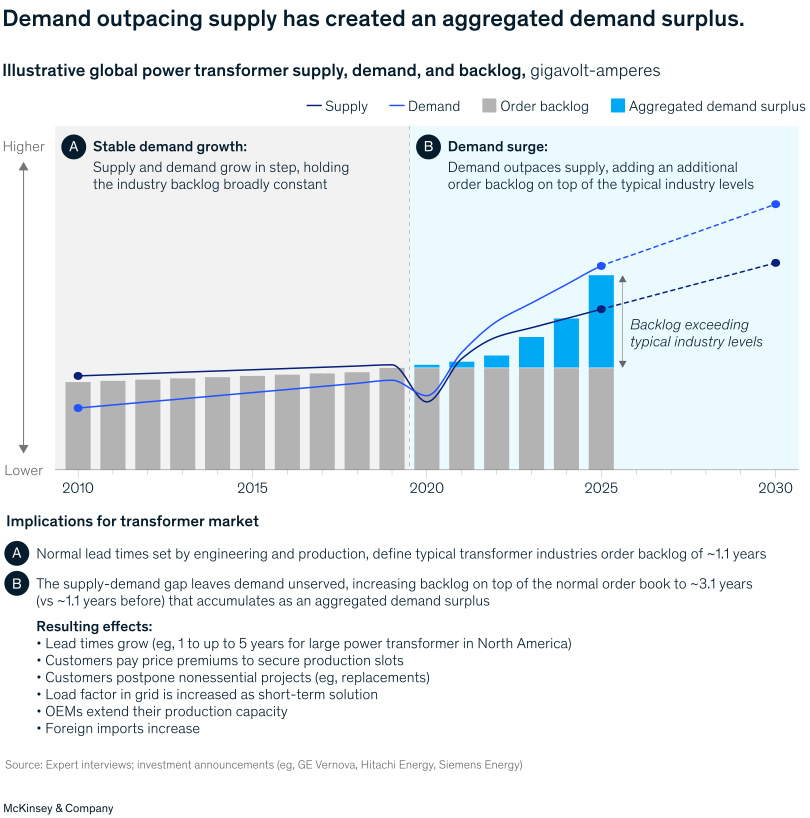
Since domestic supply and net imports remain insufficient to satisfy full demand in Europe and North America, a substantial supply deficit is likely to accumulate year over year. As this shortfall has persisted for several years, the market carries an aggregated backlog of unserved demand, estimated at 1,137 GVA in 2025, roughly 1.2 times the annual domestic demand (Exhibit 5).
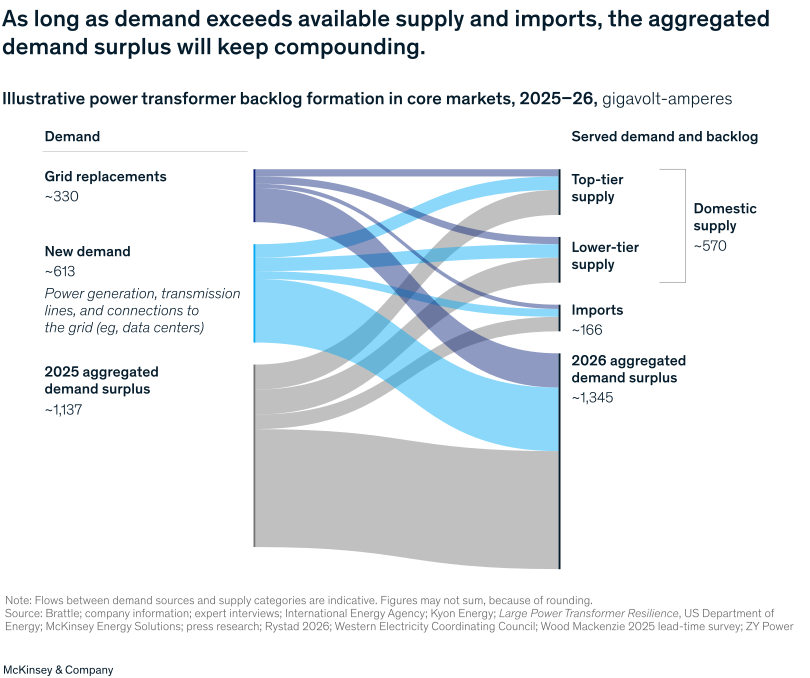
In 2026, for example, replacement demand and new demand are adding to the existing 1,137 GVA backlog, creating a total demand and backlog pool of roughly 2,080 GVA. Combined, domestic supply and net imports will serve only about 735 GVA of this, leaving approximately 1,345 GVA unserved to be carried over into the following year. This compounding dynamic is expected to continue, pushing the backlog to about 1,689 GVA, 3.3 times the annual supply, by 2030 (Exhibit 6). The accumulated backlog is expected to grow through 2030, yielding substantial unserved demand.
Closing this gap entirely would likely require one of three radical shifts: a material decline in demand, a drastically accelerated increase in domestic supply, or a massive surge in imports. None of these scenarios appears highly likely. Relying solely on domestic supply would require an estimated 40 additional capacity-expansion projects, on top of the approximately 20 already announced, amounting to roughly €5.2 billion in extra capital expenditure investment.25 Given the multiyear permitting and ramp-up periods, the capacity would be unlikely to come online fast enough. Alternatively, imports would need to grow well beyond the anticipated 18 percent annual increase, which is unlikely in the current environment. And demand remains highly resilient even under downside scenarios: if data center demand were stripped out entirely and renewable build-outs were heavily scaled back, a structural shortfall of approximately 180 GVA would persist in 2030. Therefore, the shortage is poised to endure across the entire transformer spectrum, keeping the market tight well into the next decade.
The impact of this sustained scarcity is already visible (Exhibit 7). Lead times have stretched from historical norms of about one year to up to five years today.26 Simultaneously, market prices have surged by up to €8 per kVA, an increase of over 50 percent since 2021—varying by size and region—decisively shifting market power from buyers to suppliers.27 Going forward, the aggregated demand surplus indicates continuously elevated lead times and price stability on current levels. Although the market can be expected to achieve a balance in the 2030s, supply constraints are likely to remain a key characteristic of the transformer market until then. This also implies that a growing shift to renewables or grid replacements in general cannot be significantly accelerated.
Looking ahead, the global transformer market’s value is projected to climb from around €87 billion in 2025 to €123 billion by 2035, according to McKinsey analysis. At the same time, demand growth will not continue at a supercycle pace indefinitely. After 2035, demand is expected to plateau at a structurally higher level due to a larger installed base, higher baseline electricity demand, a backlog of deferred replacements, and shorter transformer lifetimes due to heavier operating loads and lower-tier manufacturing quality.28
Implications across the value chain
The transformer has moved from a procurement detail to a strategic priority for energy infrastructure. The implications differ across the value chain, but the reality for all stakeholders is that capacity, not demand, is now the binding constraint.
For utilities and grid operators, securing capacity early is the priority. Multiyear framework agreements and expanded supplier-qualification pipelines can help ensure access to capacity before the need becomes urgent.
For generation, industrial, and data center developers, transformer lead times can now determine project timelines. The response is to lock in sourcing years ahead of planned commissioning dates and engage incumbent suppliers, including those not currently expanding capacity, rather than relying solely on anticipated capacity additions that may never materialize.
For manufacturers, the same constraint is the opportunity, but capturing it depends on more than demand growth. Companies can consider shifting focus to the highest-value and hardest-to-serve segments, particularly large power and high-voltage transformers. At the same time, exporting countries may add to their net transformer exports, including South Korea and Türkiye.
For investors, the central distinction is cyclical demand and the structural foundation beneath it. While some sources of demand fluctuate over time, grid replacement and long-term electrification are expected to keep demand above historic levels. High entry barriers, including multiyear capacity ramp-ups, scarce skilled labor, lengthy qualification periods, and localization trends, may continue to support incumbents.
This supercycle marks the beginning of a new normal for the transformer industry, one defined by sustained demand and constrained supply.
The transformer market’s constraints are reshaping decisions across the power sector. What was once a routine procurement line item is now a strategic imperative for stakeholders across the value chain. If the industry does not adapt, the consequences will be felt in delayed grid build-out and constrained capacity, which could increase energy prices and reduce power access, while putting pressure on renewables build-out.