The home and hygiene growth playbook of the past is ripe for reinvention. In 2020, home and hygiene brands grew 11 percent globally—spiking at 13 percent in the United States—spurred by the COVID-19 pandemic. Since then, the industry has relied on steady price increases to counteract volume declines, achieving about 5 percent annual growth. However, as inflation has calmed, total growth has returned to prepandemic levels—about 2 to 3 percent annually.1
In this meaningfully different environment, what will it take for home and hygiene players to grow (see sidebar, “Defining home and hygiene”)? A survey of retailers, interviews with industry leaders, and our own research into consumer spending trends suggest that eight forces will shape growth strategies in the sector. Below, we analyze each and offer a perspective on how players should adapt in response.
1. Margins can wait—disciplined growth can’t
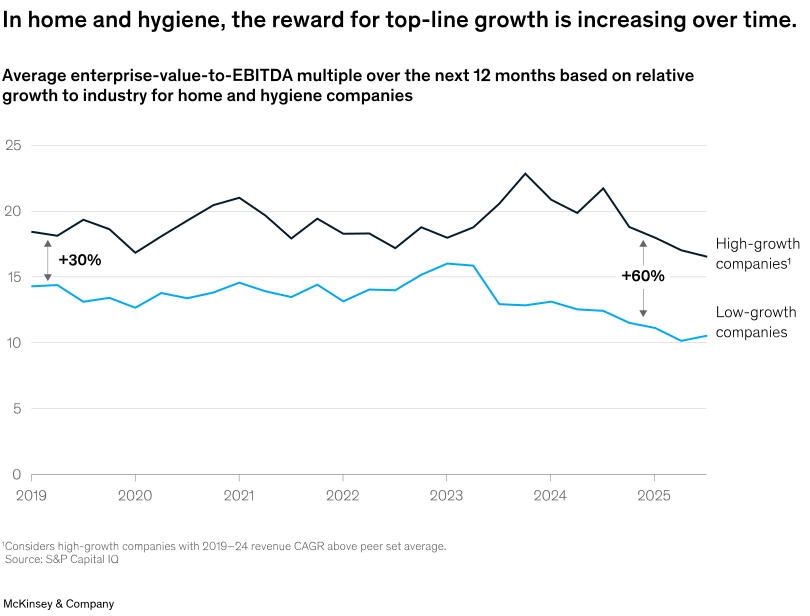
As growth becomes increasingly elusive, investors are rewarding players that can meet the challenge. The valuation multiple gap between high- and low-growth home and hygiene players is the widest it has been in the past six years: The enterprise-value-to-EBITDA delta between these groups roughly doubled to 62 percent from 30 percent in 2019.
The reward for top-line growth is significantly higher than for improved margins. Our assessment of major home and hygiene player shareholder returns reveals that a 50-basis-point increase in top-line growth expectations typically leads to about a 12 percent increase in market capitalization value, whereas a 50-basis-point increase in profitability yields only a roughly 3 percent increase in value.1
Companies are noticing and are taking active portfolio-shaping actions to best position themselves to capture future growth. For some, this has meant carving out assets—such as Reckitt, which divested its home care business to Advent International, and Kimberly-Clark, which sold a controlling stake in its international tissue and towel unit to Suzano.2 For others, this has meant increasing depth in their core categories, such as Clorox, which is acquiring GOJO Industries, the manufacturer of Purell.3
Because growth will likely remain imperative in home and hygiene, as in all of consumer packaged goods, players must continue to actively shape their portfolios to choose and prioritize growth.
2. Incumbent growth is stalling as private brands and insurgents build momentum
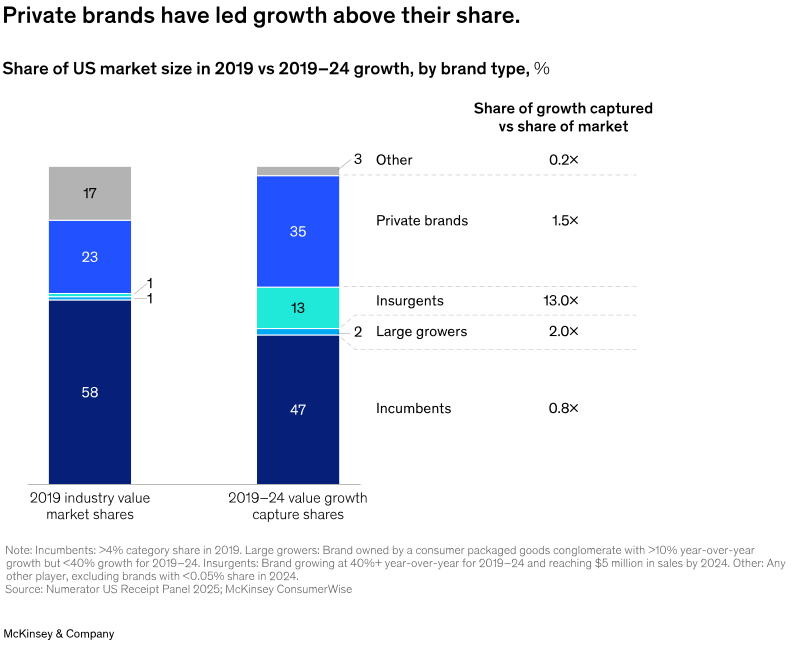
Established brands make up nearly three-fifths of home and hygiene volume today, but they accounted for less than half of total category growth from 2019 to 2024. In contrast, private brands are punching significantly above their weight, and insurgents, though small, are growing rapidly and disrupting their subcategories. Private brands have seen particular momentum in categories that are relatively commoditized with low levels of innovation and differentiation, such as disposable plastic, paper towel, and tissue. As consumers become more accustomed to buying private-brand products, we expect less-commoditized categories to show similar patterns. Across categories, private-brand sales topped $22 billion in 2024.1
Meanwhile, insurgents have built momentum across categories—with spikes in insecticides, wipes, and hand soaps and sanitizers—where new brands have paired innovative products with evocative storytelling to disrupt the traditional categories and gain share. Across home and hygiene, insurgent sales reached more than $3 billion in 20242 and accounted for more than 10 percent of category growth from 2019 to 2024, despite holding only a 1 percent share in 2019.
Select incumbents managed to capture the bulk of the growth in laundry, cleansers, and dishwashing, driven by innovation, brand rejuvenation, and an improved “better for you” offering that woos consumers wary of the impact of traditional home and hygiene products on their health. Eighty percent of merchants at major US retailers we spoke to said they are actively looking to add independent, innovative home and hygiene brands to their assortments, in line with growing consumer demand.
3. Traditional category definitions are blurring
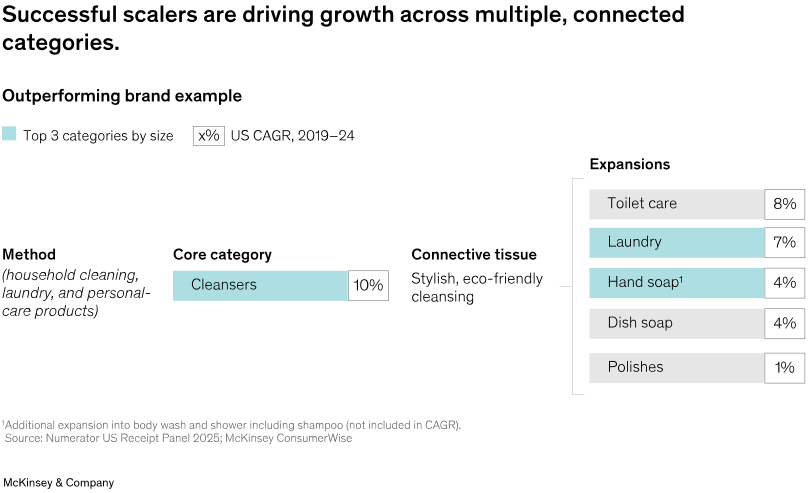
The way consumers view and engage with home and hygiene brands is changing. Where products once neatly mapped to distinct categories fulfilling a single purpose (for example, air fresheners), consumers are now blending and expanding use cases. Consumers are increasingly making buying decisions based on underlying emotional triggers or need states (such as having their home smell or feel fresh or to evoke a feeling associated with luxury or exclusivity) and are looking more holistically at consumer care products for solutions. As a result, distinctions between traditional home care categories are breaking down. This shift fundamentally changes what it takes to compete and grow in individual categories.
Successful disruptors and scalers are innovating to meet these changing consumer need states.1 They build a product bench around redefined needs, extending beyond traditional industry verticals to achieve scale and growth in multiple relevant categories. Brands that successfully doubled down on their unique advantage as the connective tissue that could bind together consumer need states achieved a five-year CAGR of up to 20 percent outside their core entry-point categories from 2019 to 2024.2

What consumer-packaged-goods companies can learn from disruptor brands
Disruptor-led growth is reshaping not only home and hygiene but nearly every consumer-packaged-goods (CPG) category. Five disruption archetypes—and six defining traits of disruptor brands—offer lessons for CPG players seeking to compete.
4. Successful insurgents are deploying agile operating models that enable an asset-light capital footprint and bolder marketing to scale
Challenger brands are embracing an asset-light operating model to grow and scale. By harnessing the increasing availability of third-party manufacturers, they are able to free up resources and respond more quickly to shifting consumer demands and preferences.
It’s not just about form and function: Challenger brands are overhauling the industry’s traditional image by applying the beauty playbook to categories previously considered primarily functional and with limited aesthetic requirements.1 Successful insurgents invest in highly emotive branding and provocative and often experiential marketing. These approaches resonate with younger consumers who are looking for more than function from products they use across every part of their lives and who are willing to reject legacy offerings if they are deemed unfashionable. For example, Goodwipes has leveraged a bold, influencer-led social media strategy amplified by provocative physical pop-ups, such as portable toilets at music festivals,2 to ensure their brand and products continue to tap into the zeitgeist.
Incumbents aren’t idly standing by. From Church & Dwight’s publicly acknowledged asset-light, brand-first model to Unilever’s broadly communicated push to reinvent home and hygiene brands through enhanced design and marketing that drives desire, players are beginning to adapt.3 Yet there is significant room for further investment and reinvention.

State of Beauty 2025: Solving a shifting growth puzzle
As momentum cools and definitions of beauty expand, beauty players face a new mandate: Win over skeptical consumers, recalibrate across markets, and prove their worth beyond the hype.
5. Brands must prove their value or risk seeing consumers trade away
Following the rising inflation of the past several years, consumers are scrutinizing the value of products they purchase more than ever. But this does not mean consumers are defaulting to trading down. Seventy percent of major US retailer merchants believe consumers are open to trading up if they recognize real value.1 Some categories have already seen price tier augmentation play out, but the premiumization playbook relies on more than slightly improved function.
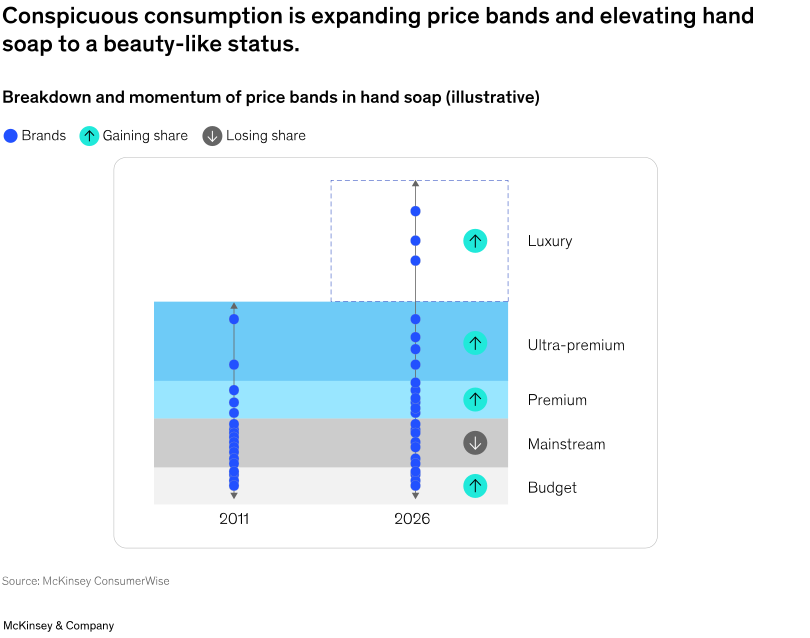
Consider hand soap: Consumers looking for pure functional performance are seeing their needs met by reliable, low-cost, and private-brand offerings that fulfill the need. At the same time, the category has seen disruption at the high end as some consumers see value in more conspicuous consumption. Aēsop and other challengers—including premium beauty players such as Byredo—have managed to stand out by evoking emotion and representing not just a soap but a lifestyle for its consumers. As a result, the hand soap market has expanded significantly, with ultra-premium brands commanding unit prices more comparable to skin care products and cosmetics.
The entry—and success—of high-end brands into a category such as hand soap demonstrates that consumers do have a willingness to pay, but it can be unlocked only by brands that can give consumers the value they are looking for.
6. Private brands have steadily advanced their value propositions to become sophisticated competitors
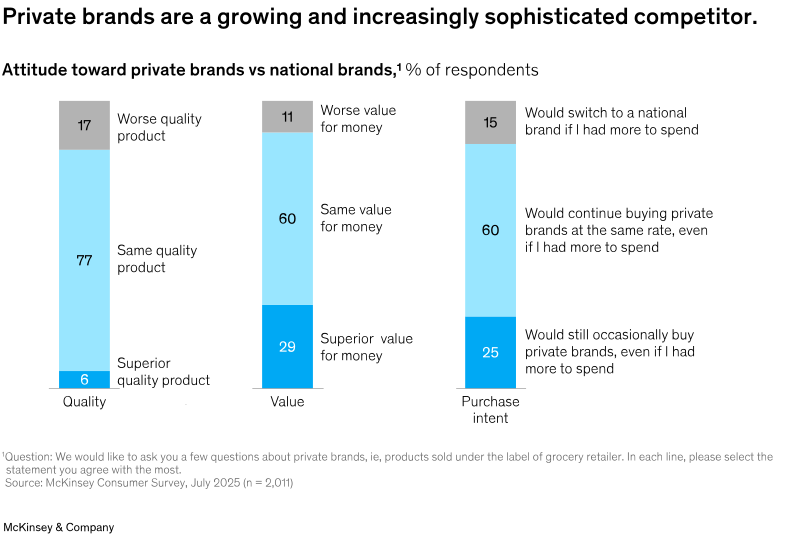
While private brands have been growing for decades, with the strongest penetration seen in commoditized categories, we believe the segment has recently reached an inflection point. Many private-brand offerings are becoming more sophisticated and redefining their image, attracting more consumers in new categories and at new price points. Indeed, private brands are no longer seen as simply a “value” offering; rather, more than 80 percent of consumers perceive private brands as similar or superior in quality and value to branded offerings. Private brands increasingly stand in direct competition not only at the low end of the price spectrum but also with brands across tiers.
What is leading to this inflection point? Many retailers are upping their sophistication and competitiveness in private brands by deploying larger teams, leveraging firsthand shopper insights, improving their sourcing, and upgrading their branding. As a result, private brands can credibly earn shelf space with better, higher-quality, and more relevant products that serve a larger portion of the market. While many incumbent brands are actively losing shelf space, 78 percent of major US retailer merchants expect to expand private brands’ shelf space over the next two to three years.1
7. The five most significant retailers continue to grow their share in home and hygiene—and are increasing their expectations of brands
Consumers aren’t the only ones fueling change in home and hygiene. Retailers have gotten the memo, too.
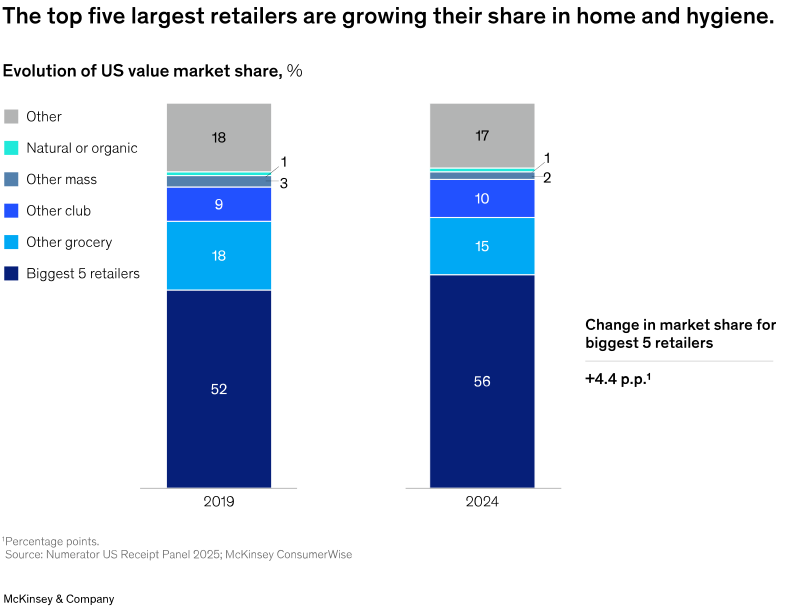
The broader US retail landscape continues to become more concentrated, with the five US retailers that make up more than 50 percent of industry sales—Walmart, Amazon, Costco, Dollar General, and Target—growing their combined share across categories.1 As the market consolidates, these retailers are increasing their expectations of brands they carry on their shelves. They want to see innovation in terms of “better for you” products, sustainability, efficacy, and convenience. And if they don’t? Results from our survey of major US retailer merchants as well as interviews with a range of industry experts all suggest that retailers won’t hesitate to reallocate shelf space if a brand does not meet their demands and is underperforming.2
To compete within the top five retailers, the merchants we interviewed suggested three focus areas to win more shelf space:
- Price-pack architecture. Pack sizes and formats can meaningfully contribute to growth if done right—such as by supporting premiumization through more convenient, on-the-go options. Different retailers have unique preferences and formats that work best, requiring a tailored go-to-market approach.
- Distribution as marketing. As marketing avenues become more expensive (particularly online), investing in packaging, design, format, exclusives, and in-store presentation can help brands—especially legacy brands with meaningful shelf space—stand out. Collaborative marketing efforts with retailers can also help brands with visibility.
- Retail media network. All five top retailers have increasingly sophisticated and scaled retail media networks. Retailers are becoming more and more focused on negotiating retail media investments as part of an overall shopper marketing strategy; strategics and brands need to rethink how to move from commercial to strategic relationships with their best retail partners, placing their bets to win in this context.
8. Agentic commerce is evolving how consumers discover, engage, and shop
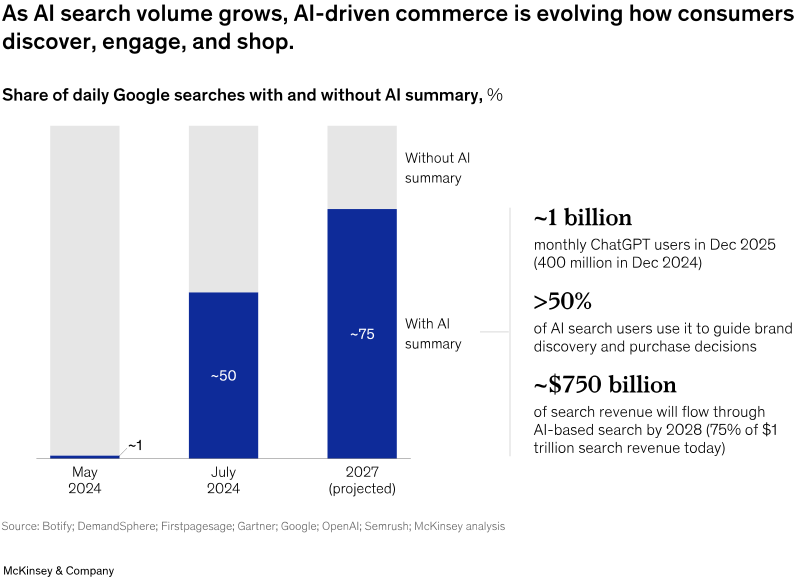
By 2030, agentic-AI-driven commerce could account for 15 to 20 percent of global e-commerce value.1 As the technology advances, brands will need to ensure that their content and products are surfaced prominently, positively, and accurately—with comprehensive details—in the environments that agents will search (so-called GEO, or generative engine optimization). Success will come from understanding how consumers are using shopping agents to aid them in making decisions. We are already seeing bold moves from the hyperscalers looking to play a large role in agentic commerce. Future leaders will keep track of how engagement between consumers and agents is evolving—from agents as aides to agents empowered to make decisions for consumers—and will respond accordingly. For home and hygiene brands already up against the rise of private label and insurgents, as well as a blurring of category boundaries, a repositioning to win in a future powered by agentic commerce could very well be the difference between growth and stagnation.
Next steps for pursuing growth in home and hygiene
What do all these forces mean for home and hygiene players that now have a new imperative for growth? A handful of moves belong at the top of the to-do list:
- Disaggregate your historical and projected performance. Identify which categories, subcategories, brands, and channels are growing fastest from a unit perspective—and where your brands have a right to win but might be underperforming potential.
- Get granular on your understanding of your consumer. Uncover who they are, why they buy your brands, how behaviors are changing—particularly in regard to need states—and where new growth opportunities are. Study the evolving shifts and blended need states in categories such as hand soaps, then determine what can apply to your categories.
- Map out channel shifts. Pinpoint where your key categories and brands are positioned to succeed as commerce evolves, and map out a stronger channel mix. Ensure you are delivering on the unique needs of each of the largest retail channels, and have a clear strategy for agentic AI commerce.
- Rev up your innovation engine, and prove your value. Consumers are ready to trade up, but they’re just as ready to trade down when a product doesn’t deliver. Ensure your teams and resources can deliver breakthrough ideas that defend your edge against competitors and resonate deeply with consumers. Look for areas that are most vulnerable to private brands, and determine if your brands can out-innovate to provide unique benefits.
- Gear to win agentic commerce. Ensure that your marketing engine is geared for a world with increased AI-driven commerce and that the value your products provide to consumers can be easily identified by AI agents so you receive credit by way of increased buying recommendations.
- Revisit your financial aspiration, and raise the bar. Underwrite your growth plan with a rigorous fact base that’s grounded in brand, category, and channel priorities.
Growth is eminently possible in the coming years for the home and hygiene sector. By innovating now, brands can secure their place on retailers’ shelves and in consumers’ minds.