During the last few years, signals have emerged that suggest that US defense industrial base (DIB) productivity is declining and the DIB is losing ground to other global players. In 2023, a slide leaked from the US Office of Naval Intelligence indicated shipbuilding capacity in the Chinese market was 232 times greater than in the United States.1 In 2024, the Chinese market was reportedly acquiring high-end weapons five to six times faster than in the US market.2 Most recently, the US DIB received a “D” grade on the 2025 National Security Innovation Base Report Card,3 which noted that US DIB production capabilities lagged behind those of other global players.4 And all of these indicators appeared following the deputy US defense secretary’s 2021 comment that the number of small businesses in the DIB had shrunk by more than 40 percent during the previous decade—and that the US DIB could lose 15,000 suppliers in the next decade if that trend continued.5
Nonetheless, indicators that US DIB output is being challenged do not mean that a global redistribution of defense production is inevitable. In fact, the US administration recently released a policy on acquisition reform that aims squarely at accelerating fielding and rebuilding the industrial base.6 In a demonstration of this policy, the PAC-3 Missile Segment Enhancement (MSE) agreement announced in January 2026 provides a scaled model for industrial investment as well as for stricter delivery accountability reinforced by incentives to reward early performance and penalize slippage.7
And when it comes to increasing capacity and productivity, our experience suggests that during the past several decades, the DIB has accumulated enough untapped potential to make significant gains on both fronts. Tapping into this potential with the right approach to improve operations and return on capital could further strengthen the DIB’s capacity—doubling productivity and increasing investment impact.
The dynamics contributing to lagging US DIB productivity
The United States has invested more capital in its DIB than any other nation8 and has amassed some unique assets as a result. Thus, while some of the buildings, assets, and infrastructure in the US DIB may be aging, ample capability remains to execute an unprecedented ramp-up in production—with the right approach. Such an approach would, ideally, address the following common dynamics that, in our experience, have contributed to stalling productivity in the US DIB and have prevented manufacturers from achieving their potential capacity:
- Demand instability and budget uncertainty. Investing new capital and pursuing increased production rates is challenging when demand signals weaken unexpectedly in the wake of policy shifts.
- Excessive rigidity and extreme risk aversion in product and process requirements. It is not uncommon for DIB manufacturers to avoid changing product designs or manufacturing methods in ways that could be advantageous from a rate or cost perspective, such as substituting commercial-grade components for military-grade components (when appropriate from a technical, risk, requirement, and performance standpoint).
- Operational complexity. US DIB products have become increasingly highly engineered.
- Supply chain fragility. Vulnerabilities in supply chains include a lack of available materials (such as rare earths), single supply sources, and complex and lengthy requirements to qualify new suppliers. Various challenges to collaboration also persist, ranging from difficulty finding the proper contact at an organization to rigid approval processes that require sign-offs from multiple individuals or functional areas.
- Talent erosion. An aging workforce has resulted in skills decay, and aerospace and defense manufacturers face significant challenges in attracting new talent in sufficient numbers and with the right skill sets.
- Misaligned incentives. Recent incentives have led manufacturers to pursue short-term wins rather than address root causes of subpar performance or boost productivity in pursuit of long-term strategic growth and capability building.
Although these dynamics present a complex picture, their impacts can be mitigated and meaningful progress achieved with sustained focus and the coordinated efforts of suppliers and customers.
Unlocking latent capacity in US DIB manufacturing with operational improvements
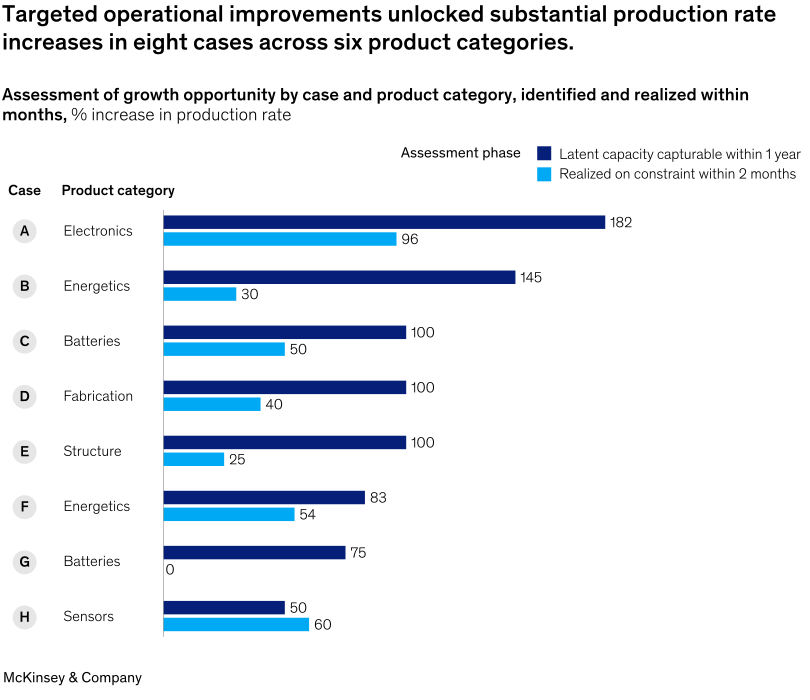
Our experience indicates substantial untapped potential capacity exists in DIB manufacturing and supply chains—and much of it could be unlocked without investing additional capital. Implementing a number of targeted operational improvements has helped some manufacturers boost production rates in critical areas by 50 to 200 percent within 12 months. Within two to four weeks of implementing these improvements, manufacturers achieved—or exceeded—the full potential rates identified for bottlenecked assets. These considerable capacity uplifts were achieved in a wide range of product categories with highly complex manufacturing processes, including steel fabrication, carbon fiber structures, complex electronics, and energetics (Exhibit 1).
Many DIB sectors face urgent needs to increase production rates. For some items, such as missiles and munitions (interceptors or artillery shells, for example), demand is growing because stockpiles have been heavily drawn from in recent years. Additionally, systems needed for products such as fighter jets or naval ships face long-term backlogs.9
According to our experience and research, the DIB could double its output in critical areas within one to two years with targeted improvements to operations that could unlock the considerable capacity latent in its current footprint, assets, and workforce.
Following are some real-world examples of how targeted actions unlocked significant production increases by mitigating the impacts of the common dynamics noted above:
- Applying single-minute exchange of die (SMED) principles to minimize changeover times. A structures manufacturer ran time studies to identify variation and sources of waste in its changeover process. By using SMED kits, preparing materials, and standardizing tasks between operators, the manufacturer reduced its changeover times by around 50 percent.
- Using Python simulations to optimize scheduling. To manage oven utilization effectively while accounting for varying cure cycle times, batch sizes, unit dimensions, and explosive weight limits, an energetics manufacturer used Python to simulate production runs and optimize its production schedule. The result? A roughly 30 percent improvement in oven utilization.
- Adjusting quality requirements to increase throughput. In instances where quality requirements were deemed too rigid for their purpose, suppliers were able to reduce inspection stringency, relax select noncritical specifications, and delegate authority for certain quality tasks to operators rather than inspectors. These improvements resulted in throughput increases of 10 to 20 percent in their respective processes while allowing inspectors to shift more time and focus to higher-priority quality assurance areas.
- Improving workload planning to boost productivity. To ensure all available operators were utilized fully and their idle time was minimized, one electronics manufacturer began assigning tasks of standardized duration to each operator every morning, improving productivity by 15 to 30 percent.
- Balancing work in progress (WIP) quantity to alleviate bottlenecks. To ensure that each of its operations remained fed continuously (rather than starved by an inadequate flow of upstream materials), one manufacturer instituted minimum and maximum WIP levels, increasing its per-operation utilization by 15 to 30 percent.
- Improving material availability to minimize stockouts and production delays. An electronics manufacturer identified controls that could be implemented for subtier suppliers in its supply chain. Recommended actions included enforcing inventory safety buffers, strengthening the demand signal to suppliers (such as by raising long-term POs), dual-sourcing components, enacting contractual incentives, and improving day-to-day collaboration with its suppliers. These controls could help minimize the risk of stockouts and potentially improve the on-time production starts compliance by 65 percent.
- Adjusting machine and workbench layout to raise throughput. An energetics supplier redesigned its factory layout—increasing space to store WIP, adding stations for constrained operations, and allowing for more optimal machine tending—to increase throughput by 5 to 10 percent.
Boosting output: Improvement first, then investment
In addition to benefits from increased production rates, these operational improvements also amplify the impact of every incremental dollar invested in additional capacity or tech stack modernization, such as using AI for production scheduling or implementing end-to-end sales, inventory, and operations planning (SIOP).10 The compounding benefits from operational improvements and investment can create a path to ramp up critical products at a much faster pace than would be possible with new investment alone (Exhibit 2).
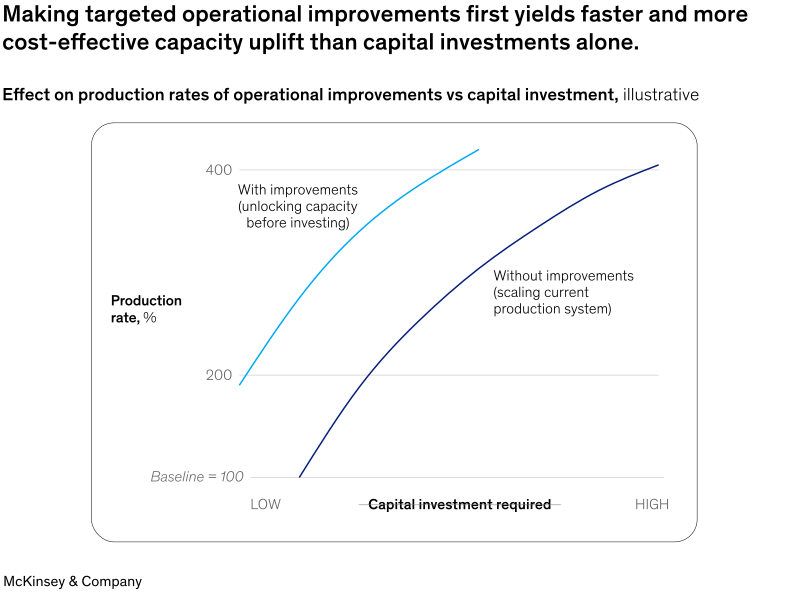
Faster scale-up means that national and allied supplies can be replenished more quickly, organizations can accelerate revenue realization, and the needed resilience is secured sooner rather than later. Getting there will require companies to facilitate their operational improvements by redoubling their commitment to the following guiding principles:
- Set aggressive targets. Clarify and strengthen demand signals.
- Act quickly. Maximize current resources (footprint, assets, and labor) while turning on new resources.
- Eliminate waste ruthlessly. Embed improvements directly on the factory floor, focus on flow, challenge legacy assumptions, and reduce complexity.
- Break down silos. Increase collaboration, both cross-functionally (such as between quality and manufacturing) and vertically (such as between buyers and suppliers).
- Invest in talent. Upskill workforces, drive accountability, and manage performance.
- Align incentives. Recognize and reward performance internally and among buyers and suppliers.
- Accelerate with digital. In addition to lean management principles, use digital tools to accelerate progress, scale rate potential, and make changes more sustainable.
For example, an initial “no regrets” step could be to create a cross-functional team focused on identifying opportunities for improvement in industrial engineering, lean management, change leadership, and coordination with customers and suppliers.
The fastest path to improving productivity of the US DIB and capital investment in it is rooted in removing constraints, improving operational performance, and unlocking latent capacity. The original Arsenal of Democracy had to be created from scratch to meet the demands of World War II. But today’s Arsenal of Democracy is grounded in a foundation that has been firmly established and steadily enhanced over several decades. In short, the US DIB is strong, and its inherent potential to support a swift and substantial ramp-up in productivity should not be underestimated.