As the United States marks its 250th birthday, we explore the foundations of its economic competitiveness—and the opportunities ahead. All this week, we examine how America’s sources of strength have evolved over time, from manufacturing and energy to technology and supply chains, and what it will take to sustain its competitive edge in a changing world.
The United States may be entering a new chapter of competitiveness, note McKinsey’s Rebecca J. Anderson, Olivia White, Eric Kutcher, Kweilin Ellingrud, Shubham Singhal, Scott Blackburn, Arvind Govindarajan, Aly Spencer, TJ Radigan, and Mark Staples. They highlight five prerequisites for the country to maintain its competitiveness in a more contentious and fractious world, including to enhance its national economic security. While the United States is the second-largest manufacturer in the world, it has lost a share of its capacity to produce a wide range of products, presenting questions about future resilience. A total of $160 billion of US imports are critical to resilient supply chains and national security, concentrated in that they are come from on three or fewer nations, and come from geopolitically distant trading partners. Central to national economic security is achieving the needed degree of resilience in sourcing critical products, whether from abroad or production at home.
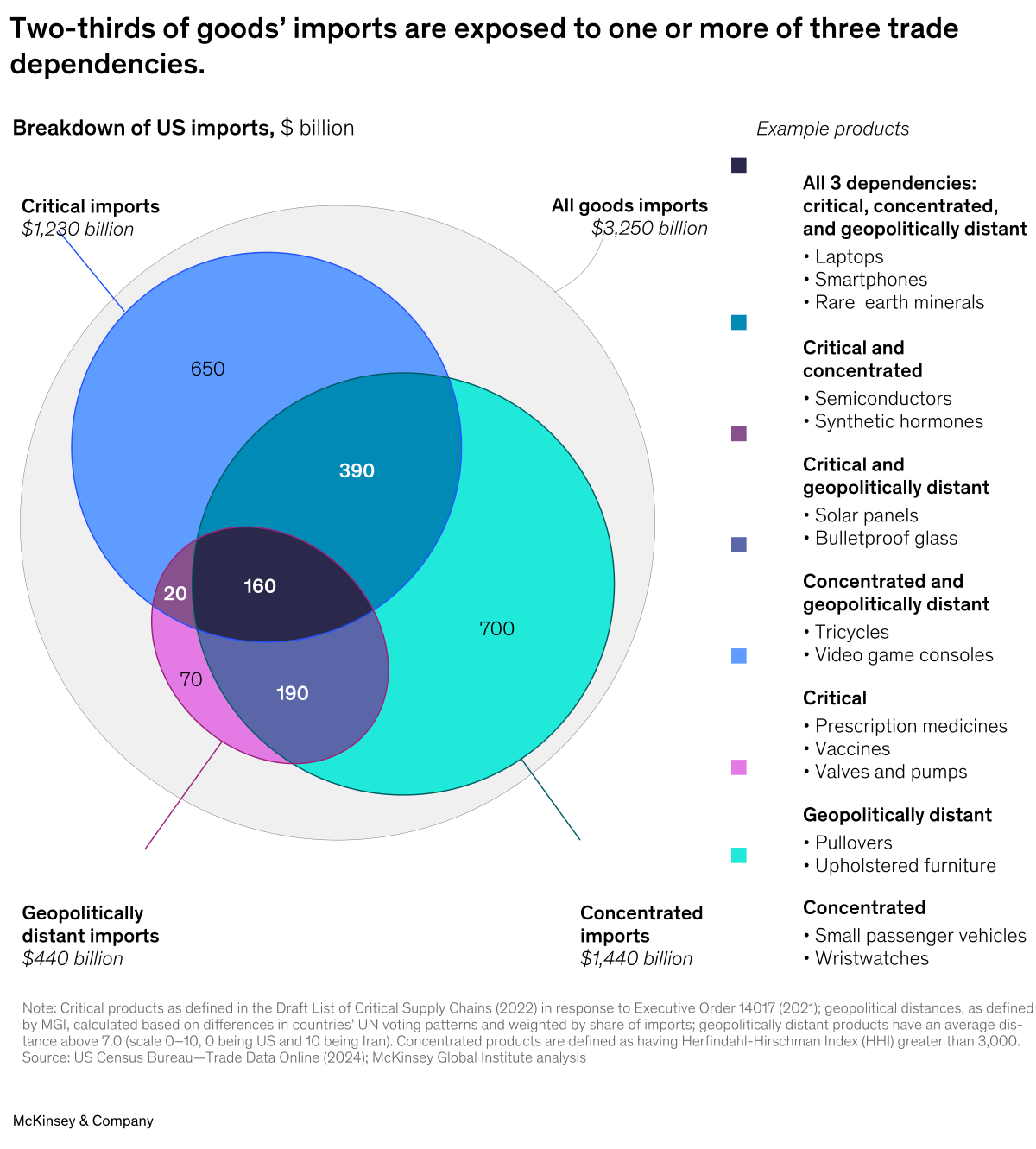
Image description.
US goods imports totaling $3.25 trillion are shown as a Venn diagram of three trade dependencies: critical imports ($1.23 trillion), concentrated imports ($1.44 trillion), and geopolitically distant imports ($440 billion). Of all imports, $700 billion are concentrated only, $650 billion are critical only, and $70 billion are geopolitically distant only. Overlapping categories include $390 billion that are both critical and concentrated, $190 billion that are both concentrated and geopolitically distant, and $20 billion that are both critical and geopolitically distant. At the center, $160 billion of imports are exposed to all three dependencies simultaneously. Example products in this highest-risk category include laptops, smartphones, and rare earth minerals. Overall, the chart shows that roughly two-thirds of US goods imports are exposed to at least one trade dependency, with substantial portions exposed to multiple dependencies at the same time.
Source: US Census Bureau—Trade Data Online (2024); McKinsey Global Institute analysis
This image description was completed with the assistance of Writer, a gen AI tool.
End of image description.
To read the report, see “At 250, sustaining America’s competitive edge,” March 9, 2026.