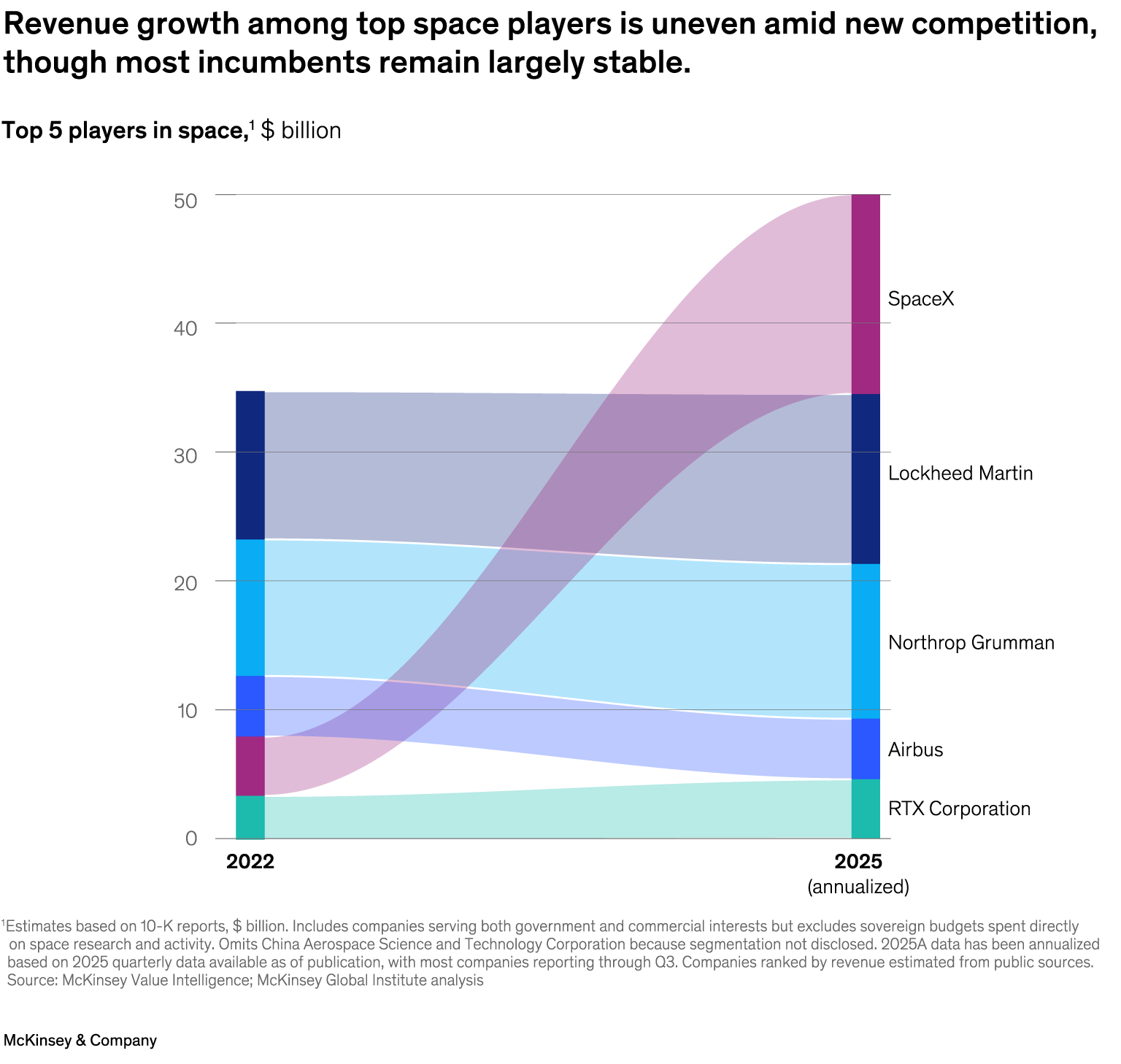
Hard tech, which comprises robotics, shared autonomous vehicles, future air mobility, space, and modular construction, is one of McKinsey Global Institute’s 18 “future arenas”— industries defined by high growth and rapidly shifting competition. Within the hard tech arena, most sectors remain early stage, but some are experiencing a renaissance. For example, space, long anchored by government and telecoms, is being reshaped by new private players that are reducing launch costs and enabling new commercial services. Commercial activity is expanding, and new competition is shifting the landscape, say McKinsey’s Kevin Russell, Chris Bradley, Naveen Sastry, Suhayl Chettih, Kweilin Ellingrud, and Natalya Goryunova. SpaceX is now the top company in terms of revenues, while institutional spending is mostly going to defense primes such as Airbus, Lockheed Martin, and Northrop Grumman.
Image description.
A flow-style chart showing estimated revenues (in billions of dollars) for the top five space industry players in 2022 compared with 2025 (annualized). In 2022, Lockheed Martin leads at about $35 billion, followed by Northrop Grumman at roughly $23 billion, Airbus at about $12 billion, SpaceX at around $8 billion, and RTX Corporation at approximately $3 billion. By 2025, SpaceX grows significantly to about $50 billion, becoming the largest player. Lockheed Martin remains around $35 billion, Northrop Grumman is relatively stable at just over $20 billion, Airbus declines slightly to just under $10 billion, and RTX Corporation increases modestly to about $5 billion. The chart highlights strong growth for SpaceX, relatively stable performance for Lockheed Martin and Northrop Grumman, a slight decline for Airbus, and modest growth for RTX Corporation.
This image description was completed with the assistance of Writer, a gen AI tool.
Source: McKinsey Value Intelligence; McKinsey Global Institute analysis
End of image description.