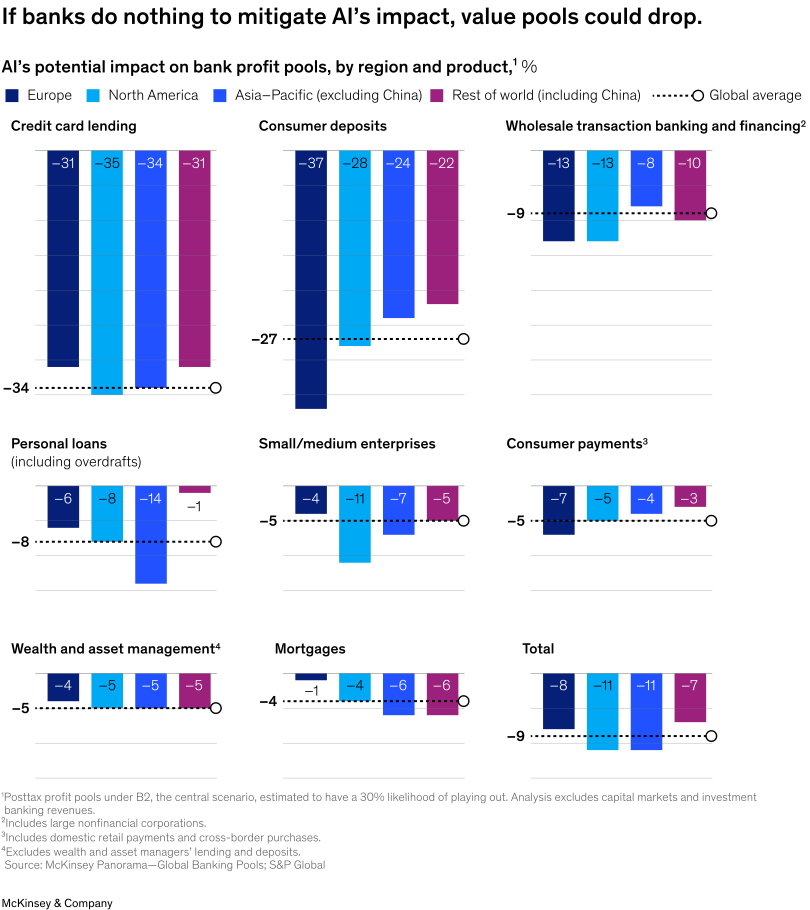
If banks fail to respond to consumers’ adoption of AI—particularly their use of AI to make financial decisions—their profit pools could shrink by an average of 9 percent globally. Credit card lending and consumer deposits are the most vulnerable, with potential profit pool drops of 34 percent and 27 percent, respectively, according to McKinsey’s Darius Imregun, Ido Segev, Jon Steitz, Klaus Dallerup, Marti Riba, Miklós Gábor Dietz, Pradip Patiath, Saptarshi Ganguly, and coauthors find. While the impact is less severe in areas such as mortgages and wealth management, virtually all banking products could see a decline if banks do not take action. To limit potential disruptions, banks can adapt their business models to improve personalization and deploy their own AI agents before third-party platforms capture customer relationships.
Image description:
A series of bar charts illustrates AI’s potential impact on bank profit pools by region and product. The chart is divided into 9 sections, each representing a different banking product or service: credit card lending, consumer deposits, wholesale transaction banking and financing, personal loans, small/medium enterprises, consumer payments, wealth and asset management, mortgages, and total. Each section contains 4 bars representing different regions: Europe, North America, Asia–Pacific (excluding China), and the rest of the world (including China). The bars are colored accordingly, with Europe in dark blue, North America in light blue, Asia–Pacific in purple-blue, and the rest of the world in purple. The chart shows that AI’s potential impact on bank profit pools varies across regions and products. For example, in credit card lending, the potential impact is –31% in Europe, –35% in North America, –34% in Asia–Pacific, and –31% in the rest of the world. The global average is –34%. In consumer deposits, the potential impact is –37% in Europe, –28% in North America, –24% in Asia–Pacific, and –22% in the rest of the world, with a global average of –27%. The chart also shows that the total potential impact on bank profit pools is –8% in Europe, –11% in North America, –11% in Asia–Pacific, and –7% in the rest of the world, with a global average of –9%.
Note: This image description was completed with the assistance of Writer, a gen AI tool.
Source: McKinsey Panorama—Global Banking Pools; S&P Global.
End of image description.