As banks grapple with falling revenues, some are exploring opportunities to use AI for productivity gains. AI’s potential effect on banking will depend on factors such as banks’ ability to become fully agentic and the extent to which banking customers adopt AI to manage their finances. In the most likely scenario, according to McKinsey’s Darius Imregun, Ido Segev, Jon Steitz, Klaus Dallerup, Marti Riba, Miklós Dietz, Pradip Patiath, Saptarshi Ganguly, and coauthors, consumers will use AI agents as a new banking channel for some financial matters but will continue to value interactions with banks. This moderate adoption could enable banks to reshape functions and achieve cost reductions of 15 to 20 percent.
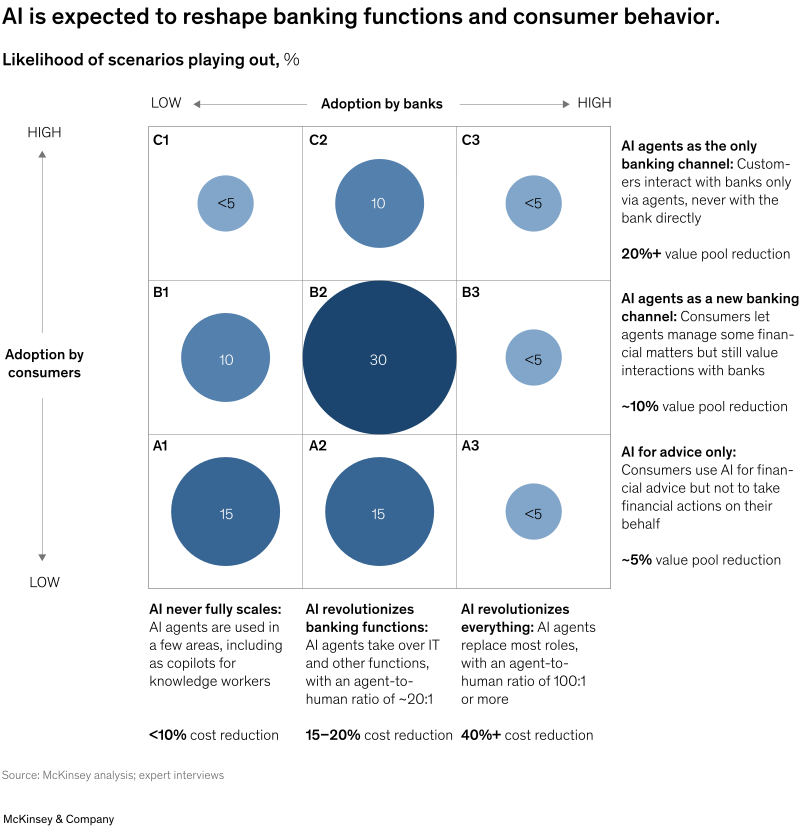
Image description.
This 3x3 matrix chart illustrates the likelihood of nine different scenarios for AI adoption in banking, segmented by adoption rates among both banks (horizontal axis: low to high) and consumers (vertical axis: low to high). Each cell contains a circle sized according to the percentage likelihood that scenario plays out, with exact percentages labeled inside. The largest circle, representing the most likely scenario at 30%, is in the center (B2), where both banks and consumers achieve a mid-level adoption, leading to "AI revolutionizes banking functions": AI agents take over IT and other functions, achieving an agent-to-human ratio of about 20:1 and generating a 15–20% cost reduction. Flanking this scenario, the next most probable outcomes are in A1 and A2, both at 15%, where AI never fully scales or revolutionizes banking functions but with only low to mid adoption by consumers and banks, respectively—yielding lower cost reductions (<10% and 15–20%). Other scenarios, such as "AI agents as the only banking channel" (C3, B3, A3) or "AI revolutionizes everything," where adoption is high but likelihoods are all less than 5%, are much less likely. The side panel provides concise explanations for each scenario and summarizes associated reductions in costs or value pools, highlighting that scenarios where AI replaces most human roles could lead to cost reductions over 40%.
This image description was completed with the assistance of Writer, a gen AI tool.
Source: McKinsey Panorama—Global Banking Pools; S&P Global
End of image description.
To read the report, see “Global Banking Annual Review 2025: Why precision, not heft, defines the future of banking,” October 23, 2025.