As the United States marks its 250th birthday, we explore the foundations of its economic competitiveness—and the opportunities ahead. All this week, we examine how America’s sources of strength have evolved over time, from manufacturing and energy to technology and supply chains, and what it will take to sustain its competitive edge in a changing world.
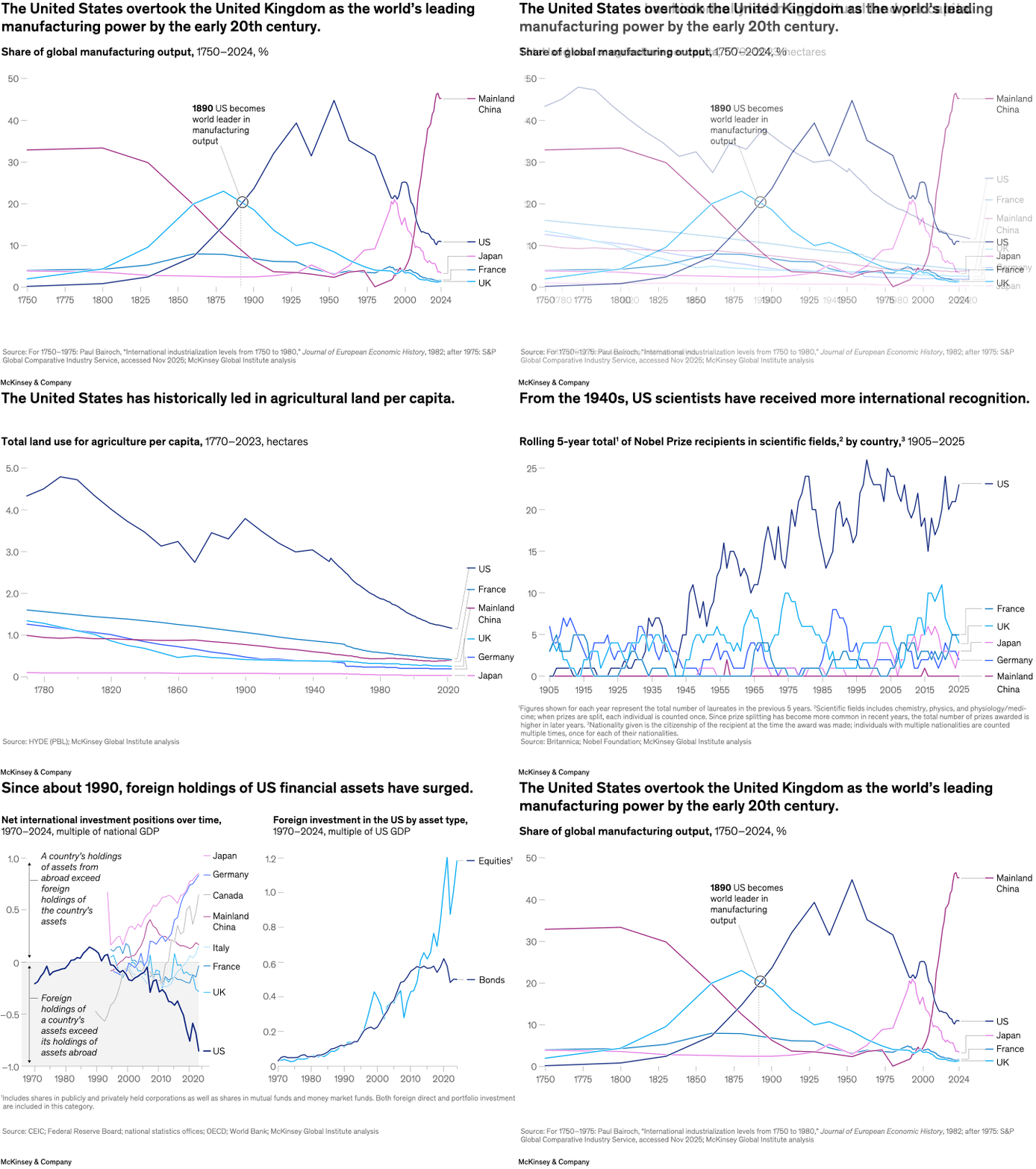
As its 250th birthday approaches, the United States holds its place as the world’s most competitive economy. But safeguarding this economic edge means continuing to evolve. For instance, the United States overtook the United Kingdom as the world’s leading manufacturer just before the 20th century and held the top position for decades. In the past 25 years, however, mainland China’s share has grown exponentially, note McKinsey’s Rebecca J. Anderson, Eric Kutcher, Kweilin Ellingrud, Olivia White, Shubham Singhal, Scott Blackburn, Arvind Govindarajan, Aly Spencer, TJ Radigan, and Mark Staples. Meanwhile, technology remained central to US competitiveness, with firms focused on knowledge-based software development and other intellectual property. Rising global demand for US financial assets propelled a surge in foreign investment beginning in the early 1990s. As financial asset exports increased, imports of goods climbed as well, reflecting the economy’s shift toward services.
Image description.
Rotating sequence of four line charts highlighting long-term indicators of US economic strength. The first chart shows that since about 1990, foreign holdings of US financial assets have surged, with the United States becoming the largest net international debtor among major economies as foreign investment in US equities and bonds rises sharply. The second chart shows that US scientists have received growing international recognition since the 1940s, with the United States consistently producing far more Nobel Prize recipients in scientific fields than other countries over recent decades. The third chart compares agricultural land per capita since 1770 and shows that the United States has historically maintained more agricultural land per person than France, the United Kingdom, Germany, Japan, and China, despite a long-term decline. The fourth chart tracks shares of global manufacturing output from 1750 to 2024 and shows the United States overtaking the United Kingdom as the world's leading manufacturing power around 1890, dominating much of the twentieth century before being surpassed by China in the early twenty-first century. Together, the charts illustrate how America's competitive position has been shaped by strengths in finance, scientific innovation, natural resources, and industrial capacity over the past 250 years.
CEIC; Federal Reserve Board; national statistics offices; OECD; World Bank; Britannica; Nobel Foundation; HYDE (PBL); Paul Bairoch, “International industrialization levels from 1750 to 1980,” Journal of European Economic History (1982); S&P Global Comparative Industry Service; McKinsey Global Institute analysis.
This image description was completed with the assistance of Writer, a gen AI tool.
End of image description.