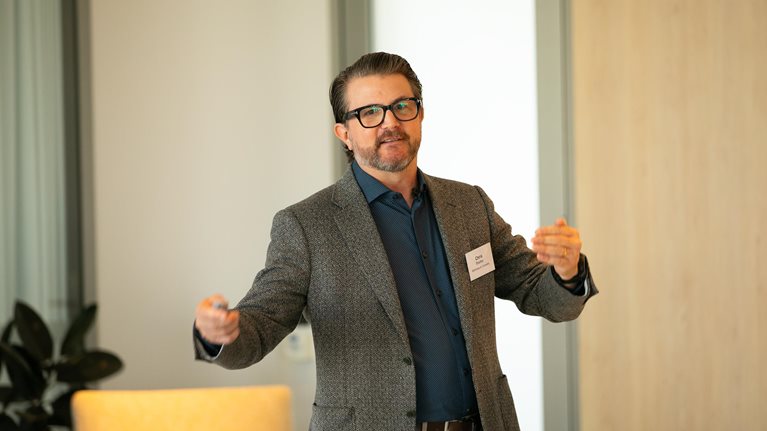
In this edition of Author Talks, McKinsey’s Charles Barthold chats with Pamela Meyer, founder and CEO of Calibrate, about How to Read the Room: The Art and Science of Social Observation (St. Martin’s Press/Macmillan Publishers, September 2026). In nearly two decades of work in fraud detection, Meyer has developed expertise in social observation, body language, facial expressions, and behavioral profiling, skills she sees as increasingly important amid a broader breakdown in trust. In her latest book, Meyer shows how sharper social observation can help leaders interpret workplace behavior, navigate power dynamics, and make smarter decisions. She explains how learning to read subtle social cues—and the context behind them—can help leaders build trust and spot what others miss. An edited version of the conversation follows.
What problems were you trying to solve when you wrote the book?
I wrote this book to solve two problems: a micro and a macro one. The micro problem is that I see very intelligent leaders make very bad decisions because they’re socially uninformed. So, if you’re someone who recently made a decision like that, this book can help you start to spot microexpressions and microbehaviors that you never saw before.
But we also have a macro problem, which I aim to address with this book. A long time ago, I taught people how to spot lies and declared a deception epidemic, but the context has changed completely. Now we are in the midst of something much more serious—a trust crisis.
What used to be considered polarization is now much more entrenched. People are more bitter, and an ambient cynicism runs through organizations. I see this when I address audiences or the C-suite, and people start nodding. We know we’re in the middle of this, but we don’t know what to do about it. Room reading is one step toward the game-changing need for trust in the environment. So that’s the second goal of the book.
You write about looking into people’s backgrounds, behaviors, and beliefs before walking into a room. Say more about what those teach you.
We teach people how to profile, but not in a racial or political sense. We teach them how to look at someone’s background and the formative experiences they may have undergone, someone’s behavior in the moment, and the belief systems that might be driving that behavior. This is a full-throated, 360-degree look at someone that we encourage people to do before they walk into the room.
We often try to glean formative experiences from a person’s background. Did they go from being an operator to a founder? Did they come to the country as an immigrant? Were they working under a famously domineering CEO for years? Was there an inflection point in their life? These things are key to know about that person.
From behavior, we try to determine who they are. Is that person a social chameleon or a gossip? Are they a people pleaser? Are they someone who drops names? How do they behave, and what do they do under pressure? What do they do when someone disagrees with them?
Beliefs are very stable over time, and they often drive us in ways that we don’t understand. They can explain very puzzling behavior. For example, if someone is defending the undefendable, there may be a related belief. You don’t know what drives someone’s behavior.
A person may believe that loyalty is the highest form of character. If someone comes into the office, finds everyone else talking about their weekends, but doesn’t talk or explain their silence, they may not be secretive. They may feel that privacy is a form of freedom. We spend a lot of time talking to people and trying to figure out their deeply held beliefs, because knowing that allows us to understand someone better and explains behavior in a more comprehensive way.
There’s a lot of information out there. How do you draw the line between what’s useful and what’s not useful?
Pursue facts, not people. We seek facts about someone that can help us understand and predict that person. We’re not looking for every single nugget of gossip. We [already] know they were lurking in bad parts of town and behaving poorly when they said that they were off skiing in Aspen. That’s not part of the profile.
Once you learn about whom you’re meeting, is it a matter of learning to work and interact with that person on their own terms, or is it about trying to change someone’s belief system?
Do you try to change someone’s belief, or do you just embrace it as is? People have very different views on this. Beliefs are deeply entrenched. We come to them early in life, and they rarely change. They tend to be stable over time.
If someone had a huge change in their belief system, that’s fascinating and worth asking about that. “Is there anything that you ever changed your belief on?” When they start to tell you that, there’s usually a huge story about what happened.
The reason could be disillusionment, a religious change, a change at work, or a devastating event. I am not a big believer in trying to change someone’s beliefs. Instead, the best thing you can do is understand and respect them. Beliefs are things we hold dear. To suggest that you could shift their belief system—particularly if we’re not among that person’s family or friends—feels arrogant on some level.
You’ve worked with many executives. What’s an example of someone you worked with and how you got them to change?
Often, I ask executives to walk into a meeting and avoid speaking for ten minutes. For example, if they typically have a half-hour meeting, during which they speak for most of it, instead they would enter and not talk. Instead of speaking, executives would observe people’s facial expressions and bodies, listen more carefully to how they tell stories, and note their interruption patterns. Regulating themselves not to invade the meeting with their own ideas is a muscle people don’t usually flex.
When they do this, the room starts to light up. Suddenly, they see something completely differently.
For example, it was hard getting an executive I was coaching to change, even though I applied this pausing process. He took up a lot of air in the room. He is unbelievably articulate, brilliant—often the smartest person in the room—and an incredible strategist, which is a very hard trait to find in an executive. He knew he was not getting the best out of his employees because he was dominating all the time. We weren’t seeing change at all; even the pausing process wasn’t enough. Sometimes you can change someone by having that person do something repeatedly.
There’s a certain discipline, and eventually you chip away at it, and executives start to see a difference. Sometimes you change them because you just frame the problem with an insight that makes them change their mind. In this case, I was able to do that.
I said, “You’re creating status with what you give your attention to.” I shared that he was doing that in the room. Every time you place your attention on the person who surfaces risks and bad news early, or on the person who’s the junior-level information synthesizer, or data person—instead of the person who’s being the most disruptive and noisy or the person who’s constantly reminding you that it’s their idea—you’re training everyone around you that you will confer status on those behaviors. And those behaviors will shift the room.
I sought to frame it for him in terms of status, as opposed to, “You have to really pause because people aren’t connecting with you.” Doing that was enough to shift the room. Sometimes, effecting change is about how you say it or how you get them to think about how they operate.
The leader who can read the room and doesn’t rely on the screen and the AI summary to figure out what’s happening will have an edge from context.
No interview today is complete without a question about AI. What’s one room-reading skill that AI can’t replace?
We’re going to have a very different conversation about this in five years, because AI is also learning to read the room. Yet one thing that AI does very badly, and which is crucial to room reading, is reading context. AI can extract a signal from everything that’s been captured: transcripts, data, calendars. It’ll tell you what the signal is.
But in the room, the signals are incredibly messy. A pause can mean you’re thinking. A pause can mean anger. A pause can mean strategy. It can mean deference. A smile can mean warmth. It can mean containment. It can mean you’re thinking about something. For most of us, it can mean fatigue. AI can’t figure that out. It can label the signal, but it cannot tell you what it costs the person emitting it. Someone may challenge the boss for the first time. But AI doesn’t know the relationship history or what it meant to that person.
The leader who can read the room and doesn’t rely on the screen and the AI summary to figure out what’s happening will have an edge from context.
Hybrid meetings have become the norm in many companies. How should we think about reading the room when much of the room is virtual?
More and more meetings are hybrid, which is very difficult to manage. I don’t know the science on this at all. Yet, anecdotally, I’ve found that unless the boss or the person with the power or the influence in that particular moment is on the screen, the real room wins.
The people who are in the room tend to dominate. So, it’s incumbent on the leader to continually rebalance the room, through comments such as, “Hey, Joe just threw popcorn at the screen. You may not be able to see this, but we saw it,” or “We haven’t heard from Alyssa,” and to call people out from the screen.
As a leader trying to run a hybrid meeting, you also have to read the negative space in the room. That includes what was omitted, who turned their cameras off, who we didn’t hear from, who withdrew, and where the silence and stillness came from. You must remind yourself that it’s your obligation to keep the room balanced and to interrupt conversations as they go on to ensure that everyone has a role.
You write about clearing the cache. It’s what others might call being in the moment. How does that play into reading the room?
As I was conducting research for this book, I was blown away by the impact of cognitive load on your ability to read the room accurately. There’s an old joke that a legal case comes down to what the judge ate for breakfast. It turns out there’s some truth to it. There’s a study that assessed 1,000 judges, who, 65 percent of the time, granted parole right after breakfast. They would get hungry by lunchtime, and that number would go to zero. After lunch, the number would go back up to 65 percent.
In another study, people were seated in a stiff chair and asked to negotiate. They were less flexible in the negotiation. In a study where people were given a bitter drink, the subjects ranked the people with whom they were speaking as distasteful. So, we’re really beholden to our environment, and we can be overrun with data coming at us that interferes with our day and doesn’t allow us to walk in either with a clean read of the room or with the ability to pay attention.
In addition, we’re often very tired. Taking this into consideration when we walk into the room can allow us to be somewhat humble about it and to realize that our reading of the room is often incredibly warped. I recommend considering how you can “clear the cache” before you walk into the room.
You can exercise or meditate, but that’s not for everyone. You can also write down what’s on your mind, so you don’t carry it with you. You can also try to narrow your purpose for the meeting or engagement to one thing.
For example, after you’ve cleared the cache and you’re ready to walk into the room, you say to yourself, “My one purpose for this room is to get Matthew to take on the budget. That’s what I’m focused on.” And if you say it to yourself out loud, you’ll be more focused on what you need to get out of the room, just by focusing your mind on that moment.
Clearing the cache of cognitive load addresses two levels of concern. First, you don’t want the administrative noise of the day to obscure an accurate view of things. Second, and more personally, we walk around with “open loops”: the fight we have with our spouse, the boss we’re not getting along with, the child who won’t go to school, the person who’s sick. We really need to work on those things because they interfere in a much more corrosive way than we realize. So, there’s administrative and personal work to do before walking into the room.
Instead of speaking, executives would observe people’s facial expressions and bodies, listen more carefully to how they tell stories, and note their interruption patterns.
All this sounds good. But often we’re called into rooms with little time to prep. What are some tips for those of us who have not prepared?
First, pause. Don’t say anything until you’ve looked around, taken in the vibe, developed a sense of the energy, and can match it. Second, try to start looking for shifts right after the action happens.
For example, there’s a challenge to power, a fight, or an inflection point in the conversation where someone brings up a completely transformative piece of data, or a new person walks in and changes the entire energy of the room. You want to look past the action.
You want to watch everything around the action, especially the first few seconds after it happens. That’s where you’ll figure out what’s really happening in the room. And if you have too much going on and you have a lot invested in this conversation, or you’ve just been thrown into it, another question you can ask yourself to get a very basic sense of the room is whether the room is expanding or contracting.
When the room is expanding, even amid a significant amount of dialogue or conflict, there’s a palpable, healthy friction. When the room is contracting, it’s quieter. Smiles and jokes don’t land well. Body language shifts, and eye contact ceases. Attention will be diverted to Slack channels or phones. That contraction is very informative. If you can’t remember anything else, ask yourself, “Is this room expanding, or is it contracting?”
You have a lot of experience in this field, but I imagine there must have been a thing or two that surprised you when you conducted the research for this book.
The most surprising thing was that teaching someone to read a room is a leadership skill, and you really can teach people to do it. Consider that doctors are taught social observation before they make diagnoses. Spies are taught to enter a room and learn situational analysis. They can enter and be situationally aware, scan the room, leave, and then tell their handlers who wore red or blue, who sneezed, who was sick, whose feet were pointed toward the exit. On one hand, reading the room requires learning to observe and interpret subtle social cues, from microexpressions and micromovements to shifts in the room. On the other hand, it’s entirely teachable—and that can give leaders an edge.
It’ll allow them to get what they want because they’ll start to see things in the room that nobody else sees. They’ll find that their connections are much more profound and much more intentional.

Visit Author Talks to see the full series.
Related Articles

Bias Busters: How cognitive overload multiplies every bias