The boardroom was quiet in the way rooms get when a high-stakes decision is on the table. The executive team had gathered to decide on a major capital allocation—an acquisition that could shape the company’s next decade. The financial models were rigorous but inconclusive. The risks were material. There was no obvious right answer.
As the discussion got underway, the tone shifted. Two executives leaned forward, interrupting each other. One pressed for boldness and speed, while the other pushed back, raising the negatives about the deal. Across the table, others withdrew—one by retreating into spreadsheets. Another tried to smooth the tension: “We’re aligned on growth. Let’s not turn this into warring camps.” The capacity for hearing alternate points of view decreased as heart rates rose.
The issue was financial, but the reaction in the room was physiological. As the stakes rose, the participants’ nervous systems began scanning for threat: not physical threat, but loss of status, credibility, belonging, and a sense of competence.
At the core of this reaction is something rarely addressed in organizational life: fear of loss. What appears as opposition, withdrawal, or overanalysis is often a self-protective response. In many organizations, these behaviors are labeled as “resistance to change,” pinning the problem on individuals or teams. But this framing obscures what is actually happening. People are not resisting change itself; they are responding to what they believe the change threatens.
Unmetabolized fear does not disappear. It narrows thinking, distorts judgment, and filters out the perceived risks that signal real vulnerabilities. In the case of the boardroom above, the decision about capital allocation will still be made, but it will not reflect the full cognitive and relational capacity in the room.
There is a different way of leading that preserves resilience and cohesion rather than depleting it. Called trauma-informed leadership, this approach recognizes how people react to anxiety and stress and how those reactions shape decision-making, relationships, and culture. Instead of interpreting behavior as resistance, leaders create conditions and regulate systems so that fear of loss is acknowledged and integrated. People can then reengage with clarity, shifting from reactivity to a more intentional response.
Trauma-informed leadership is a core discipline of operational effectiveness (see sidebar, “Trauma and the workplace”). In this article, we draw on our work with leadership teams, along with insights from neuroscience and psychology, to explore how leaders can cultivate awareness in themselves, in team relationships, and across their organizations to convert stress into focus, resilience, and performance.
The roots of trauma-informed leadership
The recognition that sustained pressure alters judgment and behavior did not originate in corporate settings. Other kinds of high-reliability organizations have long recognized that sustained performance depends less on eliminating stress and more on managing its effects on attention, judgment, and relationships.
Research on combat stress and operational fatigue1 has found that prolonged strain reduces cognitive flexibility and memory. Aviation and surgical teams have institutionalized structured debriefs not only to refine technical performance but also to metabolize accumulated strain so mistakes don’t multiply. Trauma-informed approaches are now common in healthcare, education, and social services. The emphasis is on system design: predictability, clarity, and practices that reduce avoidable stress so people can consistently perform at a high level.2
Modern organizations are environments of continuous transition: restructuring, strategy pivots, resource reallocation, project shutdowns, and role shifts. Each transition carries a cost, often unacknowledged, that can increase the fear of loss of certainty, influence, team cohesion, and identity tied to prior success.
In most business cultures, the norm is to move on. Closure is implicit, and reflection remains largely intellectual. Yet research shows that intense emotions—particularly fear and grief—stabilize most effectively when people are connecting with others rather than living in isolation. When transitions are not metabolized, strain accumulates and resurfaces as defensiveness, polarization, rigidity, or disengagement.
Traumatic experiences are often thought of as rare, but if we include developmental experiences that felt harmful, frightening, or overwhelming,3 many people have adapted to some form of trauma.4 Their patterns of adaptation don’t stay in the past; they show up in how people lead and react under pressure.5
A recent McKinsey Health Institute survey of 30,000 employees in companies across 30 countries found that 33 percent report experiencing a traumatic event that has affected their lives.6 These individuals also report lower levels of adaptability, learning, engagement, and other performance outcomes (Exhibit 1). While not causal, the pattern suggests that employees who perceive themselves as having experienced trauma may feel less safe, adaptable, and supported at work. The true percentage of individuals experiencing trauma in the general population may be higher, since not everyone chooses to disclose it or is accurately aware of the effects of a traumatic event.7
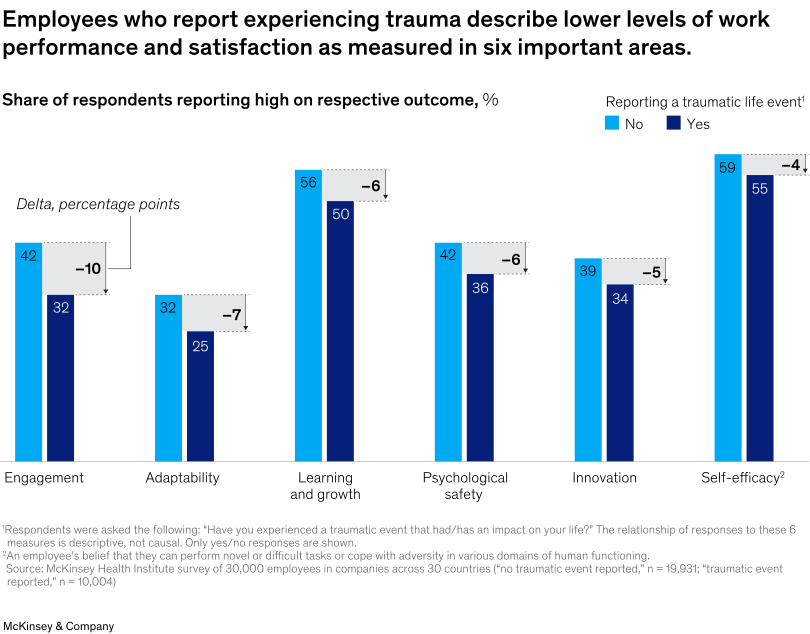
These experiences also affect how people engage and process information and how teams make decisions under pressure. Leaders who account for these dynamics are better positioned to help people adapt, maintain performance, and contribute to sustained competitive advantage.
Drawing on her training as a nurse, a senior executive at a hospital system recognized familiar signs of strain, including rising fatigue and quiet resistance, during a restructuring. Projects were ending, resources were shifting, and teams were being reorganized. The workload was manageable, but the lack of closure was destabilizing.
She understood that fear of loss was getting in the way of decision-making and moving forward. In response, she introduced a monthly session her team informally called a “funeral meeting.” It was structured to create space for people to reflect on what they would miss, what felt unfinished, and the lessons they would carry forward. People acknowledged projects that had ended, initiatives that were being deprioritized, roles that were changing, and resources that were being reallocated.
The purpose was not catharsis, but integration. A stronger sense of belonging reduced the need for self-protection and made candid dialogue possible. Over time, leaders observed less quiet resistance, faster reengagement after pivots, lower levels of conflict, and better decision-making. The workload didn’t decrease, but the sense of volatility did—allowing people to focus on performance instead of bracing against change.
Trauma-informed leadership in three domains
Our work with leaders across industries reveals a consistent pattern of organizational strain: Sustained pressure creates stress that extends well past any individual. It moves through systems, shaping how leaders manage themselves, how teams engage with one another, and how organizations process pressure.
In the organizational context, three interconnected domains determine whether judgment holds, coordination remains possible, and execution remains durable over time. We describe these as self (I-I), relationships (I-You), and system (I-We) (Exhibit 2).
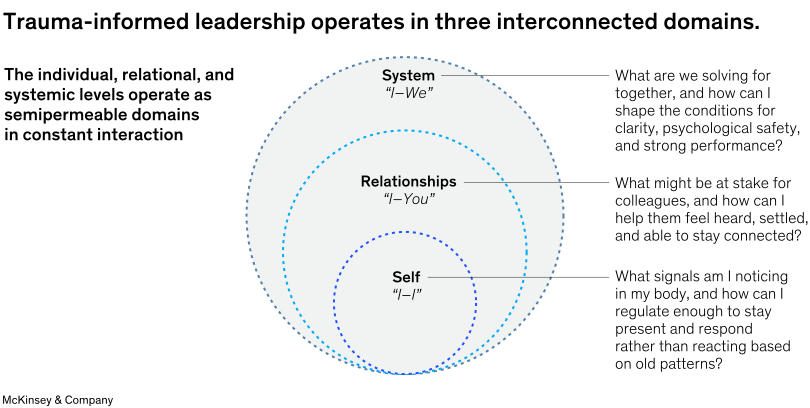
Pressure moves across multiple levels: At the self level, it alters perception, narrows options, and amplifies default patterns; at the relationship level, it influences whether disagreement becomes creative or corrosive; and at the system level, it determines whether strain is metabolized or silently accumulates.
Trauma-informed leadership becomes practical when leaders strengthen capacity across all three domains. Pressure will move through the system regardless; the question is whether it will be amplified to the detriment of organizational health or processed in a way that allows employees and teams to focus on their work.
I—Self: Regulation before response
When under pressure, leaders rarely experience themselves as “emotional.” What they notice is urgency—the pull to move faster, end debate, or resolve tension quickly. That urgency is often the first signal that the body has gone on high alert.
The CEO of a global agriculture company prided himself on encouraging challenges within his team. Yet in high-stakes discussions, he would invite debate then step in as tension rose, narrowing the conversation before key issues had been fully explored.
He believed he was maintaining momentum. In practice, he was reacting to his own discomfort with rising intensity.
Through reflection, he identified his triggers: These were moments when disagreement became visible and his reputation felt at stake, or when the room grew tense after conflict. This pattern showed up in three ways:
- Physical: chest tightening, shallow breathing, faster speech, forward-leaning posture
- Emotional: urgency and frustration, underpinned by anxiety and fear of failure
- Cognitive: internal narrative of “the team is spinning,” “I need to step in,” “this is all on me”
Individually, these signals seemed insignificant. Together, they formed a predictable sequence that led to premature intervention.
The CEO introduced two simple disciplines. The first was physiological. When he noticed these cues, he shifted his breathing, which interrupted the stress response just enough to widen his awareness. The second was to acknowledge an emotional–cognitive loop. He identified feelings of impatience, urgency, and a pull to regain control. He treated these signals as data, shaped by his experiences of dealing with responsibility and pressure in his younger days. By processing these feelings, which had been reinforced over time, he reduced their grip on his behavior.
Instead of moving immediately to resolution, he chose to stay in the conversation longer, asking himself and the team, “What do we need to solve for? What outcomes are we trying to create?” He intervened more selectively. Over time, the team remained engaged under pressure instead of deferring upward. Decision quality also improved because the CEO became less reactive (though not less decisive).
Leaders who perform well under sustained pressure develop this capacity deliberately. Regulation doesn’t slow execution; rather, it allows leaders to reflect before acting on incomplete thinking. According to McKinsey’s latest State of Organizations survey, organizations with more reflective leaders are nearly twice as likely to report that they can adapt quickly to change.
Practical steps include:
- identifying recurring triggers (visible conflict, silence after disagreement, time pressure)
- recognizing early signals of physiological, emotional, and cognitive activation
- pausing (exhale) to allow better thinking to emerge, shifting from “How do I fix this?” to “What am I solving for?”
- building resets into the day (including breaks between meetings) to reduce accumulated reactivity
You—Relationships: Helping people ‘feel met’
Under pressure, leaders often move from engaging others to managing them. Conversations become more directed, and listening becomes selective. These shifts are often driven by the same dynamics that leaders experience internally: activation, urgency, and a desire to resolve tension quickly.
In practice, this shows up in familiar ways. A leader hears concern and moves quickly to reassure a colleague that this isn’t a problem. A team member expresses frustration, and the response is to explain: “Let me walk you through why this makes sense.” At times, the message is more implicit: “You shouldn’t feel this way.” A difficult reaction is met with redirection: “Let’s stay focused on solutions.”
The intent is to help, but the effect is often the opposite. When people are activated, the body mobilizes, the mind interprets information as a threat or loss, and behavior shifts to defensiveness or withdrawal. This stress response reduces their capacity to process information.
Leaders who are effective under pressure learn to recognize activation in others before responding. Just as with self-activation, the signals during interactions are physiological (changes in breathing, muscle tension, flushed skin, a strained voice), emotional (frustration, defensiveness, or resignation), and cognitive (rigid positions, repetitive arguments, and difficulty integrating new information).
When these signals are missed, the impact shows up in delayed decisions, avoided conversations, or a pull toward overanalysis. In many cases, what is being avoided is not the decision itself, but the emotional discomfort associated with it. In these moments, the leadership task shifts to stabilizing the interaction so thinking can resume.
At one industrial organization, a senior leader was asked to launch a business outside his area of expertise. He initially resisted out of concern that he would fail. His CEO approached the situation by asking the leader what felt most difficult, rather than focusing first on performance.
When setbacks occurred, the CEO did not move immediately to problem-solving. He acknowledged the pressure and the risk the leader was carrying. Only then did they turn to joint problem-solving.
The CEO’s message was clear: You are accountable, but you are not navigating this strain alone. Over time, the leader took on greater risk, not less. The business grew. More broadly, others observed that leadership supported those willing to take on a stretch goal.
This dynamic can play out in smaller moments. Consider two responses to the same situation. After a team member receives difficult news, one leader explains why the outcome is reasonable and why disappointment is unnecessary. The intent is to reassure; the effect is to override the person’s emotional experience, prolonging activation. Another leader responds differently. She listens and acknowledges, “I know this is hard.” She does not rush to fix things. Within minutes, the intensity settles, and the conversation becomes more constructive.
The difference is not necessarily empathy as a personal trait. It is whether the interaction reduces or amplifies the perceived threat. Leaders who can “meet” others in this way create conditions in which tension can be worked through, not avoided or escalated. As a former US Navy rear admiral observed: “When people feel met, they think better. When they feel managed, they shut down.”
Practical steps include:
- noticing signs of activation in others before responding to what is being said
- acknowledging what appears to be at stake (“It feels like there’s a lot riding on this”)
- asking open, nondirective questions (“What feels most difficult here?”) and indicating when avoidance may be occurring (“Are we hesitating because something feels at risk?”)
- creating a moment of arrival in conversations (a brief pause at the start, or before responding) to help the group keep thinking rather than reacting
We—System: Designing for coherence under pressure
Organizations don’t experience stress in the abstract—it moves through structures, decisions, and routines. When systems are unclear or inconsistent, pressure compounds and is often interpreted as a threat. When they are well designed and anchored in shared purpose, they allow people to adapt without becoming reactive.
Leaders can strengthen this capacity by creating “nesting grounds”8 within the organization. These are structured conversations, forums, or routines where people can process what they are experiencing without being immediately corrected, solved, or dismissed. When intensity is high, individuals and teams need places they can return to, even briefly, to metabolize what is happening so they can reengage with clarity.
Nesting is a form of performance infrastructure. By acknowledging and integrating emotional load, the system’s capacity to think and act is restored, as is its orientation toward shared outcomes. This does not lower standards or reduce accountability.
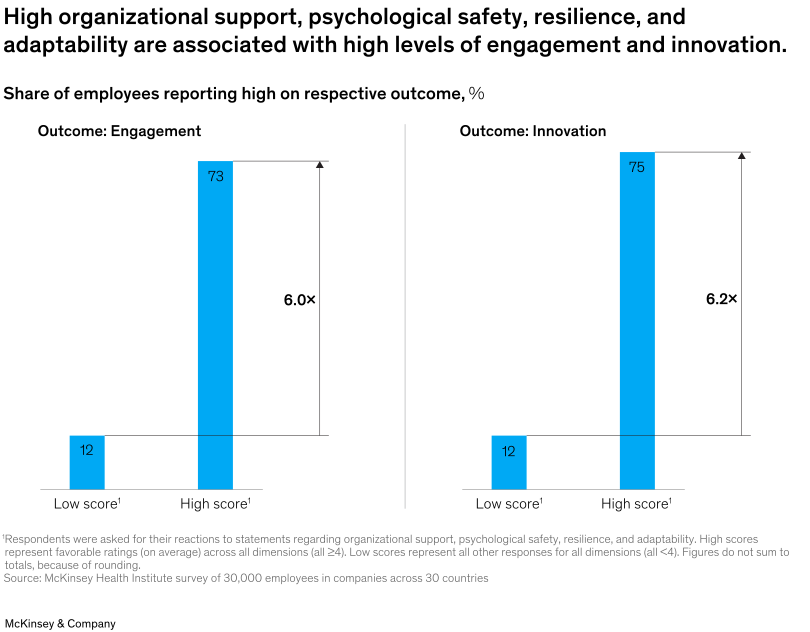
Research on psychological safety shows that performance improves when high standards are paired with relational steadiness. The McKinsey Health Institute survey found that those who feel supported, safe, and adaptable at work report engagement and innovation at six times the rate of those who don’t report high on these outcomes. While not causal, this suggests that leadership behaviors that create a stable, safe environment can contribute to stronger team performance (Exhibit 3).
In our work with leadership teams, we see that when pressure is sustained, workload alone is rarely the most damaging factor. Frequent shifts in priorities, decisions that change without explanation, and misalignment across levels create uncertainty that no amount of individual resilience can fully offset. In the absence of clear anchors and shared meaning, people are left to make sense of these shifts on their own, often defaulting to threat-based interpretations that undermine performance.
At a large transportation company in the middle of a restructuring, employees described their frustration with broad misalignment. They were exhausted by unpredictable priorities, uncertain decisions, and uneven management signals across levels. The result was hesitation, rework, and slowed execution.
The CEO responded by defining a small set of commitments that would not change, regardless of market turbulence. This action clarified decision rights, stabilized the communication cadence, and protected key rituals, including structured retrospectives and transition forums. These commitments served as anchors of what the organization stood for under pressure.
Even as strategy evolved, these anchors held. Employees could tolerate the intensity of the restructuring because they understood what would remain stable and what the organization was working toward. Trust did not erode with each shift.
Nesting practices were used as a complementary discipline to process transition. Retrospectives were designed to examine how people experienced the work. What created unnecessary strain? Where did coordination break down? What needed to stop, not just improve, for people to move ahead?
Similarly, leadership forums and town halls explicitly acknowledged what was being deprioritized, what would no longer continue, and what might be missed. This reinforced a shared understanding of what mattered most in the future.
At a media organization facing profound disruption, uncertainty had begun to fragment the system. People were preoccupied with what might be lost—roles, relevance, and stability. Risk-taking slowed, and the future felt threatened. The company’s leaders anchored their strategy in a clear sense of purpose, articulating the role the company could play in the world in a way that allowed people to locate their own place within it. From that shared direction, plans and priorities became more coherent, and energy that had been tied up in self-protection became available for problem-solving, creativity, and forward movement. People began to ask different questions—from “What do we need to protect?” to “What are we here to build”?
Practical steps include:
- articulating a clear purpose and change narrative so people understand what is shifting and where they fit
- defining decision rights, priorities, and communication rhythms that remain consistent under pressure
- establishing forums and practices to process change, surface concerns, and align messages, incentives, and behaviors
- building moments of collective pausing into team routines (for example, brief check-ins) to reduce reactivity and restore thinking
Leadership that metabolizes strain
We are operating in a period of heightened societal and organizational stress. Digital overstimulation, geopolitical uncertainty, concerns about AI, and social polarization contribute to chronic activation and employee burnout.
As pressure becomes continuous, leadership models built on restoring stability between disruptions are less effective. In the current environment, leaders must sustain coherence while disruption continues, preserving the organization’s capacity to think and act amid nonstop change.
This shift does not render established leadership behaviors obsolete. Strategic clarity, decisiveness, accountability, and execution discipline remain essential. However, when one crisis follows the next without time for recovery, these skills must be exercised in ways that do not erode cognitive, relational, and strategic capacity.
When trauma-informed leaders regulate themselves and strengthen relationships, organizations hold together under strain. Decisions move faster and land better, disagreement sharpens thinking without turning personal, and new ideas surface rather than shut down. Leaders stay connected without absorbing every tension. People can think—and create.
Pressure does not disappear, but it manifests itself differently. People can tolerate intensity because the organization no longer amplifies it. Trauma-informed leaders have the tools to design systems capable of metabolizing pressure by creating the conditions for stronger connection, healthier organizations, and more grounded human experience.
Related Articles

Developing a resilient, adaptable workforce for an uncertain future