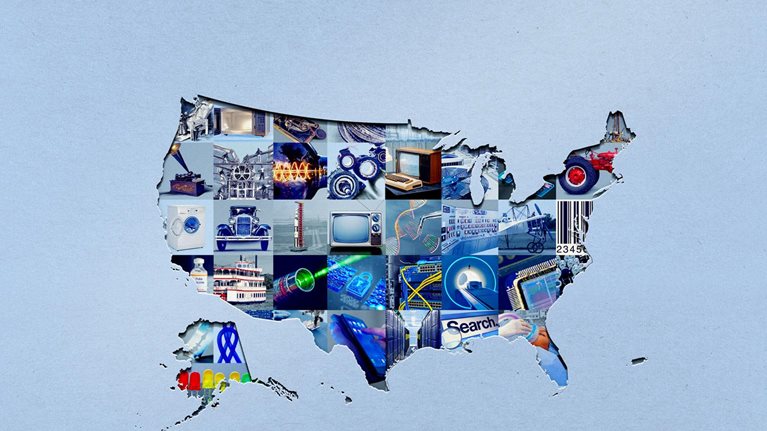
Nearly 250 years after its founding, the United States is the world’s most competitive economy. With just 4 percent of the world’s population, the country generates more than a quarter of global GDP and is home to more than half of the world’s top 100 companies by market capitalization. But with AI redefining industries and geopolitics reshaping supply chains, what will it take for the country to maintain its historical lead?
McKinsey’s Eric Kutcher and Olivia White are coauthors of “At 250, sustaining America’s competitive edge,” a new report from the McKinsey Global Institute that traces the trajectory of US competitiveness. In a recent McKinsey Live webinar, Kutcher and White joined Global Editorial Director Lucia Rahilly to discuss the United States’ history of reinvention and the challenges and opportunities ahead.
You can watch the replay of the full discussion above, including the Q&A, or explore the following transcript, which has been edited for clarity and length.
An economic powerhouse
Lucia Rahilly: Olivia, you spent months deep in the research for this report. What did the data reveal?
Olivia White: Some of the data points showed what we expected to see—for example, the US has 26 percent of global GDP but only 4 percent of the global population, and 59 of the top 100 firms by market cap are American. The numbers show that the US is doing incredibly well in some areas, such as its role in gen AI and in creating notable AI models. The numbers are big compared to the population—but are they big enough to retain the competitive position we’ve been in for more than a century? That was our starting point.
Lucia Rahilly: Is US economic strength a story about a few good companies, or is the strength more broadly distributed?
Olivia White: It’s really a story about both. The US has been home to more than half of the world’s top ten market-leading firms over the past century. But what made this so? It’s dynamism at the top. Different firms appear in that top ten list decade after decade, and that dynamism runs deep: US firms are more dynamic, all the way down to smaller firms, than those in other economies. That means they grow faster when they’re productive and disappear faster when they’re not. There’s a lot of new firm creation linked to innovation.
Lucia Rahilly: Eric, you talk to CEOs and boards across North America every day. As the competitive landscape becomes less stable, some of the ground the US has historically held is now being contested in ways that should give business leaders some pause. Where do you see the most significant pressure points?
Eric Kutcher: First, I want to go back to what Olivia was saying. The fact that the US has maintained its position on that top ten list speaks to the underlying values that have allowed the US economy to be what it is. That’s why I don’t bet against the US. If you believe in those underlying values and in the entrepreneurial spirit as core to who we are, then you have to believe it will continue. But it’s not a foregone conclusion—there’s a lot that must happen to enable it.
Regarding what’s on the mind of CEOs, topics one, two, and three are AI, and topic four tends to be geopolitics. And geopolitics is the level of uncertainty they’ve had to learn to live with.
CEOs today are more battle-tested than ever before. We used to think we couldn’t handle more than one issue or shock at a time, and now it’s multiple shocks each year. CEOs have learned to navigate through the moment. What’s on their mind is: “How do I think about labor? How do I think about capital? How do I think about the level of investment? How am I thinking about the return I’m going to get?” I keep reminding them that this is their reimagine moment—their moment to think about the business differently than ever before.
It’s a moment that should both inspire and create a level of worry. It’s an incredible opportunity to adopt the mindset of an attacker as opposed to an incumbent, given that this technology enables CEOs to rethink their businesses in a profoundly different way.
From strength to liability
Lucia Rahilly: You made the point that we shouldn’t bet against the US and that the US has an incredible entrepreneurial spirit of dynamism. But the research shows that some of America’s historical strengths are now becoming liabilities. What are the implications of that?
Eric Kutcher: There are real obstacles to overcome. For example, we have $1.5 trillion in projects that already have capital and are waiting for permitting. We need to find a way to accelerate investment to enable us to continue. That’s one example of what needs to happen.
Another example is the education system. We had the world’s best education system for a long time, but we don’t today. For example, the number of people graduating from US universities with engineering degrees is about 10 percent of the number in China. How do you compete in an engineering-oriented world with just 10 percent of the available engineers?
Debt levels and their impact on the overall US economy are another challenge we have to overcome. We haven’t been able to address this so far through any form of real budget balancing. What are the other ways to do it? Is it going to be done through growth? And does AI give us the productivity to achieve that growth and allow us to pay the bills going forward?
The future is far from certain, but I’m optimistic because we tend to find a way. Sometimes that comes from business, not government—or from both—although there is less collaboration between the two than in the past. Looking at research dollars, we are reducing funding at the federal level. Will that sustain us going forward at the scale required? These are the types of things we have to overcome.
Olivia White: If you look back over the past 250 years, as we did, you see meaningful reinventions where the US shifted what it focused on and why. The country’s competitiveness went from an agricultural base to an industrial powerhouse to a bastion of scientific strength following World War II, and then led the charge into the digital era. Each of those moments of reinvention was forged in a moment of geopolitical struggle or contention—but also moments of real “cuspiness” of technology.
As Eric says, we’ve done it before, often in tough and pronounced ways, over the course of our history. And some of these meta points, if you will, that he’s talking about—the ability to reinvent, to bring in both ingenuity and invention with a tremendous amount of natural resources and institutions—have been constants. What are the things we need to harness the moment and the potential of AI, but in a more contentious world? What do we need to do? Those constancies can help tackle the kinds of points Eric described as imperatives or challenges.
The imperative of AI fluency
Lucia Rahilly: In the research, you outlined five imperatives to move us forward—to get us to the next chapter of America’s competitiveness. The first one is AI fluency. Tell us what that means.
Olivia White: There are a couple of things. The first is to put the US in a position to lead as an AI innovator and implementer, in both software and physical AI.
That’s going to require a certain stance. It’s going to require funding, infrastructure, energy, and people with fluency in AI or engineers with the skills Eric mentioned.
At the same time, part of being competitive—and the reason you want to be competitive—is ensuring that people in the country earn good incomes. You want those incomes to be evenly distributed. For that to happen, everybody has to be able to participate in shaping the change. And the only way to participate is to be fluent in the new vocabulary. That’s why education—focused not just on the skills needed in this new world but also on how we think about operating as a society—is important. Hence, AI fluency carries a lot of weight.
Eric Kutcher: One of the skills that will be needed is high-end manufacturing; that’s one of our eroding strengths. We are still the number-two manufacturer, but we have lost a significant share, because we chose to outsource these things to other geographies. You might argue that it held inflation at lower levels and brought goods to a broader set of folks, but there’s no question that it eroded the middle class. Some of what we’re seeing economically, including some of the divergence in incomes, is a result of the fact that we no longer have those jobs. But even beyond jobs, outsourcing also affects factors like national security. As it relates to AI, we don’t make those chips here anymore. And if you said, “Let’s go try tomorrow,” that would be hard because we don’t have as much leading-edge know-how.
Whether it’s the next generation of automotive or something else, we’re not at the forefront anymore. We will need retraining and rebuilding if we want to be competitive. We also have to understand that the US can’t try to manufacture everything; we don’t have the labor base. One notable shift in the economy in the past few years is a declining labor base. Most recently, we’re seeing relatively modest job gains and losses, yet we’re not seeing a change in unemployment. And that’s a real indicator of where we are: a combination of reduced immigration and more retirements. These are real dynamics, and we have to figure out how to rebuild that know-how.
Lucia Rahilly: If we’re looking to AI to boost growth, we need massive investments to power data centers to deliver on AI’s astonishing potential. What does the research say about that imperative?
Olivia White: The good news is that we’ve put a tremendous amount of money toward AI. There’s a lot of domestic investment, not the least of which comes from companies. If you look at the biggest tech companies, the amount of money they have put toward R&D is immense. For example, Amazon has increased its capital expenditures and R&D spending by a factor of almost 50 since 2010. There’s also a lot of foreign direct investment being committed to the US in these areas.
The challenging news is that this needs to be sustained over time. To retain its competitiveness, the US needs to be a place where people want to invest. That requires them to have faith that their money will do well here—and that, in turn, requires faith that the US government will continue to be trustworthy, its debt will remain well under control, and yields won’t be too high. But we’ve recently reached a point where our annual defense spending is lower than our debt repayment. And when you have this kind of rising debt, you have to ask, “How do we reduce that debt substantially so that, over the long term, we can ensure we’ll continue to be a place for capital to grow?” There are two conventional ways: cutting costs and raising revenues. That’s another reason why growth is not only important but also potentially a virtuous cycle.
Eric Kutcher: We’ve had pristine balance sheets from some of the largest tech providers, but now we’re starting to spend beyond our operating cash flow, which means taking on more debt to pay for these things. We have to watch how this evolves and whether the overall economic equation continues to close as we go forward. I believe it will, but we’re not there yet. We’re now in a real investment phase, and the question is how much. There are lots of reasons to believe we have to be in this phase right now, given the amount of advancement in the underlying LLMs [large language models]. We have to see how those things balance out.
The need for better infrastructure
Lucia Rahilly: Infrastructure is a hot topic in the media and, at least historically, an imperative with bipartisan support. What can you say about the imperative for new and improved infrastructure?
Eric Kutcher: Infrastructure has historically been a strength but is now a liability on the balance sheet side. We once had leading infrastructure, but it’s aging. We see this every day—walk into a US airport, and most don’t feel like they’re in the US. That’s getting a little bit better, and we’re starting to see some real investment, often through public–private partnerships, with airlines and others making large investments to enhance the experience.
But whether you look at bridges, highways, or energy—which is probably the most important—all of these areas are real deficits at the moment from a US balance sheet point of view. If you look at the percentage of GDP historically invested in infrastructure and you think about a useful life cycle, we’re now living in a period where it will take real investment. Do we have that investment capacity right now? These are real challenges. I believe we can solve them over time, but it won’t be easy. That’s a massive level of investment.
And that goes back to the underlying equation for growth in the US, because I do think we’ll have to achieve this through growth. But Olivia, you probably have more facts on this than I do.
Olivia White: You’ve mentioned a lot of them, and I agree entirely. For example, none of the global top 50 ports by vessel time in port are in the US. But investment in energy and infrastructure more broadly is something that clearly repays. So it’s a matter of thinking long term, given the trajectory we’re on, to ultimately realize those benefits.
But when it comes to investment in both infrastructure and manufacturing know-how, particularly in areas of the future, there’s a broad underlying theme around physical things. Eric also mentioned engineers: China graduates eight times more mechanical engineers a year than we do. You mentioned skills and the ability to build. There’s a real shift in thinking needed toward the physical world.