Private equity (PE) is accelerating again. In 2025, global deal value rose 19 percent to $2.6 trillion, reaching the second-highest total on record. Global exit value climbed 41 percent to $1.3 trillion.
The industry’s recovery has clarified what has durably changed. Between 2010 and 2022, nearly 60 percent of buyout value came from leverage and multiple expansion. By 2025, valuation multiples hit a record of 11.8 times EBITDA. Operating performance must now carry more of the load.
The pressure already appears in the data. Hold periods are now more than six and a half years on average. Only 19 percent of 2021 acquisitions had been sold by 2025, well below the 30 percent four-year exit rate typical of the prior decade. Buyout distributions fell to 6 percent of assets under management in 2025, down from an average of 16 percent between 2015 and 2019 (Exhibit 1). And the underlying businesses are changing faster during the hold: Gen AI is reshaping cost structures and growth models, while geopolitical fragmentation is altering supply chains and routes to market.
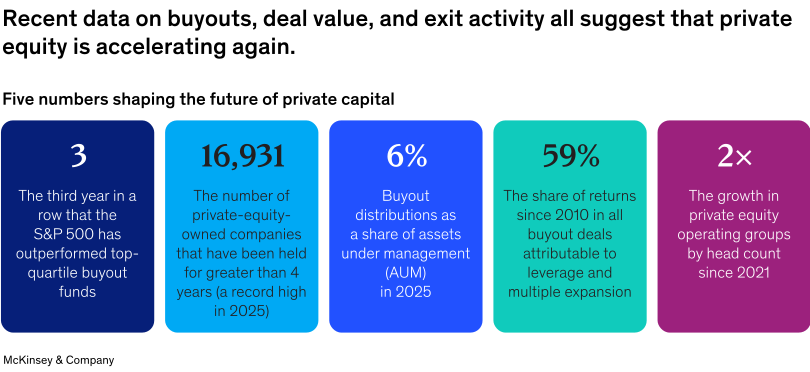
Firms have responded by expanding their value creation efforts. Since 2021, private equity firms have more than doubled the size of their operating groups on average, while expanding specialized capabilities and engaging operating teams earlier in the investment life cycle. In a recent McKinsey survey of 27 PE executives, more than 80 percent reported at least one portfolio company undergoing transformation, and 70 percent said the proportion had increased over the past three to five years.1 But more activity hasn’t necessarily led to faster exits or higher valuations.
Our research shows that leading firms are taking the following actions to streamline execution and capture value more quickly:
- “re-underwriting” value during the hold, not just at entry
- embracing enterprise transformation as the new normal
- investing in dedicated transformation leadership
- mobilizing employees deep in the organization
- building AI into a portfolio-wide value creation engine
When executed together, these five practices can help PE leaders successfully create value in a changed landscape.
Re-underwrite value during the hold
The assumptions embedded in an investment thesis rarely remain unchanged throughout the hold period. As new information emerges, sponsors reassess the company’s potential and the actions required to realize it. At leading firms, periodic re-underwriting or “rediligence” is now a mechanism for resetting portfolio companies’ ambition every two or three years. These reviews draw on management, deal teams, and operating partners to examine changes in markets, competition, operational performance, and sources of future value.
One PE firm describes its process of revisiting the investment thesis and its value creation targets as “mentally repurchasing” its portfolio companies. The firm credits its adoption of a structured re-underwriting process two years ago as a critical reason that it has since been able to distribute capital equivalent to more than 30 percent of its total fund to limited partners—materially improving its distributed-to-paid-in-capital ratio at a time when slow exits still constrained most peers.
Transforming value creation in private equity portfolio companies
Finding value beyond initial underwriting
This new mindset recognizes that some of the most meaningful opportunities only become apparent after acquisition—sometimes well after. With full access to management, data, and operations, investors can gain a deeper understanding of how the business works and where value can be created.
Typically, the initial due diligence process evaluates a target company’s potential against a minimum hurdle rate of return that the investor wants to achieve. Re-underwriting asks a different question: What becomes possible if we pull every opportunity lever simultaneously, informed by everything we now know? For one automotive distributor, the difference between the two inquiries increased the company’s improvement potential by about 50 percent—from a due diligence estimate of roughly $130 million in EBITDA to more than $200 million on re-underwriting.
A similar pattern can appear at mid-hold. In a software company where growth had slowed, owners revisited the trajectory of the business and identified the underlying drivers for more than $750 million in incremental enterprise value over three years. That reassessment informed a redesigned growth agenda and the creation of a dedicated execution structure to capture the opportunity.
Institutionalize re-underwriting during the hold
Re-underwriting is inherently demanding. It requires time from deal teams and operating partners, attention from management, and a willingness to challenge earlier assumptions. Introducing a structured cadence—reassessing at defined points during the hold—can generate significant pushback from everyone involved.
As a result, many firms do less of it than they may intend: Only about one-third of firms say they follow a disciplined approach to re-underwriting investments during the hold period. Instead, reviews of portfolio company performance remain informal or reactive, triggered by shortfalls rather than conducted systematically and at varying intensities based on an asset’s size and performance. Those firms that do manage to increase frequency find it hard to sustain that cadence across the portfolio.
When firms persist, however, the returns are disproportionate. One PE fund that re-underwrites its portfolio every year—with a particular focus in the first year after investment, at year three, and before exit—has generated more than 20 percent annualized net returns for more than a decade. It attributes a substantial share of that outperformance to the discipline of resetting ambition mid-hold rather than anchoring to the entry case. A European fund provides an even more rigorous model, which has helped it accelerate its exits by about 40 percent while substantially increasing distributions to investors (see sidebar “Applying a future-buyer focus”).
Embrace enterprise transformation as the new normal
The concentration of EBITDA margin improvement in the final year of ownership—roughly six percentage points versus about one percentage point annually in previous years—raises an obvious question: Why does so much portfolio company value still arrive so late?
One reason is that many value creation efforts remain narrowly scoped: Owners often focus first on relatively easy, incremental improvements such as procurement savings, pricing changes, cost reductions, or commercial enhancements. Because they don’t undertake enough broad, transformative value creation efforts early, the largest improvements don’t show up until later in the ownership period. Owners’ early efforts can generate results and may appear simpler to manage than a company-wide transformation. But they can end up focusing everyone’s attention on what’s readily achievable rather than on what could expand the business.
Historically, many sponsors accepted the trade-off, in part because operating resources were limited. But the doubling in size of PE firms’ operating groups since 2021 has given them a reason to pursue a different model.
Leading firms begin with a broader question: What is the full potential of this business? They assess operations, commercial performance, pricing, technology, and organizational effectiveness together, then build an integrated value creation agenda around the opportunities that matter most. The objective is to uncover opportunities that only become visible when leaders examine the business as an integrated system. McKinsey research finds that PE-backed companies pursuing enterprise-wide transformations typically achieve productivity improvements of 8 to 12 percent in the first two years after acquisition.2
That broader mandate changes both the scale and timing of value creation. By helping portfolio companies redesign end-to-end processes rather than individual functions, private equity firms are capturing more value more quickly. At the company level, initiatives reinforce one another rather than compete for attention. When pricing, operations, and commercial initiatives move together, improvements appear earlier in the hold period, allowing gains more time to compound. And as AI begins reshaping entire workflows rather than individual tasks, companies can rethink how work moves across the enterprise.
The approach also creates a different challenge. Capturing a larger opportunity requires more coordination, more management attention, and more sustained follow-through than traditional value creation programs.
Invest in full-time transformation leadership
Revisiting and expanding the plan is only part of the challenge. Delivering a company-wide transformation requires more coordination, more management time, and a higher tolerance for disruption. Those add up to a greater leadership burden than the traditional model was designed to support.
As hold periods extend, value creation depends on sustained execution over several years. Execution capacity has not been scaled in the same way. Because operating partners remain a limited resource, they engage most deeply early in the hold. “The opportunity cost of having an operating partner spend all their time at just one portfolio company is simply too high,” one PE executive told us.
Once responsibility shifts to the portfolio company management team, the value-creation agenda often becomes a secondary responsibility for a CEO whose main job is to run the business, with only intermittent support from the sponsor. Indeed, 94 percent of sponsors say portfolio company leadership drives value creation, yet only 8 percent report investing systematically in building that leadership capacity.
Transformation at the scale now required demands sustained focus, coordination across functions, and the ability to adjust priorities as conditions change.
Expand executive bandwidth
This raises a practical question for many firms: how to support a more intensive execution model without adding overhead. Historically, cost concerns crowded out other considerations. Some funds have threaded the needle not by expanding central teams but by placing targeted, time-bound transformation capacity within portfolio companies. The economics are typically self-funding: Faster execution and earlier value capture often pull forward enough value within the first year or two to offset the cost of dedicated leadership.
Most often, the additional executive bandwidth takes the form of a chief transformation officer (CTO) reporting directly to the CEO. CTOs are accountable for the entire value creation program, from defining specific targets to ensuring delivery over time. They sit within the management team, with the authority to coordinate across functions and hold leaders accountable for results.
Their most important role, however, is as a provocative agent of change (see sidebar “What effective chief transformation officers do”). Appointing a CTO can therefore create tension: Portfolio company CEOs may initially see the CTO as a challenge to their authority. When a CEO treats the CTO as a force-multiplying extension of their leadership, execution speed can more than double over a very short period.
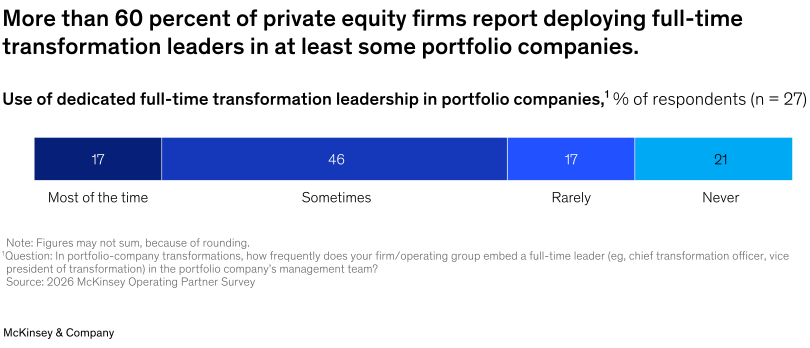
The portfolio-company CTO role is gaining traction: More than 60 percent of the private equity firms we surveyed report deploying full-time transformation leaders in at least some portfolio companies (Exhibit 2). Where this model is in place, execution tends to move faster and more consistently. In one case, the introduction of a dedicated transformation leader increased execution speed by a factor of five, reflecting clearer ownership and faster decision-making across initiatives.
Free up portfolio company leaders to lead the business
Transformation programs with dedicated leadership capture a larger share of their potential earlier in the holding period. The highest-performing programs capture roughly three-quarters of their total financial value within the first year, driven by the speed and quality of early execution.
The CTO also changes how the broader leadership team operates. When a CTO is clear about how they will work with portfolio company management, such as the support they will provide and the transparency they need, outcomes are dramatically better. The rest of the management team can focus more on decision-making and prioritization, while execution becomes more consistent across initiatives. The sponsor’s role evolves as well, with greater emphasis on ensuring that the portfolio company has what it needs to deliver the results investors expect.
Mobilize employees deep in the organization
Enterprise-wide transformation cannot be executed by the senior team alone. The initiatives that generate most of a transformation’s value sit several layers below the top team—and that’s where most of these efforts lose momentum. PE firms are placing greater emphasis on the parts of the portfolio company organization where execution occurs. This involves identifying the roles most critical to value creation and aligning talent to those roles early in the hold period. The timing matters. As Sandy Ogg, former operating partner at Blackstone Group, found, portfolio companies that place the right people into critical roles early generate 2.5 times the ROI of peers. The cost of delay can be significant. In our survey, half of senior private equity leaders said their biggest talent-related regret was waiting too long to replace underperformers in critical roles.
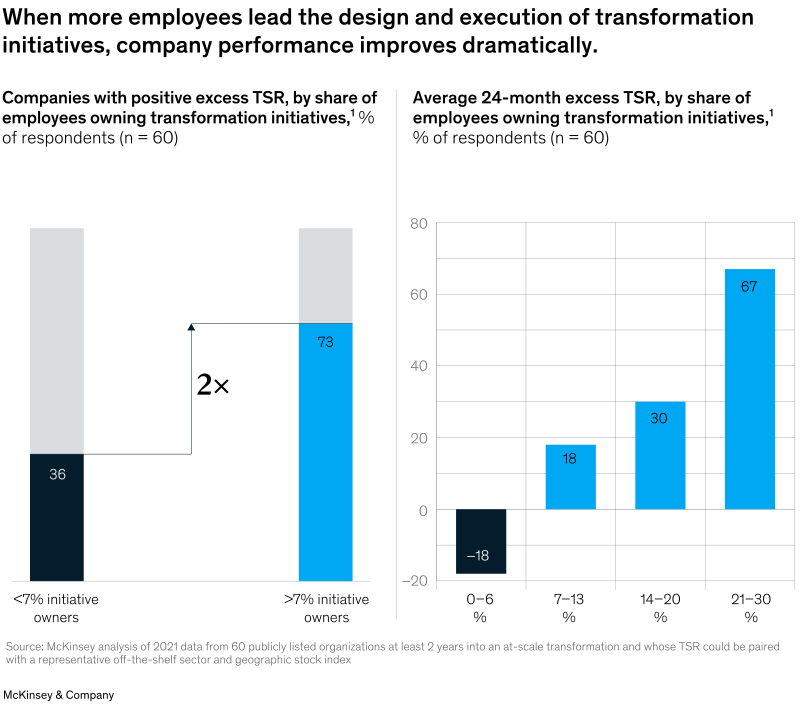
A critical task for this set of leaders is to engage the rest of the portfolio company organization, particularly in the day-to-day work of the transformation. McKinsey research from 2021 found that when more employees lead the design and execution of specific milestones or initiatives, company performance improves dramatically (Exhibit 3).3
Firms can use structured execution models that reach deeper into the portfolio company organization to translate initiatives into specific actions, with clear timelines, outcomes, and reviews to resolve issues early. This combination of broader organizational engagement and more consistent execution can increase both the speed and reliability of delivery while reducing dependence on individual leaders. The same infrastructure can also create greater visibility into performance at the initiative level. Firms can use that transparency to revisit talent decisions more frequently during the holding period rather than relying on traditional annual review cycles.
Build AI into a portfolio-wide value creation engine
AI is starting to change how firms decide where value exists and how often they revisit those decisions during the hold. Private equity leaders now recognize that AI requires speed and boldness across the portfolio.
At the fund level, AI is reducing the time required to reassess value during the hold. Re-underwriting that previously took weeks can now be completed in a matter of days, drawing on large data sets from prior transformations. This allows deal teams to test assumptions more frequently and in greater depth during the hold (see sidebar “Accelerating value creation and re-underwriting”).
Increase portfolio company performance
Within portfolio companies, AI is contributing directly to performance. Its impact is greatest when leaders build AI expectations into the corporate budget: “Otherwise, it remains a science project,” as one leader put it. In some cases, this takes the form of cost improvements, such as automation in customer support or content production. In others, the impact is commercial, with pricing, sales effectiveness, and product development now shaped by data-driven models that improve speed and precision.
These gains are often visible within the hold period, which changes how aggressively firms pursue them. In one portfolio company transformation, AI reduced content production costs by roughly 40 percent while enabling the launch of new products. In another, customer care costs declined by about 15 percent through automation and improved routing.
Scale what works
As AI moves deeper into portfolio company operations, firms face a practical set of decisions: which capabilities belong inside individual companies, which should be coordinated centrally, and how quickly successful applications should spread across the portfolio. Those choices influence how often firms re-underwrite during the hold period—and how quickly they act on what they find.
At the fund level, some firms are building AI directly into investment management. Deal teams use AI tools to reassess company performance more frequently, identify operational patterns across the portfolio, and surface underperforming assets earlier. One of the largest private investors has hired dozens of dedicated data scientists to support portfolio monitoring and cross-portfolio analysis.
Within portfolio companies, firms are taking different approaches to execution. Some leave AI development largely in the hands of management teams, allowing companies to prioritize the use cases most relevant to their operations. Sponsors still maintain visibility into pace and adoption. One large US fund, for example, has begun setting quantified goals for AI deployment and reviewing progress more frequently during the hold period.
Other firms coordinate more of the effort centrally. Shared AI teams provide common tools, vendor access, technical expertise, and support for evaluating proposed use cases. One global fund established an AI center of excellence that assesses ROI, vets vendors, and maintains a common playbook used across portfolio companies.
The broader advantage often comes from shortening the feedback loop between operational performance and investment decisions. Some firms now track initiative performance and value creation across the portfolio at a detailed level, allowing leadership teams to identify where specific AI applications are producing measurable gains and where adoption is lagging behind.
That visibility can shape decisions about where to deploy additional capital, where to increase operating support, and when to revisit the trajectory or timing of an investment during the hold period.
With roughly 16,000 portfolio companies now held for four years or longer, the pressure on private equity firms is no longer confined to a small subset of underperforming assets. More intensive value-creation efforts are required across larger portions of the portfolio at the same time, often over longer holding periods and under less stable market conditions.
That pressure is changing how firms approach ownership. Value creation becomes a repeatable system for expanding ambition throughout the hold period, with re-underwriting uncovering substantially more value than investors and management teams initially believed possible. The most advanced firms set a cadence for re-underwriting that defines a more ambitious view of value early in the hold, executes quickly, then recommits both at mid-hold and in preparation for exit.
As these practices spread, differences between firms increasingly reflect how consistently they can run this cycle across the portfolio. The result is a longer, more iterative model of ownership, in which value creation continues well beyond the original investment thesis.