For years, performance in industrial manufacturing, in sectors from aerospace to power generation, rested on engineering excellence, installed base strength, and long-standing customer relationships. Commercial models evolved gradually. Sales teams relied on deep personal networks, applying pricing strategies shaped mainly by precedent. Growth came primarily from existing accounts.
Today’s conditions are fundamentally different. Powerful AI tools and improved access to data have raised the bar for both competitors and customers. In emerging industrial growth sectors such as data centers, customers need solutions that are far more tailored and integrated than was typical in the past. Yet margins remain under pressure as geopolitics redraws supply chains and input costs remain volatile.
This new environment is stretching the limits of relationship-driven sales models, which can deliver tailored solutions for known customers but struggle to do so consistently across new segments, geographies, and product categories.
According to McKinsey research, industrial manufacturing leaders that comprehensively overhaul pricing, growth strategy, and sales productivity can unlock 5 to 20 percent revenue uplift and 5 to 10 percent EBITDA improvement within two years, with substantial gains realized in the first 12 months.
AI is accelerating this shift, not by replacing commercial fundamentals but by codifying institutional knowledge, integrating analytics into day-to-day decisions, and expanding coverage without a proportional increase in head count.
The discussion that follows examines how these pressures differ across industrial operating models, and how AI is reshaping pricing, growth, and sales productivity in response.
Why the pressure looks different across industrial businesses
Industrial companies fall into a handful of recurring economic-model archetypes, including turnkey solutions, engineered-to-order and configured-to-order manufacturers, standard-product businesses, and aftermarket and service providers (table).
| Archetype | Key characteristics | Typical sales motion | Typical challenges | |
| Turnkey solutions | Full system design, integration, procurement, installation, and commissioning of complex solutions | Direct project sales; heavily specification and relationship-driven with heavy project management and contractors; 6–24 month cycle | Proposal accuracy, subcontractor coordination, commissioning delays, knowledge transfer at handoff | |
| Engineered-to-Order (ETO) | Custom-designed per order; significant engineering content; no standard platform; drawing and BOM created per job | Direct technical + significant application engineering effort; specification-driven; 3–18 month sales cycle | Quote cycle time and accuracy, engineering rework, cost overruns, reactive field service | |
| Configured-to-Order (CTO) | Standard platforms configured per customer specification; engineering-lite; catalog plus options model; direct or channel sold | Direct sales or distributor depending on market; application knowledge for selecting right configuration; 4–12 week cycle | CPQ complexity; proliferation of configurations leading to complexity & unexplained margin variance | |
| Standard and catalog | Catalog products; no customization; volume, inventory availability and fill-rate economics; short lead times | Combination of direct and distribution based on market; rep model where product is part of larger solution; repeat and replenishment buying | Discount leakage, inconsistent pricing, lack of market view of opportunities; limited x-sell & upsell | |
| Aftermarket | Revenue driven primarily by spare parts, consumables, replacement components, and warranty tied to installed base | Service contract, direct channel, OEM-authorized distributor; mix of reactive and proactive | Parts pricing inconsistency, competitive substitution, slow-moving inventory, obsolescence, below entitlement share | |
| Services | Revenue from labor-based field service, maintenance contracts, remote monitoring, and tech support tied to an installed base | Direct field service, service contract, remote support; proactive and reactive; subscription or time-and-materials | Technician productivity, reactive vs. proactive dispatch balance, warranty leakage, knowledge retention | |
Engineered-to-order companies often struggle to quote highly customized solutions accurately and efficiently. Configured-to-order businesses face expanding product portfolios that create pricing inconsistency and hidden margin leakage. In aftermarket and service organizations, the challenge is often visibility: identifying installed-base opportunities and improving field-service productivity.
Before examining how AI is reshaping each of these levers, it is worth identifying where your company sits. Engineered-to-order businesses typically face their greatest drag in quoting and design reuse: Each new bid consumes disproportionate engineering time, and institutional knowledge about prior configurations is lost rather than leveraged. Configured-to-order manufacturers tend to find the highest-value pressure point in pricing—product proliferation has outpaced the commercial model, and margin is leaking silently across thousands of SKUs.
Standard-product businesses are often leaving growth on the table: Their prospecting is manual and relationship-dependent, which works in familiar markets but fails to capture demand in new sectors and geographies. Aftermarket and service providers commonly struggle with installed-base visibility—they know the equipment is in the field but cannot systematically identify which accounts are underserved, at risk of switching, or ready to expand. The interventions that follow are most powerful when applied with the archetype clearly in view.
In many cases, the underlying issue is fragmentation. Product, pricing, and specification knowledge remains scattered across systems, business units, and experienced employees—many now reaching retirement age. In engineered-to-order environments especially, fragmented historical records can drive repeated engineering work, procurement inefficiency, and higher downstream service costs.
AI is beginning to change this by making specification matching and design reuse scalable. Some companies are using these capabilities to move portions of the business away from fully customized engineering toward more standardized modular offerings, reducing complexity while preserving customization where customers truly value it.
The implications extend well beyond engineering workflows. Across industrial operating models, the largest gains often emerge from tighter pricing discipline, stronger prospecting, and faster frontline execution.
Pricing: Capture structural value through mix and substitution
Pricing optimization remains a fast and effective lever to improve performance in industrial businesses. Yet in many organizations, pricing structures have not kept pace with product proliferation, cost volatility, or customer segmentation shifts, let alone with the potential that could come from dynamic pricing keyed to market conditions.
At an industrial-equipment manufacturer, the starting point was more than 30,000 SKUs solving overlapping customer needs. Product specifications were incomplete and fragmented across systems. A common assumption prevailed: If a customer bought Variant A in the past, they would always want Variant A again. Pricing and substitution logic resided largely in salespeople’s heads. Similar knowledge gaps often extended into engineering and procurement decisions, where overlapping products and components were treated as distinct because specification and configuration matching remained largely manual.
AI made a different approach possible.
The effort began by building a comprehensive product dataset. Drawing on frontline sales and product expertise, the organization clarified which technical specifications truly mattered by product class. Gen AI then enriched this taxonomy by pulling data from internal systems, distributor databases, and other sources, creating a complete and usable picture of the entire product portfolio.
From there, AI compared product attributes to identify high similarity across SKUs, for example, hydraulic cylinders sharing four out of five critical characteristics. A prioritization engine then factored in margins, lead times, market conditions, and availability to produce a list of options ranked by profitability and feasibility. These recommendations fed directly into digital channels and sales tools: When a salesperson searched for one variant, the system could recommend lower-cost or higher-margin alternatives, including via tactics such as consolidation of overlapping categories or repricing (Exhibit 1). In more customized environments, similar systems can also steer engineering and sales teams toward historically higher-margin configurations by linking design choices to realized project economics.
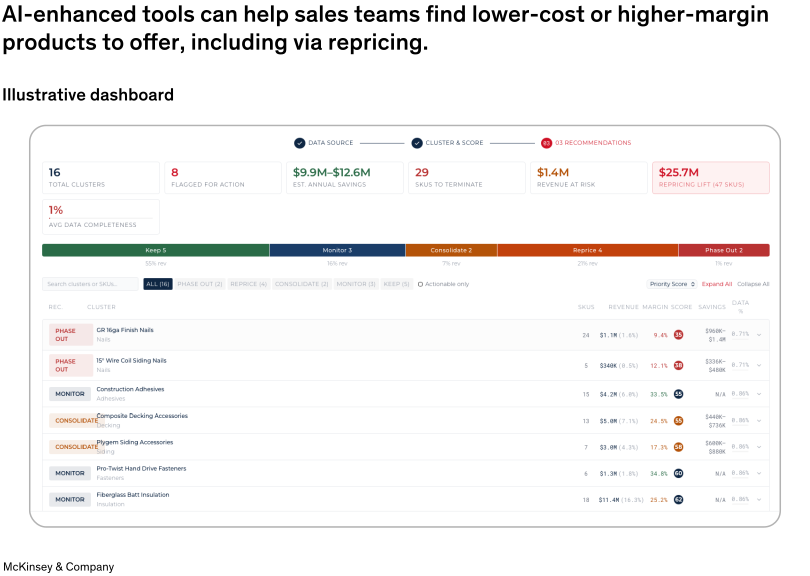
Margin was the primary metric of success. By shaping demand toward higher-margin SKUs rather than simply fulfilling historical preferences, the company increased overall margins on a $600 million business by about 1 percent, without reducing customer value.
Similar logic guided pricing for the company’s capital equipment business. AI tools helped build a taxonomy of roughly 20,000 applications for capital equipment and linked them to key pricing parameters. This combination created greater pricing consistency and reduced the time required to generate quotes from several weeks to days. Within the first year, the changes delivered approximately 2 percent price uplift, equating to several million dollars of incremental revenue. In engineered-to-order environments, AI systems can help teams identify reusable configurations from prior designs and specifications, accelerate quoting, and reduce engineering rework.
Pricing transformation is not simply about raising prices. It is about increasing transparency, speeding up quotes, refining substitution logic, embedding margin awareness into workflows, and reducing reliance on tacit knowledge. Across industrial clients, targeted pricing transformation typically generates 2 to 5 percent additional revenue over two years, with corresponding margin expansion.
Growth: Institutionalize hunting capability
If pricing protects value, growth determines how much of that value you can capture. With capital flowing into new clusters—not only data centers but semiconductor fabs, battery plants, and reshored manufacturing facilities—growth increasingly lies beyond the reach of existing relationships. Capturing it requires making relationship creation systematic: developing new muscles for structured, repeatable hunting.
In many industrial companies, lead generation remains manual, slow, and fragmented. At the industrial-equipment company, for example, lead generation relied heavily on manual research and third-party lists. These were expensive, slow to update, and poorly matched to specific products or applications. The process left sales teams with little time and energy for crafting the sector-specific value propositions and go-to-market strategies these new opportunities also needed.
The solution was an AI-powered “lead hunter” that automatically identified and qualified prospects across brands, geographies, products, and end-use verticals. Through a combination of web scraping, APIs, and the use of multiple models to cross-check accuracy, the tool generated enriched leads in under two hours, including company details, contact roles, revenue brackets, matched products, relevance scores, and confidence levels. Qualified leads flowed directly into the company’s sales tracking platform for immediate activation, turning what was traditionally an individual activity into a system-wide capability.
What had previously been a capability concentrated in roughly 20 percent of the sales organization, true white-space hunting, expanded to roughly 70 percent of frontline FTEs. While broader growth transformation is ongoing, almost overnight the number of prospects each seller could reasonably cover grew dramatically.
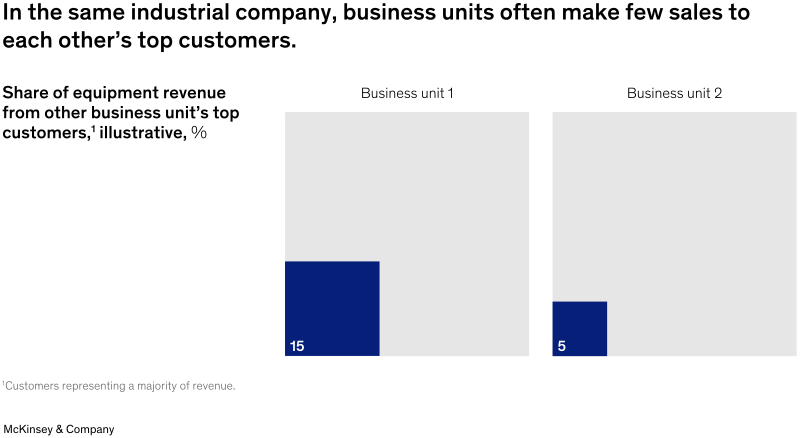
A similar pattern emerged in a private equity–owned independent service provider with repair and maintenance operations across North America. The company sought to accelerate cross-selling of newly acquired service offerings and capture untapped opportunities across its combined customer base. Working from about a dozen internal and third-party data sources, a single repository was built, geo-mapping more than 50,000 accounts and identifying over $2 billion in opportunity across existing and white-space customers.
The resulting insights revealed a significant cross-selling opportunity: At the two largest business units, less than 20 percent of total sales were to each other’s top customers (Exhibit 2).
Tactical leads, complete with site and contact details, were generated and mobilized to more than 100 inside and outside sellers. In pilot markets, the initiative drove more than 10 percent business growth from new leads, validated at the profit-and-loss level compared with the prior year.
More important is the long-term impact. Growth no longer depends on who happens to know whom. It becomes a repeatable system that combines enriched data, prioritization logic, and frontline activation. According to McKinsey analysis, this type of focused growth transformation can deliver 5 to 15 percent revenue uplift and 1 to 2 percent margin improvement within two years.
Sales productivity: Redesign the commercial engine
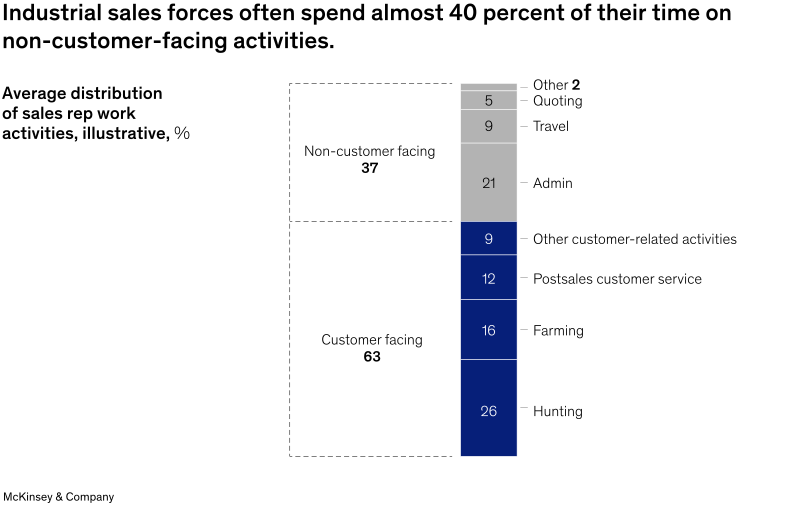
Sales are often the largest controllable cost in industrial organizations. Yet frontline time allocation frequently skews toward internal coordination, quoting, and administrative work, every hour of which is a lost opportunity to engage customers more deeply. As experienced salespeople retire and talent remains scarce, productivity constraints only intensify.
In both cases discussed above, technology adoption required minimal existing infrastructure. In collaboration with frontline users and managers, technology specialists built AI tools quickly, with minimum viable products coded in days. The objective was practical: Automate pain points as quickly as possible and shorten ramp-up for new commercial talent.
Knowledge that resided with experienced individuals, such as the pricing logic for specific applications, was incorporated into new tools, reducing onboarding time for new hires and making sales processes more consistent. To measure impact, reinforce adoption, and sustain momentum, finance and business analysts tracked metrics such as quoted margin and share of business from new accounts. In some engineered-to-order environments, the same logic was applied to engineering and sales engineering workflows. AI-enabled design-search systems helped teams retrieve historical designs, drawings, and bills of materials and generate quote-ready specifications more quickly. Tasks that had previously required hours of sifting through scattered (and often incomplete) data sources could now be completed in minutes.
In the service provider case, sales productivity improvements extended beyond lead generation. The company redesigned territories based on opportunity density and seller productivity, identified resource gaps, cleansed and deduplicated the customer master, and launched dashboards to create full transparency across the sales organization. Following the pilot, a multiyear scale-up embedded a playbook, customer relationship management interfaces, and training programs, with incentives and workflows adjusted to reinforce adoption. In configured-product environments, AI-enabled specification matching began extending into procurement and inventory workflows. By matching components and specifications across business units, AI tools helped reduce part proliferation and simplify inventory management.
The result was a commercial model in which company leaders aligned coverage, roles, and workflows to opportunity, with performance visible in near real time. The typical sales rep now spends more time engaging new clients and customizing offerings: Non-sales activities take up only 15 percent of the day, down from almost 40 percent (Exhibit 3).
Gen AI further enhances these efforts by automating proposal drafting, summarizing customer interactions, recommending next-best actions, and supporting technical troubleshooting. As illustrated in other machinery contexts, AI-enabled knowledge systems can dramatically improve first-contact resolution and reduce cycle times, improving both cost structure and customer experience.
Technology does not eliminate the need for capability building. However, it reduces reliance on scarce individual expertise and makes disciplined commercial behavior easier to execute at scale.
Turning disruption into durable advantage
The next 12 to 24 months are critical for competitive positions across many industrial segments; as demand shifts geographically and by sector, pricing complexity is rising, and talent constraints are tightening. Early movers are embedding AI into transaction workflows, prospecting engines, substitution logic, and service operations, creating systems that learn and improve over time. They are also applying the technology against recurring sources of friction in their operating model, from engineered-to-order quoting to installed-base monetization and field-service coordination.
For industrial leaders, the imperative is to tighten pricing discipline and actively shape demand. This includes building systematic hunting capability into emerging growth clusters while redesigning the commercial engine so that coverage, incentives, and workflows align to opportunity density. Under this model, gen AI does not replace commercial fundamentals—it strengthens them by democratizing expertise, increasing speed, and expanding reach.
The companies generating the greatest impact are not pursuing dozens of disconnected AI use cases across the enterprise. Instead, leading industrial companies are identifying the one or two domains with the highest economic leverage in their business model and concentrating investment there.
The highest-return action differs by archetype, and misidentifying it is one of the most common ways industrial AI programs lose momentum. Engineered-to-order businesses should concentrate first on AI-enabled quoting and design reuse: The payoff is faster bids, lower engineering cost per order, and a systematic shift of repeat work toward configured-to-order economics. Configured-to-order manufacturers should attack pricing first, deploying AI-driven substitution logic and margin-aware recommendation engines across the SKU portfolio to eliminate the silent margin leakage that product proliferation has created. Standard-product businesses should make building an AI-powered prospecting engine the priority: The return on expanding white-space coverage into new sectors and geographies vastly exceeds the return on optimizing accounts that experienced sellers already manage well.
Aftermarket and service providers should lead with installed-base intelligence, systematically identifying underserved accounts, predicting service timing, and driving programmatic outreach, because the installed base is the highest-margin growth asset most of these businesses already own and consistently under-monetize. Industrial companies that delay this focus risk ceding ground that is measurably harder to recover: Early movers are compounding advantage in data quality, model performance, and frontline adoption, while late movers are still debating where to start.
Industrial companies have long competed on technical excellence. To outperform—and to sustain this level of performance—will depend on pairing technical excellence with commercial excellence and deploying AI where it matters most: focused on the few domains that drive disproportionate value, codified, scaled, and continuously improved.