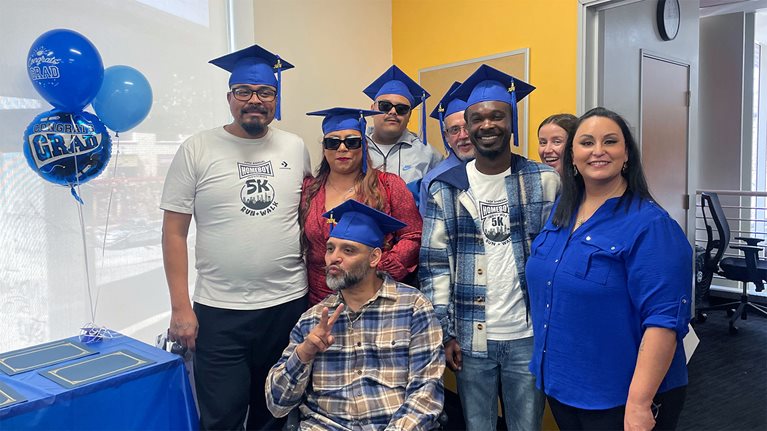
In the US, many companies still struggle to fill essential roles. What if part of the solution involves talent that has traditionally been overlooked?
Take Johanna Carbajal, who spent her adolescence shuttling between juvenile hall, foster care, and the streets before landing in prison at 18. After her release, Johanna made her way to Homeboy Industries, the Los Angeles–based organization founded by Father Greg Boyle to help formerly incarcerated and gang-involved individuals heal, find stability, and build meaningful careers.
For Johanna, finding Homeboy was a watershed moment. On this special holiday episode of McKinsey Talks Talent, you’ll hear her—as well as Father Greg, in conversation with McKinsey talent experts Brooke Weddle and Bryan Hancock, and Global Editorial Director Lucia Rahilly—talking about what leaders can learn from the Homeboy philosophy, including the impact of thinking differently about hiring, developing skills, and creating a culture where employees feel not just safe but seen.
The following transcript has been edited for clarity and length.
The Homeboy draw
Lucia Rahilly: Johanna Carbajal has a fading tattoo on her unlined face featuring an expletive.
Johanna Carbajal: Um, well, the “FU” is like—you can see—I was 15, and I hated everyone. I’d just built up so much anger for everyone, for the world, for, like, letting me down.
Lucia Rahilly: Johanna spent many years alternating between life in juvenile hall, in the foster care system, and on the streets. By the time she was 18, she wound up in prison. It was eye-opening for her.
Johanna Carbajal: I learned a lot. I learned I don’t want to do this for the rest of my life. I don’t know how I’m going to change, but I kind of knew I didn’t want to be 40 or 50 and have nothing, you know? I talked to the women, I’d support them, but I also saw how difficult it was for them. Once you do something for so long, it’s hard to break the cycle, and it’s hard to get out and actually find the right resources to lead you to the right path.
Lucia Rahilly: After she was released from prison, Johanna found her way to Homeboy Industries. It’s a not-for-profit organization based in Los Angeles that supports former gang members and those who’ve been in jail. Father Greg Boyle founded Homeboy in 1988 with the fundamental goal of helping people turn their lives around and succeed.
Father Greg: It was clear that an educated gang member may or may not return to prison or an employed one may or may not return to prison, but it became abundantly clear that a healed gang member will not reoffend, period. So what if as a society, instead of punishing a wound, we set out to heal it?
Subscribe to the McKinsey Talks Talent podcast
Lucia Rahilly: Healing wounds through meaningful work drew McKinsey to Homeboy. McKinsey Partner Bryan Hancock led a team providing pro bono work. He says Homeboy sought help in three areas.
Bryan Hancock: First, “Can you help tell our story? We think it’s compelling, but not everybody understands it in a business-grant-review-type way.” Second, social enterprises. We’re a consulting firm. We know something about segmentation and businesses. So we looked at where the opportunities were across the social enterprises.
The third thing we did was think about how to expand the impact of Homeboy. They have an incredible recipe for what they do, so we worked with them on how to partner with other employers, other training providers in a workforce development hub where others can be force multipliers. To do that requires additional clarity into where the job opportunities are, what the training opportunities are, and how to connect across the pipeline.
The benefits of hiring differently
Lucia Rahilly: Before sending any trainees, or homies, out into the workforce, Homeboy gives their clients training opportunities—in a bakery, in electronics recycling, and in other settings. Here’s Tom Vozzo, the former CEO and current senior adviser at Homeboy.
Tom Vozzo: We have training businesses, and we rotate our clients—we call them trainees—so they get workplace experience. We provide all sorts of wraparound services, but in the context of jobs and workplace therapy. A part of their transformation is that we’re also providing them with job skills and knowing what it’s like to show up every day at the workplace.
Lucia Rahilly: The idea is to hire capable people—but also to redefine what “capable” means.
Father Greg: We’re not really looking for the people most likely to succeed, because part of the process is we want a place where people really encounter healing. We’re reverse cherry pickers.
Tom Vozzo: You have to take someone who has the ability—not necessarily the proven expertise with all those years of education—and put them into that job and value that.
Lucia Rahilly: It’s easy for companies to overlook nontraditional job candidates. But McKinsey Partner Bryan Hancock says unorthodox talent can help bridge the talent gap.
Bryan Hancock: Given shortages in skilled trades and all sorts of service work, unorthodox hires can become orthodox hires. They can become great pipelines for the types of job openings that we have today—whether in allied health or in food service or in any range of services. Also, one of the great things about deeply tapping into folks from a particular community is that, many times, they better reflect the customer base in that community.
Lucia Rahilly: McKinsey Senior Partner Brooke Weddle agrees and says companies and organizations can benefit from broadening their definition of talent to stay competitive.

McKinsey Talks Talent Podcast
Bryan Hancock, Brooke Weddle, and other talent experts help you navigate a fast-changing landscape and prepare for the future of work by making talent a competitive advantage.
Brooke Weddle: We’ve seen this with organizations using skills-based hiring. For instance, I worked with a company that needed more computer programmers for their video games. Instead of trying to find more engineers and computer programmers, the company looked to the gamers themselves and ended up bringing on cohorts of these gamers that they then developed into exactly the computer programmers they needed. And these programmers had the added benefit, of course, of being fanatical players and enthusiasts about the actual products they were creating.
Lucia Rahilly: Since many folks arrive at Homeboy lacking traditional skills, they might feel trepidatious about participating. But once they spend time with the organization, their attitude tends to change.
Finding purpose and building culture at work
Father Greg: Part of it is people come here and feel safe, and then they feel seen, and then they feel cherished. A lot of homies say they’re used to being watched because they’ve been in prison. But they’ve never had the experience of being seen, which is a qualitatively different experience.
Lucia Rahilly: Is there any way Homeboy’s unique culture can be applied to the traditional business world?
Father Greg: Community is essential. But there’s also a sense of finding a purpose. As Thoreau said: “Be not simply good; be good for something.” Here, we talk about our merchandise and all the stuff we sell—products with purpose. Once you find that thing you can be good at, people engage in a way that’s unselfish, and you want to get to a place where you love to come to work every day because it’s mutually nourishing. It’s not always some grand, heroic thing. It’s more often than not tiny things with great love.
Bryan Hancock: At the end of the day, most of us want to go home feeling like we did a good job at work, whatever that job is—whether it’s pushing carts or counseling somebody who will ultimately take on a CEO role. I think while looking for broader purpose in life, all of us need to tap into the purpose right in front of us.
Brooke Weddle: Employees and teams generally come in with five sources of meaning. These are meaning through society and societal contribution; meaning through adding value to a company or organization; meaning from feeling connected because of the customers and clients you serve; inspiration and connection and meaning from working with a group of people; and then finally, the individual as a source of meaning. And that is often related to opportunities for growth and development. We work with executives to broaden their communication and engagement strategies to include all five, making it more likely to create this connection and sense of meaning.
Lucia Rahilly: And then there’s the lesson that talent development is not linear. People learn—and evolve—at different paces.
Father Greg: In gang recovery, as in alcohol and drugs, they always say, “It takes what it takes.” All the homies who run this place were starts-and-stops people. They were with us for a while, and then they left. People are in varying places of readiness. You don’t really know if they’re fully ready to surrender to the foundational healing that’s being offered here.
I asked a guy who had a lot of starts and stops and now is really solid, “How do you explain the stops where you would leave?” He said, “It was just too much love for me to take in.” I’ve never heard that before. He just couldn’t really do it. He wasn’t equipped, and now he is. He found his way back here, and now he’s in a leadership position, but it was curious to see what his process was. It isn’t linear.
Conflict as a source of inspiration
Lucia Rahilly: And when it comes to conflict, even in the most fractured work environments, empathy alleviates tension.
Father Greg: What I’ve learned with gang violence is that there’s violence but no conflict. It’s not about anything. It’s not about sitting both sides down. We presume it’s all rational, and it’s not. We tend to try to address things head-on, and we forget that they’re about something else. If you have folks who are having difficulty imagining a future for themselves, then their present isn’t very compelling. And then pretty soon, they don’t care whether they inflict harm or duck to get out of harm’s way.
You want to create a place where people feel linked to hope—and human beings are the delivery system of hope. Once you know the truth of who you are, you have to come to terms with what was done to you and also with what you’ve done. Then you can move beyond this place—even move beyond forgiveness—and land on mercy, where everybody gets to stand in awe at what each other has to carry rather than in judgment at how they carry it. Then you find that the answer to every question is compassion.
Lucia Rahilly: And Brooke says compassion can allow colleagues to more effectively solve problems—together.
Brooke Weddle: Great connection can be forged when you introduce friction or debate. In fact, teams with a little more of that diversity of thought are shown to create better outcomes. I think there is something about conflict that, if pursued in a way that is open and well intentioned, can be very productive for an organization.
Bryan Hancock: In the most fractured of relationships, peace is possible, but it needs the right container, where there is trust in the environment, trust in the manager, trust in the kinship that exists between us. In that environment, we can have deep personal disagreements and come from very different environments, but the environment we’re in now gives us the ability to work together—whether you’re at Homeboy or in any company.
Lucia Rahilly: It’s mutual trust, learning to work together, and lots of personal grit that helped Homie Johanna transform her life. She graduated from UCLA and is now studying law at UC Berkeley.
Johanna Carbajal: Homeboy never gave up on me. To this day, it’s like a family that I’ll have for the rest of my life.
For more about McKinsey’s partnership with Homeboy industries, visit this case study.