AI is rewriting an operational playbook that for decades has governed the way asset-heavy industries manage maintenance. New technology and approaches are advancing the frontier of what is possible in asset management, increasing efficiency at every step of the maintenance and reliability process and improving the availability of mission-critical equipment.
The transformation opportunity is significant. Maintenance is one of the largest controllable cost buckets in manufacturing and capital-intensive organizations such as airlines, mining, energy, and rail. And with a direct impact on operational continuity, the maintenance function has a critical influence on revenue generation and customer experience. Every day that a critical piece of equipment is unavailable, or that an airplane can’t fly, can represent millions of dollars in revenue and production losses.
Yet maintenance functions are often seen as a cost center rather than a source of value generation. Many organizations are still sitting on gold mines of underleveraged maintenance and reliability data, and relying on traditional approaches that lean heavily on experienced but scarce engineers and specialized technicians.
AI and technology have changed what’s possible by making imperfect information useful and by embedding data-driven insights within the daily workflows of the teams directly responsible for managing assets. We are already seeing agentic AI transforming spaces such as reliability, where agents can autonomously search for common failures and bad actors, and recommend actions, increasing the productivity of one reliability engineer more than 20-fold in some cases.
AI and the new era of maintenance webinar
Friday, October 23, 2026 12:00 PM - 1:00 PM ET | 6:00 PM - 7:00 PM CEST Join McKinsey experts and industry leaders to explore where digital and AI are creating value in maintenance today, and what it takes to translate that potential into sustained impact at scale.
With new possibilities such as these emerging continuously, asset-heavy organizations are rewiring their operations to unlock value in reliability, maintenance planning and execution, turnarounds, spare parts inventory, and contractor management—capturing around two to five percentage points of incremental margin in many cases.1 Those that reimagine how work gets done and bring their people on the journey may be best placed to capture and sustain this value over time.
The end-to-end maintenance transformation opportunity
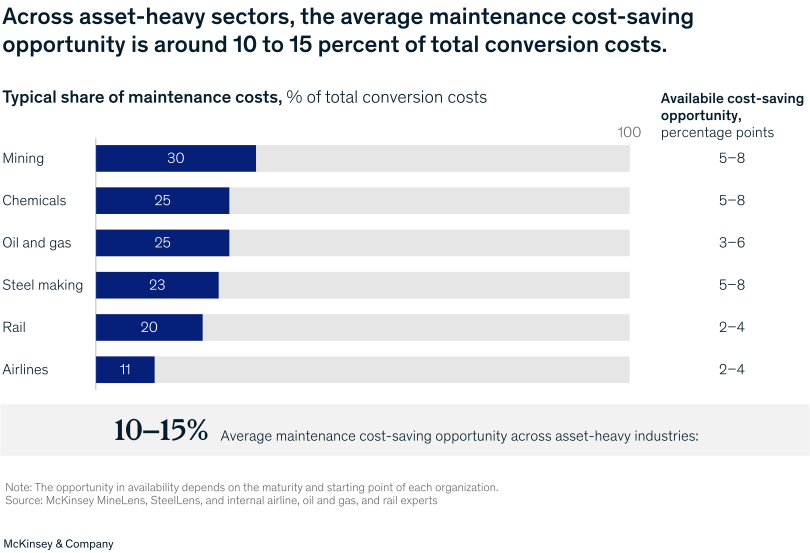
Asset-heavy organizations have good reason to explore this new frontier of AI and technology-driven maintenance. In mining, for example, maintenance costs can represent as much as 30 percent of total conversion costs, and improved maintenance performance can increase asset availability by up to eight percentage points.2 Across asset-heavy sectors, the average cost-saving opportunity is around 10 to 15 percent of total maintenance conversion costs (Exhibit 1). Organizations that ignore the opportunity could be leaving significant value on the table. Additional value exists in reliability of equipment, which can be between one to eight percentage points of additional uptime depending on the industry.
The way to capture this value is not a technology-adoption story alone, however. A common misconception regarding AI is that value primarily comes from having better and more sophisticated algorithms. Predictive algorithms are indeed powerful, but how AI solutions are adopted and assimilated into teams matters as much, if not more. This means embedding AI in the routines of reliability engineers, planners, and technicians to get to a more continuous and impactful way of working embedding the higher level of insights that AI can generate.
While many asset teams today continue to rely heavily on expertise within their organization’s centralized IT function, AI solutions embedded at the asset level shift the locus of decision-making into the maintenance function itself. The low- or no-code nature of AI tools also means it’s now possible for maintenance teams to develop their own solutions, with IT providing guidance and development standards. This change gives maintenance leaders direct accountability for asset performance and control over their own data and technology so they can manage their own processes with greater accuracy, agility, and foresight.
A high-performing global airline that transformed its end-to-end maintenance function with this approach has achieved hundreds of millions of dollars in impact across maintenance costs, fleet availability, and cost of capital. Passengers had been affected by delayed or cancelled flights, and maintenance represented a significant cost bucket for the airline, creating pressure to increase aircraft uptime and reduce costs.
After setting a clear ambition to drive efficiency while also ensuring safety, reliability, and aircraft availability, the team first rewired its maintenance processes, then introduced AI and technology in a multiyear effort. Work was carried out in three waves, starting in centralized teams and tasks, such as maintenance planning, and scaling in wave two to support processes such as procurement, then finally to maintenance execution (Exhibit 2).
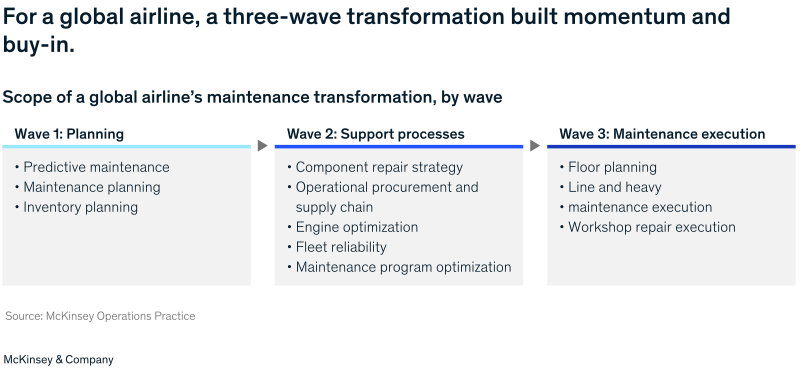
The three-wave approach worked because the team prioritized processes that could generate significant impact and required less complex change management, before moving into more challenging areas of the maintenance function. A small and centralized team was carefully selected to drive meaningful improvements without a substantial organizational effort, capitalizing on early wins and developing the capabilities needed to sustain and improve impact over time. The transformation was not just about developing new AI solutions; more importantly, it was about changing ways of working.
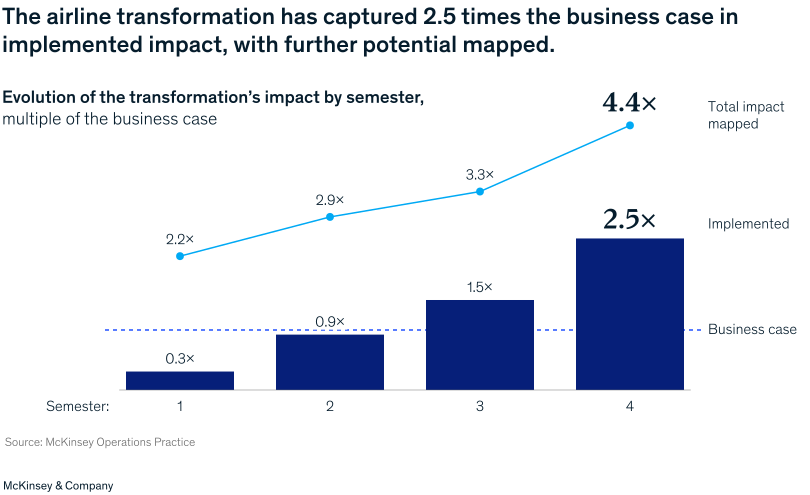
The effort reduced aircraft on ground (AOG) time by 14 percent and lowered inventory by 12 percent, collectively unlocking savings equivalent to 10 percent of maintenance profit and loss (P&L). Incremental improvement opportunities continued to emerge as the transformation progressed, with the effort already exceeding its initial business case by 2.5 times in implemented impact, and further value still to be captured (Exhibit 3).
Five areas of focus to unlock value
The greatest opportunity for asset-heavy organizations lies in an end-to-end transformation of maintenance, applying AI and technology across reliability, maintenance planning and execution, planned shutdowns and turnarounds, spare parts management and supply, and contractor management.
Reliability
Organizations often struggle to move from reactive reliability management to a more predictive and risk-based approach. Data is frequently fragmented across systems and dependent on manual inputs, making it difficult to identify failure patterns, prioritize critical assets, and anticipate issues before they impact performance.
Reliability teams are using AI in different ways to capture value. A US oil and gas company deployed a gen-AI-assisted workflow to rapidly update asset hierarchies, develop failure mode and effects analyses (FMEAs) from past work history, and draft preventive maintenance plans using digitized knowledge (for example, Piping and Instrumentation Diagrams, and maintenance records). The approach reduced the time needed to complete one site by around 80 percent, transforming a six-month effort into a six-week one.
At another airline, AI is being used to develop customized health-monitoring models for the systems and components that most frequently keep airplanes grounded. With a clear understanding of the failure modes they are designed to predict, the models not only sound the alarm for a reliability issue, but also suggest specific actions based on the level of certainty calculated and the trade-offs between risk and cost. The models have reduced the number of reliability events by around 30 percent compared to the baseline.
Another company, meanwhile, is scaling the impact of its reliability engineers with a reliability agent that supports engineers in synthesizing bad actors and potential options for eradication. The agent also flags elements of the preventive program that are ineffective and summarizes specific opportunities to train maintenance teams or update procedures. The agentic workflow has led to a reduction in total maintenance work volume of around 8 percent.
Maintenance planning and execution
Maintenance planning and execution are challenged by many factors, including complex operational requirements, limited visibility into asset condition, work-order backlogs, labor availability, and field constraints. The impact is often experienced as inefficient scheduling, low wrench time, and frequent deviations from planned work.
AI can help organizations improve their planning accuracy and weigh trade-offs that support efficiency without compromising safety. Digital solutions allow maintenance teams to dynamically prioritize interventions and ensure the right resources, procedures, and information are available at the point of execution.
AI now makes it possible for companies such as airlines to develop more “personalized” maintenance planning and execution programs, too. Instead of today’s generic maintenance plans, AI can analyze granular data on each aircraft’s individual flying history, adapting plans based on whether a plane has spent more time in coastal areas, for example, and may be at greater risk of corrosion.
Scheduling tools are already having significant impacts on technician productivity. One global manufacturer of packaging solutions has increased technician productivity by 85 percent through an agentic AI scheduling tool for maintenance. Agents assist with complex scheduling issues, including estimating the duration of work orders by analyzing past work orders and proposing schedule improvements by reassigning, resequencing, or bundling work. Further enhancements are currently in progress, including two additional agents: one to assess inventory and material readiness, and another to prioritize work orders based on urgency, safety, failure mode, location, and the project management plan.
At a major open-pit mine in Asia, the maintenance function has leveraged agentic AI to support troubleshooting and execution quality. The team developed a sophisticated workflow that empowers the front line with root-cause diagnosis, step-by-step instructions for execution, and customized checklists to ensure quality at completion. The solutions are designed to be widely accessible across desktops, mobiles, and tablets, with key features available without an internet connection. The workflow has increased the average time between failures by threefold.
Many asset-heavy companies are exploring ways to digitize their end-to-end work management processes—from better data capture of text, photos, and videos to support work-order creation, to real-time progress tracking and granular performance reporting. An oil and gas company planning to implement this approach expects to achieve a 15 percent reduction in costs.
Planned shutdowns and turnarounds
Planned shutdowns and turnarounds are high-cost, high-stakes events that require precise coordination across maintenance, operations, engineering, procurement, and contractors. Scope growth, schedule delays, and material shortages are all common, not helped by limited real-time visibility during execution.
The cost implications of suboptimal turnaround execution can be severe. In our experience, turnarounds can make up around 5 to 15 percent of a manufacturer’s cost base, and often account for 20 to 40 percent of overall fleet or plant downtime, resulting in significant margin erosion.
To improve outcomes, companies can use digital planning, simulation, advanced analytics, and AI-supported decision-making to optimize scope, reduce risk, and ensure a safe and on-time restart of operations. Making the scope of a turnaround more fact-based, risk-optimized, and economically justified is a good place to start. An oil refiner planning a major maintenance turnaround costing over $200 million used risk-based analytics to move from a “review everything on the list” approach to a more disciplined assessment of what truly needed to be executed during the outage.
By leveraging data and analytics, and asking questions such as “Is this work truly required?”, “Can it be done later?”, and “What is the real risk if not done now?”, the company risk-ranked more than 500 discretionary items to be executed during the turnaround, identifying that close to 35 percent were low-risk items that could be executed in future turnarounds or required further review to define the real value of execution. This approach led to a thinner project scope and millions of dollars in savings.
Spare parts management and supply
Spare parts management is frequently affected by inaccurate demand forecasts, poor inventory visibility, obsolete materials, and misalignment between maintenance needs and supply chain processes. These issues can lead to stockouts, excess inventory, delayed repairs, and increased working capital.
Organizations can now use data-driven inventory optimization, predictive demand signals, and integrated planning to ensure critical parts are available when they are needed, while controlling cost and inventory levels. AI tools are improving the accuracy of projected requirements for spare parts and consumables, helping to define optimal stock requirements across organizational networks.
A global airline that took this approach was able to lower inventory levels by 14 percent while also reducing operational impacts related to spare parts unavailability. Through AI-driven demand projection and by optimizing trade-offs between operational continuity and inventory costs, the airline replaced manual processes and low visibility with automated planning, increasing the accuracy of spare parts demand projection by 20 percent and service levels by 4 percent.
Contractor management
Some industrial companies are also seeing value from applying technology in two areas of contractor management: efficiency and capability controls, and invoice review.
An energy company, for example, is now using radio frequency identification (RFID) tracking to understand where contractors are within its facility, both for security purposes and to understand if maintenance craft are present in the work area. Regular review of this data with contractor supervisors has led to around 10 percent higher on-tool time. Likewise, a materials company that tracks contractor representatives onsite uses the insights to evaluate present capabilities versus actual needs, based on the contractors’ CVs.
In invoice reviews, a fertilizer company deployed AI solutions to compare invoices and unearth discrepancies between invoiced man-hours versus real capacity delivered. Companies implementing AI for invoice analysis typically capture about a 3 to 6 percent reduction in spend.
Capturing value from AI in maintenance
Scaling an AI and technology maintenance transformation requires a structured program, and this is where many organizations go wrong. McKinsey analysis of more than 200 large-scale digital and AI transformations has found six areas that make the difference when organizations rewire their operations with AI. Neglecting certain elements can see organizations start with a bold, exciting vision but lose their way in realizing value.
A focus on the end-to-end process is critical. Frequently, we see companies direct AI at one aspect of the maintenance process, only to shift the bottleneck to a different point of the value stream. Or they rely on off-the-shelf tools without a thorough assessment of what really drives value or an understanding of how the process works, resulting in poor adoption and limited impact for the business.
These six rewiring principles can help organizations move from isolated pilots that can’t be sustained to operational overhauls that unlock significant value across the end-to-end maintenance process:
- Set ambitious transformation goals with defined objectives. Leading organizations define a clear and challenging aspiration and communicate it broadly across teams to create organizational alignment. This aspiration is translated into a road map that is rooted in impact to the business and highlights the capabilities needed to deliver it. Teams have clear outcomes to achieve and explicit understanding of their contribution toward the overarching ambition, creating a greater sense of purpose in the transformation.
- Redesign teams to drive accountability and reimagine workflows end to end. Empowering product managers with decision rights over their processes and embedding the right talent within teams are critical to support autonomy and innovation. Accountable teams reimagine their own workflows and define the solutions to improve asset performance and unlock value. When reimagining workflows, the key is not to simply digitize a manual step, but to rethink how the process is done, leveraging the power of agentic AI and other transformational technology to generate more value to the business.
- Build strong data foundations to democratize data access. The value of AI in maintenance comes from better, data-driven decision-making and a more granular understanding of the cost implications of operational losses, maintenance costs, or inventory levels. Investing in data products that ensure better data availability and quality is crucial for enabling impact from AI. The key, however, is to incrementally develop a data platform that evolves in parallel as products get more mature, rather than embarking on a sprawling data project with no concrete connection to business impact.
- Develop AI-driven technology platforms to accelerate innovation. Maintenance areas tend to have multiple digital solutions sourced from different vendors or built in-house, with limited integrations to ensure the correct flow of information. A technology platform based on an API accelerates innovation and product development by supporting data flow across IT elements and digital products, enabling the reuse of capabilities and ensuring one single source of truth.
- Rewire the operating model for AI, adopting an agile approach to transformation. Embedding technology that generates impact at scale needs to account for the full complexity of the maintenance operation. Rewiring with AI is not just another IT project where the business provides requirements and it is IT’s responsibility to deliver. Business, technology, and other team members need to work as one and be jointly accountable for performance improvement. Likewise, off-the-shelf solutions are rarely “plug-and-play.” Instead, teams need to test, learn, and iterate fast to ensure that what is implemented is feasible and generates the expected impact from the business case. In certain industries, it is also important to bring regulators along and ensure new approaches meet standards for safety and transparency.
- Focus on change management and product adoption. Maintenance organizations have technical and experienced talent with ways of working that are not always easy to change. To overcome entrenched mindsets and ways of working, an integrated approach to product development is needed, bringing users into the design process from the beginning and observing their current workflows and pain points. Rapidly improving AI solutions and incorporating user feedback help to incentivize adoption and build trust in AI capabilities.
AI is fast changing the game for asset-heavy organizations, empowering asset teams with data and insights that transform how they plan and execute every aspect of maintenance. Those investing now could see reduced downtime of critical equipment, improved service levels and throughput, and lower inventory and contractor costs—all resulting in cost savings and improved margins.
A technology transformation, however, is always a people transformation at heart. Simply layering the latest applications on top of old approaches will not deliver the full potential impact.
The organizations that rewire workflows, empower teams, develop agile operating models, and enable reimagined processes via technology and data may position themselves best to transform maintenance into a value creator. Those that invest in change management and a rigorous focus on adoption, too, could be best positioned to sustain and grow that impact over time.