A structural shift is underway in business: Chief information officers (CIOs) are becoming strategy architects. Our Global Tech Agenda 2026 finds that top CIOs are weaving AI and data into their companies’ operating models to build intelligence-driven enterprises. These leaders are no longer just managing technology; they are shaping their companies’ futures.
Our latest research, supported by a McKinsey Global Survey of more than 600 technology and business leaders,1 shows a divide between CIOs who are simply modernizing their technology estate and those who are rewiring their companies for competitive advantage. At top-performing companies,2 technology’s center of gravity has shifted from a cost center to a value creator. CIOs at these companies know that technology velocity, not just efficiency, is what it will take to fuel growth.
AI and data will underpin that growth. Forward-thinking CIOs are investing in agentic automation to change how business gets done and in data productization to generate entirely new revenues. They are replacing annual budget planning with nimbler practices that fuel innovation, such as product and platform models, continuous decision-making, engineering excellence, and capability-led talent models. The result of innovation-focused technology investment is higher EBITDA growth.
Technology is strategy
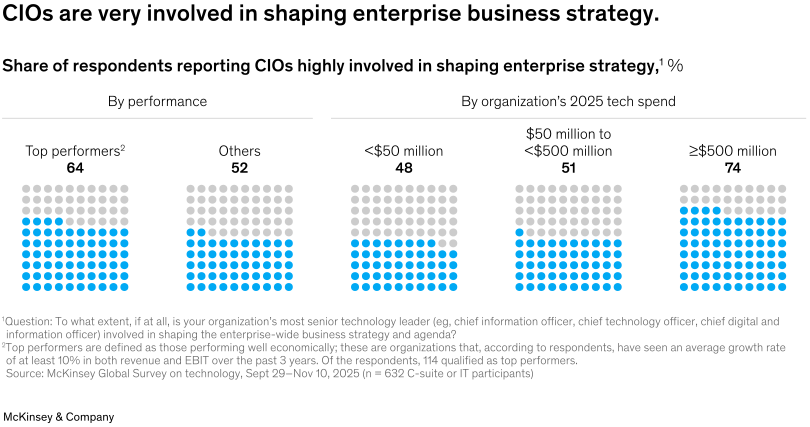
Technology leaders are shaping business outcomes. That’s a key finding from our research: Nearly two-thirds of top-performing companies say their technology leaders are “very involved” in crafting enterprise strategy, compared with 52 percent of other organizations—those not identified as top performers (Exhibit 1). The elevation of technology leadership signals that CIOs are increasingly responsible for creating bottom-line growth. Technology expertise has become strategy expertise.
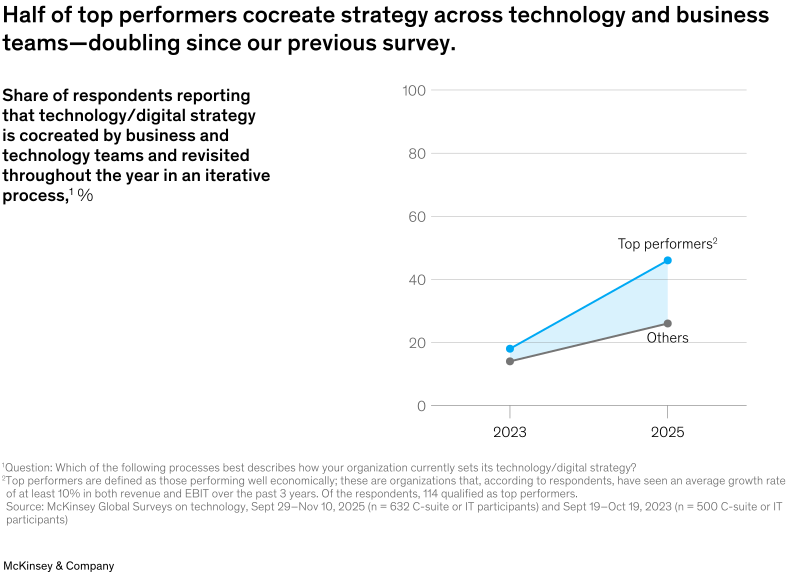
Turning technology into a growth lever requires close collaboration between business and technology leaders. About 29 percent of respondents overall say their business and technology teams cocreate strategic plans throughout the year, almost double the share in our previous survey. And at top-performing companies, nearly half of respondents now say this iterative cocreation takes place (Exhibit 2). These findings represent a profound cultural change for CIOs—from annual planning to continuous strategy development.
Inviting technology leaders to shape strategy is increasingly critical to spur growth. But companies must also make deep changes in how they structure their technology organizations. Our research shows that top-performing companies are quickly adopting product and platform operating models that align technology delivery with strategy. These models create a foundation for an intelligence layer—a unified set of data, AI models, and decision systems that serve as the control plane of the enterprise.
Our research shows that nearly one in ten top-performing companies have fully adopted product and platform models across all teams, which is more than four times that of other organizations. And nearly half of these companies indicate that at least half of their teams now operate this way.
With product and platform operating models in place, product teams become cross-functional, and decisions happen within days instead of months. Thus, the number of handoffs drops while the flow of information increases. The result is higher ROI on technology spend and faster innovation.
DBS Bank exemplifies this shift. It adopted a product and platform model that reorganized the institution into more than 30 customer- and capability-aligned platforms jointly led by business and technology. This shift enabled faster and better coordinated delivery, a modular cloud-ready architecture, and an enterprise data and AI foundation that accelerated innovation. As a result, DBS strengthened its ability to build, scale, and continuously improve digital products, helping establish it as one of the world’s top digital banks.
Of course, it takes a certain type of nimble talent—people with both technology and business acumen—to make product and platform models succeed. According to our survey, top-performing companies are hiring technology executives at nearly twice the rate of other organizations (37 percent versus 19 percent) and are also hiring more financial managers to ensure technology investment delivers measurable ROI. The intelligent enterprise does not distinguish between business and technology: They are one and the same.

The state of AI in 2026: On the road to ROI
Organizations are deploying agentic coding tools and coming to grips with the costs of AI while still seeking to capture more of the benefits that their workers are deriving from their individual use of AI.
AI: The next growth architecture
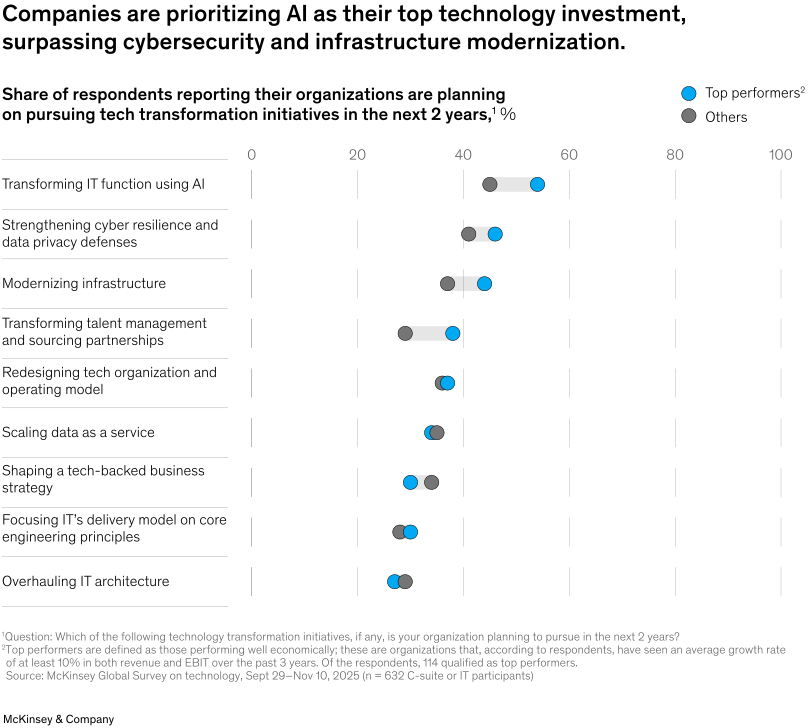
AI is no longer seen as just an experiment. AI has surpassed both cybersecurity and infrastructure modernization as companies’ top area of investment for the next two years (Exhibit 3). Half of all companies identify AI as a priority investment. Among top performers, that number rises even higher: 54 percent name AI as a top investment area. The findings point to one truth: AI has become a business imperative.
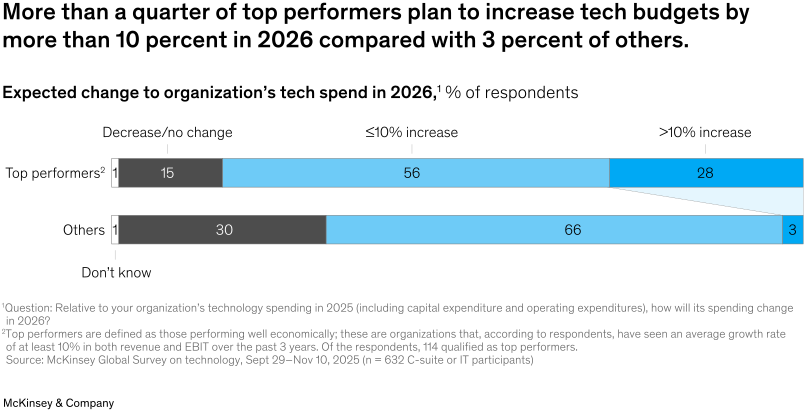
Investment in AI may power long-term growth, but in the short term, it’s straining technology budgets. Half of the respondents plan to increase their technology budgets by more than 4 percent in 2026 compared with 2025. Top performers plan to invest even more: 28 percent of those companies plan to increase budgets by more than 10 percent in 2026, compared with just 3 percent of other companies (Exhibit 4). These substantial budget increases reflect a new reality: Leading companies are investing heavily to scale agentic AI systems that autonomously plan, decide, and act across workflows.
For instance, UK insurance company Aviva deployed more than 80 AI models across its end-to-end claims journey. This was done alongside a full operating model and cultural transformation to help frontline teams make faster, more accurate decisions at every step of the claims process. By taking a domain-wide approach, Aviva materially improved business and customer outcomes: liability-assessment time dropped by 23 days; routing accuracy improved 30 percent; customer complaints fell 65 percent; and their customer satisfaction score increased sevenfold.
However, not even top performers are moving as fast as they would like with AI, especially when it comes to agentic AI. One-quarter of these companies say they lack the data foundations necessary to securely and reliably scale agentic AI. And nearly a third of all companies struggle with AI-related talent and capability gaps, as well as problems integrating AI into existing systems (Exhibit 5).
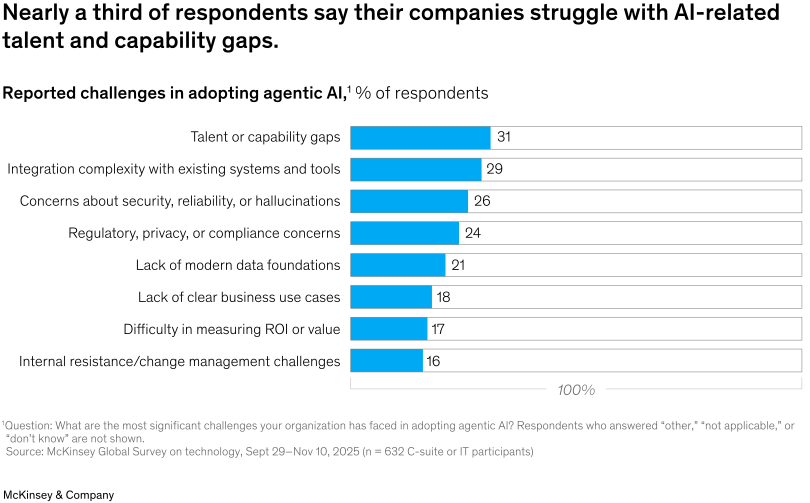
Despite these challenges, layering agentic AI into the tech stack may be the easy part. Teaching people how to use it effectively and inspiring them to embrace it in their daily workflows is harder. Nearly a quarter of top performers—compared with just 15 percent of other companies—cite change management as a core challenge to scaling agentic AI.
To equip their teams with gen AI superpowers, leading companies are pulling three levers at once: insourcing, reskilling, and targeted hiring. Their leaders understand that outsourcing builds capacity, but insourcing builds capability. When it comes to their talent-related strategies over the next two years, nearly half of top performers plan to increase insourcing to bring strategic technology expertise back in-house, compared with 37 percent of other organizations. About half of top performers are also investing in reskilling their own workforces, ensuring that core employees, not just third-party vendors, can deliver the next wave of change.
In contrast, companies not identified as top performers continue to rely heavily on vendors and outsourced teams to deliver technology work. About 40 percent of these companies expect to increase their outsourcing of lower-demand work in the next two years. While these choices boost tech team capacity in the short term, they do little to develop long-term transformation. We see a widening maturity gap: The most successful companies are becoming learning organizations, while others are still managing technology as outsourced labor. An interesting observation across all companies is that approximately 40 percent say they are opening or expanding global delivery centers to access international talent pools, which could offset some outsourcing.

The technology shifts every business leader should be watching
October 15, 2026, 9:30 a.m. ET / 3:30 p.m. CET
Join McKinsey experts Michael Chui and Roger Roberts for a discussion on tech trends, including where momentum is building, how the major trends are converging, and what these shifts mean for business leaders, workers, and society.
Rewiring the enterprise for velocity
The trend is clear: Top performers have shifted their focus from efficiency to velocity. This drives competitive advantage. For these companies, infrastructure modernization is no longer a strategy; it’s a stall. To capture the full benefits of digital innovation, leading companies are weaving technology into the very fabric of their operating models. Three-quarters of top-performing organizations have shifted technology spending patterns to capture either digital or business benefits and to meet their companies’ growing demand for technology, compared with just half of other companies—which are still more focused on modernizing technology foundations and cutting costs.
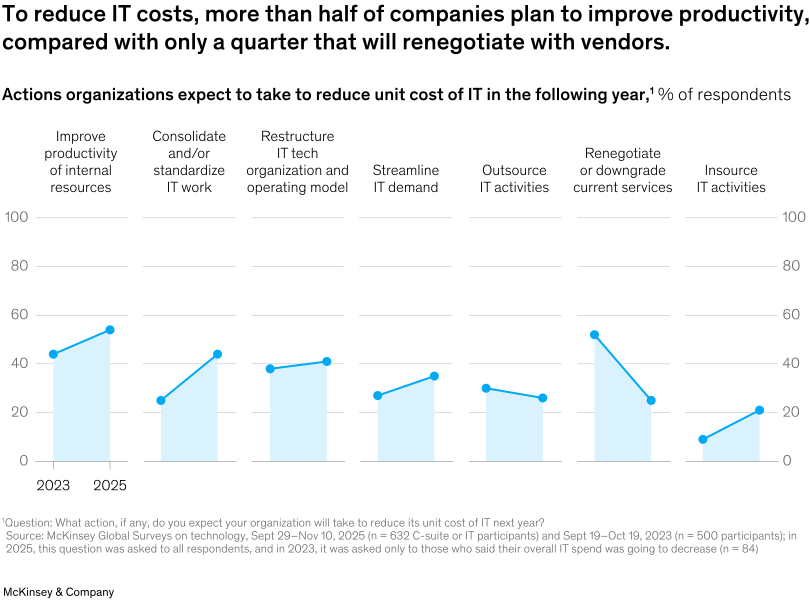
Investing in technology to spur innovation is critical, but making every dollar count is still important. Organizations have shifted from a focus on achieving episodic efficiency gains to increasing organizational velocity. While half of all companies focused on renegotiating with vendors for one-off cost cuts in our previous survey, this year the top efficiency levers center on accelerating how work gets done. Companies are making teams more productive, streamlining workflows, and restructuring technology and operating models (Exhibit 6). These shifts underscore how important it is for companies to rewire their entire ways of working. Moving fast is the only way to capture innovation at scale.
The 2026 CIO playbook
The next generation of technology leaders will not just manage technology; they will design their companies around it. But stepping into that strategic position is easier said than done. It requires spending on technology with intent: investing in agentic AI automation, hiring top talent, and building teams’ capabilities. For CIOs who want to drive sustained growth at their companies, that path begins by adopting four strategic imperatives in 2026.
1. Put technology at the center of strategy
The most successful CIOs are collaborators with CEOs in shaping business strategy. Nearly one-third of top performers will prioritize technology-led business model innovation over the next two years, showing just how tightly technology is being woven into growth plans. CIOs who do not yet fully participate in strategic decision-making can approach their CEOs with a critical request: Become embedded into business strategy design. They can design not just technology road maps, but also strategic plans that clearly illustrate how technology will advance the company’s business objectives. This ensures that technology priorities and business goals move in lockstep to deliver maximum value.
2. Cocreate continuously
Organizations that develop business and technology strategies iteratively throughout the year are growing faster than those that plan in yearly cycles. Nearly half of top performers say their technology planning cycles are now fully integrated with business planning (up from 18 percent in our previous survey), underscoring how business–technology alignment is becoming a built-in strategy discipline. In companies where technology decisions are still decided once a year, CIOs can architect a strategic shift. They can start small by introducing quarterly business–tech reviews. Over time, CIOs can work with the rest of the C-suite to create wholesale cultural change—transforming technology planning from an annual event into a continual practice.
3. Use AI to drive innovation
Leading companies are focusing their technology transformation initiatives heavily on gen AI—and that spurs innovation. Our research shows that high performers are much more likely than others to say that their technology transformations have increased innovation. Aside from placing AI at the center of their technology strategy, CIOs can further boost innovation by investing in people. They can hire new team members who embody a learning mindset, and they can reskill existing employees to ensure AI becomes a powerful coworker, not just another tech tool. This requires deploying gen AI for more than just incremental changes. Instead, CIOs can strive to integrate agentic AI into workflows to boost productivity and speed decision-making.
4. Rewire the business around AI
Cost reduction is no longer enough to extract maximum value from enterprise technology. Top-performing companies are rewiring around AI and embracing capability-led operating models to generate measurable ROI. More than half of top performers have transformed the IT function using AI in the past two years, compared with 38 percent of others. For example, top performers are leveraging AI to streamline operations and speed up development, which improves efficiency but also frees employees for more creative pursuits. CIOs should strive to fully rewire their organizations around AI to drive maximum innovation. But they can start by deploying agentic AI to automate a few critical end-to-end processes. They can also invest in building in-house technological capabilities that empower teams to achieve peak productivity and effectiveness.
The strategic mindset behind implementing these imperatives is as important as the actions themselves: Success comes not from spending more, but from spending better. The most successful CIOs manage technology investment as a system that connects people, data, and strategy—not just a budget that needs to be tamed. They apply their technology expertise to shape business outcomes. Most importantly, they ensure technology fuels growth.