Generative AI and agentic systems are rapidly moving beyond automating tasks in enterprise resource planning (ERP) to restructuring enterprise operations. AI-native solutions, often built as networks of autonomous agents, operate on top of traditional enterprise applications, automating decisions and orchestrating processes end to end.1
Early adopters of AI-integrated ERP systems are already gaining a competitive edge, reporting EBIT improvements of 5 percent or more; McKinsey’s research further shows that AI high performers pursuing growth-oriented strategies are more likely to report improvements in profitability and market share.2 In ERP delivery, our research suggests AI agents have the potential to reduce the effort needed to implement ERP systems by at least 50 percent and cut down program duration by half. Productivity improvement is no longer linear nor proportional to human resources.
As ERP vendors, tooling providers, system integrators, AI start-ups, and customers think about how to evolve, they should consider five potential ways AI could disrupt ERP systems to help chart a path toward an AI-driven ERP world.
1. AI will evolve today’s ERP architecture
In the radical view, ERP as it is currently known ceases to exist. AI agents replicate ERP capabilities, creating and optimizing processes on the fly. Data is stored in microservices rather than large tables, and application logic becomes a commodity advanced by agents. This vision aligns with the market scenario known as the “SaaSpocalypse.”
On the other end of the spectrum are those who argue the need for a stable backbone. While AI agents will execute ERP processes, the foundational ERP architecture—including its data, application layers, and even front-end layer—remains critical for ensuring reliability, auditability, compliance, and usability. Without this backbone, organizations risk a chaotic scenario of proliferating agents and customizations, undermining scalability.
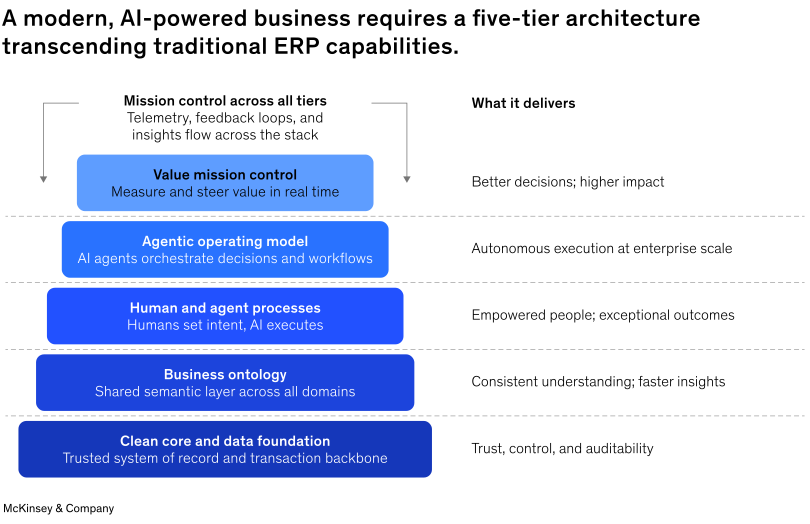
In reality, enterprise interaction will shift away from screen-based transactions toward AI agents that mediate, decide, and execute. In this scenario, the biggest changes are to ERP’s visibility and locus of control. Application logic will still enforce business rules, data structures will ensure consistency, and systems of record will provide auditability, but users won’t directly interact with them. ERP will become “headless,” but this new architecture isn’t just about decoupling the back end and front end. It is defined by several characteristics (Exhibit 1):
- Value mission control: Measuring value becomes a core architectural capability. Autonomous decisions require continuous impact assessment. Embedding telemetry and feedback loops enables organizations to quantify value and determine which agents and processes scale.
- Agentic operating model: The architecture and operating model become inseparable. The agentic operating model will be a new layer on top of the system foundation to enable workflow execution and decision-making across domains and systems.
- Human-empowering processes: The role of end users is redefined. Instead of executing transactions, end users will work with agents to set intent, validate outcomes, and intervene in exceptions. As a result, organizations will need fewer transactional specialists but more professionals who can balance business expertise with AI fluency, govern agent performance, and continuously refine decision logic.
- Enterprise-wide business ontology: Data models evolve from static schemas to dynamic business ontologies. AI enables semantic layers that encode business context in and beyond ERP databases. An AI operating system manages these ontologies, enabling agents to reason across domains and translate intent into consistent action.
- Clean core apps and data foundation: The core of ERP systems remains. These will continue to be the core of ERP systems in the future.
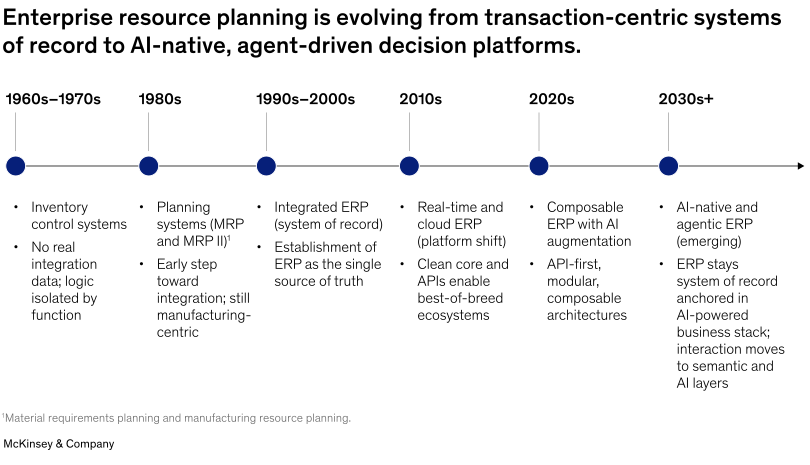
The transformation to this architecture won’t happen overnight (Exhibit 2). It requires a clear understanding of where traditional software as a service (SaaS) ERP processes and their user interfaces remain fit for purpose versus where AI-native approaches are already able to create superior value. This hybrid approach not only allows organizations to immediately realize value but also supports a cleaner ERP core.
2. Companies will continue to invest in ERP modernization
If agents become the new ERP front end, can enterprises stay on a “good enough” legacy backbone and have agents build more-effective business processes and analytics on top of ERP?
The scenario is enticing. It would save companies hundreds of millions of dollars in ERP transformation spending and free up resources to focus investments on high-value areas. However, such a future is unlikely. Robotic process automation (RPA) provides a cautionary precedent. Layered on top of legacy systems, RPA allowed companies to realize quick wins at the edge, but structural process and data issues remained in the core. Agentic AI is more powerful than RPA, but it may encounter a similar ceiling once enterprises require scale, control, and consistency.
Agentic AI materially expands the power of overlays because it can infer, generate, and adapt business logic faster than earlier automation tools. But companies likely don’t want individual AI-created solutions for processes that are largely a commodity, potentially with a lack of traceability, as opposed to an auditable system of record. Nor would they want to run critical infrastructure without vendor support. And disruptors of ERP software would likely rather create a “clean” AI-native ERP than use legacy ERPs as a basis and have to optimize for a multitude of integration scenarios (for example, multiple ERP instances from different vendors within the same company).
For now, it makes sense to continue to invest thoughtfully in ERP modernization. Investments into an improved data foundation will always help scale AI in the future. But this scenario increases pressure on ERP providers and integrators to drastically reduce the cost and duration of ERP transformations.
3. ERP transformations will be two times faster and cheaper
For a long time, the economics of large ERP modernizations have been challenging. Based on McKinsey ERP cost benchmarks, most large enterprises spend between $100 million and $1 billion to migrate their ERP systems. One-off implementation costs make up the bulk, usually reaching a multiple of the subscription cost. Trying to balance cost and value, ERP customers take one of two migration paths. In one case, they use the ERP migration as a catalyst for business transformation, re-engineering business processes and their operating model to focus on business value. In our experience, the payback period is often four to five years. In the other case, they decide to lift-and-shift—if vendors offer such a migration path—accepting a more modest initial modernization at the cost of less business value. Some have mixed both approaches.
AI disrupts the economics of ERP programs by enabling companies to better identify and track value opportunities while reducing the cost and duration of programs by at least two times (Exhibit 3).
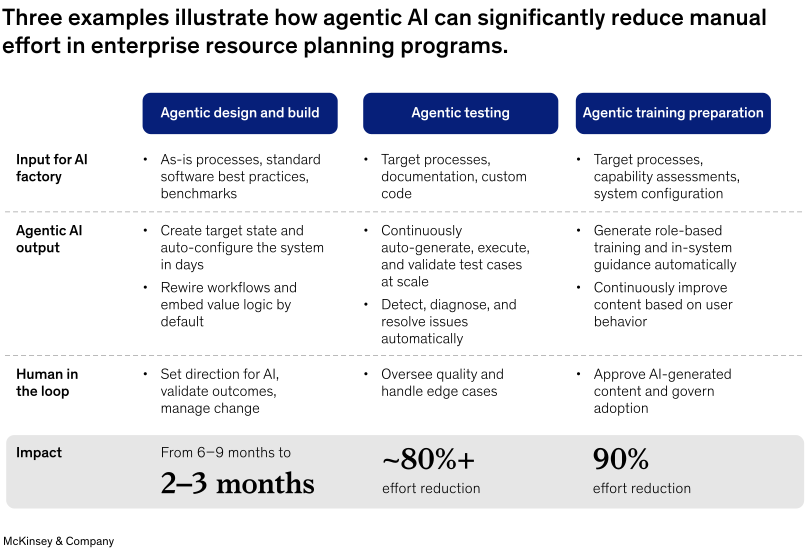
The first proofs of concept show that agentic AI setups will be able to recommend target process and design recommendations with high accuracy within a few days. The recommendations can be implemented in ERP solutions through auto-configuration, again putting the human in the loop for quality assurance. Data migration, testing, documentation, trainings—all these traditionally manual tasks will be heavily automated with agents. In this environment, change management will be the major constraint in ERP transformation road maps of the future, as ERP users still have to be taken along the journey.
4. ERP vendors could regain control of the ERP ecosystem
With AI taking over increasingly more tasks, ERP customers will expect efficiencies to be passed on to them. This trend is already visible in application maintenance, where the customer expectation for year-over-year efficiency improvements toward providers has roughly doubled, according to McKinsey analysis. In large ERP programs, enterprises are torn: Of course they would like to reduce efforts through AI, but most refrain from significant experiments given the related risks and the likely resistance to change. Most are more interested in proven solutions.
As a consequence, system integrators are largely still applying the proven delivery model, enhancing it selectively with AI use cases rather than aiming for a radically overhauled approach. Emerging AI-native start-ups, however, are offering AI-enhanced ERP delivery capabilities: matching as-is with to-be process models, reading custom code and mapping it to the new ERP standard, and creating an AI-enhanced project management office within the ERP project that focuses on improving the function of AI tools. Some of these start-ups are likely to scale fast. However, they focus on selected use cases in the ERP program cycle, leaving an opportunity to integrate the different capabilities.
ERP vendors are in the best position to fill that hole with end-to-end solutions. In previous generations of ERP, they focused primarily on the software and migration frameworks, while the partner ecosystem created migration tools, detailed playbooks, and even industry-specific templates. While this arguably increased the reach of ERP solutions across customers globally, it has also led to a high variance in delivery quality. Just 25 to 35 percent of large tech programs achieve their targeted EBITDA and cash-flow impact, while 65 to 80 percent exceed their planned budget or timeline.3 ERP vendors have an inherent interest in cheaper, faster, and better delivery. They now have the opportunity to provide an agentic AI–supported, end-to-end deployment and migration solution to their customers and partners, regaining control over delivery quality.
Looking ahead, ERP vendors will likely increase investments to overhaul their delivery approach and tooling with AI. They may acquire and integrate the more promising start-ups, allowing them to own the agentic layer above toolchains and the end-to-end integration while still partnering with selected leading tool providers. In the longer term, the biggest competition will come from providers of agentic solutions that aim to work across the transformation life cycle and across vendor platforms.
5. The value creation approach in ERP will shift from build to buy
As soon as the capabilities of gen AI became visible, enterprises started a race to implement use cases. They also encountered the issues of pilot purgatory and the limits of a use case–based approach versus domain transformations. ERP vendors were similarly eager to go to market with use cases, but often, their scope is too small to create measurable P&L impact. As a result, ERP customers have continued to build their own solutions, often supported by service and platform providers who bring their own agent or data platforms and a forward-deployed engineering model.
This approach provides great flexibility: Companies can pick any problem statement and throw AI at it. For differentiating processes—for example, in the commercial function—they can get an edge in the market. However, it is not sustainable at scale in ERP, where the objective function of most processes is standardization, not differentiation.
It is up to the ERP vendors and their solution partners to drastically increase the speed of bringing comprehensive embedded AI solutions to market. There are several prerequisites for doing this successfully:
- Take a cleansheet approach. Instead of automating steps in existing end-to-end processes, ERP vendors should reimagine processes and full domains with agentic AI. The underlying data structure and business logic may be largely reusable, but the process flow will completely change. For example, multiple iterations of top-down and bottom-up alignment in planning processes could be replaced with an AI engine that provides an advanced version of plans ingesting historical data, company strategy, and industry benchmarks.
- Make P&L impact for customers clearly measurable. Through value mission control, as described in Exhibit 1 above, establish baselines and targets and track the impact of operational improvements on P&L.
- Fully embed AI solutions. Provide straightforward AI deployment and an integrated end-user experience across AI and traditional features.
- Ensure the commercial model for AI capabilities is simple. Customers should be able to easily assess and track the cost of consumed AI.
- Ensure agents in the ERP can communicate with agents outside the vendor-specific ERP ecosystem. This open approach will be more appealing to customers, who will hesitate to bet on siloed AI landscapes.
It is a strategic imperative for ERP vendors to provide embedded AI solutions. Working alongside customers and partners, they can innovate the next, AI-enhanced generation of ERP systems. This will allow customers to focus build activities for AI on business capabilities where they can truly differentiate.
While the extent of disruption is difficult to predict, it is clear that players in the ERP ecosystem need to reinvent their delivery models and solutions to stay relevant. ERP customers, for their part, should stay up-to-date, experiment with new AI capabilities, and be open to questioning established ways of approaching ERP.
The race is on to improve AI capabilities and opportunities for value creation—until the next groundbreaking technology advancement hits.