This article is the result of a research collaboration between McKinsey and Serviceware, which provides enterprise and performance management services to global companies.
Every CIO faces the same conundrum: how to allocate budget between fundamental “run” expenditures that keep technology systems operating and “change” expenditures that introduce new capabilities to fuel top-line growth. Getting that calculation right enables companies to extract the maximum ROI from their enterprise spending while managing operational risks—and it’s never been easy. Now AI is compounding the challenge.
AI, and especially agentic AI, is not just changing how enterprise tech stacks are built and managed but is transforming companies’ entire operating models. AI is gobbling up to a third of companies’ change budgets but is also adding to technology run costs. On the other hand, AI investment is creating new business efficiencies, reducing costs elsewhere in the organization. Amid these complexities, CIOs are challenged with modernizing their technology architectures to ensure strategic replacement rather than costly accumulation.
That’s a key finding from a new McKinsey analysis of technology spending patterns at global companies conducted in conjunction with Serviceware.1 While our analysis is based on a survey of sample companies across sectors, it reflects broader trends in enterprise technology investment. Our analysis highlights a focused set of insights that are relevant to the technology investment trade-offs that almost all CIOs face in the AI era.
Overall, our research paints an unavoidable reality: Companies will need to fundamentally rethink their technology expenditures to capture the full value from AI-driven innovation. With costs rising, it won’t be enough for companies to spend more; they will also have to spend differently. This article provides technology leaders with a practical road map to solve the run-versus-change spending conundrum.
An ideal run-versus-change allocation
How are large companies allocating their run-versus-change spending today, and what impact will these choices have on their competitiveness in the future? We attempted to answer that question by surveying large companies on their technology spending patterns (see sidebar “What is tech benchmarking?”). Then, we modeled how these choices could shape their ability to invest in innovation-driven initiatives.
We classify run expenditures as mandatory to “keep the lights on,” including maintenance of infrastructure and existing applications, cybersecurity, regulatory compliance, and cloud platforms. Change expenditures are upgrades to the tech stack that create new value and capabilities, such as modernization, application development, data and analytics, and AI.
Our model analyzes technology expenditures based on two quantitative metrics: run intensity, or the share of a company’s overall revenues allocated to run activities; and change investments, or the share of a company’s technology budget allocated to change activities. We plotted these metrics for each of the surveyed companies into four IT archetypes: deliberate modernizers, strained transformers, lean operators, and heavy IT sustainers (Exhibit 1).
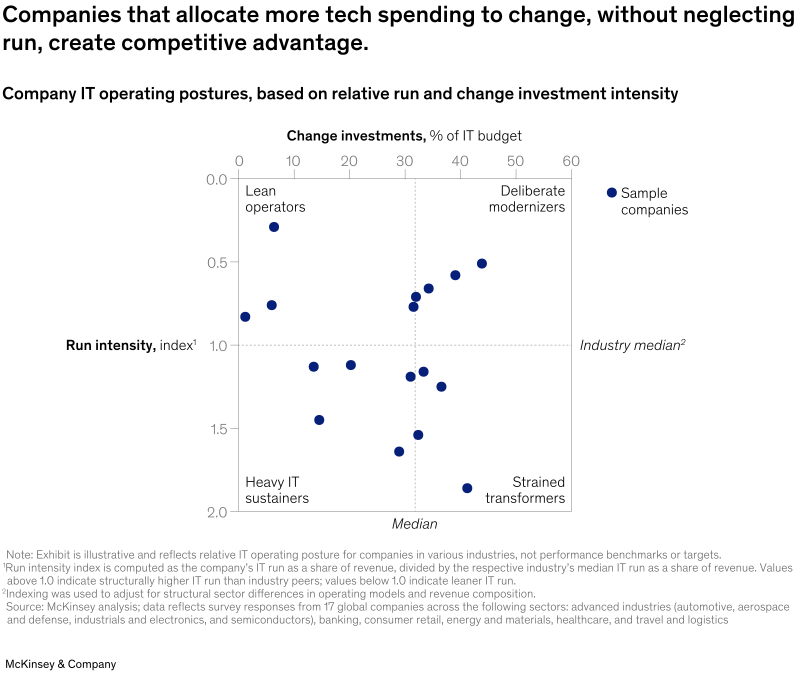
This insights-driven framework can be used by technology leaders as a diagnostic to assess their current state of technology investment—and to make informed decisions about how to reallocate spend to meet their business goals going forward. There is no right or wrong place on the quadrant, and specific industries have specific needs and constraints that define their technology budgets. “Optimal” spend ratios must always consider a company’s current tech maturity and its future value creation goals. However, these quadrants can serve as a useful guide in redefining technology expenditures to achieve optimal business outcomes.
From the standpoint of effecting the most change for the lowest possible spend, our analysis shows that deliberate modernizers are the best positioned to capture maximum value from their enterprise technology investments. Among deliberate modernizers, the sweet spot is earmarking at least one third of expenditures for change and the rest for run activities. These organizations have managed to adopt a lean posture by deploying standardized platforms and employing operating discipline across their technology stacks. They have introduced simplified application landscapes by designing services for reuse, allowing new capabilities to replace legacy systems rather than accumulate on top of them. As a result, technical debt is kept in check and, over time, run costs decline. This frees up even more money for change initiatives such as agentic AI.

The technology shifts every business leader should be watching AI: A guide for business leaders
October 15, 2026, 9:30 a.m. ET / 3:30 p.m. CET
Join McKinsey experts Michael Chui and Roger Roberts for a discussion on tech trends, including where momentum is building, how the major trends are converging, and what these shifts mean for business leaders, workers, and society.
Where do the other companies fall on the run-versus-change road map?
Strained transformers are making strong headway toward change-driven innovation. They are funding change activities such as modernization and AI but are mostly adding these new capabilities on top of existing systems. As a result, these companies face ever-increasing costs. First, they must keep legacy platforms running, and then they must spend additional budget to build and operate new applications on top of these platforms. Over time, new application deployments, especially AI, introduce additional operating burden—models to maintain, platforms to govern, and controls to manage—without reducing the legacy footprint underneath. This increases rather than decreases technical debt. If this posture persists, ROI on technology spend is likely to flatten, since any gains from change are offset by high run expenditures.

The state of AI in 2026: On the road to ROI
Organizations are deploying agentic coding tools and coming to grips with the costs of AI while still seeking to capture more of the benefits that their workers are deriving from their individual use of AI.
Lean operators are cost conscious, keeping both run and change investments small. This posture is common at efficiency-focused companies with stable operations and tight cost controls. But without deliberate investment in run initiatives such as standardized platforms and change initiatives such as AI, these companies risk hampering innovation and long-term growth. Of course, for some traditional industries, there has never been a clear business case to invest heavily in technology. Now AI is changing that calculation. Investing in AI can deliver efficiency and cost savings in even highly standardized and established business environments.
Heavy IT sustainers spend a lot on technology. They commit the lion’s share of their expenditures to run and little to change. In some cases, this choice is driven by structural constraints; many large companies have long-standing complexity embedded into their applications and infrastructure. In other cases, it reflects a deliberate choice following a major modernization effort; significant change work has been completed, and the company then spends to keep standardized platforms running predictably. The future implications differ between these two paths, especially when it comes to AI. Where run costs remain high due to unresolved complexity, AI adds to the operating burden, replicating challenges also faced by strained transformers. By contrast, companies operating a modernized tech stack are often better positioned to integrate AI without increasing systemic complexity—provided they embed AI into existing platforms rather than introduce it as a parallel stack. When AI is introduced that way, these companies risk reintroducing fragmentation and thus increasing run costs.
Crafting a technology budget: How deliberate modernizers succeed
What all companies have in common, no matter where they fall in the expenditure quadrant, is that deciding how to allocate technology budgets is not just a technical decision. It impacts business strategy at every level. Technology leaders should thus decide how to allocate spending in tandem with C-suite leaders. This requires strong alignment between technology and business objectives, with a clear understanding of how technology spend and budget allocation impact overall ROI. Our research finds that top-performing2 companies operate this way; two-thirds have technology leaders “very involved” in crafting enterprise strategy, compared with 52 percent of other companies.3
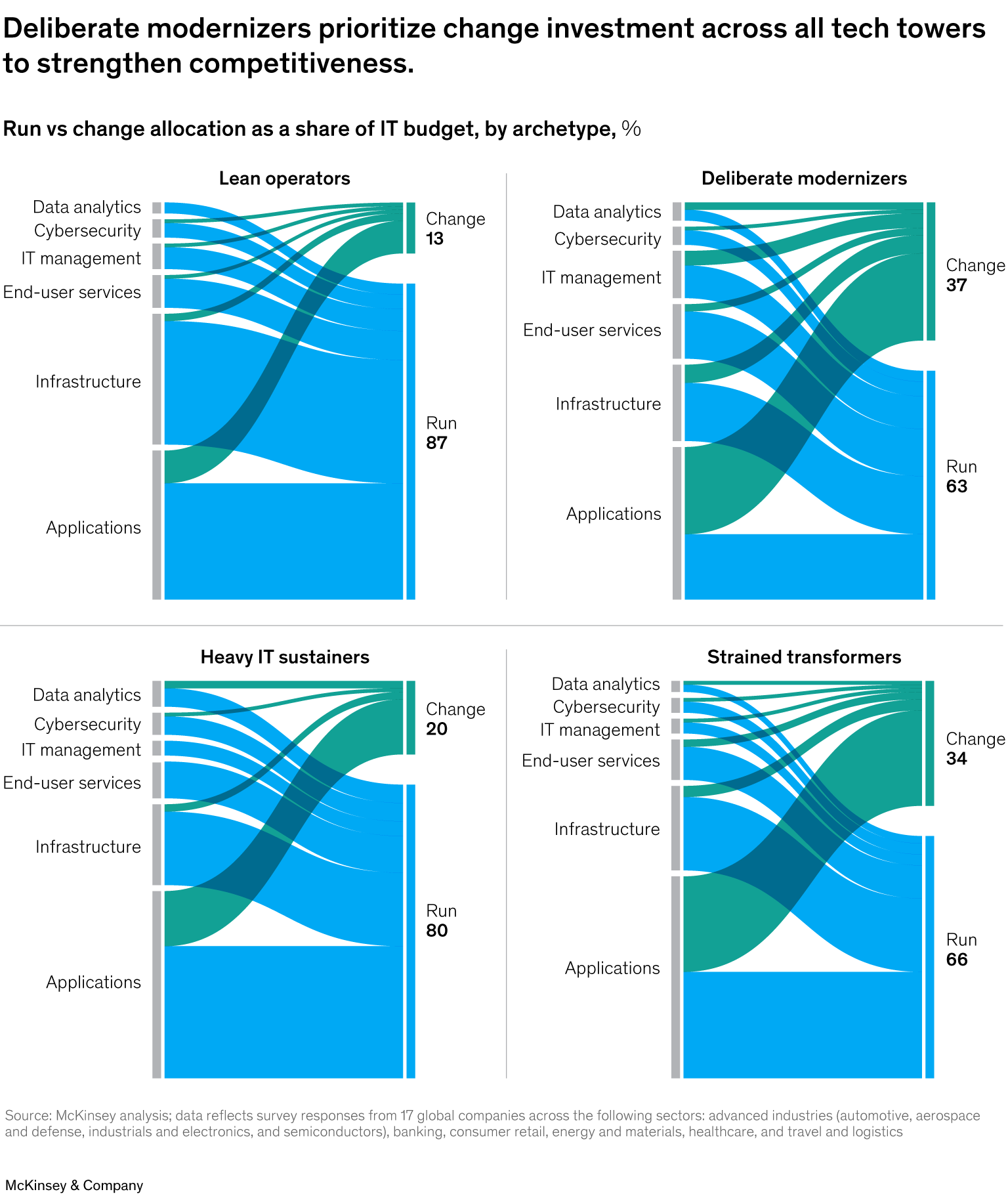
Diving deeper into our financial analysis of enterprise technology budgets, we find that certain spending decisions can have an outsize impact on creating business value. Analyzing the spending choices of deliberate modernizers, we see a few commonalities that lead to their success with balancing run and change budgets to deliver maximum ROI. For example, deliberate modernizers spread their change investments consistently across all major IT towers. They modernize every component of the full IT stack in parallel, which creates a future-ready foundation for scaling AI. Most important, deliberate modernizers keep the portion of their enterprise technology budgets allocated to run-based infrastructure costs at least 20 percent lower than other organizations. That frees up budget to fund change activities such as cloud migration, automation, and the platforms needed to scale AI (Exhibit 2).
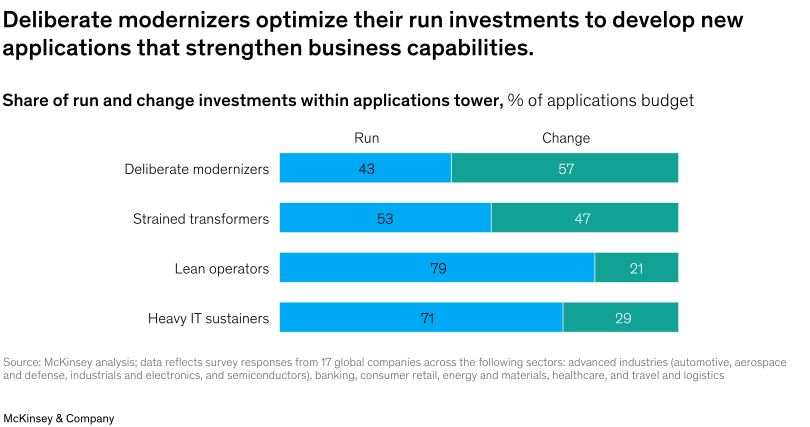
Deliberate modernizers also assign most of their application budgets to modernization and building new capabilities, directing 57 percent of application spending to these critical change categories (Exhibit 3). Our analysis finds that they do this by introducing standardized platforms, which reduce technical debt and thus keep run costs low. They also invest nearly twice as much in building data and analytics capabilities as other organizations, creating a strong foundation to scale AI.
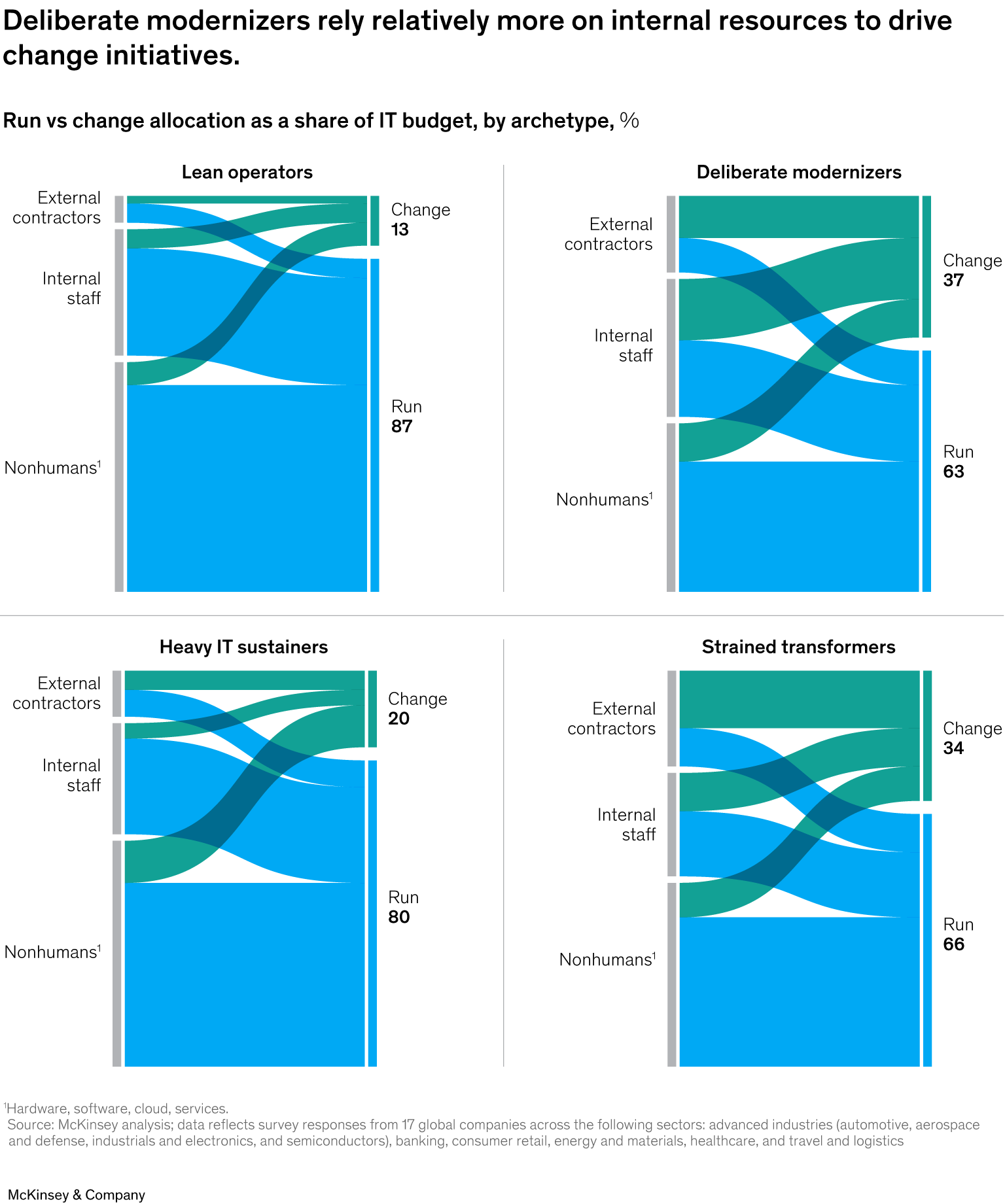
Deliberate modernizers also use internal rather than external teams to deliver critical change projects. They allocate 16 percent of their overall technology budgets to internal staff working on change, which is 1.5 to 4.0 times more than other organizations allocate (Exhibit 4). By funding internal teams that take ownership of change initiatives, these companies can closely align technology and business goals for maximum impact. This move addresses one of the biggest constraints to delivering real change: access to talent. Companies can create highly optimized enterprise technology budgets, but if they don’t address the main constraints—namely hiring and upskilling teams to leverage new technologies effectively—those investments cannot deliver optimal value. They will have all the technology in place for change but lack the capability to capitalize upon it.
Becoming a deliberate modernizer takes a concerted effort to balance technology spending across run and change with an eye on long-term growth goals. CIOs that want to unlock optimal value from technology expenditures can start by deploying three main strategies:
- Decide what to remove from run. Leaders need to make clear choices about which run applications, platforms, or services to maintain or extend. Without these decisions, change initiatives, including agentic AI, will add to run costs. But it’s not all or nothing. Often, companies can reduce usage levels for certain services or switch to less expensive options without impacting performance. These decisions are underpinned by an analysis of what each service costs and how much it’s being used.
- Ensure every dollar invested reduces future costs. Rather than optimizing for near-term delivery alone, CIOs can direct change spending toward shared platforms, standardized services, and data and analytics foundations that lower the marginal cost of future innovation. This strategy allows capabilities such as agentic AI to scale without driving proportional increases in run costs.
- Use AI as a catalyst for simplification. Forward-thinking technology leaders are embedding agentic AI into simplified processes so that AI replaces work and systems over time, instead of multiplying pilots that increase long-term run costs.
AI is intensifying a tension CIOs have managed for years: how to allocate spending to keep systems running while still creating room for innovation. Our research shows that most organizations are already operating at the edge of their change capacity, which means new AI investments often crowd out other value-creating projects—and quietly add to run costs, too. The companies that will win in the next decade are not those that blindly spend more on technology, racing to keep up with every trend, but those that make clear choices. They make deliberate decisions about what to simplify, retire, or stop so that more modern capabilities can take hold. For CIOs, the task now is to reset the run–change balance, ensuring AI unlocks lasting returns rather than reinforcing today’s complexity.

.jpg?cq=50&mw=767&car=16:9&cpy=Center)