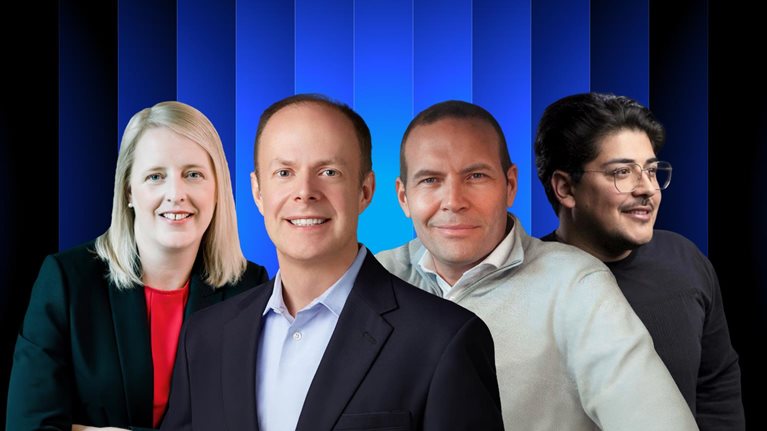
At the Cannes Lions International Festival of Creativity, leaders from across industries explored how AI, technology, and creativity are reshaping business. In this conversation, Genentech CMO Zoë Lazarre joins McKinsey partner Jennifer Dikan to discuss why marketing has become a growth engine, how AI is transforming the marketer’s role, and what it takes to build marketing organizations that embrace experimentation without losing trust. The two also look at the evolving patient journey, the future of market research, and why organizations that fundamentally rewire around AI will outpace those that simply layer it onto existing processes.
The following transcript of their conversation has been edited for clarity and length.
CMO as the impact driver
Jennifer Dikan: Zoë, your career path is a bit nontraditional for a CMO, spanning public policy, strategic leadership, and commercial leadership. What led you to where you are today?
Zoë Lazarre: I’ve always thought about it as going where I have the chance to make the biggest societal impact, the biggest impact in an organization. And I think a lot of that comes from my background in public health and health policy.
I spent a lot of years prior to Genentech on direct one-on-one ground-level community public health interventions and realized, yes, I can make an impact one-to-one, but the broader impact happens on the policy level, on the big macro changes we can make. And those are whole-scale societal changes, organizational shifts.
Jennifer Dikan: If you think about the role of a CMO and a marketer, it’s actually very well aligned in terms of having broad-scale impact on getting our benefits to the patients.
Zoë Lazarre: No more true than today, when you see marketing as the growth engine of the organization. We’re not going through one transformation; we’re constantly evolving to meet that need.
Creating a culture of experimentation
Jennifer Dikan: You’ve spent most of your career at Genentech and Roche across therapeutic areas, functions, teams. What have you had to relearn about growth as you’ve evolved?
Zoë Lazarre: The places where I’ve grown the most are places where I’ve failed first. It taught me to embrace those opportunities where you can experiment, learn, and shift your approach. I think that’s the culture at Genentech.
Everything we do must be measured. From how I personally show up as a leader and I get feedback from my teams, to how we think about the value of the work and the content that we put out in the world. The democratization of data and AI and technology has made that more important and more possible.
It’s no longer waiting nine months to get a report. It’s almost real-time feedback on the effectiveness of that campaign.
Jennifer Dikan: How do you get your teams to feel comfort with experimentation in a world where they’re being measured?
Zoë Lazarre: You have to role-model it. So you will see me at Genentech not just thinking about the big visionary changes, but in the work, sitting in what we call incubators with our teams and learning how to use our new AI tools.
The technology is not perfect, but just as important is having empathy to bring people along in that change.
We have thought hard about how we reward and incentivize our marketing organization to experiment with AI, supported with the data to learn.
Jennifer Dikan: Life sciences is going through such a fundamental shift right now. There is an evolution in the trust, the expectations of our patients and our consumers, all of our stakeholders, the therapeutic areas, and how they’re evolving. What signals to you that we are entering a fundamentally new era?
Zoë Lazarre: The healthcare journey, the patient journey, does not start in the physician’s office. It doesn’t start at that point of diagnosis. It starts late at night when a patient is searching for the cause of a symptom. It starts in the data that’s generated with Claude, or Gemini, or your LLM. It starts on a patient support group on a Meta platform. It’s really different than even two years ago.
If a patient knows their diagnosis and has a prescription, the barriers don’t necessarily end there. They may not have transportation to an appointment, be able to afford their medication, or be struggling with side effects.
Not only do we think about the start of the journey but also about that experience throughout the journey and what specific barriers we help a patient overcome along the way.
Rewiring marketing for the AI era
Jennifer Dikan: AI is transforming organizations. Some have completely transformed and rewired across brands and processes, and others are just starting. What do you think is going to separate those that fundamentally rewire using AI, versus just layering AI onto different processes?
Zoë Lazarre: We started with leveraging AI for efficiency and cost savings, and saw immediate gains there. Now we’re shifting into AI as a growth driver for our business, optimizing through content creation that’s personalized and creates additional value.
It’s really about the culture, the people, and the mindset of how people are using AI. Are they going to AI to ask questions, or is AI coming to them and solving problems for them in the moment?
Jennifer Dikan: Where do you think that that leaves not only the individual marketer of the future, but also the composition of the teams of the future?
Zoë Lazarre: There’s never been a better time to be a marketer.
It’s more fun. You can drive more value. You can be more creative as an individual. So that mindset needs to permeate some of the tougher moments of going through evolution and changes.
And the changes are really big.
One, we have our marketers own end to end the entire spectrum—from ideation and strategy, to insight gathering, to content creation, to measurement, to iteration, all the way down that value chain. They’re not relying on multiple third parties to get data six months after their campaign is released.
We’re also asking marketers to leverage new AI tools and technology. We still partner with agencies. We still have a lot of the tenets and structures of what made our marketing organization so phenomenal.
Jennifer Dikan: The notion of traditional market research is being put completely on its head, and some folks believe it’s actually going to go away entirely now that you can do so much more through AI. How do you think about the time marketers are going to spend on tactics and how that’s evolving?
Zoë Lazarre: I’ve had many conversations about creating digital twins or AI-generated focus groups, and I am all for it because the faster we can get those insights, the more the tactics and the associated content will need to change.
We are a data-driven organization; we always have been. We’ve been looking at claims data since the birth of our marketing organization. What’s really interesting is we’re shifting into new questions: How does the customer feel? Why are they making that decision? Why are they selecting a Genentech therapy? What drives them? What is their whole health history like?
That’s the kind of insight, market research, and listening to our consumer we need to pay more attention to.
Building trust across the patient journey
Jennifer Dikan: Trust in our industry is paramount, but it’s also one of the most fragile assets an organization can have. How do you think about building trust as an organization?
Zoë Lazarre: You think about why, how, and who humans—not patients, but human consumers—trust.
And I think we would all say that we’ve gone into an LLM and typed in symptoms or copied something from MyChart, and we trust, in some cases, that outcome. And we bring that outcome to a clinician or physician.
And we go to these direct-to-patient platforms, and we ask for the medicine we want. Where and how we trust is so radically different today with the advent of technology and data democratization.
We show up in those places that patients trust, like our patient advocacy groups, which we’ve done for a very long time, because that’s where our communities are. That’s who they trust.
We think about how clinicians get information, where they’re going, what they do at the end of a really long day, and who they’re listening to. We extend efforts to think about that patient through the whole cycle of their journey.
It doesn’t just stop with you’ve been prescribed a medicine. Can you get that medicine? Do you have side effects?
Making sure we have trusted resources in the moment to provide to those patients, no matter what part of that journey they’re in—that builds trust.