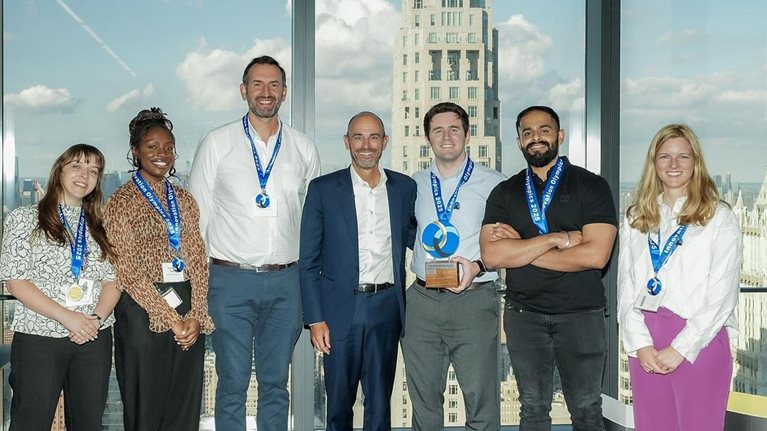
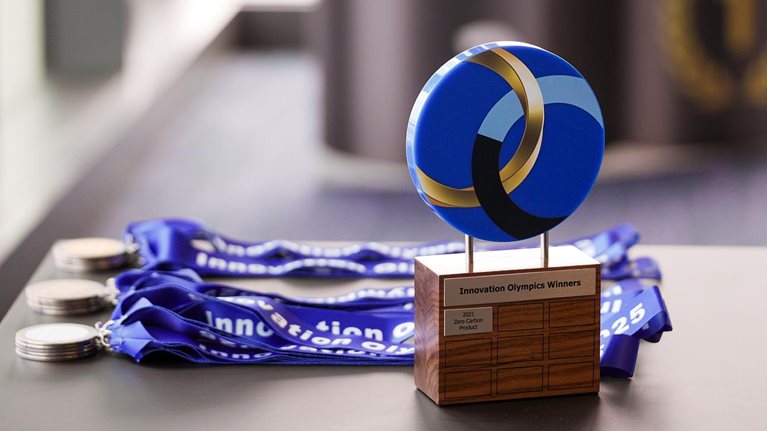
The Winter Olympics are held every four years; McKinsey’s Innovation Olympics (IO) run every year. Winter Olympians are world-class athletes; Innovation Olympians, not so much. The Winter Olympics take place mostly outdoors; the Innovation Olympics mostly in conference rooms.
The differences are obvious; even so, there are important elements the two events have in common. “I know it’s going to be stressful,” snowboarder and two-time US gold medalist Chloe Kim said of the Olympic Games, “but it’s also going to be great.” The more than 2,000 McKinsey colleagues who competed in the most recent Innovation Olympics would share that sentiment. And just as the Olympics represent the arena to which athletes bring their best, the IO plays the same role at McKinsey. The goal: to create a bottom-up innovation mechanism that discovers great ideas, then puts them to work for our clients.
Starting with a single European office in 1988, the IO went global in 1994 and has gone from strength to strength every year since. In 2025, there were more than 350 entries from more than 120 offices. In short, the IO has become a core part of McKinsey’s overall innovation strategy—and a rewarding one. The winning entries since 2021 have delivered an estimated 2,700 percent return on investment. Success means impact, not tweaks. Creativity and flair are valued but not for their own sake; a fun idea that doesn’t help clients won’t make the cut.
Even organizations that aren’t as big, diversified, or global as McKinsey can benefit from holding their own Olympics—if they get a few important elements right.
Cast a wide net—with a narrow filter
At the IO, the sheer variety of concepts presented is remarkable, ranging across the firm. In 2025, for example, the 45 semifinalists included entries to map the geopolitical landscape, improve communications coaching, and optimize vehicle life cycles. Shiny new things are exciting, but there can also be great value in adapting existing approaches or insights. For example, “Design-to-Value” was a well-established concept in 2013, but new tools to refine it won that year anyway—and some of these tools are still in use.
Winning entries reflect their times. One early IO winner proposed embedding bank branches into supermarkets, a notion that now seems positively quaint; in 2025, AI-themed entries dominated. So things change.
But the filter remains the same. Winners must demonstrate that their ideas are distinctive, evidence based, and have the potential to go big relatively quickly.
Make participation rewarding
Early on, the typical prize for the IO winner was a paid weekend for two. That was all very nice, but it served neither McKinsey nor our clients. These days, there is a medal, a dinner, and sometimes a treat, such as tickets to a major sporting event. But the real prize for the winning team is a full year of time and other resources to bring their innovation to life. The opportunity to put passion into practice is what gets people excited.
And there is another kind of reward. Most IO teams comprise people from widely diverse areas; individuals who want to participate but don’t have an idea of their own can go to the IO platform and look for an existing team that needs their expertise. Working across the usual boundaries expands personal networks and offers exposure to senior firm leaders. Plus, it’s fun.
In 1997, one of us was part of an IO winning team from India. Our presentation on “acquisition-driven growth in Asia” was, perhaps, not quite as fun to watch as seeing Chloe Kim land a 1260. But the experience was a total-immersion course in teamwork and in how to refine a general idea into something distinctive and applicable. These lessons have served both of us well ever since. As IO judges, we have the same intensity and enthusiasm.
It’s not about the contest
The IO can be a thrilling experience, but what’s truly important is what happens next. McKinsey is full of competitive people, and all of them would rather win than . . . not win. But the real purpose of the IO is to discover creative, scalable, and valuable ways that solve real-life problems for our clients. Recent winners have delivered long-ranging dividends, positioning McKinsey not as a one-off problem solver but as a continuous resource. The 2025 gold medalist, McKinsey Intelligence, is an AgentVerse-powered tool that integrates AI agents into workflows; this helps our clients make better, faster decisions. Since its creation, McKinsey Intelligence has been deployed in more than 15 engagements in the life sciences, manufacturing, and private equity industries. A 2023 finalist, a self-serve AI-enabled tool known as the Strategic Growth Hunter, helps clients identify untapped growth opportunities and has been applied by more than 100 clients.
Innovation is a journey, not a destination; the results come from the process. In Chloe Kim’s case, that is the year-round program of running, lifting, and stretching that prepares her to achieve impressive feats like back-to-back 1080s. For McKinsey’s Innovation Olympians, the process involves whiteboards, teleconferences, and coffee. Lots of coffee. In both cases, though, much of the critical work gets done when no one is looking. The results come from inspiration, perspiration, and teamwork—and victory is sweet.