As the in-person experiences market continues to grow, many brands and intellectual property (IP) holders are looking for opportunities to engage with consumers in more experiential ways. One option is to tap into the classic location-based entertainment industry, which has proven expertise in creating appealing experiences. But developing location-based attractions similar to those typically seen in major theme parks (where, for instance, an IP holding can become the basis of a roller coaster or large-scale interactive space) can involve big investments and long-term commitments that could stretch some brands’ resources and risk tolerances.
An emerging trend suggests an alternative approach. More narrowly focused regional, seasonal, or pop-up experiences could provide various players—including those not historically active in the location-based entertainment space—with novel opportunities to create compelling attractions. This version of location-based entertainment could involve smaller investments, shorter commitments, more flexibility, and the potential for quick wins. Meanwhile, it could also help provide a solution for anyone looking to fill spaces in malls, city centers, or other areas that might be underutilized.
To be sure, smaller-format location-based entertainment projects often generate limited profit margins when compared with those found at major destination-based attractions. With their higher levels of repeat visitation and the operational benefits that come with large-scale investments, traditional theme parks can achieve EBITDA margins of roughly 30 to 40 percent. Family entertainment centers and arcades can reach EBITDA margins of roughly 25 to 30 percent. Meanwhile, smaller-scale, short-term location-based entertainment projects tend to operate at slimmer margins—though financial returns can vary significantly based on the type of experience offered.
Importantly, however, even if smaller-scale experiences are only incrementally profitable, they can still provide an avenue for brands and operators to deepen engagement with their most loyal and passionate customers. “Location-based experiences allow us to connect more deeply with our most engaged fans,” says Ken Wee, chief strategy officer for Mattel, “and we know that those most engaged fans can be significantly more valuable than the average customer over time.”
Beyond deepening engagement with core fans, location-based entertainment is also a powerful tool for reaching broader audiences. Immersive, smaller-scale experiences can appeal to a different demographic: Recent McKinsey consumer research indicates that Gen Z is 1.5 times more likely than the general population to visit an immersive experience—and four times more likely than older generations.
Location-based entertainment experiences can be part of a healthy mix that includes marketing spend, loyalty programs, and other efforts that have a central goal of building deep relationships with lifelong fans and broadening exposure to new and harder-to-reach audiences.
Location-based experiences allow us to connect more deeply with our most engaged fans, and we know that those most engaged fans can be significantly more valuable than the average customer over time.
The growing business case for experiences
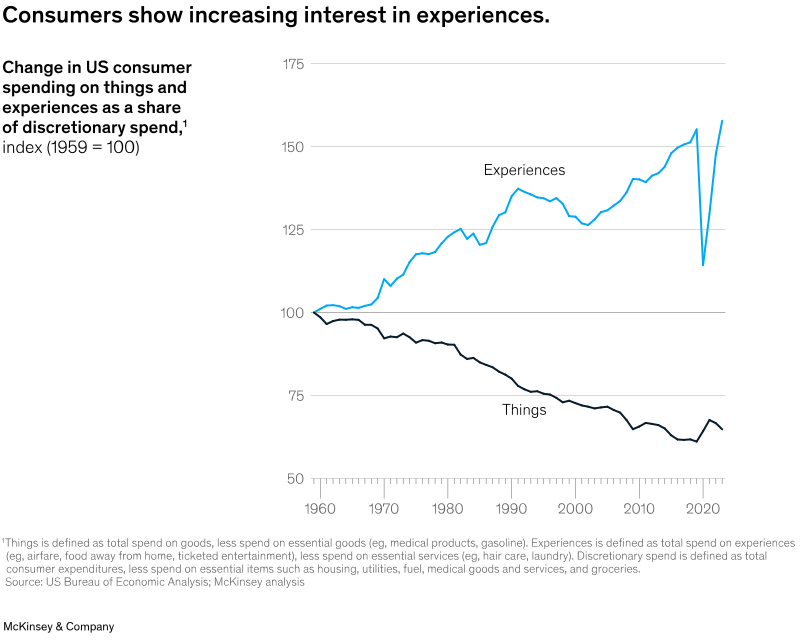
McKinsey research has found that 52 percent of Gen Zers say they splurge on experiences when traveling. These consumers will look to save money on almost anything else—including flights, local transportation, shopping, and food—before being willing to trim their spending on experiences. Meanwhile, US consumer spending data indicate that growth in discretionary spending on experiences has outpaced spending on goods (Exhibit 1).
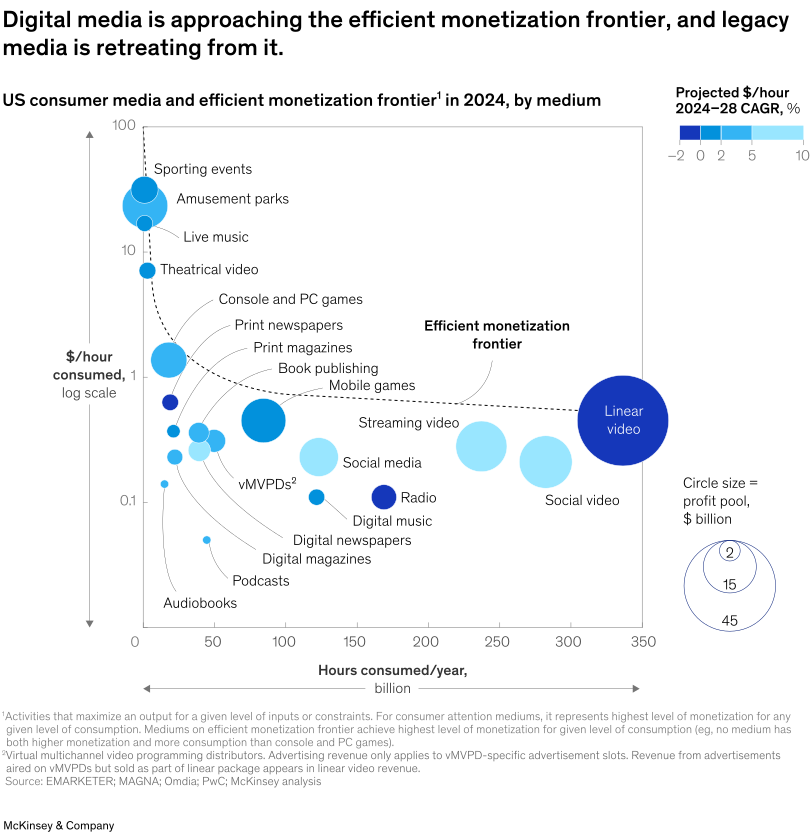
Additionally, McKinsey research on consumer attention indicates that live entertainment is on the “efficient monetization frontier,” meaning it maximizes the conversion of consumer attention into revenue. Amusement parks, in particular, generate among the highest dollars per hour consumed when compared with other entertainment media (Exhibit 2).
Major experience providers are taking note of the growing consumer interest and increasingly favorable economics associated with experiences. Universal Destinations & Experiences, in the midst of adding to its collection of Universal theme parks, has also launched new formats in new locations—including the recently opened Universal Horror Unleashed in Las Vegas and the forthcoming Universal Kids Resort in Frisco, Texas. On a 2025 earnings call, Disney CEO Bob Iger said, “We are building on our best-in-class parks and experiences businesses, with more expansions underway around the world than at any other time in our history.”
Advantages of smaller-scale and transitory experiences
Smaller-scale, location-based attractions can augment the traditional, high-capital-expenditure destination experience approach, thereby broadening the portfolio of experiences on offer. Brands could derive several potential benefits from launching smaller-scale attractions or attractions that employ a short-term or pop-up approach:
- Much smaller initial investments reduce the general risks stemming from a project that fails to meet audience or revenue goals.
- The ability to close in one location and open in another makes projects less vulnerable to shifts in local economic conditions.
- Shorter development times and more nimble operational structures make it easier to time project launches to coincide with moments when the underlying concept (for instance, a piece of IP) will have maximum cultural relevance (for instance, when a new season of a hit TV show is released).
- Limited-duration attractions can create scarcity and excitement, resulting in potential for increased social media sharing.
- Successful projects can quickly be scaled through expansion to new regions.
- As rising admission prices have become a concern at destination theme parks, smaller-scale experiences in regional locations could provide less expensive alternatives for local consumers who don’t want to spend as much on travel or admission tickets.
- As further detailed below, lower ongoing costs and less onerous contractual commitments make it feasible to build attractions around concepts that target relatively niche audiences.
Enabling newer types of experiences
A smaller-scaled, more transitory approach to location-based entertainment is already spurring the creation of new types of experiential attractions.
IP can be less mainstream
IP-powered attractions have often centered on major studio franchises and global blockbusters with broad-based fan followings. This makes sense for attractions inside destination theme parks, given the significant up-front investments those models involve. But the short-term, lower-cost experience model is making it easier for less mainstream offerings—including niche TV shows, movies, and even books—to be adapted as location-based entertainment. For example, The Queen’s Ball: A Bridgerton Experience, features immersive set recreations, live music, specialty drinks, and theatrical performances all based on the Netflix streaming series Bridgerton. It opened in 11 cities across three countries and saw more than 150,000 visitors across several of these locations within a few months of its launch. The romance book series A Court of Thorns and Roses has been the basis for small-scale, pop-up experiences that have gained attention largely through networks of like-minded book lovers who post on the social media platform TikTok.
Consumer products and food items can provide the basis for attractions
The interactive experience Monopoly Lifesized (based on the classic Hasbro board game Monopoly) launched in London in 2021 and has since expanded to tour cities in the United States, including Denver and Charlotte. The London and Denver destinations have collectively attracted nearly 500,000 visitors since their opening. The Monopoly Lifesized franchise partners with local production companies in each market. Signing short-term leases in underutilized spaces helps keep costs down.
ChainFEST—a recurring food festival that began as a pop-up event—has partnered with brands including Taco Bell, Pizza Hut, and McDonald’s. In this case, beloved quick-service food items serve as the IP that forms the basis of an attraction, with gourmet chefs creating new takes on popular chain restaurant menus.
Retail stores can double as attractions
The toy store Camp—with several US locations—bills itself as a “family experience company.” It regularly constructs in-store interactive experiences based on children’s media properties (such as the TV series Bluey or the Trolls films) that are accompanied by themed shopping opportunities.
Underused real estate can be repurposed as an attractions space
Smaller and temporary attractions can create opportunities that benefit both real estate holders and IP owners. “Many real estate holders I speak with these days have underutilized space,” says Chris Holdren, former chief marketing officer at Caesars Entertainment. “One large movie theater group told me it has 10 percent too many screens and wants new ideas about what to do with those spaces. Casinos and malls often have excess space. I think IP holders could consider moving quickly to make use of these available spaces.”
Bundling attractions together can create a mini theme park
Both Netflix and Sony have experimented with combining a limited number of IP-based attractions under a single roof. Netflix launched a Netflix House concept in Pennsylvania and Texas, with each location offering a variety of experiences—based on streaming series such as Squid Game and Stranger Things—that are gathered within 100,000-square-foot venues. Sony created a Wonderverse in Chicago that was a 45,000-square-foot space featuring experiences based on movies such as Ghostbusters and Jumanji.
Theme parks can expand to satellite locations
Universal Destinations & Experiences has previously offered “Halloween Horror Nights”—an evening presentation full of thrills and chills—to its theme park guests. But Universal has now expanded the initiative to other locations, including a pop-up haunted maze in New York called “Jimmy Fallon Tonightmares.” In Las Vegas, the year-round, 100,000-square-foot Universal Horror Unleashed experience features multiple haunted house environments.
Lego has augmented its Legoland theme parks with smaller, indoor Legoland Discovery Centers in locations across Asia, Australia, Europe, and North America.
Developing a location-based experience for brand activation
Stakeholders contemplating an investment in a location-based experience should consider important elements such as performance metrics, construction timelines, and the benefits of collecting and analyzing data to adjust approaches quickly. It’s vital to focus adequate attention on creating distinctive experiences—while also protecting IP assets.
Align on the measures of success
It’s important to align on the core purpose of creating an attraction. Profitability is, of course, a plus. But if a well-received experience generates online buzz and deeper engagement with consumers, financial returns might be a secondary goal. Stakeholders should consider in advance what success would look like.
Coordinate on realistic timelines
A typical timeline for creating a smaller-scale, immersive experience—involving one attraction in an existing building—could stretch to roughly 15 months. That can include about 90 days for contract negotiations with execution partners, eight months for construction to build out the guest environment, and two weeks of closed beta testing to resolve any issues prior to opening to the public. If activations are planned in tandem with major launches or announcements, getting up-front alignment on the timeline is crucial.
Enhance personalization through gen AI
Personalization has long been a key ingredient of experience design. As gen AI technology advances and its costs come down, it is now more feasible than ever to integrate personalized experiences into offerings. Creating ways to make each experience feel personal should be part of any planning.
The College Football Hall of Fame in Atlanta offers a personalized tour, where visitors are asked to pose for a photo and answer several questions upon arrival. Using AI, the photos and answers were incorporated into exhibits that made guests part of the attraction (for instance, by generating fake documentary videos that portrayed guests as successful college football coaches). The experience ended with guests being featured in videos imagining them being recruited to play for their favorite college football teams.
Make tangible memories part of the experience
Tangible products can help visitors remember an experience for years to come. These items can come in the form of ancillary merchandise that is sold or, if the primary goal is to drive affinity and loyalty, given to visitors as gifts. Themed menu items and specialty drinks can be tied into the overall design of an attraction and paired with take-home mementos to become integral parts of the experience. (The recent popularity of novelty popcorn buckets offered at movie theaters and theme parks helps illustrate this opportunity.) Given the high levels of consumer food and beverage spending in the attractions industry—which can be two or three times more per capita compared with consumer spending on other categories connected to attractions, such as retail sales and parking—it can be worthwhile for developers of attractions to focus efforts on both lifting the quality of food and beverage offerings and weaving them into the holistic experience.
Analyze data to adjust consumer-facing and back-of-house operations
Digitalization, robust data gathering, and the use of advanced analytics can help a short-term attraction (with limited time to get things right) quickly adjust to improve operational efficiency and identify unmet consumer needs as they emerge. Real-time insights can help with staffing decisions by ensuring workers are deployed to the right places at the right moments. Data-driven analysis can help evolve best practices, creating standardized approaches that can be replicated if the attraction expands to other locations.
Develop distinctive, promotable ideas
The family entertainment center Dave & Buster’s hosted a rave-themed pop-up—collaborating with the electronic music collective Brownies & Lemonade to transform arcades into dance parties. Dave & Buster’s Chief Strategy Officer Aldo Rosales says, “The goal was to create an experience that felt distinctly Dave & Buster’s—grounded in what our audience already loves. It’s about integrating with your guests’ passion points and giving them a reason to show up. When you start there, the marketing comes naturally. Your partners, your influencers, and your storytelling all build around that shared energy.”
Protect assets
It’s important to bear in mind the downside risk of a failed initiative. Proposals should be carefully evaluated, and potential collaborators should be thoroughly vetted. A subpar idea for a new location-based experience—or even a great idea that’s poorly executed—can create lasting headaches for the owners of both the associated IP and the experience venue. “For real estate holders, you need to give serious consideration to whether the experience will actually bring in more revenue and foot traffic than a restaurant or retail store would,” says Holdren. “And if it’s your IP that’s being brought to life, it should be an experience that you take an active hand in developing—just as you did when you were creating the IP itself. A bad experience will be memorable in a disastrous way, and it can forever damage a customer relationship.”
Smaller-scale, transitory, and IP-driven location-based entertainment formats are poised to play an increasingly pivotal role for brands, media companies, and consumer-facing businesses that want to engage their audiences in immersive new ways. These flexible attractions offer considerable advantages—from lower investment requirements and faster time-to-market to more targeted, high-impact audience engagement—which can make involvement in immersive experiences more accessible and strategically attractive for many companies. Maximizing the potential of these initiatives requires thoughtful execution and operational discipline to mitigate risks and ensure each project delivers on its promise. With the right approach, however, these innovative location-based entertainment models can serve as a powerful growth lever, helping companies captivate fans and drive tangible value through unforgettable experiences.