For two decades, our annual analysis of the aviation value chain’s financial performance has tracked how value flows across the industry’s interconnected subsectors. This year’s review, based on 2025 data, reveals a sector at an inflection point. Eight of 11 subsectors achieved positive economic profit—the highest share since the start of the pandemic. Yet the aggregate result remains firmly negative, with airlines, airports, and manufacturers accounting for the bulk of the losses.
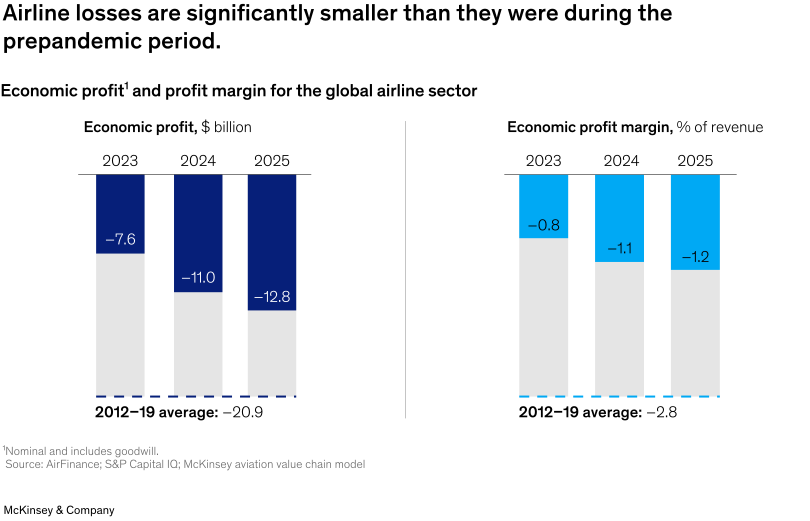
Beneath the headlines, a more nuanced story emerges. The airline sector’s $12.8 billion economic loss in 2025 is not substantially different from its 2024 result—but it still represents a significantly better performance than was typical before the pandemic. Four in ten airlines now earn their cost of capital, representing a marked improvement from historical norms. Meanwhile, the rest of the value chain is largely back in positive territory.
Our measure of value creation is economic profit, defined as the difference between ROIC and the alternative return on equal-risk opportunities available to investors. Alternative returns are calculated by multiplying the weighted average cost of capital (WACC) and invested capital. We analyze participants across the value chain, including airlines; aircraft and engines OEMs; aircraft lessors; air navigation service providers; jet fuel producers; airports; catering suppliers; ground services companies; maintenance, repair, and overhaul (MRO) organizations; freight forwarders; and providers of global distribution systems (GDS)1 and other travel technologies.
Below, we take a detailed look at the numbers. Five themes stand out in this year’s results.
Airlines are losing much less than in the past
The airline sector’s ROIC has remained continuously below WACC since at least 1996. In that sense, 2025 was no different. The industry collectively posted an economic loss of $12.8 billion.
But the trajectory has shifted. The 2025 loss was approximately 40 percent smaller than the annual average for the 2012–19 prepandemic period, when airlines lost roughly $20.9 billion per year (Exhibit 1). And the magnitude of the improvement—from a prepandemic average economic profit margin of –2.8 percent to 2025’s margin of –1.2 percent—suggests genuine structural progress.
The airline power curve remains steep, and value creators are multiplying
The airline industry’s economic profit “power curve” in 2025 reveals considerable variation between top performers and others across a 97-airline sample (Exhibit 2). The 20 airlines in the top quintile of performance collectively generated $14 billion in economic profit. The 20 carriers in the bottom quintile lost $22.9 billion. The middle three quintiles, representing 57 airlines, collectively posted an economic loss of $2.3 billion.
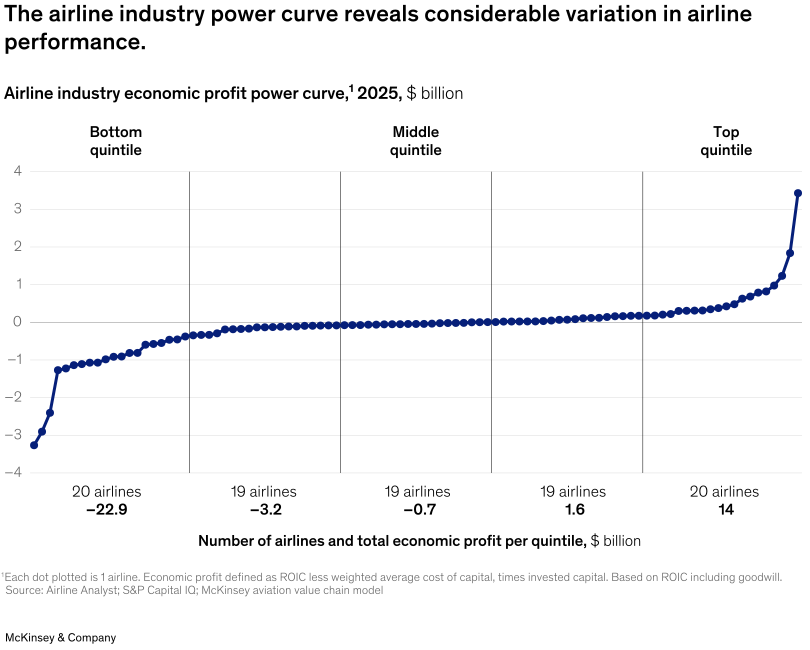
This wide dispersion is not new. What is new is the growing share of airlines on the positive side of the ledger (Exhibit 3). In each of the past three years, roughly 40 percent or more of airlines have earned their cost of capital, approaching nearly twice the long-term historical average. What’s more, a substantial share of value-creating airlines remained value creating: Of those that created value in 2025, 82 percent had also done so in 2024, and 72 percent had done so in both 2024 and 2023.
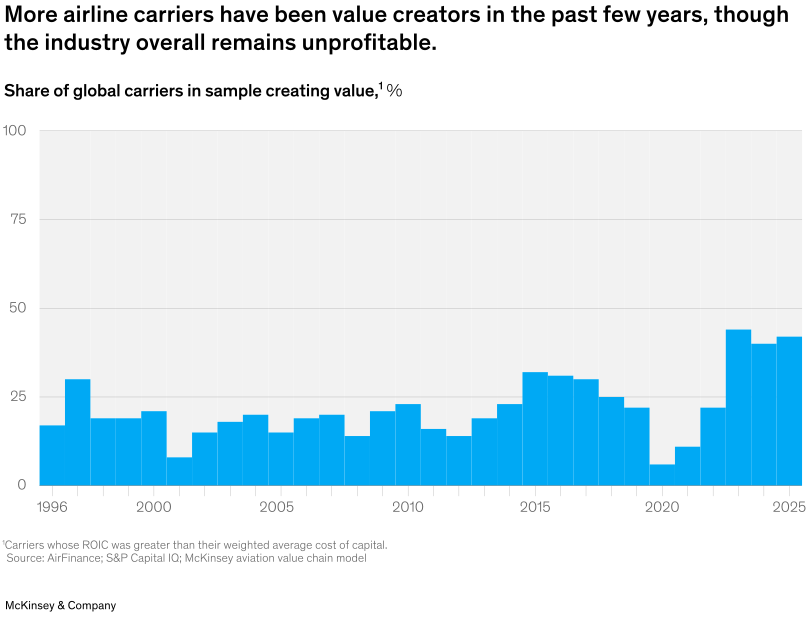
This suggests more than mere cyclical recovery. Airlines that are succeeding may have found a durable formula (which could in large part involve investing in premium products, ancillary revenue streams, loyalty ecosystems, and operational efficiency) even as many of their peers continue to lose money at scale.
North America’s discount airline model faces headwinds—as does overall carrier profitability
For multiple years before the pandemic, North American carriers led global airline profitability. But in 2025, they were no longer the primary driver of global airline economic profit, and regional performance became more balanced.
Even more striking is the reversal of fortune between North America’s legacy and low-cost carriers (LCCs). During the 2015–19 period, North American LCCs significantly outperformed full-service carriers. In 2025, that dynamic reversed, as North America’s LCCs performed worse than its full-service airlines (Exhibit 4).
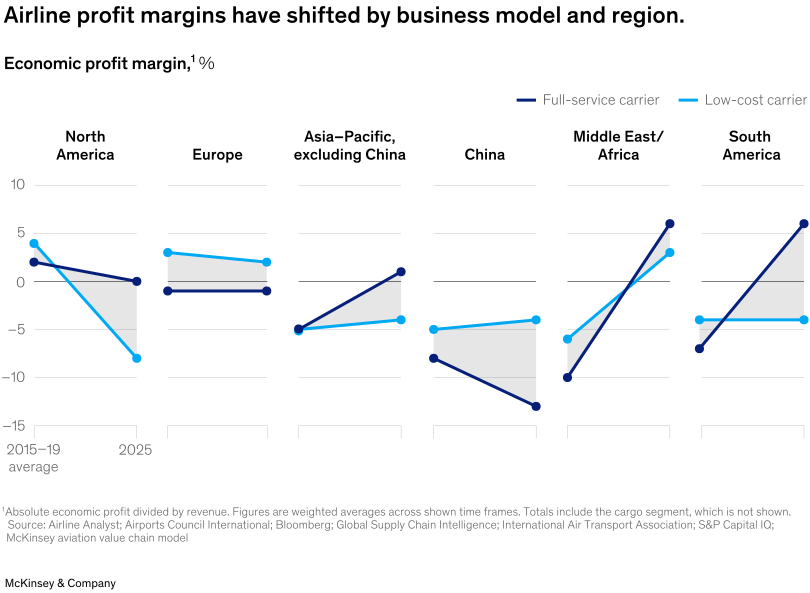
Several structural forces are driving this shift:
- Cost convergence. Rising labor costs—the largest expense line for discount carriers—have narrowed the unit-cost gap that historically defined the LCC advantage. Legacy carriers’ more diversified cost structures have proved more resilient to wage increases.
- Premium-demand capture. Today’s high-income travelers often prioritize premium experiences, and network carriers are better positioned to meet this demand through business class products, lounges, and loyalty programs.
- “Basic economy” competition. Legacy carriers have become more effective at offering unbundled “basic economy” fares that compete directly with LCCs on price while retaining the brand and network advantages of a full-service carrier.
- Loyalty revenue. Network carriers generate substantial revenue from cobranded credit cards and frequent-flyer programs—a revenue stream that’s much less accessible to discount carriers.
The airport sector remains in the red—but regional divergence is significant
The global airport sector continued to operate at a loss in 2025, though performance improved significantly from the depths of the pandemic. Perhaps the most notable development is the continued regional divergence (Exhibit 5).
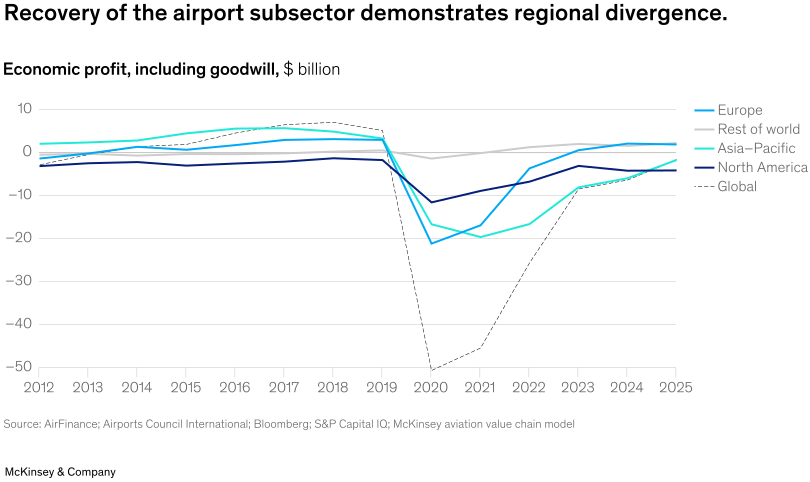
Airports in Europe have returned to positive territory, as have airports in Latin America, the Middle East, and Africa collectively. Meanwhile, North American and Asia–Pacific airports continue to post losses. North American airports face distinct profitability challenges stemming from their operating models, as the region tends to manage airports more like utilities. Asia–Pacific airports were value creating before the pandemic but were posted losses in 2025, largely because of slower recovery in passenger traffic (particularly in markets dependent on Chinese outbound travel), rising labor and aeronautical costs, and elevated capital-expenditure programs.
The divergence could indicate that airport business model economics are heavily shaped by regulatory frameworks, traffic mix, and capital-cycle positioning—not simply by traffic volumes.
Except for manufacturers, the rest of the value chain is back in the black
An encouraging finding from our 2025 analysis: Virtually all volume-dependent service subsectors have returned to positive economic profit (Exhibit 6). After pandemic-era disruptions and slower-than-expected traffic recovery, these segments have now regained their footing.
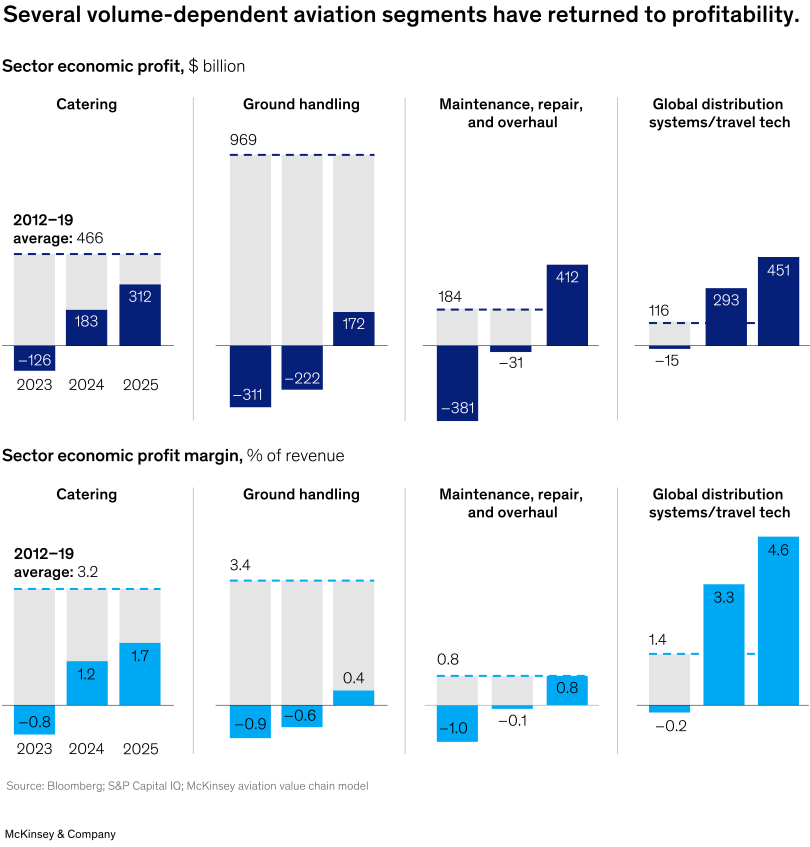
The ground handling sector’s return to positive territory is notable, given that it recorded losses in both 2023 and 2024—despite traffic having recovered to prepandemic levels. Ground handlers posted a profit of $172 million in 2025, though this was still well below their prepandemic average of nearly $1 billion. The sector’s slim 0.4 percent economic profit margin suggests that while the worst may be over, the enduring challenges posed by higher labor costs and operational complexity could continue to compress returns for some time.
The conspicuous exception remains aircraft and engine OEMs, which, on balance, continue to face supply chain challenges, quality issues, and financial burdens stemming from delayed development programs and compensation claims related to engine issues. With an economic loss of $0.8 billion, OEMs represent the third-largest loss-making subsector after airlines and airports.
What it means: Structural shifts, not just cyclical recovery
The 2025 data suggest that the aviation value chain is undergoing fundamental changes. Several observations point in this direction:
- The “profitability floor” has risen. Even in a year without exceptional tailwinds, about 40 percent of airlines created value. The mechanisms behind this profit—premium revenue, ancillary revenue streams, loyalty monetization, and operational discipline—appear sustainable. That said, given the sector’s high sensitivity to macro events beyond its control, results can easily change. The rise in jet fuel prices associated with the disruption in the Strait of Hormuz will have a material impact on carriers.
- Business model boundaries are blurring. The North American LCC reversal illustrates that legacy carriers can adopt the innovations of the discount model while retaining their own structural advantages. Conversely, successful LCCs in other regions are “trading up” by adding premium products that resemble those offered by legacy airlines.
- The value chain’s center of gravity is shifting. Service subsectors (such as MRO, catering, ground handling, and GDS and travel technologies) are collectively more reliable value creators than more asset-heavy segments (such as airlines, airports, and manufacturers). For investors, it’s worth considering whether this could indicate where more stable returns might be found.
- Geographic concentration of losses is increasing. Asia–Pacific airports and North American LCCs have lagged behind their respective global subsectors. Targeted interventions in these pockets could meaningfully shift aggregate results.
What happens next for aviation
As the industry looks to the future, several forces could shape value creation.
Geopolitical uncertainty and ongoing conflicts could continue to disrupt traffic patterns and jet fuel prices. Flying is price elastic, meaning higher fuel prices—coupled with higher maintenance costs driven by ongoing supply chain issues—will lead to less demand. A recent survey reveals that 56 percent of airlines expect a slowdown in air travel in the next two to three years. Amid these potential headwinds, capacity constraints stemming from manufacturer delivery delays and engine challenges could continue to affect the supply–demand balance.
Industry concentration is likely to continue, as larger airlines grow faster while some airlines fail or are acquired. Collectively, the industry could view this development in a positive light: History suggests that consolidated markets can better match capacity growth to demand. High fuel prices could pressure airlines to be nimbler than ever, but in the end, may also speed industry consolidation.
Technology and AI are creating new revenue and efficiency opportunities across the value chain, in areas ranging from pricing to predictive maintenance. Airlines could become significantly more efficient as they adopt AI. The benefits of AI for any one airline could be short-lived—as the whole industry adopts AI, the benefits will increasingly pass through to the customer.
Flying is set to become even easier for travelers. AI could enable new and innovative customer experiences achieved through improvements in, for example, personalization and self-service. Imagine a world in which travelers never need to call an airline contact center and disruptions are handled automatically, with control and choice given to the traveler. Airport journeys could become more seamless, with a move away from paper documents and passport checks. AI can also help flying become less commoditized: As customers place greater value on brands, AI could create new opportunities for airlines to differentiate themselves and thereby sustain higher ROIC.
The aviation value chain has once again failed to earn its collective cost of capital. But 2025’s results show that eight of 11 subsectors are back in the black. And the airlines and subsectors that have cracked the code on profitability are pulling further ahead of those that have not. For every participant in the value chain, the challenge is to raise the bar on performance and build lasting profitability while navigating the new aviation landscape.