As AI takes over the technology world, enterprise software companies of all sizes, from legacy providers to venture-backed software-as-a-service (SaaS) players, face unprecedented pressure from customers and investors to prove their worth. B2B tech customers are scrutinizing budgets more closely and demanding clear evidence of the value they are getting from their spend. Our latest B2B Pulse research shows that eight in ten B2B decision-makers will actively look for a new vendor if performance guarantees aren’t offered (such as a refund if certain milestones can’t be met).
The transition from subscription to consumption-based pricing models, which are likely to become more prevalent in the AI era, only heightens the need to deliver value. The AI native players that threaten to displace legacy and SaaS players also struggle with the same dynamics. Software vendors and buyers alike expect that AI will transform the customer experience, further raising the bar for chief customer and commercial officers. It is more critical than ever for software vendors to have regular, outcome-based conversations that remind customers of the benefits of a continuing partnership.
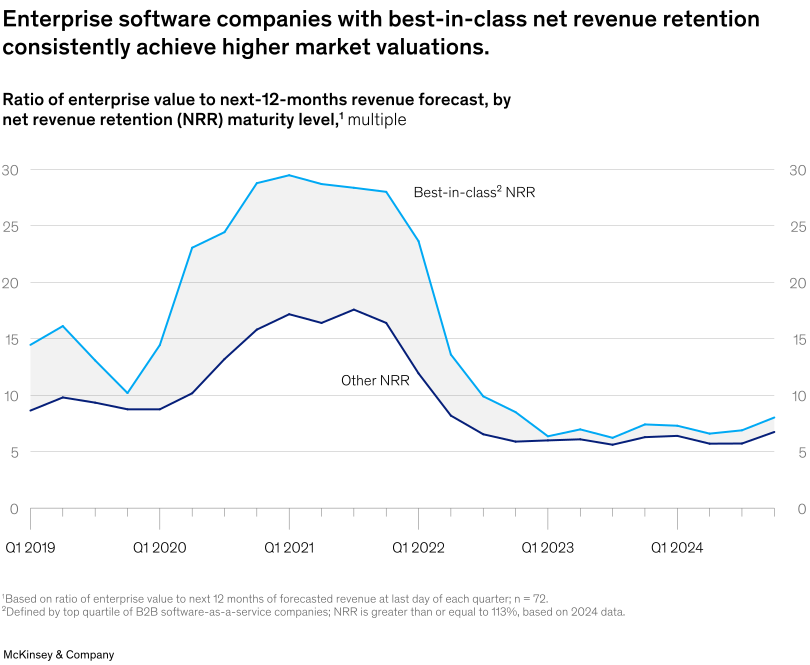
At the same time, tech companies can no longer afford to focus on growth at all costs without worrying much about consistent profitability. Markets are increasingly demanding margin expansion and efficient, sustainable, and recurring growth. Our analysis of more than 100 B2B SaaS companies found that efficient growth is most correlated with value creation. Companies in the top quartile of valuation multiples—with a median enterprise-value-to-revenue multiple of 24x, compared with 5x for their bottom-quartile peers, analyzed between the first quarter of 2019 and the fourth quarter of 2024—show better performance on core metrics of efficient growth.
This is particularly the case for net revenue retention (NRR), which tracks how much a company would continue to grow exclusively from its existing customer base—and, as such, acts as a proxy for the strength of its loyalty.1 Whereas top-quartile-valued B2B SaaS companies achieve NRR rates of 113 percent—meaning they grow 13 percent without adding any new business—their bottom-quartile peers only reached an NRR of 98 percent.
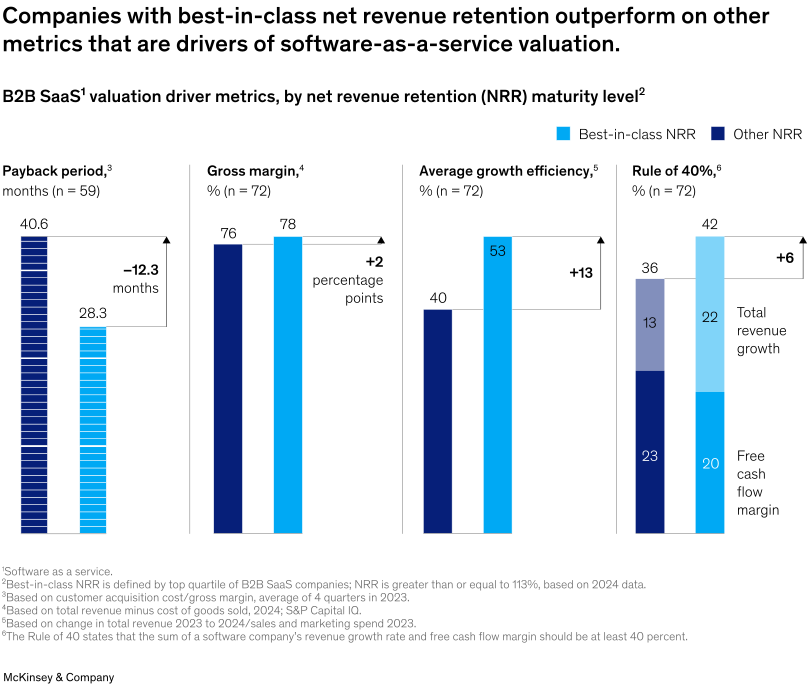
Effectively responding to the shifts in investor and customer expectations is no small feat, but outperforming on NRR is a critical part of the equation. Companies that do so see the rewards in return. Our analysis of 55 B2B SaaS companies shows that top-quartile NRR players sustain higher valuations than peers through both bull and bear markets (Exhibit 1). Moreover, top-quartile NRR companies also outperform peers on key financial and operational metrics—including higher growth efficiency and shorter payback periods (Exhibit 2).
What it takes to drive best-in-class NRR
There is no silver bullet to drive best-in-class NRR. Some companies have an inherent advantage, with NRR sustained by distinctive solutions, limited competition, and high barriers to customer switching. For example, one leading technology company uses a simple-to-deploy, easy-to-use offering, consumption-based pricing, and a product-led sales model to achieve an NRR of over 115 percent.
Even though those types of factors are becoming more common, most enterprise tech businesses have yet to master this critical metric. More and more often, they contend with several challenges, including increasingly demanding customers, decreasing barriers to switching, complex buying processes involving a growing number of stakeholders, and intensifying competition that makes product differentiation harder over time. To better understand what enterprise tech companies can do to achieve best-in-class NRR, we surveyed more than 100 commercial, revenue, sales, and customer success leaders across 98 B2B SaaS companies to measure their organizational maturity across 20 practices or areas and gauge their effects on NRR (see sidebar, “About the research”).
Understanding the basics across the 20 practices is the bare minimum needed to succeed with NRR. Unsurprisingly, our findings and experience suggest that they don’t all play an equal role and require different levels of mastery and attention (Exhibit 3). For instance, sticking to the foundational basics for a small subset of them—success planning, customer success, and support offerings—often suffices; more attention and investment do not necessarily correlate with an increase in NRR, as evidenced by the fact that the majority of top performers have only basic practices in place for these areas. Several other practices, including partner management, customer segmentation, product telemetry, and frontline tooling, help to some degree with NRR and warrant companies going beyond the basics to develop a greater degree of, or advanced, competency.
Would you like to learn more about our Technology, Media & Telecommunications Practice?
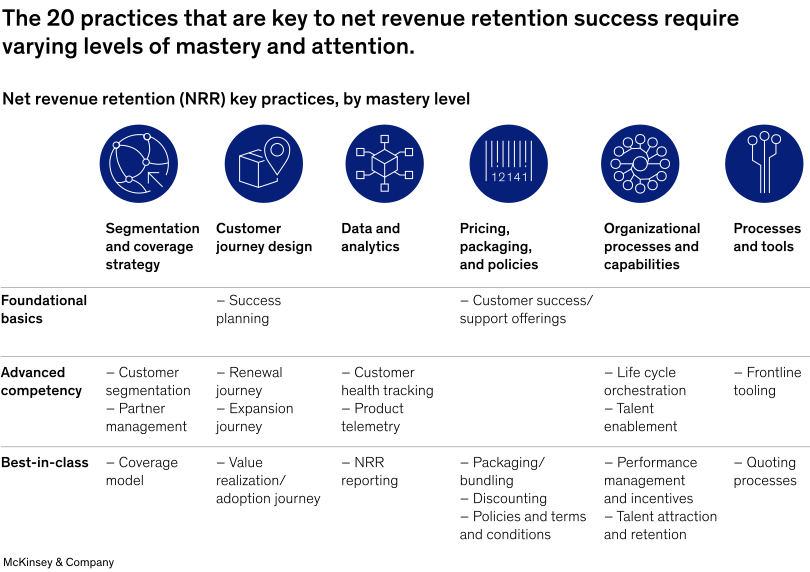
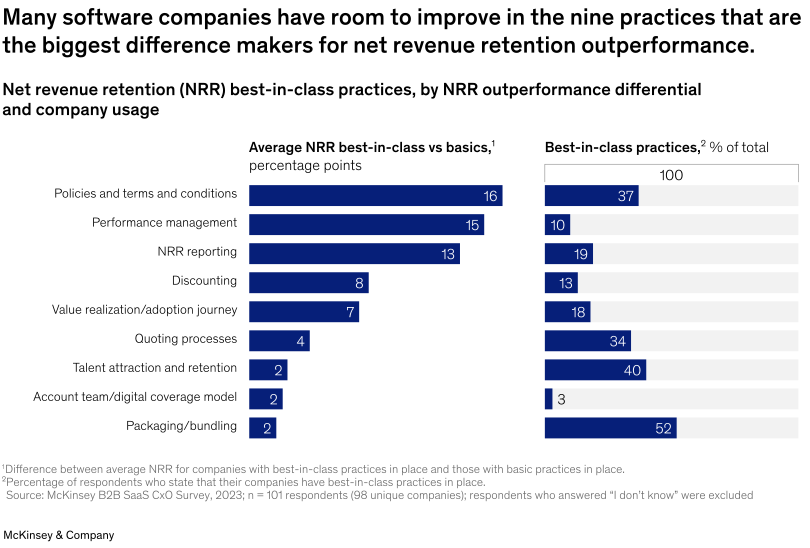
Yet nine of the 20 practices we assessed proved to be the real difference makers for outperforming on NRR (Exhibit 4). B2B tech leaders looking to excel at this increasingly important metric can focus their organizations on becoming best in class in these select areas. Doing so requires a willingness to push beyond boundaries, investing time and resources in a challenging undertaking. The following four rules, centered on those most valuable practices, should help companies start the critical journey to outgrow their peers in NRR—and better satisfy demanding customers and investors in the process.
1. Anchor customers in value
As customers increasingly demand higher ROI from their vendor spending, it becomes critical for enterprise tech companies to quantify and communicate the value they are delivering. Regular conversations about the customer’s success in meeting agreed-upon goals or milestones are no longer optional; they should be embedded into the critical moments of the customer journey (such as renewals and upsell or cross-sell opportunities) and revisited periodically as part of dashboards and quarterly reviews. Our research shows that companies that offer their customers the most sophisticated value realization and adoption journeys produce NRR around seven percentage points higher than peers with basic practices in place.
For these leaders, which represented only 18 percent of our survey respondents, customer success specialists align with their customers on clear onboarding (for instance, time to activate the first 100 users) and adoption (for example, high-value feature usage) goals and metrics with their customers at the outset and are incentivized to drive quick time to value2 through various check-ins.
2. Replace the go-to-market pyramid with a flexible flywheel
Regardless of the stage, from acquisition to expansion to renewals, most go-to-market strategists have repeatedly relied on a pyramid labeled “high touch, medium touch, tech touch” to categorize customers rigidly by type of service or outreach. The pyramid is still necessary—but no longer sufficient. Different customers require different treatments throughout their journeys. Companies ahead of the NRR curve are making significant investments in tools and analytical capabilities to develop a dynamic, “digital- and AI-led, people-supported” flywheel model that spans all segments and helps teams understand where and when to invest in the existing customer base. An IT service and operations management platform provider (with an NRR of 125 percent), for example, excels at this approach by engaging its customer experience function—along with partners and a strategist—early in the sales cycle. Furthermore, a customer dashboard and regular health checks provide detailed visibility into customer health.
This company’s model is a notable exception to the rest of the market—only 3 percent of survey respondents reported having best-in-class coverage models featuring seamless, omnichannel approaches for customer success and renewals tailored to customer needs. SaaS companies across the board have significant opportunities to improve on this front, but doing so will depend on their ability to attract the high-quality talent that drives and maintains best-in-class coverage models. Distinctive companies in this area recruit from varied internal and external talent pools, retain employees with nonmonetary incentives (such as “team of the month” designations), and use creative methods of development (including frequent classroom training, gamified certification processes, access to on-demand curricula, field application activities, and best-practice sharing sessions).

The AI-centric imperative: Navigating the next software frontier
3. Get more from pricing and packaging discipline
Our research consistently showed the importance of pricing and packaging in driving NRR. Survey respondents assessed their organizations on packaging and bundling, discounting, policies and terms and conditions (T&Cs), and quoting processes. Companies with best-in-class practices in place experienced roughly 16 percentage points higher NRR on average compared with peers with basic practices. To reach that level of success with pricing and packaging, enterprise tech companies can invest in six key elements:
- Design product pricing and packaging with multiple predefined upsell paths that allow teams to monetize growth in value through mechanisms such as capacity increases and add-ons.
- Feature attractive cross-sell offers or bundles that incentivize customers eager to shift to a platform to consolidate with one vendor.
- Leverage in-product journeys to drive trial and adoption of new functionality and products (where possible).
- Have standard T&Cs with penalties for partial cancellation, reinstatement, and abuse of license clearly spelled out.
- Develop (and ensure adherence to) a robust set of policies to restrict discounting and ensure repricing in case of partial churn (for example, a multiproduct discount is automatically removed if a customer drops one or more products).
- Rely on automated quoting of the vast majority of expansion and renewal opportunities through the configure, price, quote tool (integrated with the customer relationship management system), supported by dynamic deal-scoring models that provide granular, customized discounting guidance to account teams.
A platform provider (with an NRR of more than 110 percent) leverages some of these pricing and packaging best practices to enable the expansion of business within existing accounts. Those customers can assemble tailored packages but are automatically upgraded to higher tiers when adding certain products. By tying each tier to multiple variables (such as number of users, data storage, data transfer), customers are motivated to upgrade even if they don’t need more of all of them. Furthermore, product bundling encourages customers to trial additional platform products, while modular add-ons create new cross-sell paths.
4. Keep NRR front and center
At the most basic level, it is hard to excel at NRR if you aren’t tracking it or its drivers in the first place, and far too many B2B tech companies are making that same mistake. By contrast, the most successful companies have a detailed understanding of the granular drivers of NRR specific to their customers. With the help of near-real-time dashboards that allow them to drill down into microsegments, these NRR leaders can know, for instance, how a price increase, or the end of a promotion, impacts customer behavior.
As part of this holistic approach, they incorporate nonfinancial metrics into the account team incentive structure (for example, time to first value for the customer success function). Both performance management and NRR reporting are significant NRR drivers; best-in-class companies achieve 15 and 13 percentage points higher NRR than their peers with basic practices in place for each area, respectively. Moreover, less than 20 percent of survey respondents have best-in-class practices in place for both areas, indicating significant opportunities for companies looking to improve their NRR.
Where to begin with boosting NRR
In this era of efficient growth, when retaining customer loyalty is increasingly challenging, it is more important than ever for tech players to understand and optimize their NRR performance. Companies eager to take that leap can get started by making three initial moves:
- First, undertake a rapid NRR maturity assessment built around the 20 practices examined in this article, including baseline, benchmarks, current capabilities, and opportunity. This should inform the business case for change—including setting the future NRR aspiration. Decide if you need to undertake a rapid, cross-functional NRR-intensive assessment over a quarter to make an immediate performance jump and establish a positive trajectory to set the tone.
- Second, build an NRR “MVP early-warning backbone.” Despite being designed with good intentions, many modeling exercises get stuck due to competing priorities, too many analytical tools to navigate, and a lack of data or telemetry. Forward-thinking organizations can break the cycle by focusing predictive analytics on their highest-value use cases (adoption, retention, cross-sell); in other words, rather than building elaborate, overly broad, business-rules-based models that aren’t predictive, in practice, start by building an effective, dynamic AI model focused on the metrics that matter most.
- Finally, map the NRR components to incentives. It is rare—and often not possible—for one leader to be responsible for the entirety of the NRR metric. However, the three buckets of NRR (retention, pricing, and expansion) should have clear owners with clear incentives to drive the right behaviors.
Even with these three critical actions, companies may still struggle to make progress at NRR. One major organizational challenge is that responsibility for different components of NRR typically falls under multiple leaders (for instance, discounting under pricing, retention under customer success, expansion under sales). For that reason, succeeding at NRR requires a concerted effort, in which companies start with CEO- and CFO-level sponsorship, a unified road map, and a detailed understanding of NRR drivers—with owners clearly lined up against each. Only then can they hope to make sizable and sustainable gains in the crucial metric, increasing and demonstrating their value to customers and investors alike.