Not all consumer attention is created equal. McKinsey’s recent report The ‘Attention Equation’ explains differences in media monetization through two drivers of value.1 Commercial quotient captures traditional factors such as consumer value, platform sophistication, and industry structure, accounting for two-thirds of monetization. Attention quotient reflects the quality of consumers’ attention, shaped by how actively they engage with content and why they are consuming it, and accounts for the remaining one-third. Together, this equation explains 80 percent of the variation in monetization across media.
By these measures, gaming is exceptional. Roughly 75 percent of players have high focus while playing PC or console games and 55 percent on mobile, levels comparable only to live events and handily beating formats such as social media, newspapers, and podcasts. That focus underscores the highest value per hour of any digital medium at $1.50 on PC and console, and $0.46 on mobile.
Gaming’s attention advantage is rooted in how and why it is consumed. While television and social feeds have increasingly become background companions to second-screen scrolling, gaming demands cognitive presence. It fulfills the most valuable “jobs to be done” identified in our research, specifically love and connection, where the player is an active protagonist rather than a passive observer. By requiring agency to progress, gaming creates immersion that is more difficult to fragment than other formats.

Yet, despite this advantage, there is a gap. Though gaming has mastered the art of generating focus, there is commercial opportunity left on the table. Gaming has a disconnect between its attention quotient (intrinsic quality of attention) and commercial quotient (intrinsic ability to monetize that attention), representing one of the largest untapped opportunities not just in gaming but across media.
What makes this dynamic especially compelling is how strongly spending responds to attention quality. Our research shows that a 10 percent increase in consumer focus correlates with a 17 percent increase in spend. Gaming already operates at the high end of the spectrum; the challenge is not to generate more—or higher quality—attention, but to more effectively monetize the attention it already commands.
Why that value often goes unrealized becomes clearer when usage and spending are viewed together. While the top decile of media consumers accounts for roughly 20 percent of total time spent, only about one-third of those heavy users are also top spenders. In other words, super-users are not automatically super-spenders. For gaming in particular, monetization is concentrated among a narrow share of users,2 with large volumes of highly engaged time not fully reflected in current revenue models.
This article examines how gaming studios across PC, console, and mobile can close the gap between attention and value by increasing the medium’s commercial quotient through a distinctive set of organizational capabilities—and why sustainable growth will depend on doing so.
The trends redefining value
The environment in which those capabilities matter is changing. The video game industry has reached significant scale, with the roughly $360 billion global market (including digital content, hardware, in-game advertising, and licensing) expected to grow at around 5 percent annually through 2030, following a period of faster expansion (8 percent annually in 2015–24).3 After a decade of growth driven largely by increasing market penetration, value creation in gaming is shifting amid rising budgets, longer development timelines, more efficient indie studios, and increasing pressure from lower-cost global development markets (see sidebar, “The most valuable player segments”).
- Advertising as a missing piece in average revenue per user (ARPU) growth. With consumer-paid models such as microtransactions and battle passes maturing after widespread adoption, further growth potential exists beyond direct spend, in ways that protect the attention players have chosen to give. From an advertiser’s perspective, gaming’s attention is underpriced relative to its quality, but on PC and console, the absence of programmatic buying limits how that value can be attained. Mobile demonstrates what scaled monetization can look like, with advertising’s share of revenue rising from 35 percent to 48 percent between 2015–24. By contrast, PC and console remain largely untapped at 4 percent, leaving substantial white space to monetize.4 How ads are presented will differ by platform, but gaming remains a large, underpenetrated channel with natively high-quality, differentiated inventory, an increasingly attractive proposition as broader entertainment and media ad revenue slows (from 25 percent annually in 2015–20 to 12 percent in 2021–24)5 and post–identifier for advertisers (IDFA) targeting constraints persist.6
- The challenge of maintaining a direct player relationship. Control over discovery, identity, and payment is increasingly contested, with hardware platforms and ecosystems such as Xbox, PlayStation, Nintendo, and Discord shaping how players find games, sign in, and spend. As the player journey fragments across platforms and new services, brand control erodes and power shifts toward those that can unify the experience or control key access points between players and content.
- Longevity of live-service offerings. Live service, including ongoing updates and microtransactions, is projected to account for 70 percent of incremental gaming revenue through 2030.7 The model, however, is becoming more difficult to do well as players show signs of “battle pass fatigue,” expressing across forums that new content can begin to feel like a chore. Studios that treat live operations as a creative discipline can excel. This includes building modular systems that allow new modes and mechanics to layer naturally onto foundational gameplay, cultivating self-sustaining user-generated-content (UGC) ecosystems supported by tools, discoverability, and creator rewards, and strengthening community management as a marketing capability that deepens trust and keeps players meaningfully connected.
- Transmedia IP as a strategic anchor. Audiences gravitate toward recognizable worlds, following characters and stories across games, film, television, and social media. Reflecting this shift, the number of film and series adaptations originating from gaming intellectual property (IP) has grown at a 32 percent CAGR since 2018,8 quantifying how rapidly other mediums are investing in established gaming franchises. For publishers, owning IP is powerful for long-term margin resilience and brand equity, particularly as media companies broaden value creation across the entertainment ecosystem.
- Generative AI as an equalizer and differentiator. Amid ongoing debate around creative ownership and workforce impact, AI-enabled tools are compressing production timelines and lowering barriers to entry, sparking a wave of lower-cost challengers. Eighty-seven percent of developers already use gen AI to automate tasks and reduce production costs, with asset creation costs alone expected to decline by 25 to 35 percent.9 That efficiency acts as an equalizer. The differentiator will be how studios apply AI to create experiences that were previously impractical, such as more adaptive worlds, richer systemic behavior, and greater personalization at scale. The basis of the AAA advantage may rest on creative direction, system design, and the ability to sustain experienced teams, rather than sheer production scale and visual fidelity alone.

The capabilities to build in gaming’s new frontier
Levers for success in gaming are shifting from content output to capability depth. Our research on attention economics and our work with game developers globally has surfaced six core capabilities, broadly aligned to the trends redefining value in the industry, that studios can build to close the gap between high player attention and commercial performance.
Advertising
Advertising in games often conjures images of disruption: pop-ups, banners, or interruptions that pull players out of the game. The opportunity ahead looks different, provided monetization and player experience are treated as complementary, rather than competing, objectives.
Advertising remains one of the most under-monetized levers in gaming, despite evidence that PC and console players are broadly open to in-game advertising: 76 percent report being receptive, nearly on par with the 83 percent seen on mobile. This challenges the common misconception that advertising is fundamentally incompatible with PC and console experiences. Yet outside mobile, most ad activity still takes the form of sponsorships and bespoke promotions rather than scaled, marketplace-driven advertising, leaving a large share of attention unmonetized (Exhibit 1).
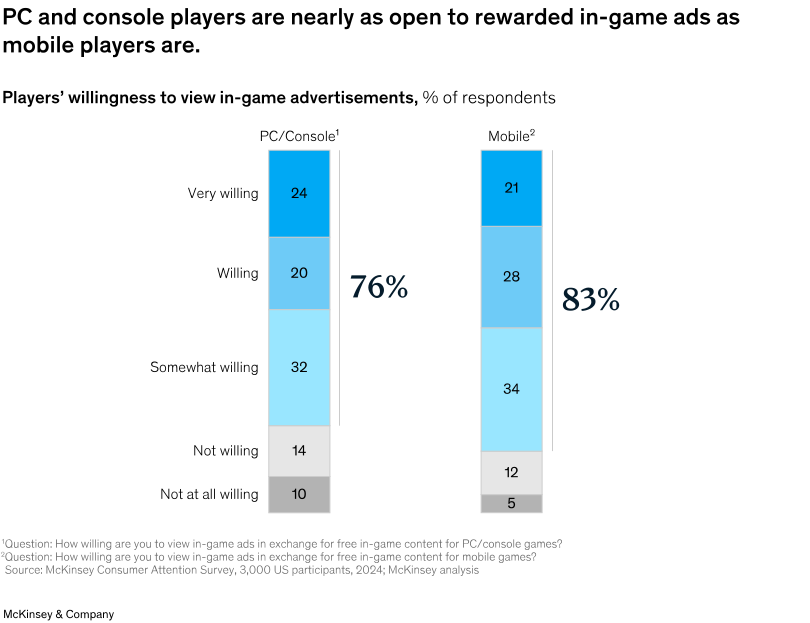
On mobile, advertising already represents roughly 50 percent of total monetization, but formats remain largely transactional and disruptive. On PC and console, ad integration is still nascent, accounting for only around 4 percent of revenue today and hampered by publisher caution around player experience, leading many studios to underinvest in integrative experimentation despite demonstrated openness.
For publishers, the economic upside of monetizing hours of attention that today may generate little or no value is significant. When designed carefully, advertising can provide high-margin, incremental revenue while preserving the integrity of the player experience and reducing dependence on in-app purchases (IAPs) that are subject to platform fees of up to 30 percent.10 It also diversifies income across player segments and unlocks access to brand marketing budgets, an ever-growing pool of spend as commerce media expands toward more than $100 billion by 2027. Getting it right could lift industry ARPU by several percentage points while boosting player engagement in rewarded formats.

What excellence looks like
- Diegetic marketplace for agencies. On PC and console, advertising is most likely to succeed when it feels intrinsic to the game. The challenge is in translating immersion into formats that agencies can plan, buy, and optimize as easily as they do on platforms like Meta or Google. Today, most diegetic integrations remain bespoke sponsorships that are negotiated deal by deal, as seen in EA Sports FC. Future experimentation will need to balance scalability with the risk of eroding immersion. For players, this could look like billboards, storefronts, or transit ads in open-world games that refresh based on region and time, or brand-sponsored challenges to earn cosmetics, boosts, or early access (an approach already visible in products like Discord Quests). Games that protect the player experience while meeting programmatic buying requirements can create the conditions for ARPU expansion, especially on PC and console, where the current ad share hovers around zero.
- Player value exchange and monetization mix. Ad acceptance (defined by ads being perceived as nondisruptive) increases 1.5 times when advertising is delivered through rewarded formats. At the same time, IAPs have grown materially on mobile and now account for nearly 25 percent of revenue, roughly double their share three years ago.11 As a result, optimizing the balance between ads and purchases has become a core design decision. Zynga tailors ad placement and intensity by game type and player intent, leaning on rewarded ads in social titles like Words With Friends while emphasizing IAPs in progression-driven games such as Empires & Puzzles. Looking ahead, reward models could extend beyond currency to include early access to events, campaign-linked cosmetics, or temporary premium unlocks.
- Cross-media and cultural integration. Even as scalable, agency-enabled formats present a monetization opportunity, premium activations remain an important lever for reach and revenue. Collaborations such as Fortnite x Marvel, League of Legends x Louis Vuitton, and Discord x Arcane rank among the most commercially effective partnerships for their respective platforms, extending visibility well beyond core gaming audiences. In rarer cases, this convergence can go further, unfolding narrative moments inside gameplay, blurring the line between advertising, entertainment, and transmedia. While difficult to standardize, these integrations anchor brands in major cultural moments.
Questions to test your excellence
- Do we have a differentiated advertising value proposition that is meaningfully distinct from other non-gaming channels (for example, player data enabling tailored ads, high-quality attention advantage, or a customer satisfaction score of greater than 70)?
- Have we identified and begun investing in a credible path to making advertising inventory programmatically accessible to agencies within our game experiences?
- Are our advertising formats adding to player experiences and demonstrably incremental (such as generating higher ARPU, particularly from free-to-play players), rather than detracting from premium purchases?
Consumer-centric growth
Success in gaming’s next era will depend on how effectively publishers and studios understand and respond to what keeps players engaged amid growing media fragmentation, as highlighted by the attention equation.
At the macro level, consumer-centric growth provides the foundation for effective live-service management, aggregating signals across millions of sessions to guide decisions on progression systems, content pacing, and portfolio-level strategy. At the micro level, it enables games to act on individual player moments as they occur: adapting pacing to sustain engagement, surfacing relevant content to reinforce habits, and timing commercial interactions when players are most receptive. Together, these capabilities create a shared, continuously updated understanding of the player that allows studios to scale engagement and retention.

What excellence looks like
- 360-degree player profile. High-performing publishers operate a unified intelligence layer across the player ecosystem. This combines in-game activity and telemetry (gameplay actions, feature usage, progression, session patterns), transaction and economy data (purchases, currency balances, spend velocity), acquisition and geographical signals, and off-platform inputs such as community participation and sentiment from owned channels. These get processed in real time and fed into AI models that continuously update a player’s “job to be done,” powering the other capabilities.
- AI-enabled engagement loops. Sustaining engagement and retention depends on connecting each player to the right experience at the right moment. The 360-degree view can be used to infer why someone is engaging (what motivated the download, what sustains play, and what disrupts it) and align gameplay accordingly. Core loops and features can be organized around needs such as mastery, competition, connection, or collection. This enables dynamic discovery by prioritizing modes or friend prompts and reinforcing predicted behavior through rewards. The same signals guide when to introduce new habits, such as social play or additional experiences, at moments of high attention. Outside the game, reengagement follows the same logic, with CRM touchpoints triggered by intent and friction signals rather than broad campaign blasts. Titles like Candy Crush Saga and Monopoly Go! illustrate elements of this approach through difficulty and reward tuning that sustains years of retention.
- Situational monetization. Durable monetization is built around the commercial moment. Storefronts become intent based, surfacing boosters during competitive sessions, cosmetics or gifting during social play, and progression utilities when players stall. The same logic governs adaptive advertising, with rewarded ads offered after near-success defeats and diegetic brand placements informed by off-platform interests. At the individual level, player economies are continuously recalibrated through drop rate adjustments or situational bundles during resource hoarding or friction. Off-platform affinity signals extend this further, enabling transmedia value exchange: Mastering a character could unlock early-access physical collectibles tied to a show release, while cross-portfolio bridges preserve loyalty by carrying currency into the next title a player is primed to adopt. Done well, monetization adapts to gameplay and revenue scales with attention quality.
Questions to test your excellence
- Where are there gaps in forming a comprehensive, real-time view of our players, such as off-platform signals or in-game friction points like stalled time in menus?
- Are our dynamic product and monetization actions fast and ambitious enough to consistently deliver double-digit improvements in retention and revenue versus control experiences?
- Does our marketing spend efficiently reflect projected lifetime value (such as targeting a 3:1 LTV:CAC ratio)?
Live-service development and management
Live-service operations—battle passes, cosmetics, live events, and ongoing content updates, among others—keep games evolving creatively, technically, and commercially, sustaining large, active communities over time. While titles such as Elden Ring and Marvel’s Spider-Man 2 have proved live ops is not required for success, the retention and ARPU upside for games that get it right can be substantial. As development costs have risen, live-service-oriented franchises with stickier player bases have become more attractive as a way to create evergreen economics, helping publishers derisk dependence on expensive, one-off launches.
Our research indicates that live ops in gaming is a roughly $147 billion market, projected to grow to $167 billion by 2030 (approximately 3 percent CAGR) as the category matures. Live ops is already the largest revenue driver across PC and mobile, where full-game and subscription revenue has flattened and is expected to remain so. On console, the opportunity is accelerating: Live-ops revenue is projected to grow at 7 percent CAGR in the same period, reaching parity with full-game sales.12
What is changing is not the importance of live ops, but how it must be executed. Rising production quality means players are continually exposed to more polished, content-rich experiences, raising expectations for how quickly live-service games should evolve, especially amid crowded release schedules. The margin for error is razor thin: When live experiences stall or stumble, players tend to move on. As a result, effective live ops is codependent on the “consumer-centric growth” capability, using player insight and rapid experimentation to guide pacing, personalization, and community engagement.

What excellence looks like
- Fast, safe iterations. Player sentiment will continue to move faster than any patch cycle, spreading across community spaces long before it shows up in telemetry. Future-ready studios can invest in live-ops systems that read those signals in real time and deploy or roll back changes without downtime.
- Community as an operating model. User-generated content is an efficient way to keep players invested. Roblox and Minecraft have proved the economic and creative upside: Millions of grassroots creators build, test, and ship content daily, driving engagement at a scale no studio alone could match. Attaining that advantage requires publishers to deliver on three key elements: lowering the barrier to creation through intuitive in-game tools, maintaining quality through discovery algorithms and moderation systems that surface the best work, and ensuring that creators are rewarded for their contributions.
- Player trust at scale. Growth increasingly breaks down when players lose confidence in how changes are made. The impact is material: Trust erosion accelerates churn, compresses monetization windows, and amplifies execution risk. Leading publishers are sharing live-ops talent and learnings at the portfolio level so that lessons compound rather than reset (Supercell and NetEase), delivering consistent community interaction and transparency rather than reactive fixes (Baldur’s Gate 3 and Warframe), and investing in communication models that reach players both inside and outside of the game.
Questions to test your excellence
- Do we give players compelling reasons to return daily, weekly, monthly, and yearly?
- Do we have the mechanisms to listen to our community, act on feedback, and deliver improvements at the pace players expect across those moments?
- Are strong outcomes attributable to our live-service offerings (such as 10 to 20 percent day 30 retention, three times higher ARPU at day 30 versus day 1)?
Life cycle IP management
Strong intellectual property is an enduring advantage for game studios, serving as a reliable anchor for player attention as audiences increasingly follow worlds and characters across transmedia ecosystems, compounding franchise lifetime value. Life cycle IP management is the capability to plan and govern those extensions effectively by preserving narrative integrity, sequencing releases to sustain cultural momentum, and ensuring that each new format contributes something players cannot experience anywhere else.
This challenge plays out differently depending on a studio’s role. For publishers that own IP and license it outward, the focus is on designing monetization models that balance creative control with commercial scale: spanning royalties, minimum guarantees, and fixed-fee or codevelopment arrangements across licensing, merchandising, and media partnerships. For publishers that license third-party IP for their own games, the challenge is to translate existing worlds with authenticity: maintaining tone, lore, and fan trust while introducing new creative or gameplay experiences that feel additive rather than derivative. When carried out successfully, both sides create a network effect where every new touchpoint expands reach, deepens the universe, and fuels future investment for commercial value.
What excellence looks like
- Transmedia flywheel. Leading IP owners treat games as one layer in a broader ecosystem. Amazon’s Fallout television series illustrates the asymmetric upside for game IP holders: The first season generated an estimated $80 million in incremental game sales, in-game revenue, and licensing fees for Bethesda,13 largely without the studio bearing production, marketing, or distribution costs. Fortnite’s live Star Wars: The Rise of Skywalker reveal demonstrates the reverse by using gameplay itself as a primary distribution channel for film content. When orchestrated deliberately, transmedia execution compounds franchise value across games and other media in both directions.
- Narrative integrity with distinctive extensions. The best IP portfolios stay true to the core worlds while expanding into new creative or gameplay experiences. Second Dinner’s Marvel Snap shows how familiar IP from the Marvel Cinematic Universe can make innovation approachable by reimagining the collectible-card genre through its high-stakes “snap” mechanic, encouraging bold play within a universe players already trust. Similar discipline is applied through LEGO Ideas, extending value across physical products, games, and media by turning fan submissions into official sets.
- Well-paced rollouts and orchestration. Successful franchises time and stage their releases to sustain momentum and avoid overwhelming fans. Updates, show premieres, and product launches are staggered to keep the IP constantly visible but never oversaturated. The Sims is a notable example: Despite its last full release being more than a decade ago, a carefully sequenced stream of expansions and updates has sustained a loyal fan base. Similarly, Nintendo’s cadence for Mario shows how steady exposure can sustain multigenerational relevance, balancing game launches, film releases, and theme park expansions.
Questions to test your excellence
- Are we deliberately orchestrating transmedia in both directions: using games to amplify value into film, television, merchandise, and live experiences, as well as using other media to drive engagement back into games?
- Are we creating new value through distinctive creative choices or meaningful gameplay innovation that feel exciting for consumers?
- Are these extensions strengthening overall IP growth (for example, expanding reach and delivering measurable cross-media engagement lift during new releases)?
AI for game creation
Generative AI in game creation remains controversial, raising valid questions about authenticity and job displacement. Used thoughtfully, however, it can open a new design space. Instead of deterministic systems where interactions must be manually scripted, gen AI introduces the possibility of responding to player intent more dynamically. While the “AI for hyperefficiency” capability focuses on optimizing the existing production pipeline (the how, covered in the next section), AI for game creation offers an additional creative option to expand the player experience canvas (the what).
It matters because it helps address a linear scaling problem in game development. Historically, increasing a game’s depth or systemic complexity has required a near 1:1 increase in manual inputs, creating a practical ceiling on how reactive or personalized experiences could be. By working at a higher level of creative abstraction, gen AI offers an early path to devise overarching rules and logic that function beyond individual assets or scripts. Current capabilities are additive rather than a wholesale market shift, but gen AI meaningfully broadens the range of experiences that can be delivered. This includes higher replayability and new horizons for cocreation, where players shape their own worlds and narratives, effectively turning UGC into an extension of the creative team.
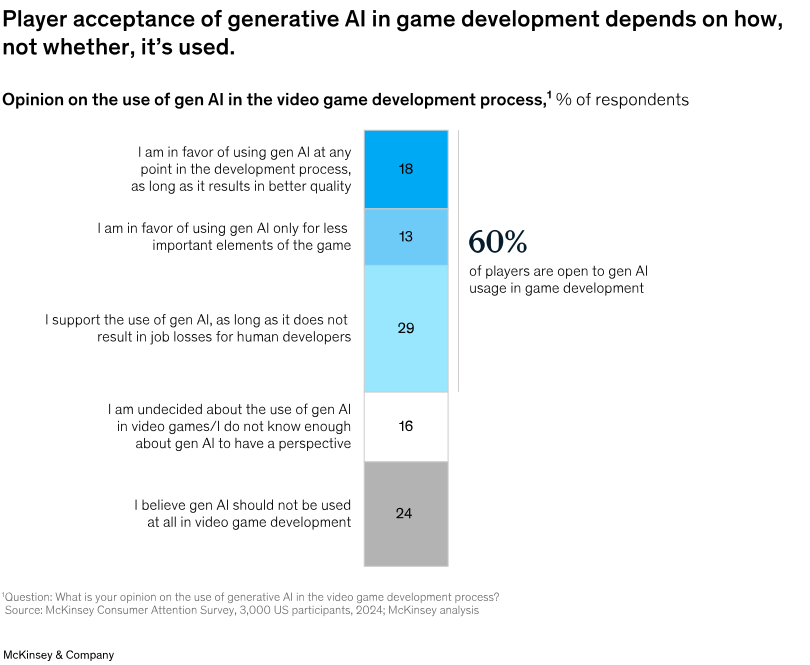
While sentiment today is nuanced, a majority of players express openness to gen AI under specific conditions. Around 60 percent support its use at various points in development, provided it improves the game experience, is applied to less critical elements, or does not displace human developers.
Still, concerns remain. Roughly a quarter of players oppose AI use entirely, reflecting anxieties around authenticity and job loss amid already rising industry layoffs. Taken together, the findings suggest that player acceptance of AI is less about the technology itself and more about how it is used: augmenting creative teams rather than replacing them, and enhancing the final experience rather than undermining it (Exhibit 2).
Historical technological shifts, however, suggest that consumer reticence is rarely static; it typically follows a value-led adoption curve. When CGI first entered film, it faced skepticism around “soulless” automation before crossing a quality threshold that enabled new forms of storytelling such as Jurassic Park and Toy Story. As explored in our recent perspective on what AI could mean for film and TV production, new production technologies often first reshape workflows before unlocking new formats and redistributing economic value as adoption scales. For studios, the challenge is experimenting with AI in ways that expand creative bounds rather than simply compressing the labor floor.
In practice, the industry is currently in a period of technical catch-up. While the vision for agentic non-playable characters (NPCs) and infinite narratives is compelling, toolsets often struggle with coherence, keeping many abstract ideas in the pilot phase. Nevertheless, staying committed to this capability is a differentiator: As the technology matures, the studios that develop AI muscles will be able to deliver unique, agentic player experiences. Ultimately, successfully linking these generative systems to gameplay provides a path to improved commercial outcomes, where dynamic content reduces exhaustion to lift day 30 retention, and varied replayability extends lifetime value, separating the next generation of winners from those solely focused on the efficiency-led half of AI.


What excellence looks like
- AI-enhanced creativity. AI can extend human imagination while preserving creative intent. As capabilities grow, impact is likely to move beyond incremental enhancements to existing tools and toward new forms of creation. Cyberpunk 2077: Phantom Liberty illustrates this potential, using AI voice modeling with consent to revive a late actor’s performance that would have been impossible otherwise. Similarly, Square Enix applied machine learning in Final Fantasy VII Rebirth to synchronize character facial animation across multiple languages, preserving the emotional acting of the cast for global audiences. Looking ahead, this could enable more participatory UGC-driven worlds, where players describe a relic or creature and AI generates a functional 3D asset that adheres to the game’s rules, allowing individuals to expand a shared, evolving ecosystem.
- Personalization with purpose. AI could enable worlds to operate like living, breathing societies rather than abstract levels. NPC networks that share context could track player behavior to shape social dynamics organically. A reckless driver in an open-world game might find insurance prices rising or towns reacting warily; a player whose actions favor negotiation, restraint, or alliance building could see rival factions join forces behind the scenes. The result is personalization that feels like real-life logic.
- Responsible AI integration. As AI tooling matures, many studios are likely to adopt third-party platforms and toolchains such as Unity’s Inference Engine instead of building everything in-house. This lowers barriers to adoption, especially for indie teams, but raises new responsibilities. Studios will need guardrails to ensure AI-generated content is safe, stable, and consistent with game worlds, avoiding broken layouts, lore inconsistencies, or unintended behavior, while maintaining transparency around how AI is used so it expands creativity rather than erodes trust.
Questions to test your excellence
- Are we using generative AI to create player experiences that would not have been possible otherwise, rather than simply improving existing workflows or content?
- Would a player meaningfully notice if these AI-enabled experiences were removed, or would the game feel largely the same?
- Are we measuring and observing positive impact for our teams and players (for example, 80 percent internal tool adoption among intended users, 70 percent positive sentiment from players)?
AI for hyperefficiency
AI is reshaping efficiency in game development at a moment when production economics are under strain. Its growing role has sparked conversations about team structure and workforce stability in an industry facing employment volatility. At the same time, with production budgets for AAA titles often exceeding $200 million (an eightfold increase since 2000),14 studios face mounting pressure to control costs while still delivering quality, speed, and creative ambition (Exhibit 3).
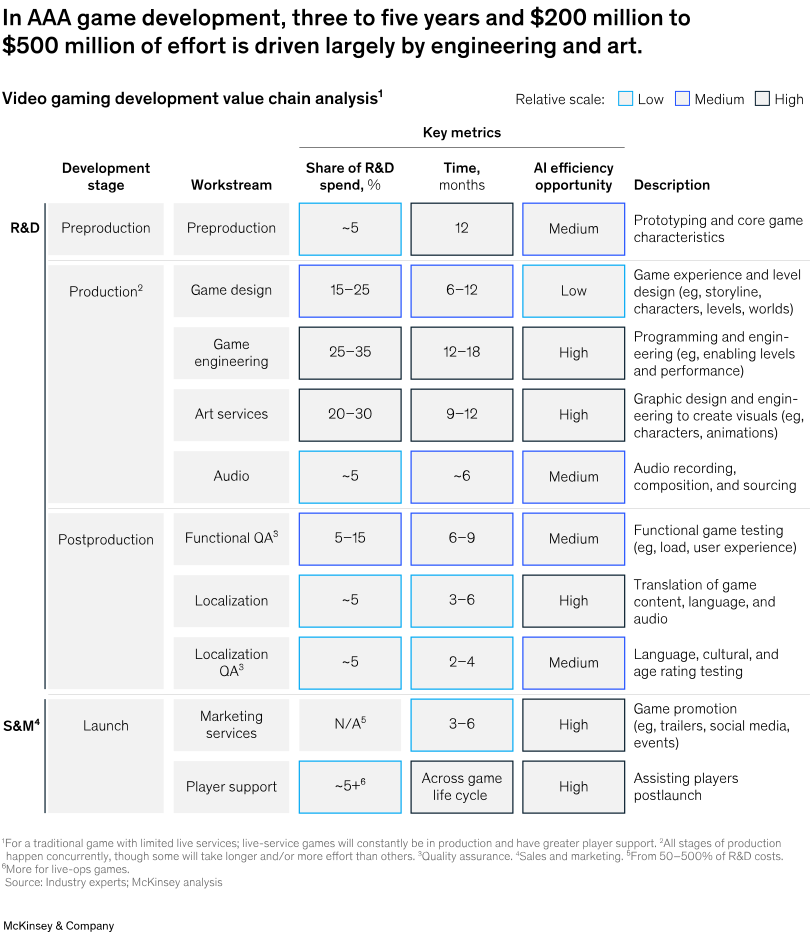
Meanwhile, longer development cycles, frequent delays, and funding constraints have contributed to fewer AAA releases in recent years, raising the stakes for every project.
AI systems that automate quality assurance (QA), asset generation, and pipeline management can reduce operational overhead and compress development cycles, ultimately creating headroom to reinvest in talent, player retention, and design quality. Efficiency remains a cost imperative, but applied well, it can also support more stable production models and sustained creative capacity.
AI can also extend efficiency beyond new development. Technologies such as Nvidia DLSS and AI-based upscaling are enabling high-fidelity restoration of legacy titles. With players reporting that 64 percent of their playtime is spent on titles released more than one year ago, studios have a significant long-tail opportunity to enhance, rerelease, and monetize existing libraries with modern performance expectations.
These dynamics are not unique to gaming. McKinsey’s State of AI in 2025 report finds that AI is delivering efficiency gains across industries, and that software engineering, marketing, and service operations rank among the functions reporting the highest rates of cost decreases, with nearly half of organizations indicating benefits. Gaming stands out because these same functions account for a disproportionate share of production and live-service cost. Software engineering has particularly seen large efficiency gains, with AI-native enterprise software companies frequently writing half of their code with AI assistance,15 though game engineering carries additional constraints such as bespoke engines and creative intent.
What excellence looks like
- Operational efficiency with creative upside. Automation across testing, debugging, and asset creation is streamlining production while improving quality and predictability. Ubisoft’s RevMate, for example, predicts code errors before they occur, reducing debugging time and stabilizing builds. Publishers such as Tencent and NetEase are deploying gen AI across animation, background generation, and scenario design to accelerate iteration cycles. Advances in rendering technology further extend these gains: Nvidia DLSS innovations like Ray Reconstruction and Frame Generation allow developers to target levels of visual fidelity, such as full path tracing, that would otherwise require supercomputer-level performance.
- Sustainable production models. Used well, AI stabilizes teams by reducing the need for short-term hiring spikes in functions it can already supplement (such as localization, asset iteration, and QA) that often lead to postlaunch layoffs. Used poorly, it risks being perceived as a blunt replacement for human talent. This distinction matters to players: As noted earlier, 29 percent support the use of AI in game development provided it does not displace human developers. Studios that adopt AI workflows to reduce production volatility and cost overruns will need to use efficiency gains to sustain longer-lived teams rather than amplify boom-and-bust cycles.
- Intelligent reuse and restoration. AI-driven upscaling, remastering, and localization can extend the life cycle of established IP, creating value from existing assets with limited incremental cost.
Questions to test your excellence
- Do we understand where our largest productivity costs lie?
- Are our AI implementations delivering meaningful efficiency gains in those areas (for instance, 25 to 35 percent reductions in production costs)?
- Are we using these gains to strengthen our long-term advantage (for example, reinvesting in creative work, raising quality bars, or accelerating innovation)?
The choice facing gaming leaders
Gaming has mastered attention, but publishers have not yet unlocked its full value.
Who can translate exceptional attention into sustainable commercial advantage while preserving the experience that makes it valuable? Who will push the envelope of their capabilities to close the gap?
The companies that effectively answer these questions will be best positioned to earn the attention of consumers for years to come. Where that value materializes will depend on who chooses to act.