Know the asset, own the outcome. High returns start with effective diligence at acquisition, to understand not just a company’s sources of value when purchased but also its opportunities to generate significantly more value if it’s managed to full potential. High-performing private equity (PE) firms recognize that insights are never “one and done;” rather than stowing deal diligence away postclosing, they draw on what they’ve already learned and build on their knowledge during the holding period. They adapt, recalibrate, and refine their diligence—and put themselves in the best position to meet the market and deliver alpha. They reunderwrite.
When done in a rigorous, disciplined way, reunderwriting provides a powerful mechanism to combine pre-deal analyses with postacquisition experience and drive value creation. Indeed, some of the most effective PE leaders systematically review each asset every two to three years throughout the hold period. Notably, their approach is additive: they build on diligence, rather than replace it. Moreover, they recognize AI’s dual impact: its capabilities as an accelerator that significantly improves the review process, and its force as a macro disruptor that makes taking a second look more critical than ever.
To better understand what works (and what doesn’t) in reunderwriting, we drew on our work with more than 120 executives in the HBS–McKinsey PE Portfolio Company CEO Excellence program and conducted multiple, in-depth assessments of how PE leaders worldwide across firm sizes and strategies approach midcycle reviews. In particular, we sought more detail on when firms reunderwrite during the hold period, who participates and leads the process, and what information and metrics are used.
Most important, we wanted to see how the findings can best come together to create a reunderwriting playbook, with actionable examples under real-world circumstances. While only about one-third of respondents reported a formal, highly structured reunderwriting process, the leaders who do take a disciplined approach believe it enables more exits and higher exit valuations.
When: At what point and how often firms conduct reunderwriting
Timing is the most frequent failure point in reunderwriting. Not establishing strict dates or milestones for reviews—and instead periodically holding side conversations to test buyer appetite—squanders the opportunity to conduct a meaningful, actionable assessment. Conversely, declaring that reunderwriting happens “the moment we acquire the asset,” and then sticking with the same equity story in the face of operating and market changes, risks turning the process into busywork, no matter how rigorously a reunderwriting calendar is adhered to.
The firms we studied fell broadly into three categories regarding when they conduct reunderwritings: milestone-based reviews, recurring portfolio reviews, and trigger-based reviews. While the categories theoretically are not mutually exclusive, we found that firms overwhelmingly adopt one of the three approaches:
- Milestone-based reviews: Milestones can be fixed or flexible. Fixed milestones anchor the review to a set point in time in the hold period—that is, a predetermined number of months or years after closing or before a targeted exit date. The most common milestone is two to three years after the acquisition. However, among firms that use fixed milestones, reunderwritings can range from several months to several years after closing, or be set at 18 to 24 months before exit. The milestone, moreover, is not always based on the acquisition or exit date; a few of the most successful firms use buy-case milestones. These firms reunderwrite when the asset reaches a predefined strategic juncture outlined in the original investment thesis, such as the completion of a specific roll-up acquisition or the execution of a planned geographic expansion. Tying the review back to the investment thesis forces the deal team to reconcile actual progress against specific day one promises rather than defaulting to the calendar.
- Recurring portfolio reviews: The second category—recurring portfolio reviews—refreshes diligence at a hold- or exit-decision point (for example, a yearly portfolio vintage rank). One of the highest-performing firms uses this model to review the entire portfolio annually and enforces a systematic “hold, exit, or recapitalize” decision across different fund vintages. This process institutionalizes a repeatable rhythm that prevents assets from “drifting” without a clear path to liquidity. With average holding periods growing longer (recently increasing to 6.6 years), an initial reunderwriting is more likely to be followed by several additional years of PE ownership, highlighting that more than a one-time midcycle review may be needed. In these cases, transformation expertise—emphasizing clear accountability, rigorous processes, and a tight focus on performance metrics to increase the organization’s speed and prevent initiatives from losing momentum—can be particularly helpful. The approach also allows more time for the value of a second wave of opportunities to compound before exit.
- Trigger-based reviews: Firms that conduct trigger-based reviews reunderwrite when a given event or disruption occurs, such as unexpected market volatility, a refinancing, or a significant dip in performance. This approach is fundamentally reactive; while a buy-case review follows the deal’s specific investment thesis, a trigger-based review responds to subsequent performance failures or external shocks. Trigger-based reviews are typically more resource-intensive. That’s a lesson for firms that could have allocated resources more surgically if they had built buy-case milestones into their acquisition plan.
Who: The people involved—and the ones in charge
Ownership of reunderwriting can sit with the deal partner, a portfolio-review forum, or a dedicated exit-readiness or portfolio-realization team. Larger firms are more likely to distinguish between day-to-day asset management and a purposeful, nonmanagement-driven reunderwriting review, and use the investment committee (IC) as the final decision-maker on exit route and timing. Yet while nearly every respondent reported that the deal partner or team regularly participates in reunderwriting, only 35 percent reported that the IC does as well (Exhibit 1).
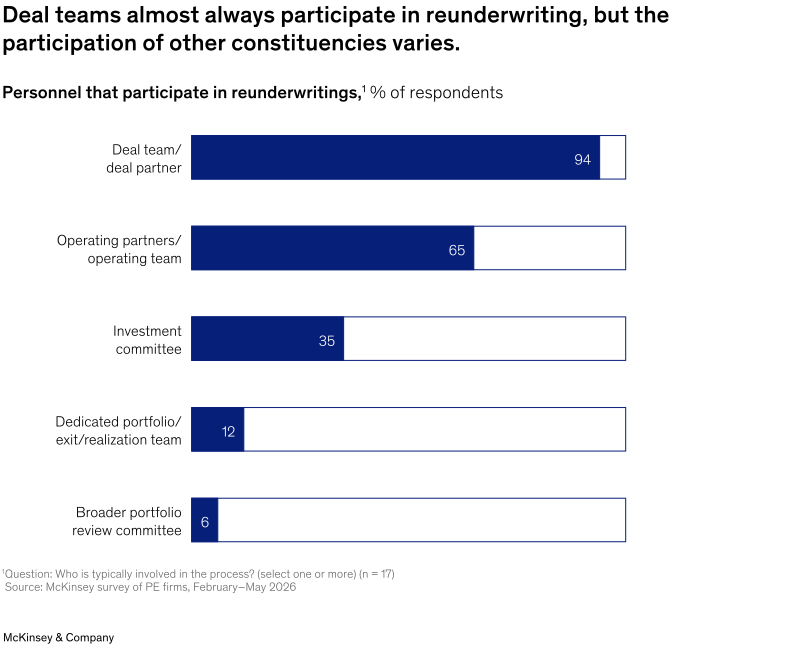
Across the firms we studied, we found that robust governance and incentive structures are best practices. The most effective reunderwritings have clear IC gates, traffic-light outcomes, and dedicated exit resources that complement deal teams without removing accountability. While every company should be assessed with an eye toward maximizing value creation, many assets—particularly underperformers—can benefit significantly from bringing a transformation team to reunderwriting, even if a deal partner may push back.
Indeed, while it’s critical for a deal partner to have conviction, a recurring challenge in reunderwriting is overcoming “partner discretion”—the natural tendency for deal partners to give their asset the benefit of the doubt and to avoid discussing certain subjects or metrics, whether because they reflect poorly on the investment or exceed a core team’s capabilities or comfort zone. To enable a more comprehensive review, including “unknown unknowns,” leading firms are moving away from narrative-heavy updates led solely by a deal partner and toward a portfolio review forum or a specialized subgroup of the IC, sometimes with assistance from external advisers. These teams act as independent challengers, using an evidence-based approach and ensuring that the review is driven by objective, pre-agreed-upon metrics rather than individual sentiment, and taking a holistic perspective. One leader shared with us that “After establishing the exit holistic function two years ago, in the past 12–15 months, the firm accelerated exits to around ten per year, returned more than 30 percent of assets under management to investors, reduced portfolio size from the low-50s to the mid-40s, and avoided resource-heavy sell-side processes by strengthening exit readiness upstream.”
The personnel deployed, we found, tended to follow a tiered resource strategy. For high-stakes or distressed assets, leading firms reported bringing in external teams for a 12-week full-potential commercial due diligence (CDD). But for assets that are performing well, we frequently observe that the management team and operating partners tend to lead a lighter internal deal process that uses fewer additional resources, with the goal of keeping the asset ready for market without unduly taxing the firm’s internal resources. Yet every firm that did invest the effort to conduct a fuller due diligence identified meaningful opportunities for value creation.
The key is to reunderwrite with discipline. Firms across sizes and categories understandably resist adding head count, concerned about a potential drag on returns. Here, increasingly, far-sighted firms are using AI as a force multiplier for their existing teams to access detailed, industry-specific intelligence that can improve valuation accuracy and risk analysis. For example, one AI tool streamlines diligence by scanning, summarizing, and structuring thousands of documents within virtual data rooms. Beyond organizing files, it analyzes financial data, answers standard diligence queries, and enhances insights by integrating proprietary information with public data such as customer and employee sentiment.
In another case, we found that a two-person team used AI for a midsize medtech company that was performing a pre-exit diligence refresh. The technology enabled the team to simultaneously scan regulatory filings, academic databases, and local-language trade press across 14 markets. That work would have taken a full CDD team eight to ten weeks; with AI, the team needed only four days to surface a cluster of Southeast Asian peers operating at margins 12 percentage points above the portfolio company’s current run rate. This crucial insight led the firm to reorient the company’s core equity story, from a cost-restructuring narrative to a case for margin expansion.
What: The information reviewed
The “what” of reunderwriting is not an off-the-shelf list of metrics. The most robust approach is a holistic, full-potential reunderwriting that seeks to realize the maximum economic potential of the business (Exhibit 2). To this end, some firms undertake a full potential review immediately after an acquisition closes, when they have unrestricted access to the company’s management and data; they identify a comprehensive range of meaningful, incremental opportunities and flag suboptimal alternatives (for example, overindexing on growth can have negative effects on cost—and vice versa). Other PE firms take a more 80/20 approach: They report that investing in a few, highest priority initiatives better meets their targets and constraints.
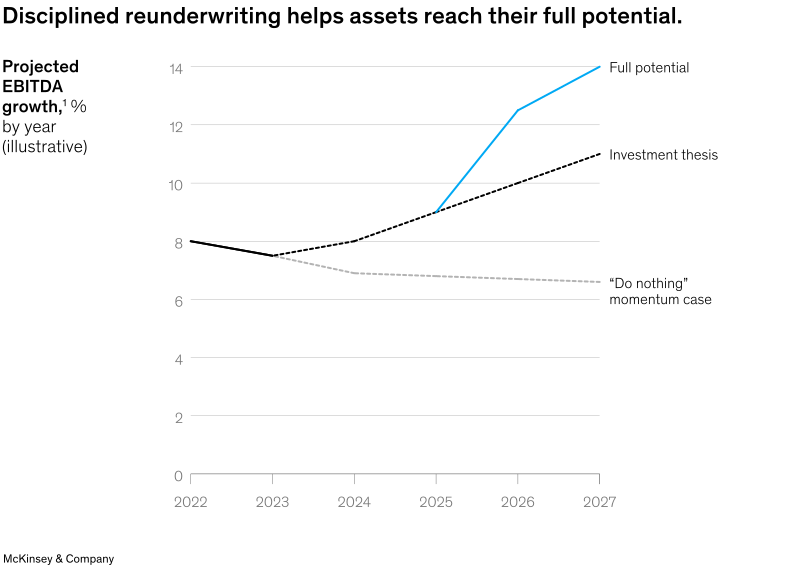
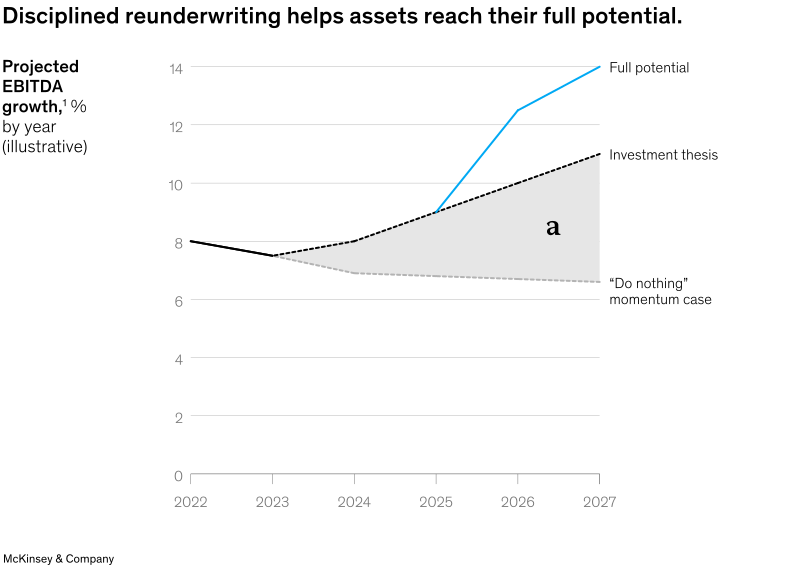
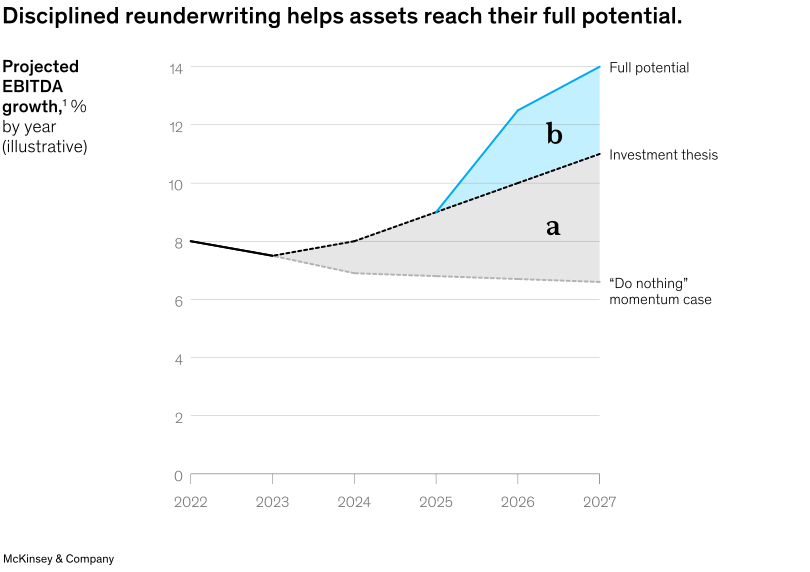
We found that firms covered a wide range of topics in their reunderwritings, including exit timing and route decisions; updated value creation and full-potential plans; operational improvement progress; commercial performance and market effectiveness; equity story refreshes; downside scenarios; and management team readiness. Across the range of topics and levels of scrutiny applied, three discrete archetypes emerged:
- Diligence refresh: The first archetype is a diligence refresh approach, which is most frequently used for assets that are performing broadly in line with the buy-case. It’s a light-touch framework that focuses on verifying that the original investment thesis remains intact. This typically involves updating a core set of ten to 15 KPIs—such as organic growth, customer retention, and cash conversion—to ensure there are no hidden pockets of decay that would surprise a buyer in 12 months.
- Buyer backward: The second archetype is the buyer-backward audit. For assets that are nearing a 12-to-18-month exit window, firms can shift the information focus forward to build a bespoke evidence pack. Firms that use this approach move beyond internal management reporting to assemble concrete proof points that a future buyer will prioritize, such as granular win–loss rates, pricing elasticity by segment, and operational margin productivity. The intent in this approach is not merely to report performance but to preemptively address the bid–ask spread by anchoring the equity story in buyer-grade data.
- Cleansheet reunderwriting: Finally, with some assets, a cleansheet reunderwriting process is applied. These reviews act as a complete retabling of the investment; firms examine the “what” as if they were acquiring the company for the first time, today. That includes a total reassessment of the right to win, a deep dive into competitive positioning, and a fresh look at leadership and governance readiness for a restructured value-creation plan. In practice, this approach is used the least frequently. Moreover, when it is used, there has usually been a significant market disruption or meaningful stretch of underperformance. While the impulse to resist a cleansheet reunderwriting is understandable (it takes a few weeks of work and thought), the firms that do invest the time and resources are better positioned to outperform.
A practical playbook to build capability without adding bureaucracy
The goal of reunderwriting is not to create another layer of committee oversight; it’s to generate clarity faster and produce information that withstands real-world investor scrutiny. Our observations suggest that the most successful firms avoid unnecessary complexity by building a minimum viable reunderwriting engine powered by five key actions:
1. Define the objective and success measures: Leading firms begin by clearly defining what the review is intended to solve, specifically value creation. High-performing firms achieve it through specific levers that should always work in tandem: profit acceleration, future-growth optionality, exit maximization, and DPI (distributions to paid-in capital) pacing. By insisting that decisions tie back to these levers while adhering to a holistic approach, the process avoids becoming a generic status update and instead becomes an actionable intervention focused on generating alpha.
2. Communicate timing: A recurring point of failure, we noted, is waiting too long to start. As one fund manager put it: “You cannot fabricate buyer proof halfway through a process—the evidence has to exist before.” Being proactive about timing also lets portfolio companies understand what’s coming, eliminating a sense that they are unexpectedly under scrutiny. The firms that typically derive the most value from reunderwriting establish a buy-case refresh at a fixed milestone. Their timing is well considered—to provide enough history to judge performance while allowing a sufficient runway to shift the equity story or close evidence gaps before a sale. That said, best practice is to supplement buy-side milestones with explicit trigger overrides for unexpected developments. Flexibility helps ensure that firms don’t remain wedded to an outdated plan simply because the calendar hasn’t turned.
3. Clarify ownership: One of the most delicate balances we observed is maintaining deal partner accountability while introducing independent challenge. In the most robust models, the deal partner remains the primary owner of the asset’s performance and a key voice in reunderwriting. Still, an independent exit squad prepares the case for the investment committee, which serves as the ultimate decision-maker. The goal is not to win a turf war—it’s to implement full potential diligence to maximize value creation.
4. Use simple outcomes: Simplicity unleashes insight. In the most effective reunderwritings we studied, the key deliverable that sits above appendices is not a massive report. Instead, it’s a surgical short list of three to five actions. To remain exhaustive but not exhausting, outputs should be distilled into simple, binary, or traffic-light outcomes, enabling clear decisions to hold, accelerate, or retake (reunderwrite) the asset. Each outcome should be linked to a clear, short list of steps that directly improve buyer confidence and valuation. This helps focus the firm’s energy on the specific S-curve of growth needed for exit, and avoids a complete, and often expensive, redesign of every operational nuance.
5. Pilot, standardize, and codify: The transition to a portfolio-wide capability, we found, works best when it begins with a pilot on three to five assets. This allows the firm to standardize, retune, and codify templates and dashboards that can eventually be scaled across the portfolio. Moreover, using consistent, apples-to-apples metrics in the evidence pack—such as commercial win rates, churn, and pricing elasticity—can help firms move toward an automated overview and clear asset comparisons. This institutionalizes a Goldilocks setting: a repeatable operating rhythm that ensures every asset is exit-ready without draining the firm’s resources.
Leading private equity firms recognize that achieving full value requires a disciplined, adaptive approach throughout the hold period. Reunderwriting provides that edge—serving as a distinctive capability that builds on initial deal diligence rather than replacing it. While many firms currently don’t follow a formal, structured reunderwriting process, those that do report faster exits and higher exit prices. Value creation benefits from an additive second look.