The pulp and paper packaging industry is undergoing a structural reset. For several years, the industry has faced slowing demand with limited growth, partially due to factors such as the COVID-19 pandemic, the war in Ukraine, the conflict in Iran, and increased use of tariffs. Persistent overcapacity across grades and elevated volatility in input costs, particularly for fiber (in certain geographies such as Europe and large parts of North America) and energy (across the globe), have also had an impact. Traditional tactics for addressing performance, including procurement optimization, lean manufacturing, and energy efficiency, can no longer fully bridge the cost gap, leaving companies with limited room for incremental gains.
In this environment, functional excellence is no longer the only path to creating value; rather, organizations need to optimize at the system level. The most successful players are moving beyond siloed cost programs toward integrated approaches that address the full production system. This requires tighter coordination across operations, procurement, energy, and analytics, supported by advanced data capabilities and gen AI.
We call this new approach “site sprints”: rapid, cross-functional interventions that target the total cost baseline of a mill. By jointly optimizing fiber use, machine performance, energy systems, and indirect spending, site sprints enable companies to identify the cost-optimal operating point of their production systems and chart a course to achieve it.
Companies that adopt this model can unlock substantial cost reductions while building capabilities for sustained performance improvement. One global pulp and paper company that adopted this approach saw cost savings at individual mills ranging from 8 percent to nearly 20 percent, totaling several hundred million dollars. In a lower-growth, more volatile environment, such results become a critical determinant of competitiveness.
A changing landscape demands a new operational response
For decades, the pulp and paper packaging industry operated on a stable economic model: high asset intensity, strong variable margins, and a focus on maximizing throughput to absorb fixed costs. That model is now under sustained pressure.
A combination of structural and cyclical forces has fundamentally reset industry dynamics. Supply disruptions, such as reduced access to Russian timber in Europe or the mountain pine beetle epidemic in Canada, have tightened fiber markets and increased input costs for European and North American producers.1 Price spikes for old corrugated containers have put producers in India under pressure, while Latin American producers are seeing increased eucalyptus prices due to land cost inflation and competition for raw materials as a consequence of rapid pulp capacity expansion (although the increase starts from a lower base).2 Energy price volatility has further amplified cost pressure, with recent geopolitical developments adding additional uncertainty to already elevated cost levels.
At the same time, companies have expanded their capacity and converted legacy assets (such as reconfiguring newsprint machines to produce containerboard), creating persistent oversupply in several segments. In parallel, postpandemic demand has normalized, e-commerce growth has stabilized, and consumer demand has weakened, leading to flat or declining volumes across many end markets.3 The result is a sustained imbalance between supply and demand, driving margin compression across the paper and packaging value chain.4 Meanwhile, players from Latin America and Southeast Asia, with access to lower-cost short fibers largely driving their structural cost advantage, are exploring entering Western markets, further increasing the cost pressure in these markets.5
This shift marks a structural break: Most companies can no longer rely on volume growth to offset inefficiencies. Indeed, pricing rather than volume has increasingly driven revenue growth across the value chain, but given current oversupply, companies have limited headroom for further price realization in the short term.6 Instead, operational rigor, cost discipline, and the ability to adapt operating models to a more volatile environment increasingly determine value creation.
Customers are also reshaping demand patterns. Consumer packaged goods players are reducing inventory levels and increasing order volatility while pushing for more-frequent pricing adjustments. These shifts are increasing variability in mill operations and placing additional pressure on utilization, planning, and cost efficiency.
Understanding the cost structure: Where value is at stake
Unlocking meaningful cost improvements requires a clear understanding of the industry’s cost base. Across most pulp and paper packaging operations, five categories dominate7:
- Fiber (25–70 percent). Fiber is the largest cost component, with significant variation depending on vertical integration and geography. Integrated producers with access to low-cost wood (for example, eucalyptus in Latin America) operate at the lower end, while nonintegrated players relying on market pulp can exceed 60 percent.
- Energy (10–25 percent). This is a structurally significant cost, given the energy intensity of pulping and papermaking. Integrated mills can partially offset these costs by generating their own energy, but they’ll still need to rely on external energy markets to a degree, and these costs can be material.
- Chemicals (8–25 percent). Chemicals are critical inputs across pulping, processing, and water treatment; both the formula a mill uses and consumption efficiency affect cost.
- Logistics (10–15 percent). Raw materials and finished products are both logistically intensive, given their high weight and volume; nonintegrated or geographically dispersed operations are especially affected by this.
- Fixed costs (15–25 percent at full utilization). Fixed costs, including labor, maintenance, and depreciation, become increasingly burdensome as utilization declines. At current utilization levels of approximately 70 percent, fixed-cost shares can rise above 30 percent, amplifying margin pressure.
Impact summary: McKinsey’s collaboration with a pulp and paper company
At a global pulp and paper company, site sprints have delivered a step change in profitability. Client teams and McKinsey experts jointly developed and implemented more than 1,000 improvement levers. Initiatives span the full operational footprint and all four focus areas of the site sprint approach:
- Traditional AI and gen AI applications. These applications have further unlocked value, such as in digestor performance. By improving wood fiber yield, with wood cost being the largest cost component on the company’s profit-and-loss statement, the organization captured several additional percentage points of valuable output and a respective reduction in spending.
- Lean operations and manufacturing excellence. By mapping fiber losses across the value stream, from the supplier through to the finished product, the company was able to target root-cause interventions. This effort reduced fiber spend by several percentage points across both virgin and recycled mills.
- Energy system optimization. Optimizing the energy system at one of the company’s largest integrated mills entailed dozens of improvement levers, including dynamic steering of steam and power generation, aligned with electricity market conditions and operational constraints. The combined result was a reduction in energy consumption of several hundred gigawatt-hours annually, effectively shifting the site from a net fuel consumer to a net exporter.
- Procurement and spend excellence. A cross-functional approach, including dynamic recipe optimization based on market conditions, reduced variable production costs by up to 5 percent while maintaining consistent product quality.
These levers were developed by integrated McKinsey–client teams with a dual mandate: to deliver immediate value and build enduring capabilities. This included upskilling teams at the mill level as well as strengthening central operational-excellence functions to support and ultimately lead scaling efforts (exhibit).
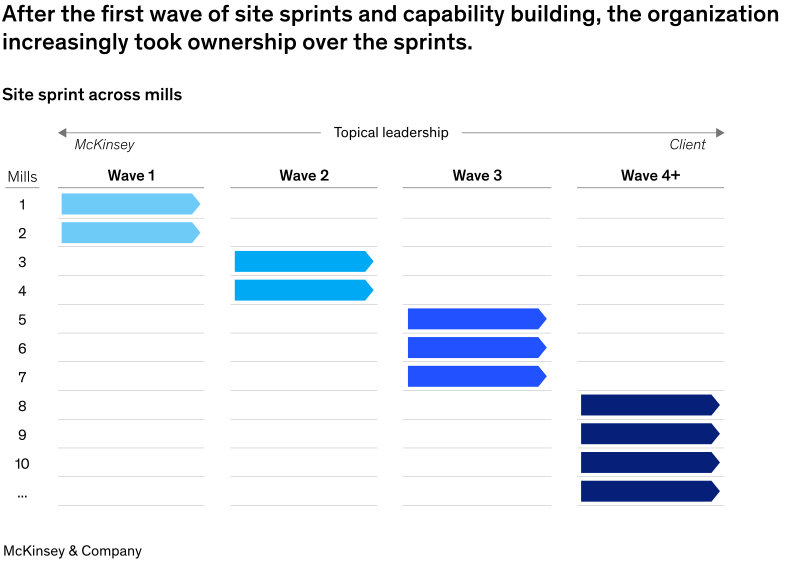
Site sprints were rolled out across the company’s global plant network in less than two years. Individual mills achieved savings ranging from 8 percent to nearly 20 percent, with total impact worth several hundred million dollars. Today, the organization independently conducts multiple site sprints each year, embedding a culture of continuous improvement across its operations.
Moving beyond traditional cost programs
The most successful players are shifting toward integrated, cross-functional cost optimization, focusing on the total cost baseline rather than individual cost lines.
This reflects a broader evolution in the industry wherein coordination across functions increasingly drives value creation, supported by advanced analytics and digital capabilities. Gen AI is beginning to accelerate this shift. While the industry has historically lagged behind in digital adoption, momentum is building rapidly, with many companies now moving from experimentation to deployment. Early use cases in procurement, supply chain, and manufacturing are already improving decision-making, reducing manual effort, and unlocking additional cost-optimization opportunities across the value chain. In particular, gen AI is enhancing speed and consistency of decisions at scale in information-intensive processes such as supplier analysis, demand planning, and production optimization.8
To capture this opportunity, companies can undertake site sprints, which are rapid, cross-functional interventions designed to optimize the total cost baseline of a mill. They bring together expertise from operations, procurement, energy management, and data science into a single, integrated team. This team pursues interventions in four complementary areas that together target companies’ five main cost categories:
- Traditional AI and gen AI applications. Companies could launch advanced recipe management across fibers, energy, and other variable costs, enabling cost-efficient optimization and substitution across grades in production and development. Analytical models can identify opportunities to substitute lower-cost inputs without compromising (and possibly improving) product specifications.
- Lean operations and manufacturing excellence. For example, companies could optimize fiber yield end-to-end, from the fiber source (such as improved chip quality management) through processing (such as cooking control) to the web (such as web break prevention). Companies should tackle such improvements—in yield but also in runnability and chemical dosing—comprehensively, thereby reducing waste, downtime, and variability while improving throughput.
- Energy system optimization. Integrated optimization of steam, power, and utility systems, aligned with production planning and energy price signals, can significantly reduce total energy costs.
- Procurement and spend excellence. Indirect spend is often fragmented and under-optimized. Procurement and spend interventions include category redesign, local sourcing, supplier consolidation, and bundled service models.
Successful interventions follow rapid execution cycles focused on near-term impact, have strong top-level sponsorship paired with local ownership, and incorporate capability building to sustain improvements over time. These practices enable both speed and scale, allowing companies to realize immediate cost reductions while embedding new ways of working. And by coordinating changes across multiple areas, companies can consider any trade-offs that arise. For example, if a company makes a fiber substitution, they will also need to make various other adjustments, such as to the refining energy and chemicals mix, to maintain the properties of the final product. By harnessing AI to understand and optimize such interdependencies and trade-offs across the full system, companies may be able to intelligently combine and offset negative effects, ultimately reducing costs while arriving at a better product. Well-executed site sprints can reduce costs by up to 20 percent, depending on a company’s starting point and how its assets are configured.
However, this is only part one of the disruptive journey ahead for mill operations. New technologies continue to gain traction; soon, robots could have agentic capabilities, creating opportunities for large-scale automation in mills based on physical AI.
For CEOs and operations leaders, the implication is clear: The next wave of performance improvement will require fundamentally changing how the system is optimized. For companies looking to capture this opportunity, the first step is often a rapid diagnostic to get a structured, data-driven assessment of cost performance across the four core pillars. This diagnostic should map key cost drivers and performance metrics, identify cross-functional inefficiencies and bottlenecks, benchmark against internal and external performance levels, and quantify savings potential using analytical models. Many organizations begin with targeted pilots in high-impact areas, such as optimizing fiber or balancing energy, before scaling successful interventions across production lines and sites.
Leaders who act decisively to reset their cost base can build a durable advantage in an increasingly constrained market. Those that delay risk being structurally disadvantaged as cost gaps widen.