



As countries seek scalable ways to decarbonize energy systems and secure their energy supply—particularly amid heightened geopolitical uncertainty and energy price volatility—renewable natural gases (RNGs) are gaining momentum. Produced from agricultural residues, organic waste, and other biomass streams, RNGs can serve as a direct substitute for natural gas, helping broaden the energy mix and reduce dependence on imported fossil fuels. Their compatibility with existing gas infrastructure also makes them one of the few renewable-energy solutions that can scale without requiring entirely new end-use systems.
The growth outlook for RNGs is both substantial and increasingly evident. Demand for two key forms of RNG—biogas and biomethane (a purified form of biogas upgraded to natural-gas quality)—is projected to rise from about 0.9 exajoules (EJ) in 2022 to nearly 8.0 EJ by 2050, accounting for about one-third of total sustainable fuel demand by mid-century (Exhibit 1). Biomethane is emerging as the most important of these fuels.
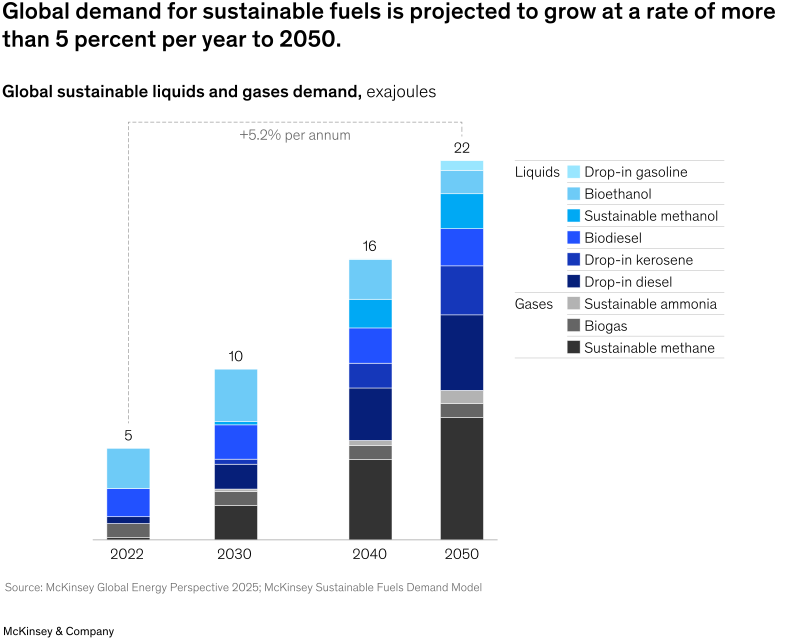
The growth potential also spans multiple industries and regions. Over the coming decades, demand for biomethane is expected to expand steadily across power generation, buildings, industry, and transport.1 While Europe and North America today account for roughly 60 percent of global demand, future growth is expected to come primarily from emerging markets, where rising energy demand coincides with large untapped waste and agricultural resources. China alone accounts for approximately 40 percent of the global rise in biomethane demand between 2023 and 2035, while India’s demand is projected to triple over the same period.
Despite this strong growth outlook, the market still represents only a fraction of the available resource base. The current sustainable global feedstock availability could support roughly one trillion cubic meters (approximately 36 EJ) of biogas production annually, highlighting a substantial gap between today’s supply outlook and the underlying technical potential. Closing this gap is a central opportunity for the industry.
A sector undergoing structural change
As the market expands and the scale of the opportunity becomes clearer, the biomethane sector is undergoing a profound structural shift. Sophisticated investors are entering the sector, challenging the traditional paradigm of a tariff-dependent industry and repositioning biomethane as a scalable and economically viable infrastructure asset class.
In the early phases of the industry—roughly from the late 1990s onward—biogas plants were typically developed and owned by small agricultural enterprises. Their primary objective was to produce electricity, using agricultural waste as feedstock. Economics were largely driven by the avoidance of electricity costs and supported by feed-in tariff schemes. However, these assets often faced structural limitations: relatively high feedstock costs (about €2 million per plant annually in many cases), limited scale, and a heavy reliance on policy incentives. As a result, returns were typically modest, and the model remained dependent on continued regulatory support.
Over the past few years, the industry has entered a second phase, marked by the development of traditional biomethane plants. Infrastructure investors and multi-utility companies began upgrading biogas into biomethane for injection into gas grids and for use in a growing range of end markets—particularly in transport fuels such as compressed biogas (bio-CNG) and liquefied biomethane (bio-LNG).
This evolution has opened new commercial pathways for renewable gas across several markets. However, the industry remains fragmented, and operational performance varies significantly across assets. Feedstock sourcing, for instance, is often driven by dedicated or ad hoc production of crops (such as straw) rather than by a structured strategy that optimizes feedstock mix, transportation distances, and methane yield per ton of biomass. Consequently, many plants operate with higher feedstock costs and suboptimal gas yields. Combined with heterogeneous plant configurations and operating practices, this results in business models that continue to rely heavily on regulatory incentives to deliver attractive returns.
The industry is now moving into a third phase, in which biomethane projects are developed as part of a professionalized energy infrastructure platform (table). Private equity funds and energy majors are building portfolios of plants and optimizing them through integrated feedstock logistics, industrialized operations, and diversified revenue streams. Additional sources of value are emerging, including biogenic CO₂ offtake and, where viable, the use of digestate as a soil improver. These platforms can benefit from lower feedstock costs (often closer to €1 million to €1.2 million per year per plant), higher operational efficiency, and greater revenue resilience.
The biomethane industry is becoming professionalized.
| Past: Electrical biogas plants | Present: Traditional biomethane plants | Future: Professionalized biomethane | |
| Ownership | Small agricultural enterprises | Niche infrafunds and multi-utilities | Private equity funds and oil majors |
| Mission | Production of electricity | Production of biomethane to access regulated tariff | Development of infrastructure for national energy security |
| Feedstock | Self-consumption of own agricultural waste (diet cost: +€2 million) | Ad hoc production of straw to feed a biomethane plant (diet cost: €1.5 million–€1.8 million) | Selection of feedstock through its logistics and biomass cost-yield optimization (diet cost: €1.0 million–€1.2 million) |
| Revenue stream | Electricity cost avoidance | Biomethane revenues from tariff | Biomethane revenues from tariffs and GC2 revenues from hard-to-abate offtakers; soil improver revenues from market sales; CO2 revenues from offtake agreements |
| Sustainability | Not sustainable without incentivized feed-in tariff (FiT) | Not sustainable without incentivized FiT | Self-sustainable without incentivized FiT because of diversified revenue streams and low operating costs |
| Returns (based on Italy market data) | Low yield (IRR1 < 8%) | Medium yield (IRR 8–12%) | High yield (IRR >20%) |
As the biomethane sector transitions to a more industrialized model, the sources of competitive advantage are shifting. Scale, operational excellence, and integrated capabilities are becoming critical differentiators, and biomethane platforms are starting to systematically capture value across the full life cycle of projects.
How leading players are professionalizing the industry
The platforms delivering the strongest performance are converging around several practices that enhance resilience, improve plant economics, and unlock additional revenue streams. Six lessons are defining this new model:
1. Create structural advantage through portfolio and cluster strategies
Individual plants remain exposed to volatility in feedstock supply and operational variability. Leading operators are therefore building portfolios of ten or more plants, often organized in geographic clusters. This approach enables shared feedstock basins, coordinated logistics and maintenance, and stronger supplier relationships, creating a repeatable and more resilient model for scaling biomethane infrastructure.
2. Improve ROI and reduce costs through standardization
Operators are moving away from fully bespoke engineering toward more standardized plant architectures that embed proven technologies, thus helping to reduce capital cost variability and increase operational reliability. Leading players complement standardization with rigorous procurement practices, such as total-cost-of-ownership benchmarking and cleansheet costing, to challenge supplier pricing and negotiate from a position of analytical strength. These capabilities can deliver a lower cost base and higher project returns across successive plant deployments.
3. Deploy advanced analytics to transform plant operations
Leading developers are using integrated sensor networks and advanced analytics to optimize fermentation processes in real time. By analyzing a broad set of operational parameters (such as flow rates and pressure levels) and feedstock characteristics (solid/liquid manure versus nonmanure), these systems enable operators to improve methane yields by up to 30 percent. They also enable continuous refinement of feedstock inputs and help reduce feedstock and logistics costs by 20 percent or more.
4. Internalize core capabilities to boost efficiency and margins
Operators are bringing in-house previously outsourced functions—such as plant maintenance, logistics coordination, and core operational management—to gain operational control and cut costs. At the same time, specialized activities tied to specific equipment or technologies (for example, liquefaction and advanced process diagnostics) are typically still outsourced, reflecting the benefits of supplier expertise and economies of specialization. This hybrid operating model allows platforms to become more efficient while maintaining flexibility in the most technical areas of plant operations.
5. Target the most attractive demand segments
Beyond operational improvements, value creation in biomethane hinges on strategic positioning in the most attractive demand pools. Among end-use sectors, transport currently offers the strongest economics, supported by regulatory requirements that sustain high prices—often €100 per megawatt-hour (MWh) or more—and by robust willingness to pay for low-carbon fuels. Looking ahead, additional demand growth may emerge from maritime applications (where liquefied natural gas [LNG] is leading the alternative fuel order book) and from carbon-pricing mechanisms affecting buildings and industry. Developers that anticipate these shifts and align their commercialization strategies accordingly will be better positioned to capture long-term value.
6. Monetize multiple biomethane by-products
The economics of biomethane plants increasingly depend on the ability to monetize multiple output streams generated in the production process. In addition to biomethane itself—often sold with guarantees of origin—operators are developing structured offtake strategies for biogenic CO₂ and digestate-based biofertilizers. Securing commercial agreements across these product streams can enhance revenue diversification and strengthen project resilience.
What’s at stake for traditional biomethane players
Together, these levers fundamentally change the economic profile of biomethane assets. Our analysis shows that systematically applying these levers can raise the EBITDA of an average biomethane project by 40 to 90 percent (Exhibit 2).
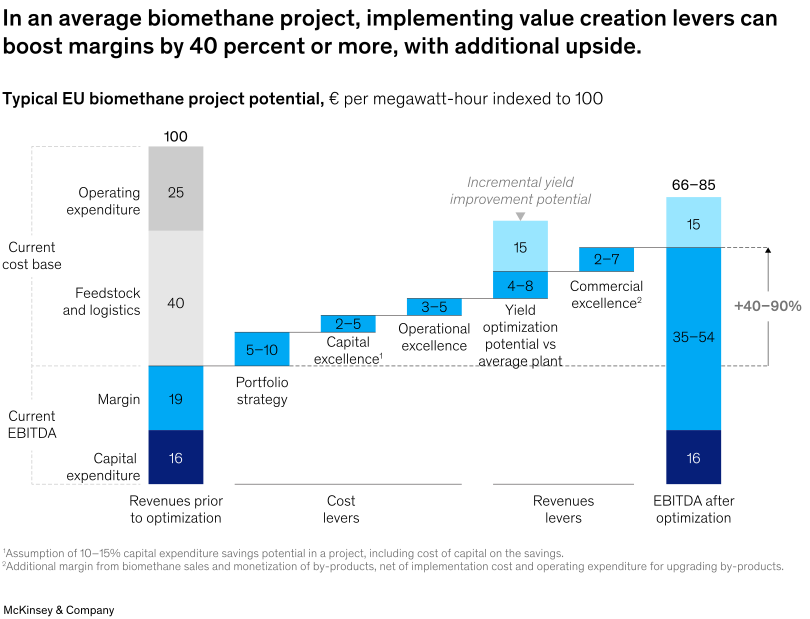
Plants that were once largely dependent on tariff regimes can evolve into diversified infrastructure assets with stronger margins and greater stability across regulatory cycles. In this context, the companies best positioned to succeed will be those that professionalize the entire biomethane value chain.
Implications for gas network operators
As the biomethane sector adopts platform-based models, much of the focus has been on the professionalization of upstream activities—from feedstock sourcing and plant design to operations and commercialization. Leading players are leveraging scale, standardization, and advanced analytics to optimize performance and reduce costs.
However, unlocking biomethane at scale will also require a corresponding step change in the midstream. Gas network operators will need to move beyond case-by-case approaches toward more standardized, industrialized models for integrating biomethane into the grid. This implies developing cost-efficient and replicable connection solutions, streamlining permitting and connection processes, and establishing common technical and commercial standards—rather than relying on bespoke, asset-by-asset configurations that can slow deployment, increase costs, and limit scalability.
In this context, distribution system operators (DSOs) and transmission system operators (TSOs) can proactively shape market conventions and enable a more efficient, systemwide approach to biomethane integration. This will require action across several key dimensions, including the following:
- Network development models. Operators will determine the optimal balance between centralized injection points and more distributed models with multiple local entry points, reflecting the inherently decentralized nature of feedstock availability and biomethane production. While centralized hubs may offer economies of scale and simplified system management, distributed injection models can minimize transportation needs and better align with local production clusters. Balancing these trade-offs will necessitate a rethinking of traditional network planning, including capacity allocation, bidirectional flows, and targeted grid reinforcements.
- Regulatory frameworks. Operators will need to work within—and help shape—regulatory frameworks that support biomethane integration, including connection rules, cost allocation mechanisms, and incentive schemes. Clear and stable regulation will be critical to derisk investments, accelerate deployment, and avoid fragmentation across regions. Benchmarking across markets can provide valuable guidance, particularly in identifying best practices on connection cost sharing, tariff design, and mechanisms to incentivize both producers and network operators to scale biomethane efficiently.
- Operational and technical readiness. Upgrades to networks, metering systems, and gas quality management practices will be necessary to accommodate a growing number of injection points and more variable biomethane flows. This may include investments in compression, reverse-flow capabilities, and blending infrastructure, as well as enhanced monitoring and digital tools to ensure system stability. As injection patterns become more distributed and dynamic, operators would do well to improve their forecasting, data integration, and real-time system management capabilities.
This step-up in midstream capabilities is not only a technical necessity but also a strategic opportunity for gas network operators. For DSOs and TSOs alike, biomethane represents a compelling lever to build a more resilient, future-proof gas system. Three factors are especially relevant:
- Enhancing security of supply. Because it is produced locally, biomethane can reduce reliance on imported gas. In addition, a more distributed production base can strengthen system resilience by diversifying supply sources and limiting exposure to single points of failure or external disruptions.
- Preserving infrastructure value. Increasing biomethane volumes can reinforce the long-term value of gas infrastructure by lowering the carbon intensity of the gas flowing through existing networks. This enables continued asset use while mitigating the risk of stranded infrastructure and supporting a cost-efficient energy transition.
- Linking the energy and circular-economy systems. Biomethane converts agricultural residues, organic waste, and by-products into energy—creating economic value across agriculture, waste management, and energy systems while reducing emissions. This cross-sector integration can stimulate local economic development, bolster rural value chains, and position gas networks as critical enablers of a more circular and resource-efficient economy.
If DSOs and TSOs deliver this step change in professionalization, they stand to capture a dual benefit: enhancing the long-term value of their infrastructure assets while simultaneously supporting more sustainable, resilient, and affordable energy systems.
Biomethane’s potential is becoming well understood. The differentiator now is execution. As the industry shifts from stand-alone plants to scaled platforms, players that professionalize operations and integrate the value chain will be well positioned to generate the strongest returns and capture a disproportionate share of the upside.
1. Outlook for biogas and biomethane: A global geospatial assessment, Stated Policies Scenario, IEA, May 28, 2025.
The authors wish to thank Cecilia de la Morena, Giorgio Bresciani, Javier Ferrer, Lazar Krstic, Namit Sharma, and Tapio Melgin for their contributions to this article.