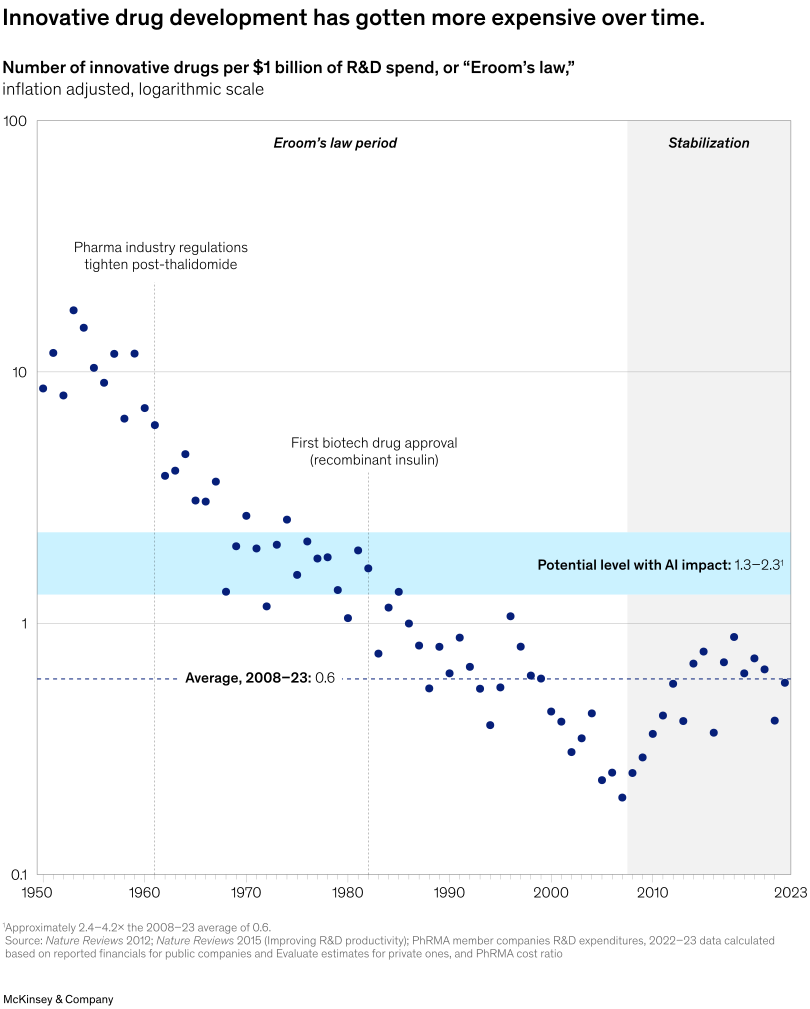
Pharmaceutical research and development faces a compounding productivity crisis. For decades, the number of new drugs approved per billion dollars in R&D spend has declined exponentially (Exhibit 1). Although industry attention fixates on late-stage clinical attrition, only around 10 percent of candidates entering Phase I ever reach markets.1 That economic drag is largely predetermined years earlier at the bench. Flawed target choices, fragile biological hypotheses, and preclinical assays that fail to translate seal a program’s fate long before clinical trials begin.
Incremental optimization of manual laboratory routines will not disrupt this dynamic. The industry has reached an inflection point: The convergence of agentic AI and physical robotics offers a realistic path to bend the productivity curve. By directing automated hardware through closed-loop experimental cycles within boundaries set by scientists, biopharmaceutical companies can fundamentally reinvent early-stage discovery.
Reaching R&D escape velocity through institutional memory
For decades, pharmaceutical research has operated as a collection of episodic, often manual tasks. Experiments are run, documented, and closed out, while negative results and granular observations rarely inform future work.
The laboratory of the future changes this economic equation. It enables research teams to reach “escape velocity”: a productivity system in which processes improve with every experiment as they increasingly build on existing institutional knowledge, so output starts to scale with investment instead of plateauing. Two complementary capabilities drive this compounding effect:
- Continuous, high-throughput experimentation that generates proprietary training data at scale. Automated hardware runs around the clock, removing manual handoffs and capturing full experimental context and protocol parameters directly at the bench. Every run, including failed ones, becomes structured, proprietary training data—creating a shared institutional memory. For example, Novartis compressed a purification workflow from more than one week to 42 hours per plate using microscale automation;2 Roche doubled fermentation throughput with the same staffing via robotic microbioreactors;3 and an AstraZeneca–University of Leeds platform completed roughly 900 automated reactions in 192 hours.4
- Predictive AI models that decide what to run next. Data trains models that design and prioritize the experiments most likely to reduce uncertainty, so each experiment’s main output is a better model rather than just a single result. Those experiments go back to the automated lab in a feedback loop, producing more valuable data and better models with each cycle. For example, Genentech’s closed-loop workflow demonstrated a 54-fold improvement in molecule selection compared with expert medicinal chemists.5
Physical instruments serve as schedulable services, coordinated by digital orchestration software. Scientists become “scientific tastemakers”; they define the overall strategy, interrogate biological anomalies, and set experimental guardrails, leaving physical execution to automated systems.
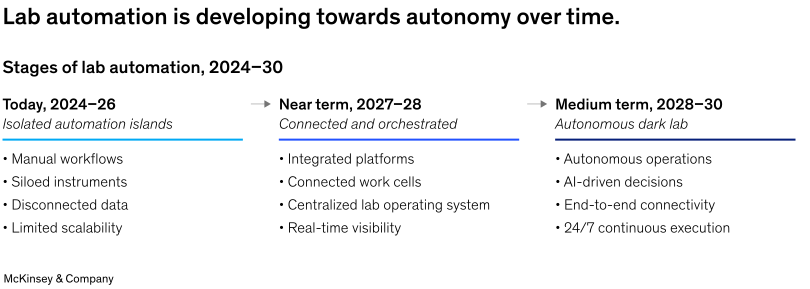
Discovery organizations progress through three distinct architectural stages (see Exhibit 2). Today most laboratories operate as isolated automation islands with stand-alone instruments and fragmented files. In the near term, teams are connecting these islands into orchestrated laboratories that centralize instrument control and data flow. Over the next five to ten years, this connected foundation will support the autonomous lab, where robotics execute protocols continuously, and AI systems analyze outputs to trigger subsequent runs.
Five structural design choices
Moving from isolated bench experiments to an orchestrated laboratory cannot happen overnight. Leadership faces a vendor landscape spanning point robotics, scheduling layers, and orchestration middleware. R&D leaders are navigating five pragmatic trade-offs to build compounding capabilities without accruing technical debt.
1. Define proprietary core capabilities versus commodity procurement
Commercial laboratory technology has matured. Biopharmas no longer need to build every tool themselves. The governing rule is to build what delivers proprietary biological advantage and procure off-the-shelf solutions for commodity execution.
Core differentiating capabilities remain in-house to protect the discovery engine’s intellectual property. These assets include proprietary molecular design algorithms, foundation models trained on internal data, and custom data schemas. Standard liquid handlers, robotic arms, scheduling software, and laboratory information management systems can be procured from commercial vendors.
BioNTech’s discovery model reflects this distinction. Through its acquisition of InstaDeep, the company internalized proprietary AI foundation models for sequence design.6 It runs nondifferentiating operational tasks on commercial cloud infrastructure and standardized laboratory software.
2. Integrate selectively where iterative learning demands it
Full end-to-end automation across every bench workflow is impractical. Instruments require maintenance, assays evolve, and experimental volumes fluctuate. Modular, plug-and-play automated stations provide the agility to reconfigure protocols or replace malfunctioning hardware without halting an entire facility.
Certain workflows require tight dependencies and rapid, iterative learning. High-throughput screening loops and formulation optimization justify fully integrated, closed-loop systems. In these targeted workflows, data from one experiment autonomously triggers and refines the next run.
AstraZeneca’s iLab uses this selective integration model. By tightly coupling design, synthesis, testing, and analysis for priority discovery pipelines, the platform aims to reduce candidate identification timelines by 50 percent.7
3. Standardize a shared scientific language, not software tools
Imposing a single software suite across an entire discovery organization usually backfires. Synthetic chemists, structural biologists, and imaging specialists rely on specialized applications. Forcing every discipline onto a single platform creates friction and slows research.
Leading organizations standardize the data layer instead. Common data dictionaries, unified sample identifiers, and structured metadata capture ensure results maintain consistent scientific meaning across systems. Heterogeneous laboratory tools can feed centralized AI training pipelines while scientists retain the software best suited to their discipline.
4. Focus not just on physical robotics but the broader digital orchestration
Physical automation is necessary, but hardware alone is insufficient. Installing high-speed robotics without a robust digital layer merely executes legacy protocols faster. Speed increases linearly, while scientific learning stalls.
Effective programs also establish the digital foundation. This infrastructure includes experimental design algorithms, orchestration engines, and data pipelines that capture bench results in structured formats. Systems operate under clear operational guardrails: Automated tools execute within defined biological and safety boundaries, and automated triggers escalate anomalies to human researchers.
Takeda’s partnership in the Scientific AI Lighthouse program exemplifies this digital-first approach by replatforming scientific data and AI workflows across R&D and manufacturing to create the data infrastructure that enables intelligent automation, both existing and future.8
5. Build scalable foundations while proving near-term pipeline value
Focusing solely on optimizing existing bench setups creates isolated automation islands. Multiyear architectural overhauls without near-term proof points risk losing leadership support.
Leading teams establish enterprise data standards, orchestration protocols, and modular interfaces and deploy them on high-priority disease programs. Automated assays used today must produce model-ready training data for tomorrow’s predictive tools. Genentech, for instance, engineered high-throughput bench pipelines that feed directly into continuous model-training workflows, validating the architecture through tangible speed and molecule-selection gains on active discovery targets.
Three organizational enablers to operationalize autonomy
The autonomous lab is not just an engineering project. Technology investments fail most often because the surrounding organization doesn’t adapt to support them. An automated platform capable of running 2,000 experiments a day delivers little value if bench scientists avoid it or if findings remain trapped in departmental silos. Three operational enablers make autonomy work.
1. Shift change management from displacement to empowerment
Automated laboratories are reshaping daily bench routines. Scientists who spent years perfecting manual assay execution suddenly face systems that run protocols at superhuman speed. Many researchers fear that automation will commoditize their expertise and eliminate their jobs.
Executive teams address this friction directly. They define future-state workflows in which scientists remain essential. Automation handles repetitive tasks, freeing researchers to focus on experimental strategy, interrogate model outliers, and formulate biological hypotheses. Realizing this shift requires formal investment in hybrid upskilling, combining bench wet-lab expertise with data fluency, and updating performance metrics to reward contributions to enterprise models alongside project milestones.
2. Capture negative results as institutional data assets
Experimental automation delivers value only if its output reliably trains predictive algorithms. In many organizations, data governance is a compliance exercise. Raw data remains locked in proprietary instrument formats, and negative results disappear.
Turning experimental data into enterprise assets requires capturing the full experimental context at the bench: environmental conditions, instrument parameters, and protocol variations. Governance systems must log failed experiments alongside successful hits. For machine learning models, negative data points provide essential boundaries for predictive algorithms. Cataloging failed runs prevents parallel teams from repeating dead ends and refines future experimental design.
3. Redesign workflows for automation-native velocity
Automating an existing manual protocol step by step embeds historical bottlenecks into expensive machinery. Realizing the promise of autonomy requires rethinking workflows from first principles—both at the bench and across the broader development pipeline.
At the bench, legacy approval gates designed to catch human pipetting errors can be replaced with automated data-integrity checks. Experimental steps traditionally run in sequential batches to fit daytime shifts can run concurrently around the clock. Across the pipeline, linear handoffs between early discovery and downstream chemistry, manufacturing, and controls (CMC) or formulation teams can be reengineered into continuous feedback loops. When downstream developability and stability readouts flow directly back into discovery workflows, automated systems learn to optimize for chemical synthesis, target binding, and clinical developability simultaneously.
Compounding returns in early research
The physical hardware and computational tools needed to build an autonomous laboratory are available today. Competitors cannot, however, purchase the operational advantage that accrues from continuous execution.
Every closed-loop cycle produces structured, contextualized data that improves the next cycle’s predictive power. Better models enable more informative assays, informative runs resolve biological uncertainty faster, and fewer resources are lost to programs that fail in the clinic.
This dynamic creates an enduring operational divide. Over the next 24 to 36 months, organizations that operationalize closed-loop laboratories will train predictive models on proprietary experimental outcomes, including thousands of negative runs not reported in the public literature. Competitors that rely on traditional, episodic bench workflows may fall behind on an accelerating learning curve that capital investments alone cannot close.