Why biomanufacturing needs a different model now
After a decade of significant cost improvements, productivity gains have plateaued. From 2014 to 2018, manufacturing delivered strong gains, with productivity up around 25 percent and unit costs down by more than half. Since then, momentum has stalled, productivity has declined by 5 percent, and unit costs have largely plateaued. Traditional improvement levers are no longer enough.
At the same time, pressure is intensifying. Net prices for branded drugs are declining across major markets, while healthcare spending continues to outpace GDP growth. Manufacturing is becoming structurally more complex, with increasing modality diversity, more competitive pipelines, and a growing number of products and launches to support simultaneously.
This is further compounded by a more fragmented and geopolitically sensitive manufacturing footprint, requiring companies to rethink how and where capacity is deployed across global networks.
As manufacturers look for new sources of performance, digital and AI have moved to the top of the agenda. But the issue in many companies is not lack of activity. Most manufacturers have started digital and AI journeys, and many have launched pilots. Yet too few efforts have translated into scaled operational impact: About two-thirds of companies remain in exploration or targeted implementation, while only a very small minority have fully embedded AI across operations.1
These pilot AI use cases are often built onto existing handoffs, documents, local spreadsheets, and manual decision processes. As a result, they improve individual steps without changing how the manufacturing system works.
The next wave of value will come from a different approach: redesigning work end to end, building a connected data foundation, automating routine activity, and operating each plant as part of a broader network. This article lays out a practical blueprint for the biopharma plant of the future, both for new facilities and for existing sites.
What digital and AI are already making possible
The potential is already visible. Early digital adopters have delivered meaningful gains, including 10 percent improvements in overall equipment effectiveness, 20 percent reductions in conversion costs and faster time to market. These results show that digital and AI can create value, even if they are still concentrated in specific use cases or parts of the operation.
The next level of impact comes when digital and AI are scaled across the full operating system of a plant. This is visible in the World Economic Forum’s Global Lighthouse Network, cofounded with McKinsey, which highlights companies using digital and analytics across the value chain to improve productivity, resilience, and sustainability.
In biomanufacturing, one North American biologics site recognized as a Lighthouse2 has created more than 30 digital and AI use cases. That effort has reduced new product introduction timelines by 42 percent, increased production volumes by more than 40 percent, and lowered emissions by a similar amount. The company is proof that digital transformation can simultaneously drive speed, scale, and sustainability efforts.
Across both early adopters and more advanced Lighthouse examples, four groups of technologies are becoming especially important:
- The industrial internet of things and edge computing enable a connected manufacturing data backbone and provide real-time visibility into equipment, materials, and process conditions across production, quality, maintenance, planning, and logistics.
- Machine learning enables predictive and adaptive operations, using production data to anticipate deviations, optimize process parameters, and continuously improve planning and performance.
- Agentic AI is orchestrating knowledge work, using AI agents to coordinate scheduling, deviation investigations, batch review, quality release, and planning decisions. The system handles routine coordination; people handle judgment calls and escalations.
- Autonomous robotics and physical AI automate repeatable shop floor tasks including material handling, sample management, analytical testing, kitting, and packaging—removing people from routine physical work.
The difference between incremental improvement and step-change impact is not the technology itself, but how it changes the work. The plant of the future is not defined by how many digital tools it deploys; it is defined by the rewiring of workflows that changes how work, data, assets, and decisions are organized. Companies that capture the most value do not simply add AI to existing steps. They connect data across functions, remove unnecessary handoffs, automate routine decisions, and keep people focused on exceptions. In this model, agentic AI helps coordinate work across planning, production, quality, maintenance, and release. The result is not just a more digital plant, but a different way of running the plant and the broader manufacturing network.
These tech enablers apply to both greenfield and brownfield sites. The difference is the path. In a new site, companies can design the model from day one. In an existing site, they use the same technologies to transform the most important workflows over time.
What this means across the biomanufacturing value chain
The four key tech enablers only create value if they are applied to real workflows end to end, not step by step. The right approach starts from the workflow, not the tool. For each major process from production scheduling to deviation investigation, the question is the same: What does this workflow look like when the data backbone connects every step, agentic AI handles coordination and knowledge work, physical AI removes routine execution, and people focus only on exceptions?
It is important to redesign work to break down current silos. Don’t automate existing workflows; redesign them. Define what the system handles autonomously and what it escalates. Operators, quality teams, and planners shift from executing tasks to reviewing exceptions, making trade-offs, and improving the system.
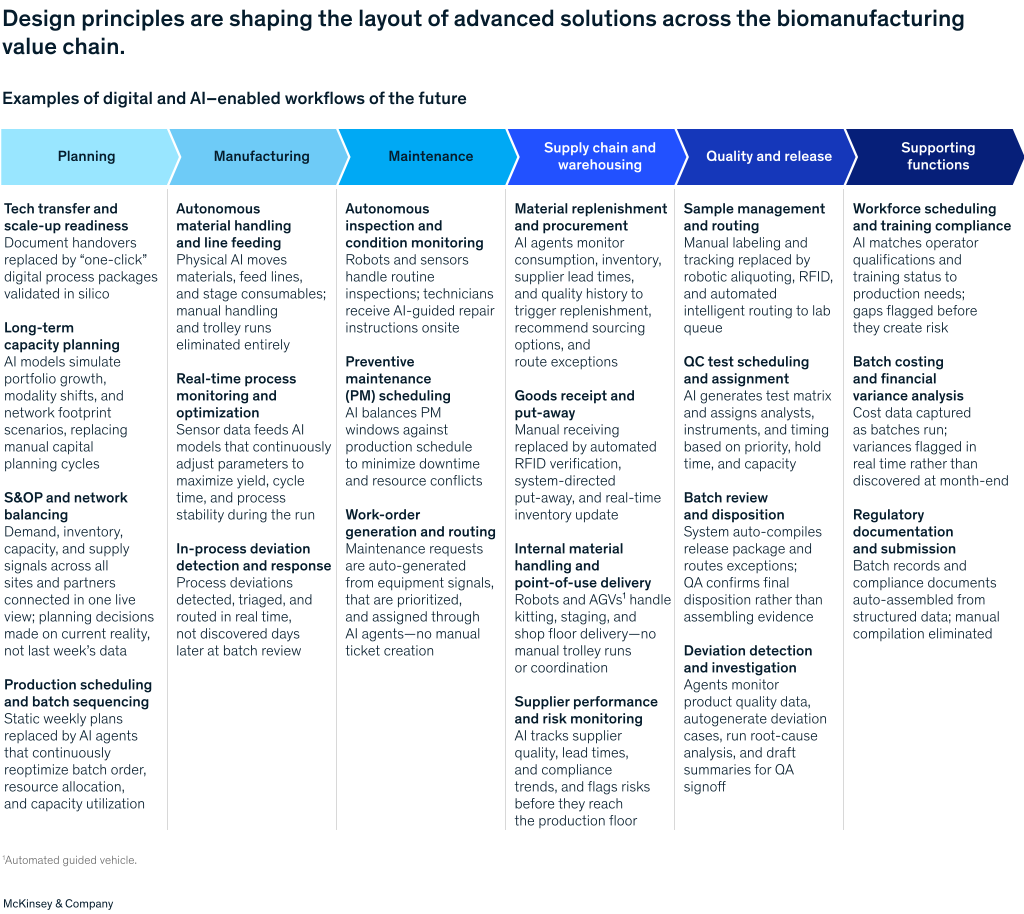
Across the six operational functions of a biomanufacturing site, this translates into more than 20 workflows that can be fundamentally rewired (Exhibit 1).
Planning
Planning can move from fixed cycles to a more dynamic way of managing the site. Teams can see demand, inventory, capacity, materials, and quality constraints in one place, instead of rebuilding the plan from scattered inputs. AI agents can help test scenarios, refresh schedules, and show what happens if a batch slips, a material is delayed, or demand changes. The planner’s role becomes less about collecting the facts and more about choosing the best path forward.
Manufacturing
Manufacturing can become more self-steering during the run. Equipment and process data can show whether the batch is moving as expected, where performance is drifting, and which parameters may need attention. Physical AI, robotics, and automation can take on routine shop floor work such as material movement, line feeding, sampling support, and packaging. Operators spend less time on repetitive tasks and more time keeping the process stable.
Maintenance
Maintenance can shift from “fix it when it breaks” to “protect the next campaign.” Sensors, equipment history, and production plans can help identify which assets are most likely to create downtime and when action is needed. AI agents can help create work orders, check spare-parts readiness, and align maintenance windows with production priorities, not just maintenance calendars.
Supply chain and warehousing
Supply chain and warehousing can become more responsive to what is happening in the plant. AI agents can monitor material consumption, inventory, supplier lead times, and quality status to trigger replenishment earlier and flag risks before they delay production. In the warehouse, AI, digital tracking, and automated handling can reduce manual searches, staging errors, and last-minute expediting.
Quality and release
Quality can move closer to the process instead of waiting until the end of the batch. Sample management, quality control (QC) scheduling, testing, batch review, and deviation investigations can be supported by systems that assemble evidence as work happens. Agentic AI can help prefill cases, scan prior events, draft investigation logic, and route issues to the right reviewers. Quality teams still make the final calls, but with better context and less manual evidence gathering.
Supporting functions
Supporting functions can become more embedded in daily plant operations. AI agents can help match workforce coverage to the production plan, check training readiness before work is assigned, and flag gaps in environment, health, and safety (EHS), cost, or documentation earlier. Batch costing and regulatory documentation can be built from operational data instead of reconstructed later. These functions become less like back-office reporting and more like part of how the plant runs.
A closer look
Here’s a look at how AI can be integrated in both deviation management and production execution workflows, enabling many steps and activities to be done effectively and efficiently.
AI-enabled deviation management
Deviation management is one of the most resource-intensive workflows in biomanufacturing. A single deviation can involve dozens of manual steps across quality assurance (QA), operations, and engineering: event logging, batch context assembly, root-cause analysis, corrective and preventive action (CAPA) definition, documentation, and closure. In many sites, investigations take weeks and consume significant QA capacity, often pulling the same people away from release work.
In a rewired operating model, agentic AI supports the workflow from detection to closure (Exhibit 2). When an event is detected, the system can classify the deviation, prepopulate the quality management system (QMS) record, link relevant batch and equipment context, and route it for QA review. During investigation, AI agents can scan historical deviations, training records, alarm logs, batch data, lot genealogy, and process parameters to suggest likely root causes and investigation paths. During action planning, the system can identify recurring issues, recommend CAPA options, track execution, and generate trend reports.
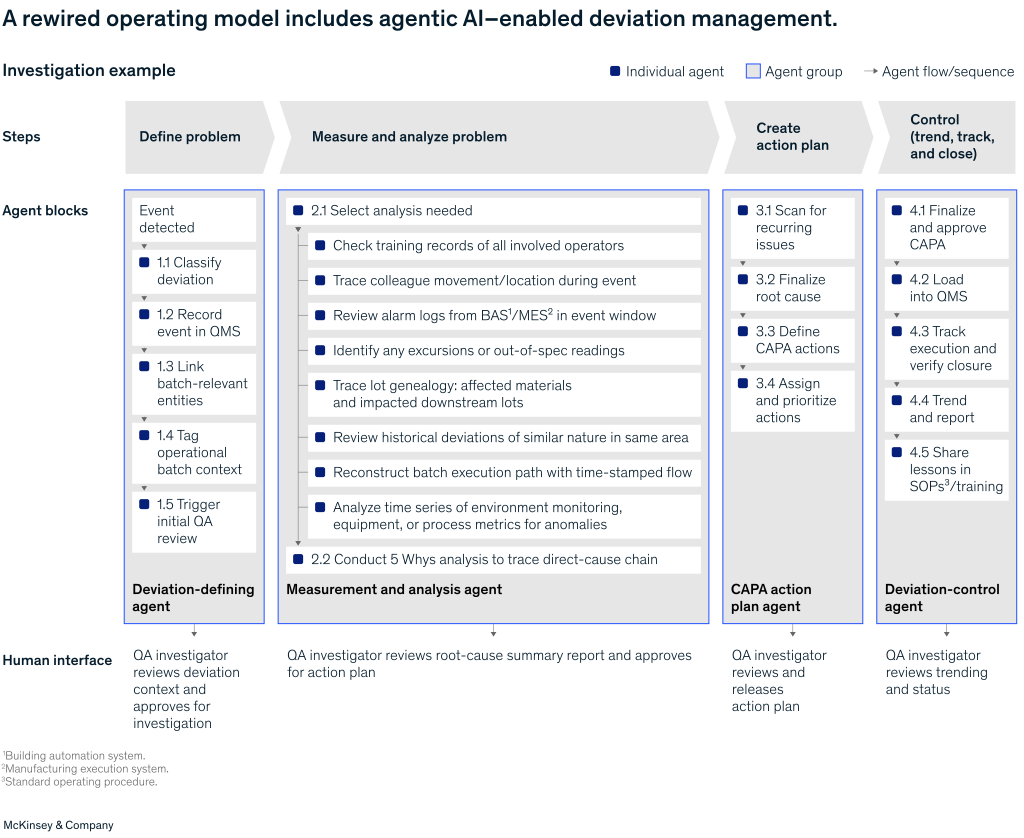
The human role does not disappear; it becomes more focused. QA investigators remain accountable for critical judgments, but they spend less time gathering evidence and drafting routine documentation. Instead, they review, challenge, and approve at key decision points: deviation classification, root-cause conclusion, CAPA plan, and final closure.
This is what exception-based work looks like in practice. The system assembles the evidence, runs routine checks, and coordinates the workflow; the expert makes the call. The same logic can be applied to other workflows across the plant, including scheduling, sample management, batch review, predictive maintenance, and procurement.
AI-enabled production execution
Production execution is a highly coordinated workflow involving operators, manufacturing systems, and quality teams across equipment preparation, batch execution, in-process testing, process monitoring, issue resolution, and line changeover. Many activities remain manual, with operators continuously monitoring process performance, identifying deviations, documenting events, and coordinating corrective actions across multiple systems. This reactive approach limits process optimization and increases variability.
In a rewired operating model, AI is embedded throughout the production workflow (Exhibit 3). During execution, machine-learning models monitor process parameters, detect emerging trends, and recommend operating adjustments to improve yield and process stability. When production issues arise, agentic AI supports deviation triage by assembling relevant process context, suggesting likely root causes, and generating draft investigation records. Throughout the workflow, AI continuously captures production knowledge while keeping operators in the loop for review and approval.
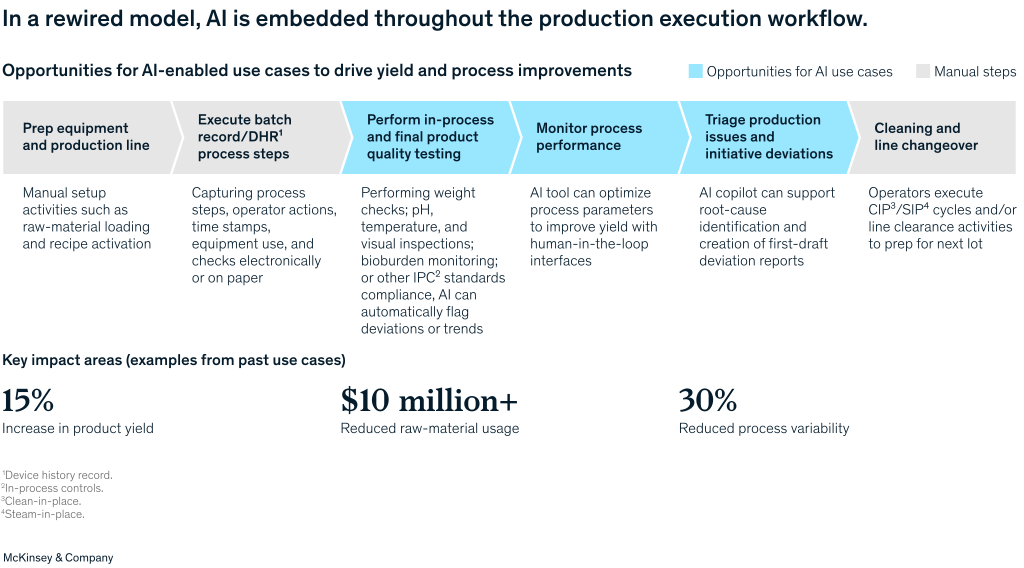
The operator’s role shifts from continuously monitoring routine activities to supervising AI-driven operations and managing exceptions. Rather than manually interpreting process data and coordinating routine actions, operators validate recommendations, intervene when required, and focus on decisions that require operational expertise and risk-based judgment.
How to unlock value in greenfield and brownfield sites
The same ambition applies to new and existing sites: Redesign the workflows that determine how the plant runs. But the path is different.
For greenfield sites, the main opportunity is to design the future operating model before the facility is built. The risk is spending hundreds of millions of dollars on a new site but recreating the same manual workflows, disconnected systems, and late-stage reviews that exist today. A greenfield investment should not simply add digital tools to a traditional plant design. It should use the future way of working as the design brief for the site.
Here’s an example of a practical greenfield sequence:
- Define how the main workflows should run digitally. Start with planning, manufacturing, maintenance, supply chain, quality, release, and support functions before locking the site design.
- Decide which tasks will be done by people, and which by the system. Define what can be handled automatically, what should be escalated, and where people need to make decisions.
- Define the data and systems needed to make it work. Decide what data is required, where it will come from, which systems need to connect, and where AI or automation will be used.
- Build the physical site around those workflows. Design the layout, material flows, sample flows, lab setup, warehouse setup, automation zones, and operator movement around the future way of working.
- Design for scale from the start. Make equipment, recipes, automation logic, data models, and digital workflows reusable across products, lines, and sites.
For brownfield sites, the path is more constrained but also more immediate. Leaders cannot redesign the full site at once. They need to work around legacy equipment, fragmented systems, validated processes, Good Manufacturing Practice (GMP) constraints, space limitations, and existing supply commitments. The right approach is to start where the current operating model creates the most friction.
Here’s an example of a practical brownfield sequence:
- Prioritize three to five high-impact workflows. Select areas where redesign can significantly improve efficiency or reduce cost.
- Map the key outputs of each of these current prioritized workflows.
- Re-design the future state agentic process with right human in the loop. Ensure the pain points of the current process like duplicate checks, avoidable approvals, and system breaks are addressed by the future state design.
- Connect only the data needed for the workflow. Do not wait for a perfect enterprise data backbone; define the minimum data set needed to run the workflow digitally.
- Deploy targeted automation and AI. Use physical AI where manual movement or handling creates friction, and agentic AI where coordination, review, or documentation creates burden.
- Prove value and replicate. Use the first workflow to create a repeatable pattern that can scale to the next line, lab, site, or process.
The common challenge across greenfield and brownfield sites is people. Operators, engineers, planners, quality teams, and support functions will all need to work differently. As routine execution and manual checks become more automated, people will spend more time managing exceptions, making trade-offs, and improving workflows. They do not need to become data scientists, but they do need to know how to work with AI-enabled systems and improve them over time.
Where leaders can start
The plant of the future can sound distant, but the starting point is practical. Leaders can begin with three moves that create near-term value while building toward a more connected and intelligent manufacturing system.
- Start with existing sites and redesign a few high-value workflows end to end. Rather than waiting for the next large capital project, companies can select a small number of important workflows in brownfield facilities, redesign them end to end, and deploy digital and AI solutions built for replication. The first transformed site can become a blueprint for the network.
- Make footprint and investment choices with the future operating model in mind. Decisions about where to build, upgrade, consolidate, or use external partners should reflect future portfolio needs, modality shifts, resilience requirements, and the role each site will play in the network. Greenfield investments should be designed against future-state principles from the start.
- Build digital and AI capability in your people. Talent will remain a constraint, especially for people who understand both GMP operations and advanced technology. Companies can move faster by upskilling process experts, creating bridge roles between operations and data, and involving frontline teams directly in the transformation.
Biomanufacturing is entering a period in which manufacturing advantage will depend less on isolated productivity programs and more on how companies redesign work, data, decisions, and network coordination. Digital and AI provide the tools. The larger opportunity is to build a manufacturing system that can adapt as portfolios, technologies, and market needs change.