Advances in AI, sensing, and manipulation are pushing robotics beyond isolated automation toward something fundamentally different. As manufacturers face reshoring pressures, fragile supply chains, and rising demands for flexibility, the question is no longer what robots can do alone, but how effectively people and machines can work together to create lasting value. The next generation of robots may look quite different from the systems showcased in today’s lab demos and videos—but the real shift will be less about appearance than about collaboration.
At the 2026 Consumer Electronics Show in Las Vegas, McKinsey Partner Ani Kelkar sat down with Mikell Taylor, head of robotics strategy at General Motors, to discuss what this next chapter looks like in practice. Drawing on her prior experience at Amazon Fulfillment Technologies, Bluefin Robotics, and other companies, Taylor offers a cross-industry perspective on why the future of robotics will be less about spectacle and more about thoughtful system design—one that enables humans to do their best work alongside increasingly capable, collaborative machines.
A nuanced picture of the future of robotics
Ani Kelkar: There’s so much excitement about robotics these days. Given all the funding moving into the field, are you nervous about elevating expectations and then falling short?
Mikell Taylor: Robotics has an incredible future ahead, but it will not look exactly like what people predict now or what they say on national news. The risk when these hype cycles occur is that expectations will be massively inflated. And then when people are inevitably disappointed, they assume nothing will come of it—and that’s not true. So, I am a bit nervous about that.
On the other hand, this hype is similar to what occurred with self-driving cars ten to 15 years ago. That spurred a lot of innovation in sensing, compute, and machine learning that are used today. That was critical work, and a lot of money was poured into it. I’m not sure the robotics industry has ever seen this much money poured into manipulation and perception, which are core technologies that will underpin what the future looks like. It always makes me nervous, but there will be amazing things that come of it.
Ani Kelkar: Imagine the factory of the future. What role will robotics play in manufacturing in 2040?
Mikell Taylor: Automation is going to be critical for manufacturing, especially in the United States during reshoring efforts. The nuance that can’t be overlooked is that success will rely on how well people and automation work together. I am not a believer in lights-out manufacturing. I’ve worked long enough in robotics to know that stage is a wonderful North Star, but it never becomes a reality.
Even as robotic technologies continue to expand their capabilities, there will still be an important place for the absolutely incredible hands, eyes, and brains of human beings. Working in robotics has given me a profound respect for the human body and brain, and a knowledge of what we’re good at.
Looking ahead, not far in the future, there will be a lot more automation than there is now, including more advanced automation. But there will still be people. The roles that the people perform may be different, but they’re still going to make the orchestra play together to get the kind of manufacturing capability and capacity that we want.
There will be a real shift in how manufacturing is done. Automotive manufacturing is one kind of science, and electronics manufacturing is a different kind of science. A lot of those sciences, and the associated business models, have been built around humans for a very, very long time.
We must think about how we can enable humans to do their best work in environments that may change as automation takes over some tasks. We need to be willing to rethink how things are designed, how they are manufactured, the processes that we rely on, and what we assume is the right way to optimize production. That, to me, is an incredibly exciting part of our highly automated manufacturing future.
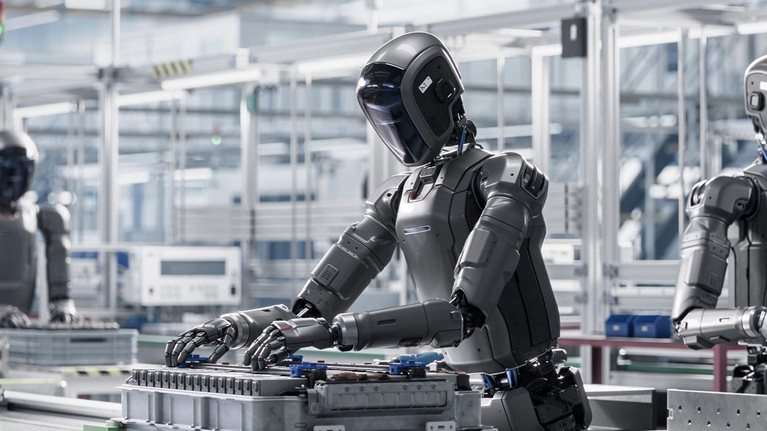
Ani Kelkar: Many people are particularly interested in humanoids. Do you think they will play a major role in the workplace, or are they a distraction?
Mikell Taylor: There are single-armed robot systems out there that can do amazing work, whether they have traditional technology or newer manipulation systems. But there’s a lot that really can only be done with two hands and an advanced perception system. What exactly will that form factor look like? Is it a bipedal humanoid? Is it a wheeled torso? Is it a fixed torso? Is it a three-armed system? Does it have a prehensile tail?
There’s a lot of exploration to be done, but I think it’s a good hypothesis to start with the human form factor. What it’s really going to come down to is this: How do you make more than one hand that can do what a human hand can do, synchronize that, and do exponentially more complex things than we can right now?
Ani Kelkar: What are your boldest predictions when it comes to robotics—some moon shots that could happen in the next 15 years that people are not expecting or tracking?
Mikell Taylor: A lot of the technology in today’s robots will be embodied in things that people don’t even think about as robots, and people will not even realize how pervasive it is. In 15 or 20 years, we will have thought pieces that say, “Gosh, whatever happened with those humanoids that were so big in 2025?” They will completely miss the fact that the DNA of that work is everywhere they look. It’s just not going to look like it does today. They won’t even realize the degree to which it’s impacted their lives.
Turning lab demos into real-world impact
Ani Kelkar: How do you talk to your leaders and executives about what robots can do and how they can be useful? Is there a framework for thinking about what should be automated and when?
Mikell Taylor: I love the framework that I took from the self-driving-car industry, which is operation design domain, or ODD. This is defined as the set of conditions under which an autonomous system will work well and safely. In the self-driving-car world, the Southwest United States might involve a nice, mild climate and grid-patterned, well-marked streets. That’s a completely different operation design domain from, for example, downtown Boston after a snowstorm. Looking at that, you would say, “Self-driving cars could work in one of those places but not that other place.” That’s how I look at robots in different environments, as well as the kinds of tasks that they do.
What matters to me, and one of my happy places in this industry, involves mapping all of the possible things we could do with robots to their current ODD. One robot might be able to carry pallets but not racks, so I think about all the places where robots could assist by carrying pallets. There might be a set of potential ergonomic risks; I have to think about how I can map them to available technology so that those risks to people can be eliminated.
This mapping is complex—it defines where robotic technology can become a robotic product. It involves figuring out how to match the current ODD with value. You have to go about it methodically and systematically before you can say, “Yes, this technology is ready today to solve this problem.”
Ani Kelkar: Beyond ODD, what should CEOs consider when designing a transformation program around robotics?
Mikell Taylor: They should consider the role of humans along the way. How should people be involved in the work being done? Where are the opportunities, and do we have a workforce that is ready to retool their jobs and work side by side with this technology? Are there areas where that will be harder to do?
The future of robotics: Intelligent, adaptable, and on your team
CEOs should also consider where the powers of people and robots combined really make a huge difference. Is it in quality? Is it in reliability? I think many companies are overindexed on productivity gains. There are so many other reasons to introduce automation, and you need a road map for all of those.
Ani Kelkar: We keep hearing that many newer robotic technologies are brittle when they move from lab settings to the real world. What are the challenges that must be solved for robotics to deliver economic impact?
Mikell Taylor: Fundamentally, it requires engineers to be willing to hear that their baby is ugly, and for them to take that baby out into the world as soon as possible and hear that. The longer something stays in a lab or in shiny videos, the less successful it’s going to be.
It can be difficult, especially in high-uptime environments, to get things into the field and try them because you risk impacting a lot of very important business. But you need to find opportunities to do that, and to get very candid feedback from the operators who are not excited about the novelty of a robot. They want equipment that works, and a robot is equipment to them, no matter how cool we think it is. We need to treat it like any other equipment and say, “Let’s try this. What do you think? How can I make it better?” We need to involve workers in the process and ensure they’re part of the design effort to create a product people want and love, not just a cool robot.
A new era for automotive
Ani Kelkar: Based on your experience at Amazon and elsewhere, is there anything unique about robotics in the automotive sector compared with other industries?
Mikell Taylor: Compared with other sectors, both logistics and automotive share an incredibly high bar for uptime and reliability. In your home, you’re happy if 50 percent of your dishes get loaded the right way, but that’s not good enough in these environments. You can lose thousands of dollars for every second that something is down and not working.
In automotive, the expectations for the readiness and maturity of the technology are completely different from those in many other industries that robotics serve. Logistics often involves parallel workflows, but manufacturing is famously very linear. That presents different challenges in how we integrate robots. The sensitivity of that linear system in manufacturing is very different from the massively parallelized system in logistics.
Ani Kelkar: Does the linear system go away once robots are much more dexterous, mobile, and reliable?
Mikell Taylor: That is a question I lie awake at night asking myself. The advent of automation will require rethinking how this work is done, as it did in logistics. Kiva Systems, which became Amazon Robotics after an acquisition, didn’t have robots walk up and down aisles. They said, “We’ll bring the aisles to you. You stand still.” That was revolutionary, and it completely changed what fulfillment logistics look like.
We’re probably due for a similar rethinking within automotive. Every automotive manufacturer is thinking about that. You’ve seen a lot of experimental facilities that manufacturers are building because everyone is trying to figure out what automotive will look like with all this automation. I am fascinated to watch that and very excited to be a part of it.
Ani Kelkar: Over the next five years, do you think the automotive sector will continue its incremental adoption of robotics, or do you think there’s going to be transformational change in how we manufacture cars?
Mikell Taylor: There’s going to be rapid adoption in the coming years. The COVID pandemic exposed the brittleness of our supply chains. There will be jobs for years for many people who want to work in automotive, but automation will also strengthen manufacturing domestically. Experts in process design need to understand this new technology—first to get experience with it and then to be the innovators who say, “If we design this product differently, or if we rethink the assembly line, we could do so much more.” That’s going to be an exciting follow-on to the initial rapid adoption of robotics.
Ani Kelkar: What automotive innovations would you like to see once robotics is available as a tool to designers, manufacturing engineers, industrial engineers, and folks on the shop floor?
Mikell Taylor: Selfishly, I’m hoping to see a lot more electric vehicles [EVs]. It’s my genuine hope, for the good of the world and the industry, that we see a lot more EVs out there at incredibly cost-effective price points.
Ani Kelkar: In 2040, what activities will robots perform in the automotive sector that they did not previously handle?
Mikell Taylor: Assembly line tasks are the holy grail because of how much we rely on the capabilities of the human body to execute them successfully. Those will be heavily manual for a long time. Right now, the opportunity lies in using more advanced robotic technologies to let robots and people share the same space more often.
Traditionally, especially in automotive and other manufacturing sectors, robots are fenced off. There’s been so much work over the years in making robotic systems safe and able to recognize people in their space—to stop, slow down, or move around them to keep them safe. That was a good first stepping stone. Now we also need software systems that allow people and robots to share work—to hand off work from one to the other, or to even work on the same thing at the same time. We need different models of collaboration or teaming.
I think different approaches will come together so we can start using robots to take over tasks that are currently hazardous for people. Robots will move heavy objects in the proximity of other people or carry pallets across a fulfillment center, warehouse, or factory. That’s going to open a lot of opportunities. We’re also going to see a massive improvement in safety across many industrial environments, both because robots are inherently safe and because we can automate hazardous tasks that were previously off-limits due to the need for physical separation between humans and robots.
Developing the robotics stack—and the talent behind it
Ani Kelkar: What is the greatest challenge you think the robotics industry must solve by 2040?
Mikell Taylor: It’s a systems engineering problem. You’ll hear some companies and some researchers say, “The software is a commodity. The problem’s in hardware.” Some other folks will say, “The hardware is a commodity. Now the problems are in software.”
Neither is true. The problems are everywhere. The success lies in the fully integrated system that is codesigned top to bottom in the stack, physical and virtual. I want to see more companies recognize that and put an innovative spin on it. Those are the companies that are going to have the most success.
Ani Kelkar: The excitement is drawing a lot of young people to explore robotics. What skills will be important for someone who wants to build foundation models in robotics?
Mikell Taylor: All engineering disciplines are critical for robotics. AI machine learning is obviously very important right now, but so is embedded software. It’s also important to develop safety and regulatory standards. That will not go away. But at every part of the stack, both physical and software-based, you have to be grounded in the problems they are solving.
There’s a natural attraction to robots for use at home because everyone knows what their home is like. Everyone knows they have to fold laundry and load the dishwasher. There’s no replacement for getting your hands dirty and seeing the environment where a robot will be used, or for talking to people, watching them work, and truly understanding what matters to them. It might be something very different from what you, as a roboticist, consider important.
Ani Kelkar: You’re also a roboticist at home; you helped your daughter’s team build Lego robots. What did you learn from that experience?
Mikell Taylor: I learned that robotics problems are the same, no matter what team you’re on. There are lessons to learn about what is hard, what is easy, and how to get people with very different skill sets to work together. It was funny—and validating—to see it repeated in the microcosm of a tween Girl Scout troop building robots together.